
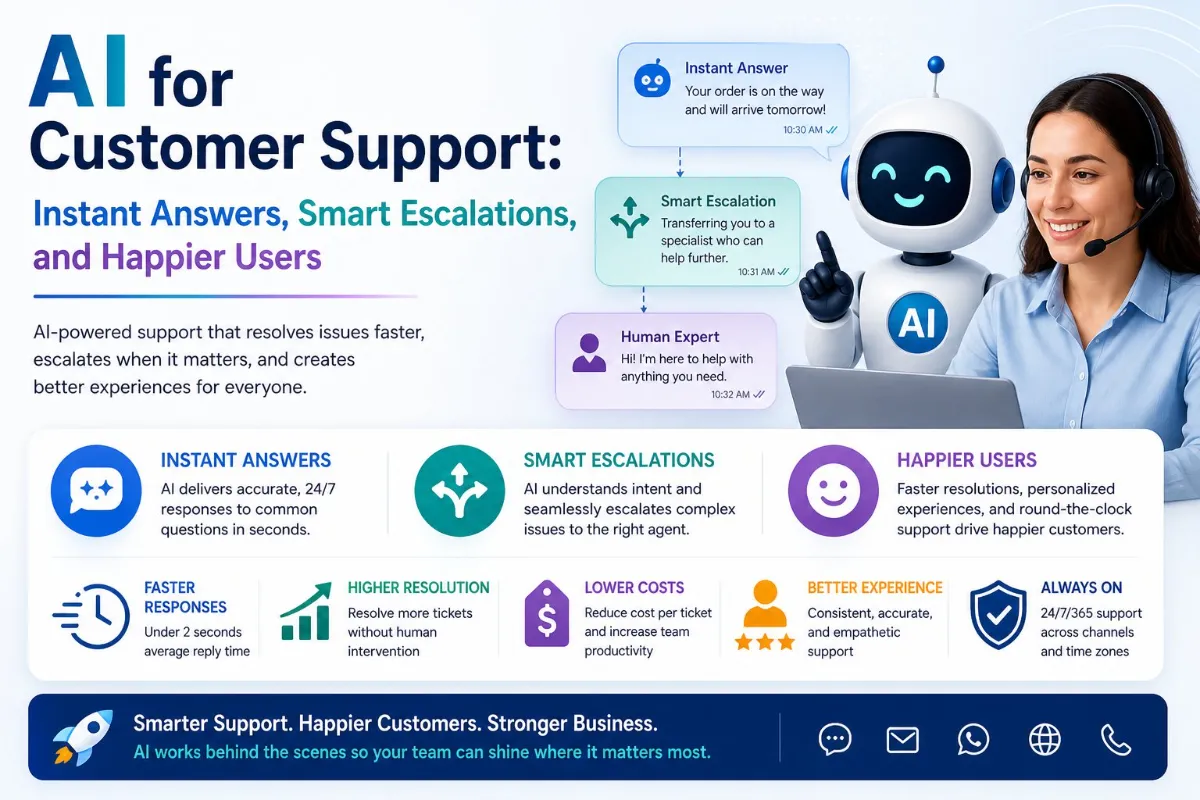
AI for Customer Support: Instant Answers, Smart Escalations, and Happier Users

Shahid Ali
May 5, 2026
Table of Contents
- Introduction
- What Is AI for Support?
- AI-Powered Support vs. Traditional Support
- Top Signs Your Business Needs AI for Support
- Why Traditional Support Breaks Down: Root Causes
- How to Get Started with AI for Support
- Solutions and Strategies
- Actionable Framework: AI Support Implementation Checklist
- The Hidden Impact of Delayed AI Adoption
- Common Mistakes to Avoid
- Frequently Asked Questions
- Conclusion and Next Steps
Introduction #
Your support team is stretched thin, tickets pile up, and customers wait while your best agents spend hours answering the same five questions. You know something has to change, but rebuilding your entire support operation feels impossible to justify alongside everything else. That is precisely the situation AI for support was built to address.
The AI customer support market reached $12.06 billion in 2024 and is projected to hit $47.82 billion by 2030, growing at a compound annual rate of 25.8% (Polaris Market Research). Companies deploying AI for support report an average return of $3.50 for every $1 invested, with leading organisations achieving up to 8x ROI. The evidence is no longer anecdotal; it is institutional.
This guide breaks down exactly what AI for support is, how it compares to traditional approaches, and what a practical implementation looks like, whether you are a startup founder, a CX manager in a scaling business, or an e-commerce operator managing surging ticket volumes.
What Is AI for Support? #
AI for support refers to the deployment of artificial intelligence technologies, including natural language processing (NLP), machine learning, and generative AI, to automate, augment, and intelligently route customer service interactions. These systems handle inquiries, detect sentiment, draft responses, and escalate to human agents when complexity demands it. The result is a support operation that is simultaneously faster, more consistent, and more scalable than any purely human team.
AI for support is the strategic integration of machine learning, NLP, and conversational AI into customer service workflows to deliver instant, personalized, and continuously improving assistance at scale, without proportionally scaling headcount.
As of 2025, 75% of customer inquiries can be fully resolved by AI tools without any human intervention (industry data). The technology has evolved far beyond rule-based chatbots; today's systems learn from every interaction, detect emotional cues, and generate responses that 48% of customers cannot distinguish from those written by a human agent (NextPhone, 2025).
AI-Powered Support vs. Traditional Support #
Understanding the structural differences between AI-powered and traditional support is essential for any business evaluating the transition. The comparison below maps where each model excels and where it falls short.

The table does not render one model superior across all dimensions; the most effective operations combine both. 42% of customers appreciate a combination of AI and human support, and businesses whose AI is actively managed by humans see a 73% customer preference rate (NextPhone, 2025).
Top Signs Your Business Needs AI for Support #
The following indicators signal that a business has outgrown its current support infrastructure.
Your average first response time exceeds four hours during peak periods, and customer satisfaction scores are declining as a direct consequence. Your support agents spend more than 40% of their time on repetitive, low-complexity queries that follow entirely predictable patterns. Your business operates across multiple time zones or languages, yet your team coverage is limited to a single region and working day.
You are experiencing agent burnout: research from Salesforce in 2025 found that 56% of customer service representatives report burnout, directly damaging retention and service quality. You face ticket volume growth that consistently outpaces your ability to hire, train, and retain qualified agents. Customers regularly report having to repeat themselves when transferred between agents, a clear signal that your context continuity is broken.
Why Traditional Support Breaks Down: Root Causes #
The failure of traditional support at scale is structural, not personal. Three compounding factors drive the breakdown.
Volume asymmetry is the first cause: customer bases grow exponentially while support teams grow linearly, creating an ever-widening gap between demand and capacity. Knowledge fragmentation compounds the problem; when answers live in individual agents' heads rather than a shared, searchable system, quality becomes erratic and training cycles remain perpetually incomplete. Contextual amnesia closes the loop: in 2025, six in ten agents lack sufficient customer context to resolve issues on first contact (Zendesk), forcing customers to repeat themselves and extending resolution times unnecessarily.
How to Get Started with AI for Support #
Implementation need not be a wholesale replacement of existing infrastructure. A phased approach reduces risk and builds organisational confidence progressively.
Audit your ticket data. Export and categorize the last 90 days of support tickets by topic, complexity, and resolution time to identify your highest-volume, lowest-complexity queries; these are your first automation targets.
Define your escalation criteria. Establish clear rules for when AI should route to a human: by sentiment score, topic category, customer tier, or query type.
Select an integrated platform. Choose a tool that connects to your existing CRM and helpdesk; Zendesk AI, Intercom Fin, Freshdesk Freddy, and Salesforce Einstein are leading options in 2025.
Automate FAQs first. Deploy AI on your top 10-20 most common queries before expanding scope; this limits risk and accelerates the system's learning curve.
Feed the system real data. Import historical chat logs and resolution notes; AI systems learn faster from authentic interactions than from curated training sets alone.
Monitor escalation rate and CSAT weekly. Target an escalation rate below 15% and an AI accuracy rate above 85% as early performance benchmarks.
Expand iteratively. Once baseline metrics stabilise, extend AI coverage to additional query types, channels, and languages.
Solutions and Strategies #
Foundational: What Every Business Should Implement First #
Every business, regardless of size, should begin with an FAQ automation layer capable of handling password resets, order tracking, billing queries, and account updates without human involvement. A knowledge base integration ensures the AI retrieves answers from a single verified source of truth rather than generating them from inference alone. Basic sentiment detection should be active from day one, ensuring that frustrated or distressed customers are routed to human agents rather than handled by automation.
Tools: The Technology Stack for 2025 #
Zendesk AI and Intercom Fin represent the enterprise tier, offering deep CRM integration, omnichannel coverage, and advanced analytics. Tidio and Freshdesk Freddy serve mid-market businesses with strong out-of-the-box capabilities at accessible pricing. ChatGPT API integrations via platforms such as Zapier and Make.com allow smaller teams to build lightweight AI support flows without dedicated engineering resources.
Professional: When to Bring in Specialists #
Businesses handling more than 10,000 tickets per month, or operating in regulated industries such as finance, healthcare, or legal services, benefit from working with AI implementation consultants who can navigate compliance requirements and configure enterprise-grade escalation protocols. Organisations pursuing agentic AI, where the system resolves issues end-to-end without human involvement, should engage specialist vendors; the market is transitioning rapidly toward this model, with companies like Sierra, Decagon, and Intercom now pricing per successful resolution rather than per seat.
Actionable Framework: AI Support Implementation Checklist #

The Hidden Impact of Delayed AI Adoption #
The consequences of deferring AI adoption extend well beyond longer response times. Agent burnout accelerates as human teams absorb growing ticket volumes without relief; 69% of organisations report that agent attrition creates significant operational difficulties (Salesforce, 2025). The financial cost is equally significant: Gartner estimates up to $80 billion in contact center labor cost savings will accrue to AI adopters by the end of 2026, representing a direct competitive disadvantage for those who delay.
The less visible cost is reputational. 73% of consumers will leave a business after multiple bad experiences (Zendesk, 2025), and 56% do so without complaint, providing no opportunity for recovery. Customer-focused organisations that have made the transition already achieve 49% faster profit growth and 51% higher retention rates than their peers (Forrester, 2024).
Warning: Deploying AI for support without a clearly defined escalation path is one of the most common and damaging implementation errors. A 2025 Twilio report found that 78% of consumers consider the ability to switch from AI to a human agent important; businesses that eliminate this option risk permanent customer attrition.
Common Mistakes to Avoid #
Automating without an escalation strategy is the most consequential error; AI that cannot recognise its own limits will frustrate customers on precisely the queries that matter most. Deploying on incomplete or outdated knowledge bases produces inaccurate answers that erode trust faster than no AI at all; 61% of leaders report a backlog of articles requiring revision (NextPhone, 2025). Measuring only cost reduction rather than customer satisfaction and retention creates a misleading picture of ROI and misses the strategic value of AI as a loyalty driver.
Over-automating prematurely pushes complex, emotionally sensitive interactions through channels that the AI is not yet equipped to handle well. Neglecting agent training on how to collaborate with AI tools results in productivity gains being captured by neither party. Treating AI as a one-time deployment rather than a continuously maintained system leads to performance degradation as products, policies, and customer behaviour evolve.
Frequently Asked Questions #
What is AI for support and how does it differ from a basic chatbot? #
AI for support encompasses the full ecosystem of artificial intelligence technologies applied to customer service, including NLP, machine learning, sentiment analysis, and generative AI. A basic chatbot operates on fixed rules and decision trees, returning pre-written responses to keyword matches. Modern AI support systems learn from interactions, understand conversational context, detect emotional states, and generate novel responses rather than retrieving pre-written ones.
How long does it take to implement AI for support? #
For most small to mid-sized businesses, a basic FAQ automation layer can be deployed within two to four weeks using a platform like Tidio or Intercom. A more comprehensive implementation, including CRM integration, sentiment-based escalation, and multilingual support, typically requires eight to twelve weeks. Organisations with complex compliance requirements or high ticket volumes should plan for a three to six month implementation timeline.
Will AI replace my customer support team? #
No credible evidence supports wholesale replacement of human support teams in the near term. The data points in a different direction: 89% of consumers believe companies should always offer the option to speak with a human (Kinsta, 2025). The most effective model pairs AI handling of high-volume routine queries with human agents concentrating on complex, emotionally sensitive, and high-value interactions.
What is smart escalation and why does it matter? #
Smart escalation is the process by which an AI system detects, through sentiment analysis and confidence scoring, that a customer interaction has exceeded its competence or that the customer is distressed, then transfers the conversation to a human agent with full context intact. It matters because it preserves the efficiency gains of automation while ensuring that the interactions most likely to damage customer loyalty receive the empathetic human attention they require. Without it, AI support systems generate the very complaints they were designed to prevent.
How do I measure whether my AI support implementation is working? #
The four core metrics are: first contact resolution rate (target above 70%), AI escalation rate (target below 15%), customer satisfaction score for AI interactions (benchmark against your human agent baseline), and average resolution time (compare pre- and post-implementation). Cost per ticket and agent productivity metrics should supplement these but not substitute for customer experience measurement.
Is AI for support suitable for small businesses? #
Yes, and the economics are particularly compelling for smaller teams. Platforms such as Tidio, Freshdesk Freddy, and Intercom offer accessible entry-level pricing, and the return on a modest automation investment is often immediate. A business missing 60-80% of incoming contacts due to after-hours unavailability can recover substantial lost revenue by deploying even a basic AI response layer.
What queries does AI for support handle best? #
AI excels at queries with predictable structures and verifiable answers: order tracking, password resets, billing inquiries, returns and refund policies, account management, and product FAQs. These categories typically represent 60-70% of total ticket volume in most e-commerce and SaaS businesses, meaning that effective automation of this segment alone produces a substantial reduction in agent workload. Queries requiring empathetic judgment, complex diagnosis, or multi-system intervention remain better suited to human handling.
Conclusion and Next Steps #
AI for support is not a future capability being evaluated at the margins; it is present-tense infrastructure that determines competitive positioning today. The businesses that have deployed it report measurably better outcomes across cost, speed, retention, and agent satisfaction. Those that have not are absorbing hidden costs that compound with every quarter of inaction.
Your immediate next steps:
Audit your last 90 days of support tickets and identify your top 20 repeating queries
Request demos from at least two AI support platforms appropriate to your scale
Define your escalation criteria before selecting any technology
Pilot automation on one query category before expanding scope
Set baseline CSAT and resolution time benchmarks to measure against post-deployment
The future of customer support is not about choosing between AI and humans. It is about building the operational architecture that allows each to do what it does best: AI handling volume with consistency, and humans handling complexity with empathy. The businesses that get this balance right will not merely support their customers better; they will retain them longer, grow faster, and spend significantly less doing it.