Schema Markup in 2026: What Still Works for SEO and AI Search

Tuba
July 6, 2026
Table of Contents
- What is schema markup, in plain terms?
- Does schema markup still help SEO in 2026?
- What changed in 2026, and why it matters
- Which schema types actually matter in 2026?
- Where schema fits in your SEO and AI search strategy
- How to add schema markup the right way
- How to know if your schema is working
- The bottom line
- Frequently asked questions
Schema markup has a reputation problem in 2026. For years, the pitch was simple. Add a block of code, win a rich snippet, and climb the rankings. Then this year arrived, and a few large changes flipped that story. Google retired FAQ rich results. A major study found that adding schema did little for AI citations on its own. And testing showed that when an AI engine fetches your page live, it often ignores your structured data completely.
So is schema markup still worth doing? Yes, but for reasons different from those most guides admit. This guide explains what changed, which schema types still earn their place, and how to use structured data as the support layer it was always meant to be. If you are also investing in AI SEO, schema is one piece of that picture, not the whole of it.
What is schema markup, in plain terms? #
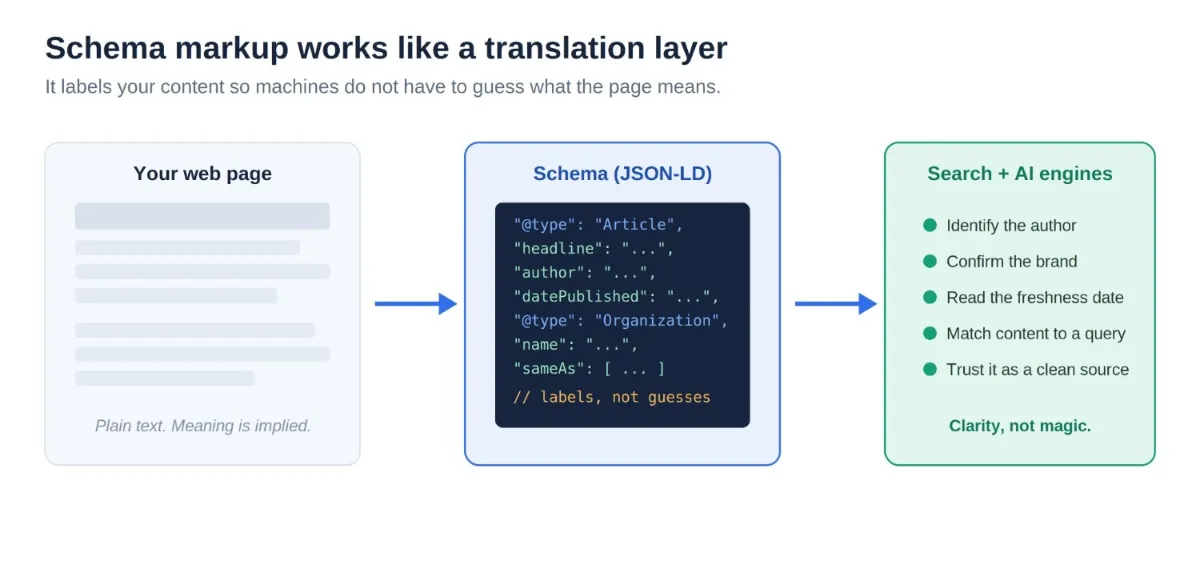
Schema markup is a small block of code you add to a page. It uses an agreed-upon vocabulary from Schema.org to label the content. It tells a search engine that this name is the author, this is the price, this is the publish date, and this brand is a real company. The Schema.org vocabulary has 800 types as of March 2026, but only a handful matter for most websites.
Most sites add it as JSON-LD, a clean script block that sits in the page head and stays separate from the visible content. Think of it as labeling the boxes in a warehouse. Your content is the goods. The labels do not change what is inside, but they make everything far faster to find, trust, and pull off the shelf. That is the entire job of structured data: remove doubt about what each page holds.
Does schema markup still help SEO in 2026? #
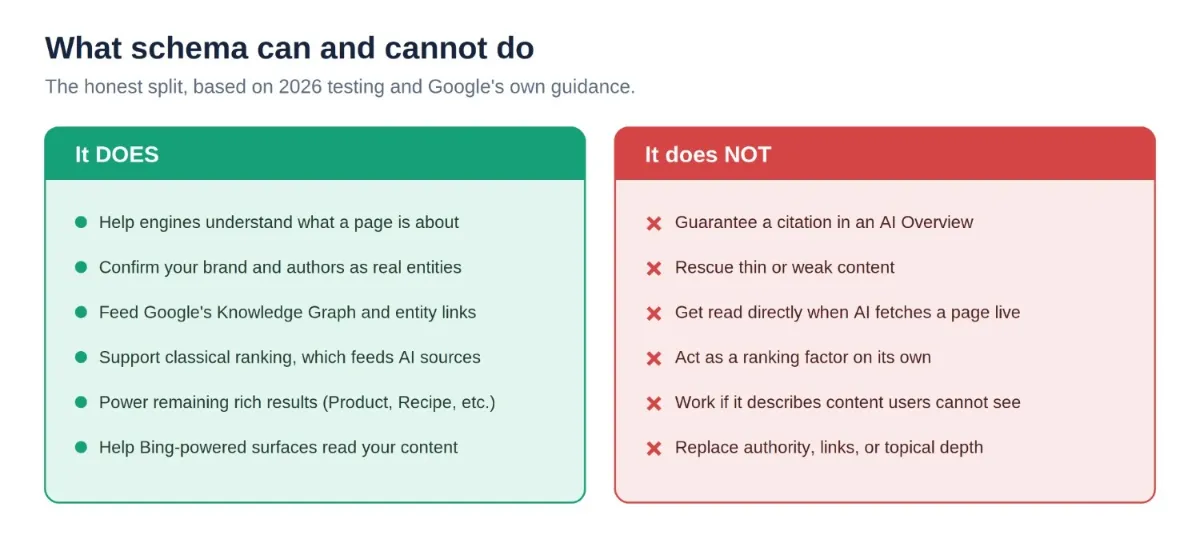
Short answer: yes for understanding and ranking, no as a magic citation button. Here is the honest version.
First, the support is real. Backlinko found that 72% of pages on Google's first page use some form of schema. JSON-LD now appears on roughly 41% of all pages, up from 34% two years earlier, according to the HTTP Archive Web Almanac. Google's own search team confirmed in April 2025 that structured data gives an advantage in search results, and Microsoft's Bing team confirmed in March 2025 that schema helps its language models understand content for Copilot. Sites that invest in clean markup tend to be the same sites that rank well, which is exactly the company you want to keep.
Second, the limits are also real, and 2026 made them clear. In May 2026, an Ahrefs study tracked 1,885 pages that added JSON-LD between August 2025 and March 2026, matched them against 4,000 similar pages, and measured citation changes across Google AI Overviews, AI Mode, and ChatGPT. Adding schema produced no meaningful citation lift on any platform. A separate retrieval test from searchVIU found that when five major AI systems fetched a page live, each read only the visible text and skipped the hidden JSON-LD.
The takeaway is not that schema is dead. It is that schema that sits upstream of citations, not as a direct cause of them. It strengthens the understanding and ranking that feed AI answers, rather than flipping a switch that puts you in one.
What changed in 2026, and why it matters #
Three shifts reset the playbook this year.
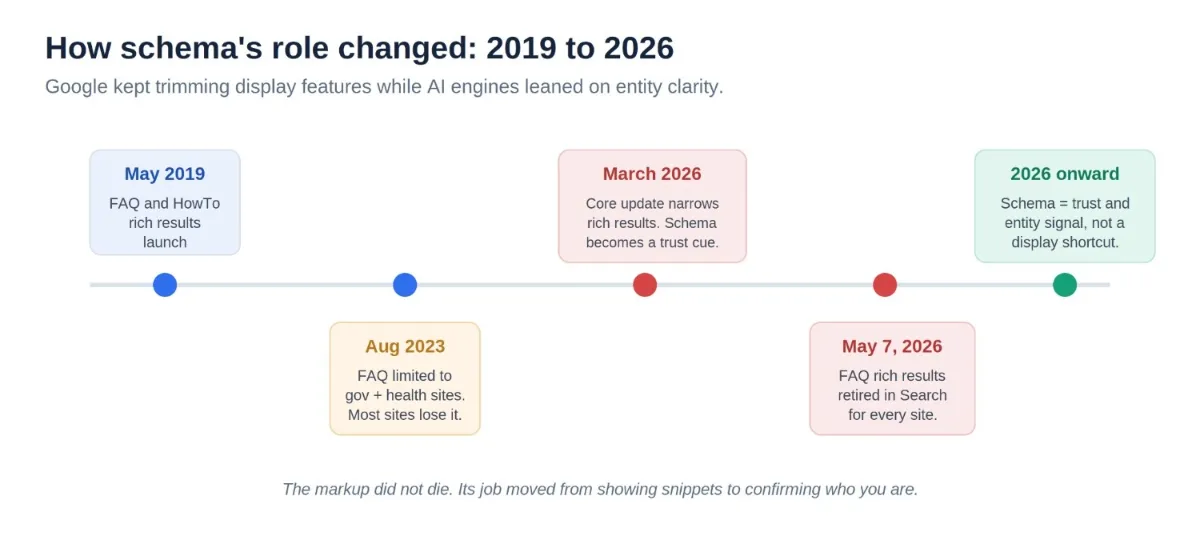
The March 2026 core update narrowed which pages qualify for rich results and cracked down on schema added to pages it did not describe. At the same time, sites with clean, accurate entity schemas saw higher citation rates in Google's AI Mode. The value of the schema did not fall. It moved from triggering a display feature to acting as a trust and entity signal.
On May 7, 2026, Google retired FAQ rich results across all of Search. The reporting tools follow a schedule: the Search Console FAQ report and Rich Results Test support end in June 2026, and Search Console API support ends in August 2026. This finished a wind-down that began in August 2023, when Google limited FAQ rich results to authoritative government and health sites. The detail that matters most is buried in Google's own note: it will continue to use FAQ structured data to understand pages, even though the dropdown is gone.
The Ahrefs and searchVIU findings, both published in 2026, confirmed that schema is not a direct lever for AI citations. Put together, these changes do not tell you to stop using schema. They tell you to stop treating it as a shortcut. The same shift is reshaping how engines pick sources, which is the heart of generative engine optimization, where clear entities matter more than clever markup.
Which schema types actually matter in 2026? #
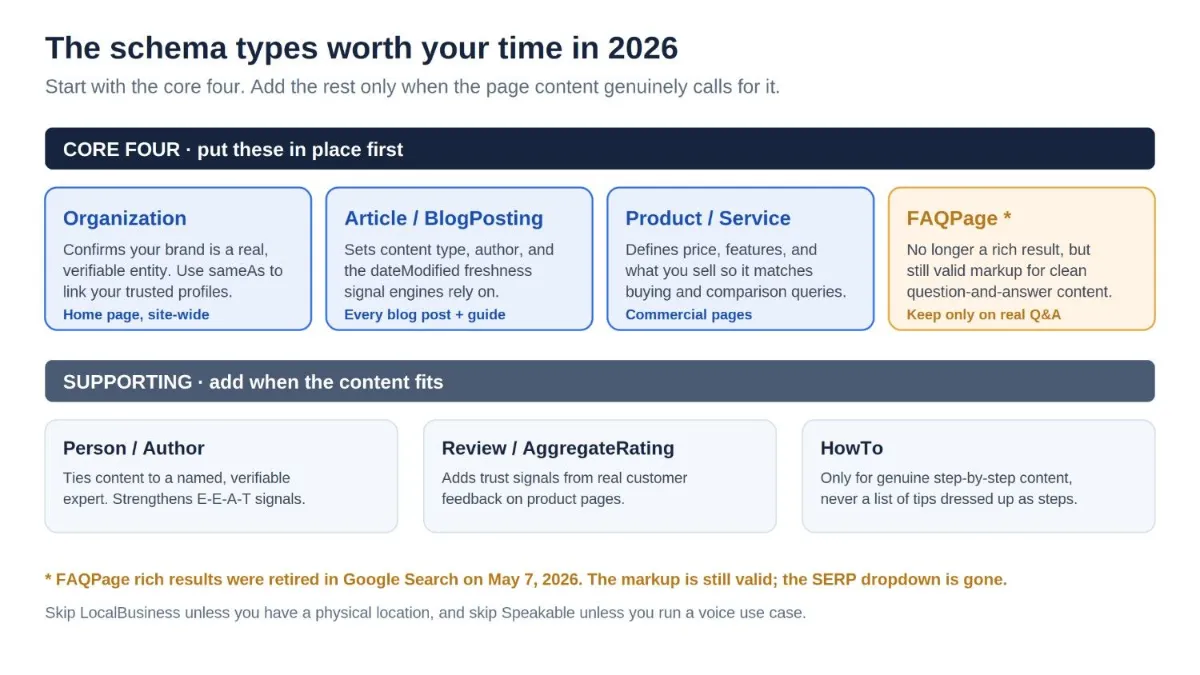
You do not need every type. Start with four, then add more only when the page genuinely contains that kind of content.
The core four:
• Organization. Site-wide, anchored on your home page. It confirms your brand is a real, named company. The field that does the heavy lifting is a list of links to your trusted profiles, like LinkedIn and Crunchbase. This connects every mention of your brand to one entity.
• Article or Blog Posting. On every post and guide. It sets the content type, the author, and the dateModified field that engines read as a freshness signal.
• Product or Service. On commercial pages. It defines what you sell, the price, and the features, so your pages match buying and comparison queries. This matters most for ecommerce product pages, where Product and Review markup feed shopping results and comparisons.
• FAQ Page, with a caveat. The rich result is gone, but the markup is still valid, and Google still parses it to understand a page. Keep it only where you have real, visible questions and answers. Do not bolt it onto a product page just to tick a box.
Supporting types, when the content fits #
Person or Author schema ties content to a named expert, strengthening your E-E-A-T signals. Review and AggregateRating add trust to product pages. HowTo helps genuine step-by-step content, but only when the page is truly built as steps, not a list of tips wearing a costume.
Skip the rest for most sites. LocalBusiness is for physical locations. Speakable is for voice use cases. Stacking six or eight types on a single page adds complexity without payback. Match each type to content a visitor can actually see.
Where schema fits in your SEO and AI search strategy #
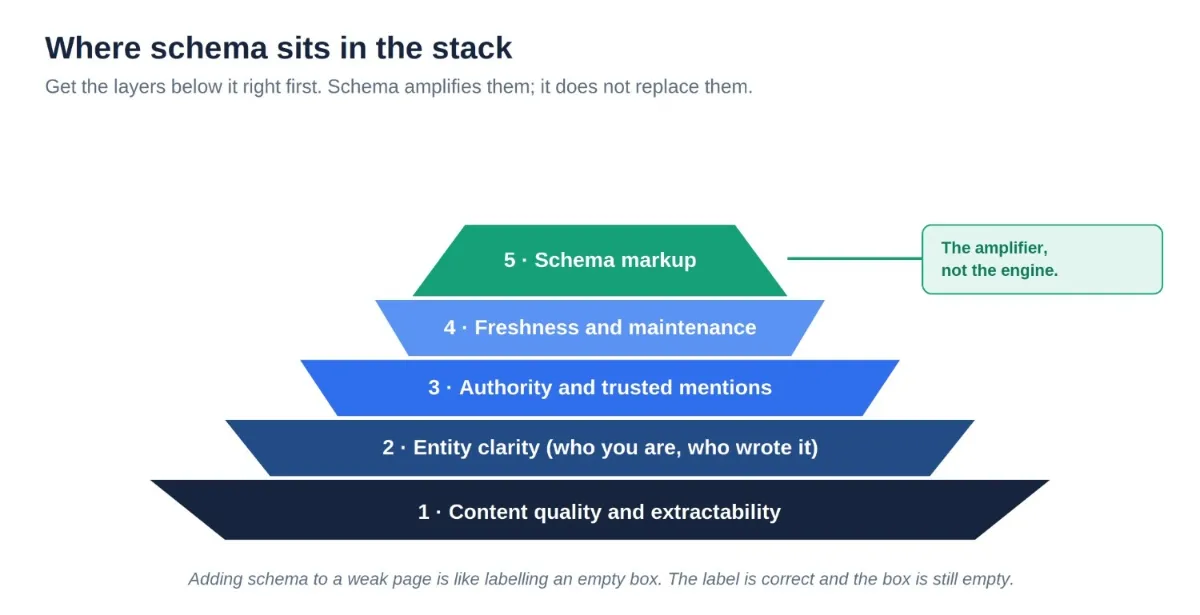
This is the part most guides skip. Schema is a support layer, not the foundation. The layers that actually decide whether you get found and cited sit below it.
Content quality and clear, extractable answers come first. Princeton and Georgia Tech researchers tested this directly and found that adding inline citations to primary sources increased AI citation rates by 40%, adding specific statistics by 37%, and adding named expert quotes by 22%. Those are content changes, not code changes, which is why strong, well-written content does more for visibility than any markup. The above content sits: entity clarity, then authority and trusted mentions, then freshness. Schema sits on top, making it all easier to read.
Here is the simple test. Adding schema to a thin page is like putting a neat label on an empty box. The label is correct. The box is still empty. Get the content and authority right first, often with the help of solid technical SEO, then let schema amplify what is already strong.
How to add schema markup the right way #
You do not need to be a developer. Most teams add schema in four steps.
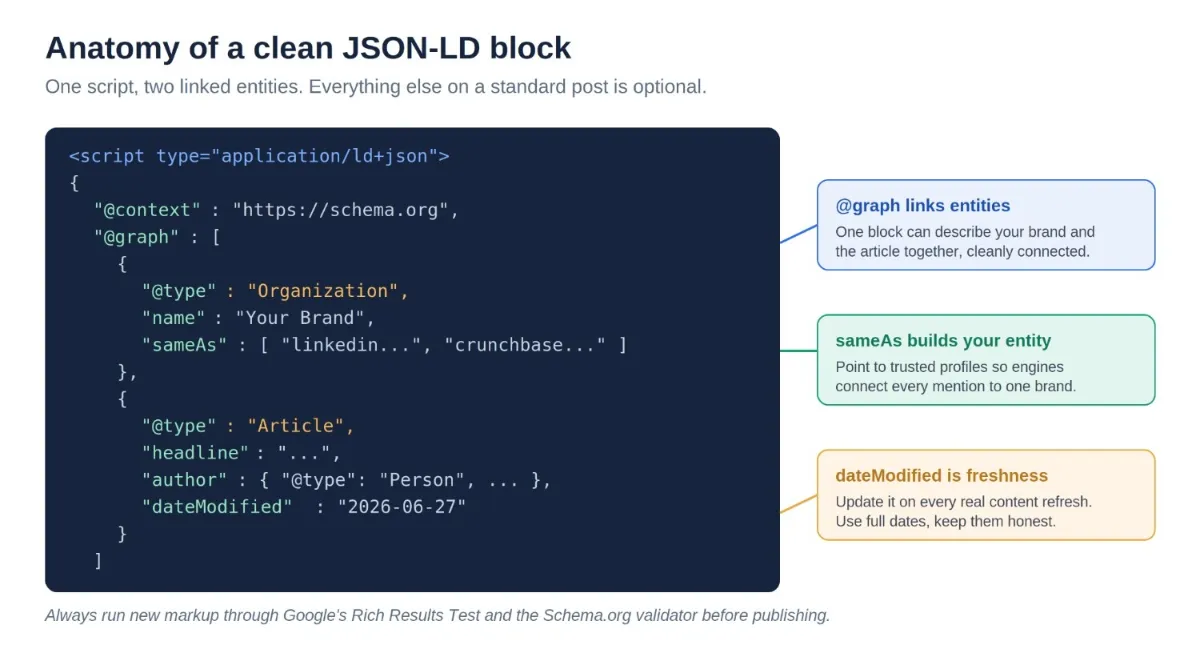
Pick the type that matches the page. Use one main type per page. If you need more than one, connect them with @id or @graph so engines read them as a set.
Write it as JSON-LD. This is Google's recommended format. It sits as a single script block in the page head and stays separate from your visible HTML. On WordPress, plugins like Yoast, Rank Math, or Schema Pro can generate it. On a custom or headless build, your developer adds the block per template.
Keep it accurate. Every field must match what users actually see on the page. When content changes, update the schema, especially dateModified.
Validate before you publish. Run every new block through Google's Rich Results Test and the Schema.org validator, and fix any errors before the page goes live.
One practical warning. Never copy schema directly from a rich-text editor like a word processor or a notes app into your CMS. Those tools quietly convert links into formatted hyperlinks that break the JSON. Always paste through a plain text editor first. For sites on a clean, modern stack, this is far easier to manage, which is one reason a solid web design and build, and structured data work best when planned together.
How to know if your schema is working #
Schema rarely shows up as a clean line on a traffic chart, especially now that so many searches end without a click. Track visibility instead.
• Use Google Search Console. The Enhancements reports show valid items and flag errors. Watch impressions on the pages where you added schema.
• Watch your AI appearances. Pages that rank for related follow-up questions get cited far more often. A Surfer SEO study of 173,902 URLs in December 2025 found that pages ranking for AI Overview follow-up queries were 161% more likely to be cited than pages ranking only for the main query.
• Run your own prompts. Ask the AI tools your customers use the questions they would ask, and check whether your brand shows up.
• Turn visibility into action. Pair this tracking with conversion rate optimization so that the attention you earn from search and AI actually converts into leads and sales.
The bottom line #
Schema markup is still worth doing in 2026. It just earns its keep in a quieter way than the old pitch suggested. It will not win citations on its own, and it will not rescue weak pages. What it does is remove doubt. It tells search engines and AI systems who you are, who wrote your content, and what each page is for. On strong, well-structured content, that clarity compounds.
So get the order right. Build genuinely useful content with clear answers. Earn authority and mentions. Keep your pages fresh. Then add a clean, accurate schema on top and validate it. That is the version of structured data that still moves the needle.
Frequently asked questions #
Does schema markup help SEO?
Yes. It helps search engines understand your pages and supports ranking, even though it is not a standalone ranking factor. Around 72% of first-page Google results use some form of schema.
Is schema markup a ranking factor?
Not directly. Google has said structured data gives an advantage in search results, but it works by improving understanding and eligibility, not by boosting rank on its own.
Does schema markup help with AI Overviews?
Not directly. Google says no special schema is needed for AI Overviews, and a 2026 Ahrefs study found no citation lift from adding it. Clear, extractable content matters more.
Is the FAQ schema dead in 2026?
The FAQ rich result was retired in Google Search on May 7, 2026, but the FAQ Page markup is still valid, and Google still uses it to understand pages.
Should I remove the FAQ schema from my site?
Usually no. Keep it where you have real, visible questions and answers. Remove it only if the section is thin or the markup no longer matches the page.
What schema types should every website have?
Organization-wide site and Article or Blog Posting on content pages. Add Product or Service on commercial pages and Person on authored content.
What is the best schema format?
JSON-LD. It is Google's recommended format and the easiest to add and maintain as a single script block in the page head.
Can schema markup hurt my SEO?
Yes, if it describes content that is not on the page, uses the wrong type, or holds outdated data. Mismatched markup can trigger a manual action.
How do I add schema markup to my website?
Generate JSON-LD for the page type, paste it into the page head, and validate it. WordPress users can automate it with plugins like Yoast or Rank Math.
Do I need a developer to add a schema?
Not always. CMS plugins handle most cases. Custom or headless sites usually require a developer to add blocks to each template.
How do I check if my schema is valid?
Use Google's Rich Results Test and the Schema.org validator. Both flag errors and confirm whether the markup is read correctly.
How often should I update schema markup?
Update it whenever the page content changes, especially the dateModified field. Review the Organization and Product schema at least quarterly.
What is the difference between structured data and schema markup?
Structured data is the general idea of machine-readable labels. Schema markup is the specific Schema.org vocabulary most sites use to apply it.
Does schema markup increase click-through rate?
It can when it powers a rich result, since enhanced listings stand out. With many rich results now retired, the gain comes more from understanding than from display.