
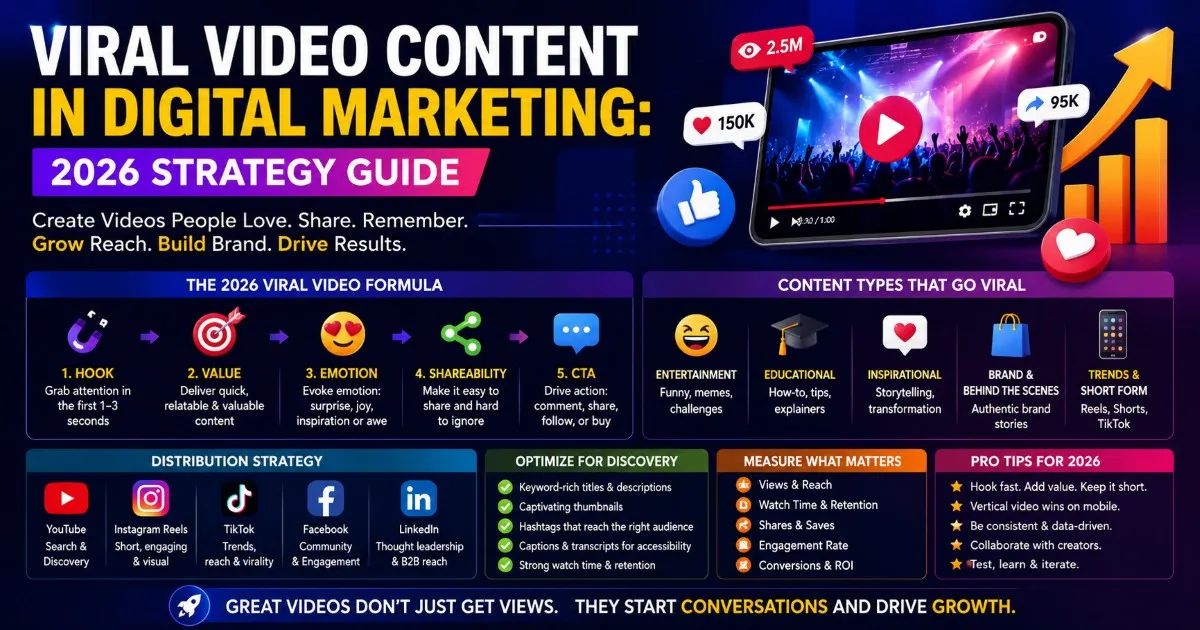
Viral Video Content in Digital Marketing: 2026 Strategy Guide

sadiya
May 7, 2026
Table of Contents
- What is Viral Video Content in Digital Marketing?
- Viral Video Content vs Traditional Digital Content
- Top Signs/Reasons You Need Viral Video Content in Digital Marketing
- Root Causes/Mechanics: Why Viral Video Is Reshaping Marketing
- How to Get Started / Diagnose
- Solutions & Strategies
- Actionable Framework: Viral Video Content Planning Checklist
- The Hidden Impact
- Common Mistakes to Avoid
- Frequently Asked Questions
- Conclusion & Next Steps
A few years ago, brands could post polished graphics, write a few captions, and still get decent reach. That is not enough in 2026.
Audiences now discover brands through short videos, creator clips, product demos, behind-the-scenes moments, reactions, memes, tutorials, and social search. Video is not just another content format anymore. It is where people compare, trust, laugh, learn, and decide what to buy.
The target audience for this guide includes digital marketers, social media managers, small business owners, e-commerce brands, SaaS teams, agencies, creators, consultants, and startup founders trying to grow visibility without wasting budget on content people scroll past.
The shift is backed by the market. HubSpot’s 2026 marketing statistics say short-form video is the most leveraged media format by marketers, and the top ROI-driving content formats are video-based, including short-form video, long-form video, and live-streaming video.
Your draft already frames 2026 as the year when viral video moves beyond entertainment and starts shaping how brands connect, convert, and build communities.
What is Viral Video Content in Digital Marketing? #
Viral video content in digital marketing is short, shareable, emotionally engaging video content designed to spread quickly across social platforms while supporting brand awareness, trust, engagement, and conversions.
A viral video does not always mean millions of views. For a local business, “viral” may mean reaching the right neighborhood audience. For a B2B company, it may mean one strong LinkedIn clip that brings qualified leads.
The key is not only reach. The real value comes when video creates attention, relevance, memory, and action.
In 2026, viral content is shaped by AI-powered content discovery, platform algorithms, creator behavior, audience comments, watch time, sound trends, and fast-moving cultural moments.
Viral Video Content vs Traditional Digital Content #
Traditional content still matters. Blogs, landing pages, emails, case studies, and search content help build long-term authority.
But viral video works differently because it can create fast discovery and emotional connection before the user even visits your website.

The better strategy is not choosing one over the other. Strong brands use viral video for discovery, then support it with SEO, landing pages, email capture, retargeting, and conversion content.
Top Signs/Reasons You Need Viral Video Content in Digital Marketing #
You probably need a stronger video strategy if your current content is visible but not memorable.
Common signs include:
Your social posts get low reach
Your brand feels too polished or distant
Competitors are growing faster with simple videos
Your audience asks the same questions repeatedly
Your product needs visual explanation
Your paid ads are getting expensive
Your website traffic is not enough
Your team has Creative content ideas but no system
Your brand is not showing up in social search
Social media is now too large to ignore. DataReportal reported that global social media user identities reached 5.79 billion by April 2026, equal to 69.9% of the global population, though user identities do not always mean unique individuals.
That means your customers are already watching. The question is whether your brand is showing up in the moments where they pay attention.
Root Causes/Mechanics: Why Viral Video Is Reshaping Marketing #
Viral video is reshaping digital marketing because platforms now reward attention signals, not just follower count.
The algorithm looks at how people behave after a video appears. Do they stop scrolling? Do they watch again? Do they comment? Do they share it with someone? Do they save it? That changes the rules.
A small brand can outperform a large brand if the video feels more useful, funny, honest, or timely. A founder talking directly to camera can beat a studio ad. A customer reaction can feel more believable than a polished product claim.
TikTok’s 2026 trend report says audiences are moving toward unfiltered stories, behind-the-scenes moments, real process, and real people over curated perfection.
AI has also changed discovery. TikTok said marketers need tools to identify and respond to trends faster by analyzing stories, language, and behaviors in real time.
Warning: Chasing virality without strategy can damage your brand. A video that gets attention but attracts the wrong audience, wrong comments, or no action is not a marketing win.
How to Get Started / Diagnose #
Before posting random videos, diagnose what your audience actually needs.
Define the business goal
Decide whether the goal is awareness, leads, sales, followers, website traffic, community, or product education.
Identify your target audience
Write down who you are trying to reach, what they care about, what frustrates them, and what type of videos they already watch.
Audit your current content
Look at your top posts, weak posts, comments, saves, shares, and watch time. Patterns matter more than opinions.
Study competitor videos
Check which competitor videos get comments, not just views. Comments reveal what people actually react to.
Build content pillars
Choose repeatable themes such as education, behind-the-scenes, product demos, founder insights, mistakes, myths, customer stories, or industry reactions.
Create a hook bank
Write 20 opening lines that stop the scroll. Examples include “Most brands get this wrong,” “Here’s why your ads are not converting,” or “Before you buy this, check this.”
Test fast, then improve
Publish small batches of videos, review performance weekly, and double down on formats that earn saves, shares, comments, and qualified clicks.
Solutions & Strategies #
Foundational Strategy #
Start with simple videos that answer real questions. You do not need a studio. You need clear ideas, strong hooks, clean audio, captions, and useful storytelling. Good starting formats include:
Problem-solution videos
Before-and-after clips
Behind-the-scenes videos
Founder opinion videos
Customer FAQs
Product demonstrations
Myth-busting clips
Short tutorials
Trend-based reactions
For B2B brands, short clips can simplify complex ideas. For e-commerce brands, video can show product use, quality, packaging, results, and customer reactions.
Tools Strategy #
Use tools to speed up production, not replace thinking. Useful tool categories include:
Editing: CapCut, Adobe Premiere Pro, Descript
AI video: Runway, Pika, Synthesia
Captions: Captions, Submagic, Descript
Research: TikTok Creative Center, YouTube Studio, Instagram insights
Planning: Notion, Airtable, Trello
Analytics: GA4, platform analytics, UTM tracking
Repurposing: OpusClip, Riverside, Descript
The smartest use of AI is for AI-powered content discovery, hook testing, caption drafts, clip selection, and repurposing long videos into short clips. Keep the human part in the idea, story, opinion, and brand voice.
Professional Strategy #
A professional viral video strategy should not be “post more reels.” It should include audience research, creative direction, trend monitoring, scripting, editing systems, publishing cadence, analytics, and conversion tracking.
For agencies and growing brands, the better model is a repeatable video engine:
Weekly trend scan
Monthly content calendar
Batch recording
Short-form editing
Platform-specific captions
Creator collaboration
Performance review
Landing page or CTA alignment
This is how viral video becomes part of digital marketing instead of random content activity.
Actionable Framework: Viral Video Content Planning Checklist #
Use this checklist before creating your next batch of videos.

The Hidden Impact #
The biggest hidden impact of viral video is that it changes how people judge your brand before they ever visit your website. A strong video makes the brand feel human. A weak or forced video makes the brand feel disconnected.
There is also a trust impact. Audiences are tired of perfect ads that feel empty. They often respond better to honest process, real people, useful opinions, customer reactions, and small imperfections.
For marketing teams, video creates pressure too. Trends move fast, and teams can feel like they are always behind.
That is why systems matter. Without a clear process, viral video turns into daily panic. With a process, it becomes a practical growth channel.
Common Mistakes to Avoid #
Avoid these mistakes when using viral video content in digital marketing:
Copying trends without brand relevance
Making every video a sales pitch
Ignoring the first three seconds
Posting without captions
Using AI-generated content with no human insight
Measuring only views
Ignoring saves, shares, comments, and clicks
Posting inconsistently
Using the same video style on every platform
Not connecting videos to landing pages or offers
Deleting early videos too quickly
Trying to go viral before understanding the audience
The biggest mistake is chasing attention without intention. A good video should give the viewer something clear: a laugh, a lesson, a reason to trust you, or a next step.
Frequently Asked Questions #
Why is viral video content important in digital marketing in 2026? #
Viral video content matters because people increasingly discover brands through short-form platforms, social search, creator clips, and algorithmic feeds. It helps brands earn attention faster than static content when the idea, hook, and timing are right.
What makes a video go viral? #
A video usually goes viral because it has a strong hook, emotional pull, high relatability, timely context, and easy shareability. The algorithm also rewards watch time, replays, comments, saves, and shares.
Do small businesses need viral video content? #
Yes, but small businesses should not chase random mass virality. They should focus on reaching the right audience with useful, honest, and locally relevant videos that can drive trust, visits, inquiries, or sales.
How does AI-powered content discovery affect video marketing? #
AI-powered content discovery helps platforms predict what users want to watch and helps marketers spot trends faster. It also means brands need sharper creative ideas because content is competing inside highly personalized feeds.
What are good Creative content ideas for viral videos? #
Good Creative content ideas include behind-the-scenes clips, mistakes to avoid, customer reactions, founder opinions, product demos, myths, quick tutorials, trend reactions, before-and-after stories, and “things nobody tells you” videos. The best ideas are specific to your audience, not generic trends.
Which platforms are best for viral video content? #
TikTok, Instagram Reels, YouTube Shorts, and LinkedIn video are strong options, depending on your audience. E-commerce and lifestyle brands often do well on TikTok and Instagram, while B2B brands can use LinkedIn and YouTube Shorts for education and trust.
How do you measure viral video success? #
Measure more than views. Track watch time, completion rate, shares, saves, comments, profile visits, website clicks, leads, purchases, and whether the video attracted the right audience.
Conclusion & Next Steps #
Viral video content is no longer just a social media trend. It is changing how people discover brands, judge credibility, and decide what deserves attention.
Key takeaways:
Viral video content in digital marketing helps brands earn attention faster.
AI-powered content discovery makes relevance and timing more important.
Creative content ideas should come from audience problems, not random trends.
Views matter, but watch time, shares, saves, comments, clicks, and conversions matter more.
The best videos feel human, clear, timely, and useful.
Start by auditing your current content, studying what your audience already watches, and creating a small batch of simple videos around real questions. Then measure what earns attention and what drives action.
For brands that want a stronger video strategy, Vynce Digital can help plan creative angles, content systems, platform strategy, and conversion-focused campaigns that turn attention into measurable growth.
The future of viral video is not about being loud. It is about being useful, human, and easy to share at the exact moment your audience is ready to care.