
The Agentic Web: What It Is and How to Get Your Business Ready

Tuba
July 3, 2026
Table of Contents
For most of its life, the web has been a place people visit. You open a browser, click around, read, and fill in forms. That is changing. A new kind of software, called an AI agent, is starting to do that work for you. It can search, compare options, pick one, and even complete the job, such as booking an appointment or placing an order. This new way of using the web has a name. People call it the agentic web.
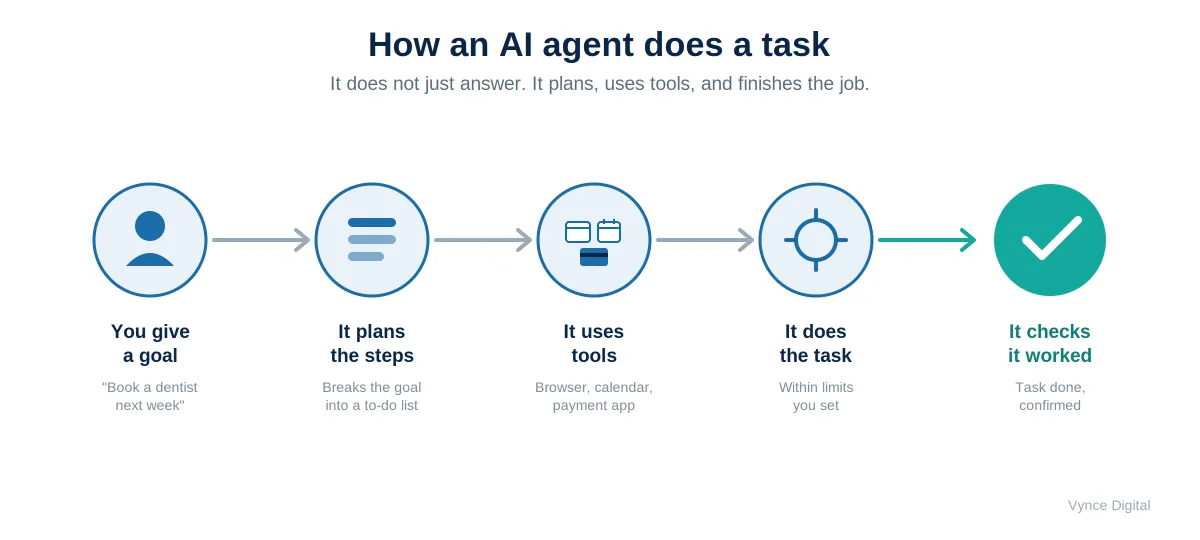
This is not science fiction, and an AI agent does not just answer. It plans the steps, uses tools, and finishes the task for you. It's not years away. The tools that make it work are already here. The big card companies have built safe ways for agents to pay. And research firms are putting real numbers on how fast it is growing. This guide explains what the agentic web is, who is building it, how soon it is coming, and what you can do to get your business ready.
What the Agentic Web Actually Is #
The agentic web is the internet where AI agents can do things for you, not just tell you things. A normal AI tool reads the web and gives you an answer. An agent goes one step further. It takes a goal, breaks it into steps, uses tools like a web browser or a payment app, does the task, and checks that it worked.
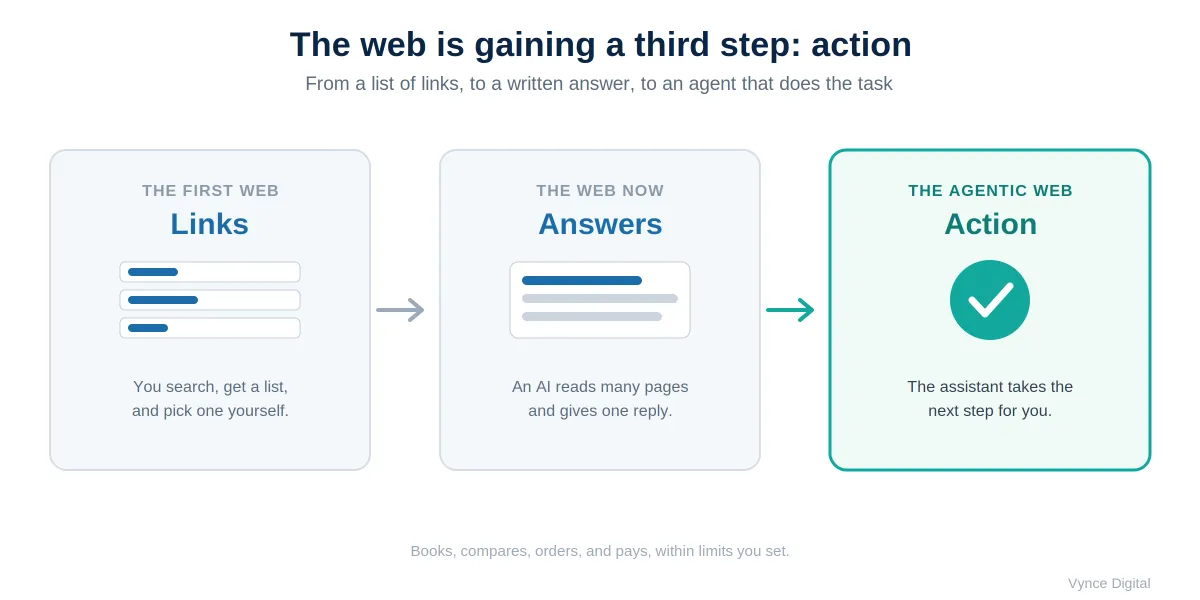
Think of it as three steps that build on each other over time. The first web was about links. You searched, got a list, and picked one. The web we mostly use now is about answers. An AI assistant reads many pages and gives you a single reply. The agentic web adds a third step: action. Now the assistant can take the next step for you. Microsoft talked about this plainly at its 2025 developer event, where it shared plans for what it called the open agentic web.
Websites and links are not going away. But your website is no longer the only way in. A second door is opening, and it is built for agents working on behalf of a person.
The Standards are Quietly Building It #
The agentic web runs on a few shared rules, called open standards. They matter because they enable agents from different companies to work together rather than being stuck in separate systems. Three of them stand out.
Model Context Protocol (MCP). Introduced by Anthropic in late 2024, MCP is often called the USB-C for AI. Just as a USB-C port lets you plug in many devices into a single port, MCP provides an agent with a simple way to connect to external tools and data. With it, an agent can check a calendar or look something up in a database without a special setup for each one.
Agent2Agent (A2A). Launched by Google in April 2025 with more than 50 partner companies, A2A agents from different companies communicate, share information, and pass tasks back and forth. It is now run as an open project by the Linux Foundation.
NLWeb. Introduced by Microsoft in 2025, NLWeb lets a website answer plain-language questions from both people and agents. It also works with MCP, so a site can make its content easy for agents to find and use.
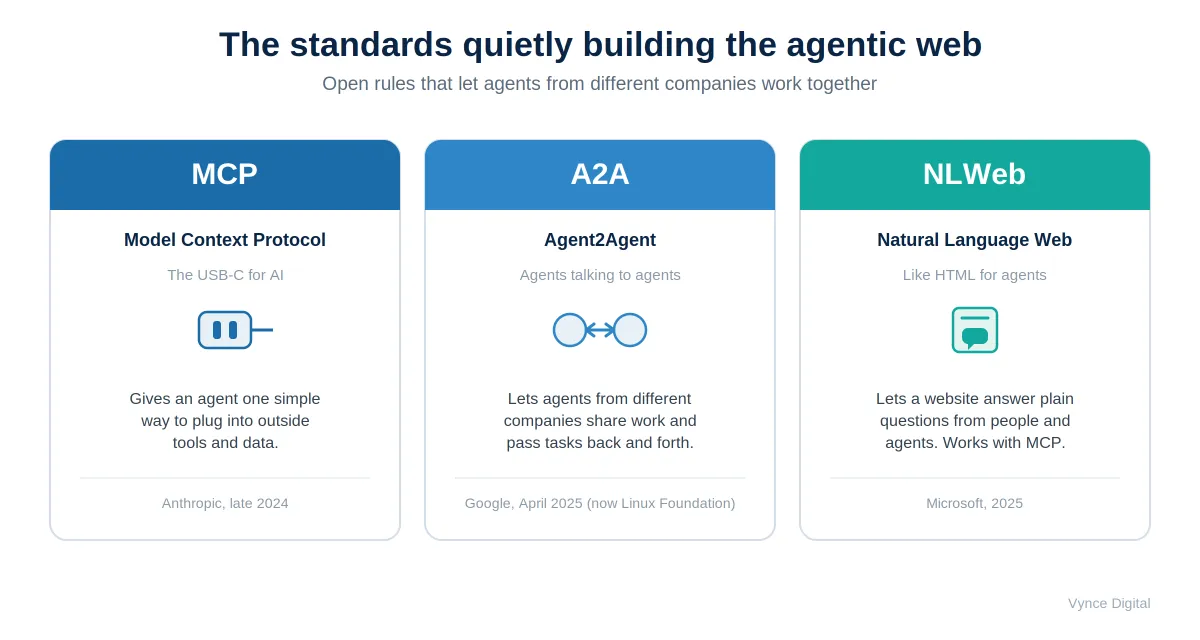
Here is a simple way to see it. These new standards do for agents what the early web rules did for people. Some of them control how agents access tools and communicate with each other. Another helps machines read what is on a web page. The big difference is speed. The early web rules took years to catch on. These have been picked up by major platforms over the past few months.
How Fast is it Arriving #
The numbers are moving fast. Gartner expects that by the end of 2026, 40 percent of business software will include built-in AI agents, up from less than 5 percent in 2025. Looking further out, it says agentic AI could account for close to 30 percent of business software sales by 2035, worth more than 450 billion dollars, up from about 2 percent in 2025.
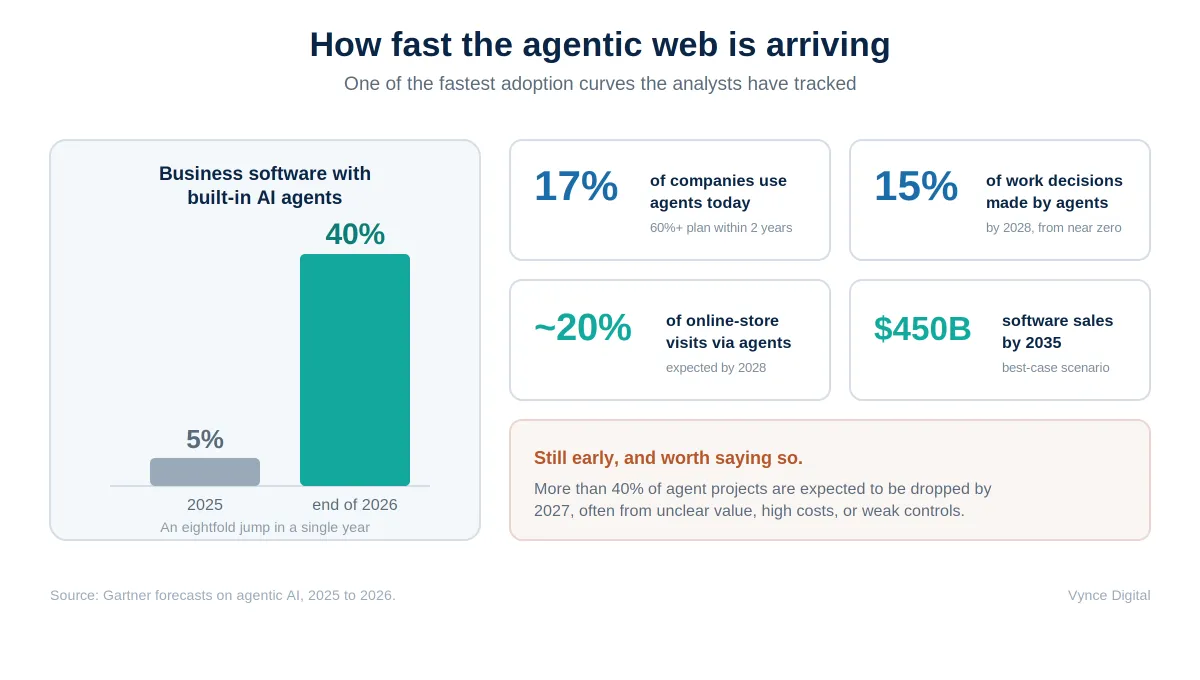
It is real, but it is still early, and it is fair to say so. According to Gartner's 2026 work on agentic AI, only about 17 percent of companies have put AI agents to work so far. But more than 60 percent planned to within two years, the fastest take-up of any new tech it tracked. The market itself was worth about 7.6 billion dollars in 2025, passed 10 billion in 2026, and is growing more than 40 percent a year. At the same time, Gartner expects more than 40 percent of agent projects to be dropped by the end of 2027, often due to unclear value, high costs, or weak controls. So the change is real, but the winners will be the ones who treat it as serious work, not a quick demo.
Two more forecasts show where this is going. Gartner expects that by 2028, agents will make at least 15 percent of everyday work decisions on their own, up from almost none in 2024. It also expects agents to handle about 20 percent of visits to online stores built for people. When an agent, not a person, is doing the looking and choosing, the things that win change. Clear facts, honest pricing, and machine-readable content are starting to matter more than flashy design.
Agentic Commerce: When the Agent also Buys #
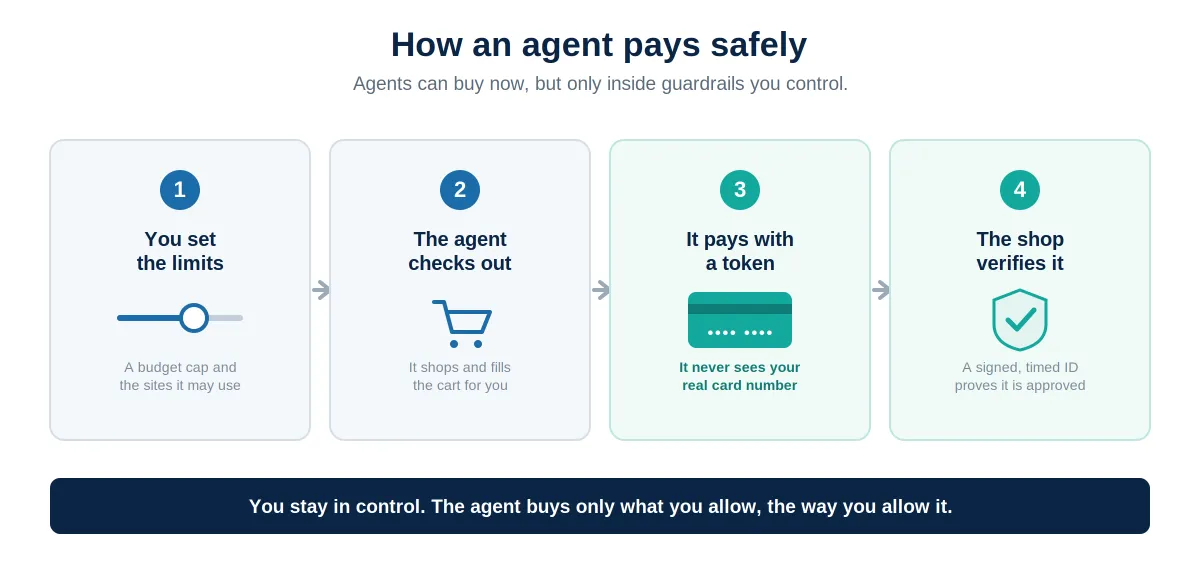
The clearest sign that the agentic web is here is that agents have begun paying. For a long time, the rule was simple. AI could suggest things, but a person had to do the buying. That is starting to change, step by step, and the world's biggest card networks are building the tools to make it safe. Visa Intelligent Commerce launched in April 2025, with several major AI companies on board. By December 2025, Visa said it and its partners had safely completed hundreds of agent-led purchases, with more than 100 partners taking part. In June 2026, it linked up directly with a major AI platform. The key safety trick is that the agent never sees your real card number, and it can only spend within the limits you set.
Mastercard did much the same. It started its Agent Pay program in 2025 and made its first agent-led payment later that year. In June 2026, it launched Agent Pay for Machines, made for a world where agents pay each other all day long, sometimes amounts worth less than a penny. The example says a lot. A person tells an agent to set up a flower shop, and the agent buys the web address, hosting, images, and checkout pages, all within a set budget. One request turns into a whole set of purchases.
For shoppers, buying in a chat became a reality in late 2025. OpenAI and Stripe shared a common rulebook, the Agentic Commerce Protocol, allowing people to complete certain purchases without leaving the chat. Google launched its own version around the same time, backed by many payment and retail names. The exact products are still changing, and a few early tests were pulled back. But the pattern is clear. The checkout is moving into the conversation.
The money explains the rush. The consulting firm McKinsey estimates that AI agents could handle around 1 trillion dollars in United States purchases by 2030. The early signs are already showing. Adobe reported that visits to United States retail sites coming from AI tools rose about 1,300 percent over the year during the 2024 holiday season and jumped 1,950 percent on Cyber Monday. By the middle of 2025, they were up several thousand percent. This group of shoppers is still small but growing fast, and they tend to buy.
All of this raises a new question: trust. If an agent is spending money, a shop needs to be sure the agent is real and approved, not a bad bot. So the card networks and tech firms are also developing ways for agents to prove their identities, using signed, time-stamped IDs. This trust layer will grow alongside the buying tools, because one does not work without the other.
What this means for your business #
You do not need to guess which agent or platform will win to get ready. The work is steady and familiar, and most of it also helps the people who still visit your site.
Start by making your content easy for a machine to read and trust. Put the answer first, explain terms early, and keep your facts, prices, and claims up to date and the same across every page. This is the same work that goes into generative engine optimization: writing content so AI tools can find it, trust it, and use it correctly. Add structured data and clear FAQ sections so an agent can grab a clean, correct answer without guessing.
Next, make your proof easy to see. Agents trust sources that look fair, specific, and backed up. So show your evidence clearly, with real numbers, dated results, case studies, reviews, and credentials. Vague claims that a person might skim past are exactly what an agent will skip.
Then make the steps that lead to a sale as smooth as possible. As more buying happens through assistants, what matters less is the color of a button and more whether the path can be completed cleanly, by a person or by an agent acting on their behalf. Fewer form fields, simple menus, clear pricing, and fast, reliable pages all help. This mix of clear content and a clean, machine-friendly setup is why AI SEO services are becoming their own field, separate from old-style ranking work but built on the same basics.
None of this means dropping what already works. Strong SEO, a fast site, and a trusted brand still matter, and these are the same things agents look for. You are just writing and building for two readers at once, the person and the agent acting for them.
Frequently Asked Questions #
What is the agentic web?
It is a version of the web where AI agents can do things for you, like booking or buying, not just answering questions. Websites stay, but a new door opens for software acting on a person's behalf.
What is an AI agent?
An AI agent is software that takes a goal, breaks it into steps, uses tools like a browser or a payment app to complete the task, and then checks that it worked. It acts, rather than only responding.
What is the difference between an AI agent and a chatbot?
A chatbot answers questions inside a conversation. An AI agent goes further and takes action on your behalf, such as booking or buying, using tools to complete the whole task.
How is the agentic web different from AI search?
AI search reads the web and gives you a summary. The agentic web adds the next step, in which the agent actually performs the task.
What is agentic AI in plain terms?
It is AI that can plan steps, use tools, and act, with safety limits such as spending caps and approvals, rather than only chatting or summarizing.
Which technologies make the agentic web possible?
Open standards like Model Context Protocol, Agent2Agent, and NLWeb let agents connect to tools, talk to each other, and read website content in the same way.
What is Model Context Protocol (MCP)?
MCP is an open standard introduced by Anthropic in late 2024 that provides AI agents with a simple, shared way to connect to external tools and data. It is often described as a USB-C port for AI.
Who is building the agentic web?
No single company. The standards come from Anthropic, Google, and Microsoft, while card networks like Visa and Mastercard are building the payment tools, and many platforms are adopting them.
What is agentic commerce?
It is when an AI agent does the shopping and checkout, not just the suggesting. Card networks now offer safe ways for an agent to pay within limits you set.
Are agent payments safe?
The card networks built guardrails. The agent never sees your real card number and can only spend within the limits you set. Signed agent IDs help shops confirm a request comes from an approved agent.
How will the agentic web change online shopping?
More buying will happen in chats and through agents acting on behalf of shoppers. That makes clear facts, honest prices, and machine-readable product pages matter more than visual design.
Is the agentic web here yet?
Parts of it are live now, like in-chat purchases and agent payment tools. Full self-running agents are still early, and many business projects are still tests.
How do I get my website ready for AI agents?
Make your content clear and machine-friendly, add structured data and FAQs, and keep your facts up to date so an agent can find, trust, and act on them.
Will the agentic web replace SEO?
No. It builds on the same basics. Clear structure, trust, and accurate content help both human visitors and the agents acting on their behalf.
Conclusion #
The web is getting a new layer. For most of its life, it was made for people to browse. Now it is being rebuilt so that software can act on their behalf. Open standards are setting the rules, card networks are building the payment tools, and research firms say it is growing faster than the early days of cloud computing.
You do not need to know which agent or platform will win to get ready. The work is steady. Make your business easy for a machine to understand, easy to trust, and easy to act on. Post clear, well-organized content; keep your facts up to date; show your proof; and take the friction out of the steps that lead to a sale. The brands that do this now will be the ones agents pick when they act for a customer, just as the brands that moved early on search came to own the click.
The agentic web is not one big moment you can wait for. It is arriving piece by piece. The businesses getting ready today are setting themselves up to win the result, not just the visit.