AI Content Decay: Why Top Articles Vanish From AI Answers

Tuba
July 9, 2026
Table of Contents
- Why Your Best-Performing Articles Stop Appearing in AI Answers
- What AI Content Decay Actually Is
- The 2026 Wake-Up Call: When One Update Reset the Citations
- Why Updating the Date is Not Enough Anymore
- The Signals AI Systems Actually Reward Now
- How to Spot AI Content Decay Before it Costs You
- A Refresh System That Re-Earns Citations
- How to Measure AI Visibility, Not Just Rankings
- The Takeaway
- Frequently Asked Questions
Why Your Best-Performing Articles Stop Appearing in AI Answers #
AI content decay occurs when a page that once appeared in AI answers quietly stops being cited, even though its search rankings have not changed. It is not the slow traffic slide most teams already know. A page can still rank on the first results page and still lose its spot in the AI answer sitting above those results. In 2026, this has become one of the most common reasons a strong article suddenly underperforms, and changing the date rarely fixes it. Here is why it happens, how to catch it early, and how to rebuild the signals that bring your content back into AI answers.
What AI Content Decay Actually Is #
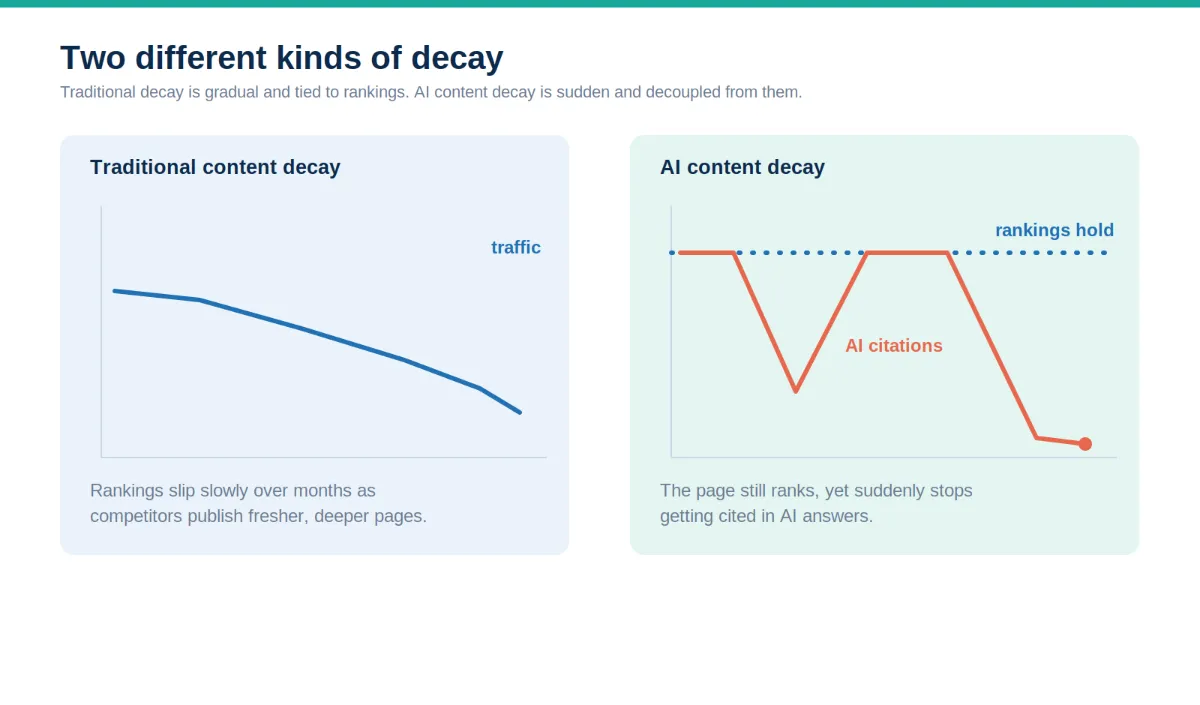
Traditional content decay is a gradual loss of organic traffic over months. Competitors publish fresher, deeper pages; links rot, intent shifts, and your rankings drift down with it. AI content decay works differently. Your page loses its place in AI-generated answers, often suddenly, and often while its blue-link ranking has not changed at all.
The reason is in how these systems read. They do not scroll a results page the way a person does. They pull short passages from the sources they judge most current, clearest, and best supported, then stitch them into one answer. When a fresher or better structured source shows up, or when the system simply re-evaluates, your passage gets dropped. That is why classic on-page SEO alone no longer protects your place in AI answers.
Ranking and citation have also come apart. In mid 2025, roughly three out of four pages cited in an AI answer also ranked in the top ten for that query. By early 2026, that overlap had fallen to between 17 and 38 percent, depending on the dataset, according to analyses by Ahrefs and BrightEdge. A top ranking is simply no longer a reliable proxy for AI visibility.
The 2026 Wake-Up Call: When One Update Reset the Citations #
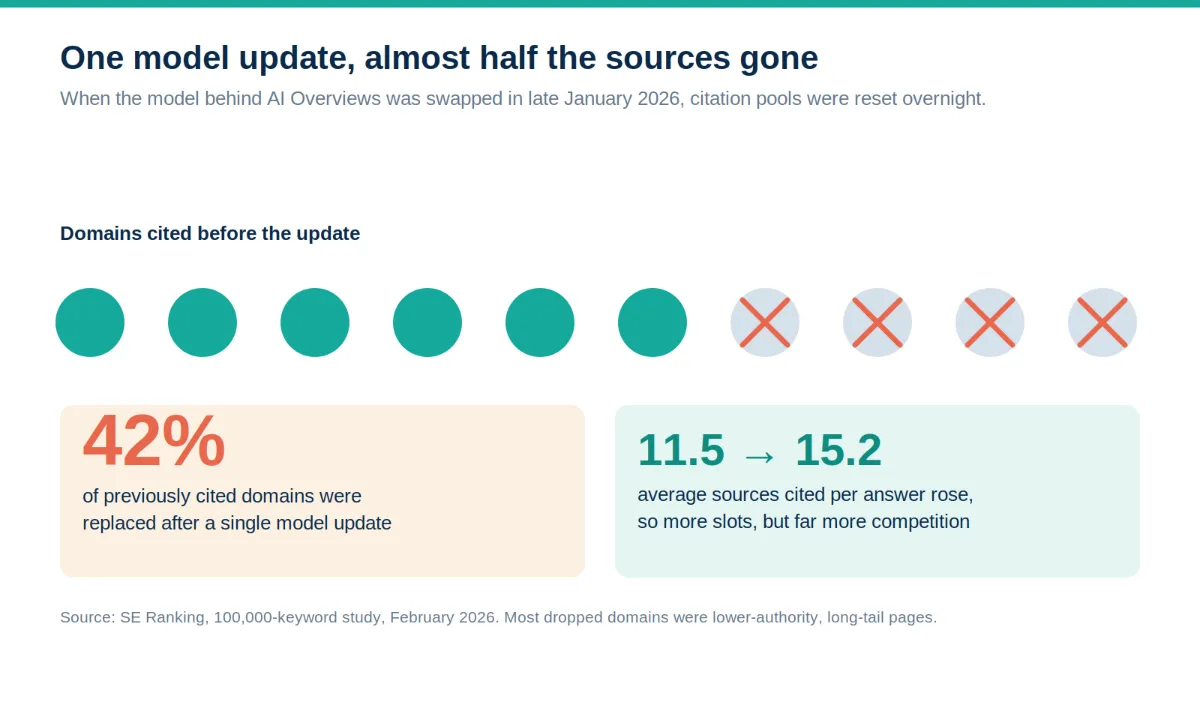
The clearest proof arrived in late January 2026, when the model powering AI Overviews was switched. A 100,000-keyword study by SE Ranking found that about 42 percent of the domains previously cited disappeared from those answers, mostly lower-authority, long-tail pages. At the same time, the average number of sources cited per answer rose from roughly 11.5 to 15.2, so there were more citation slots but far more competition for them. The pages that vanished did not lose rankings. They lost citations overnight, because the system re-decided what to trust.
And it is not a one-off. AI answers are unstable by design. One analysis found the content of an AI answer changes roughly 70 percent of the time when the same question is asked again, and when it regenerates, close to half of the citations are swapped for new ones, per tracking from Profound. Volatility that search marketers once counted in algorithm updates per year is now measured in weeks.
Why Updating the Date is Not Enough Anymore #
When traffic dips, the reflex is to refresh: change the modified date, swap the year in the title, tweak a few lines, resubmit. That used to help because freshness signals nudged rankings. It does very little for AI citations, because these systems re-read the actual content and compare it, passage by passage, against everything else available. If the substance has not changed, the model has no new reason to pick you.
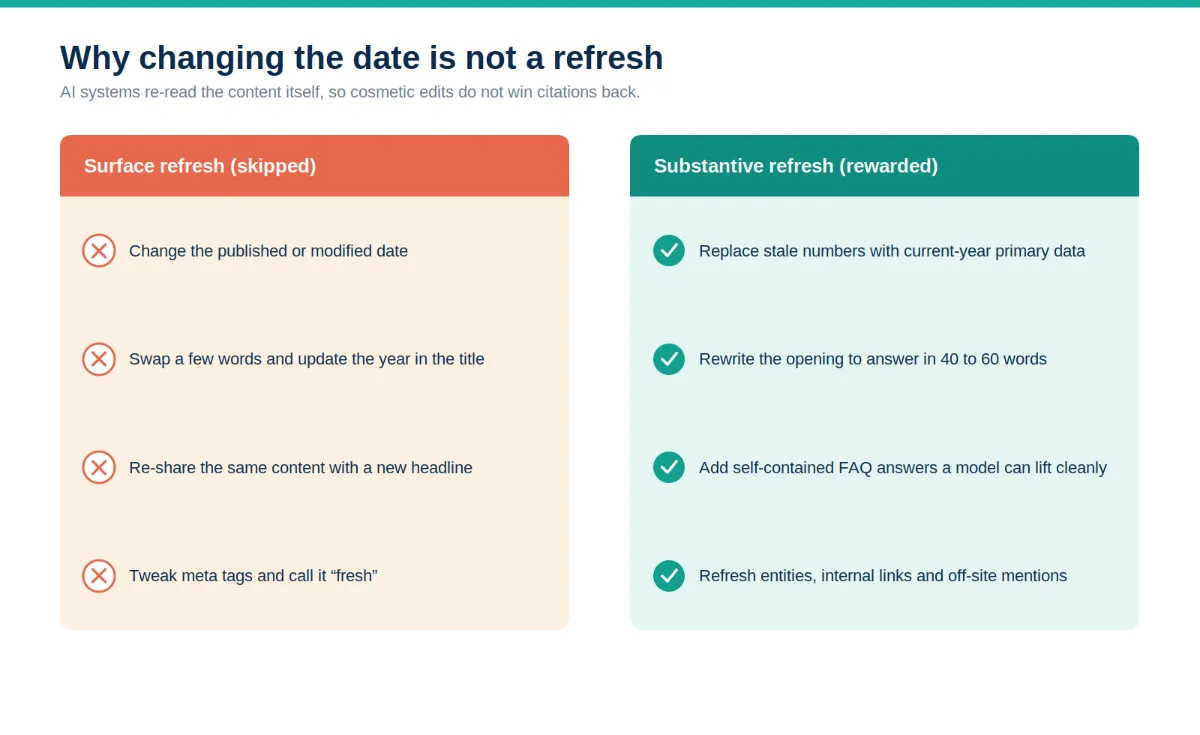
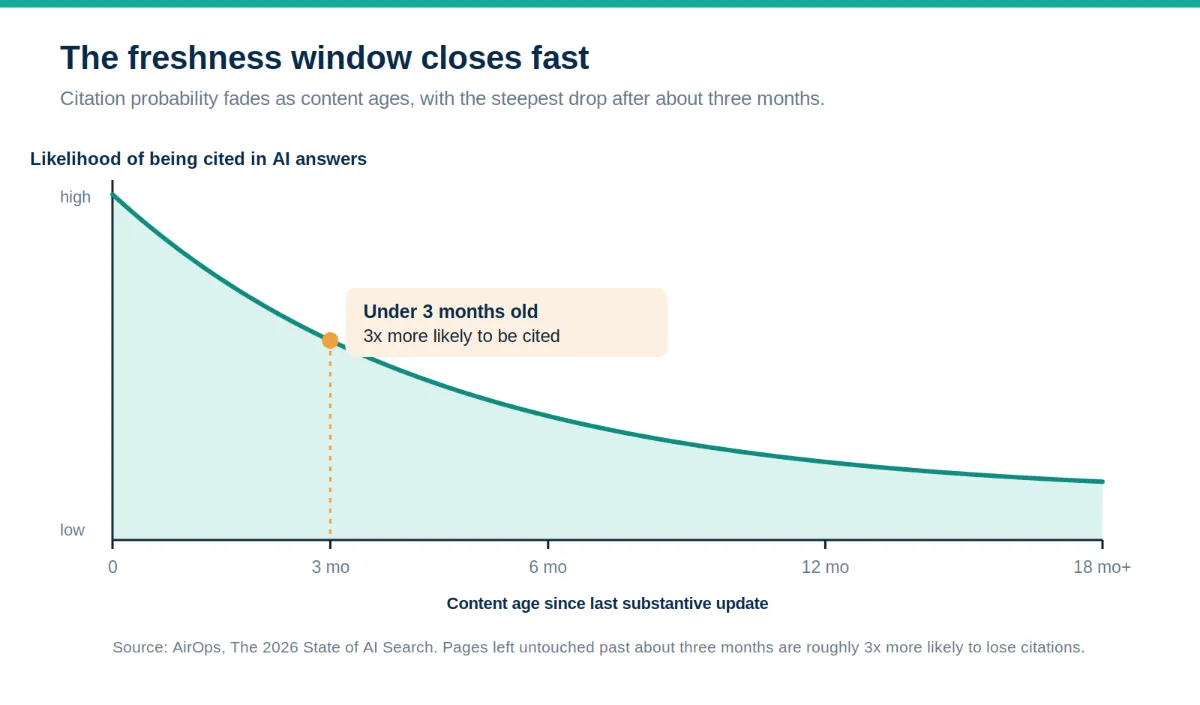
What works is a genuine, substantive update, and freshness here is measurable rather than vague. Research from AirOps found that pages updated within the last three months are about three times more likely to be cited than older pages, and pages left untouched past that window are roughly three times more likely to lose citations they already had. The date only matters when it reflects a change the model can verify in the text. A steady content refresh program is what keeps that window open.
The Signals AI Systems Actually Reward Now #
Re-earning a citation means rebuilding the signals a model looks for, not editing the page once. Five carry most of the weight.
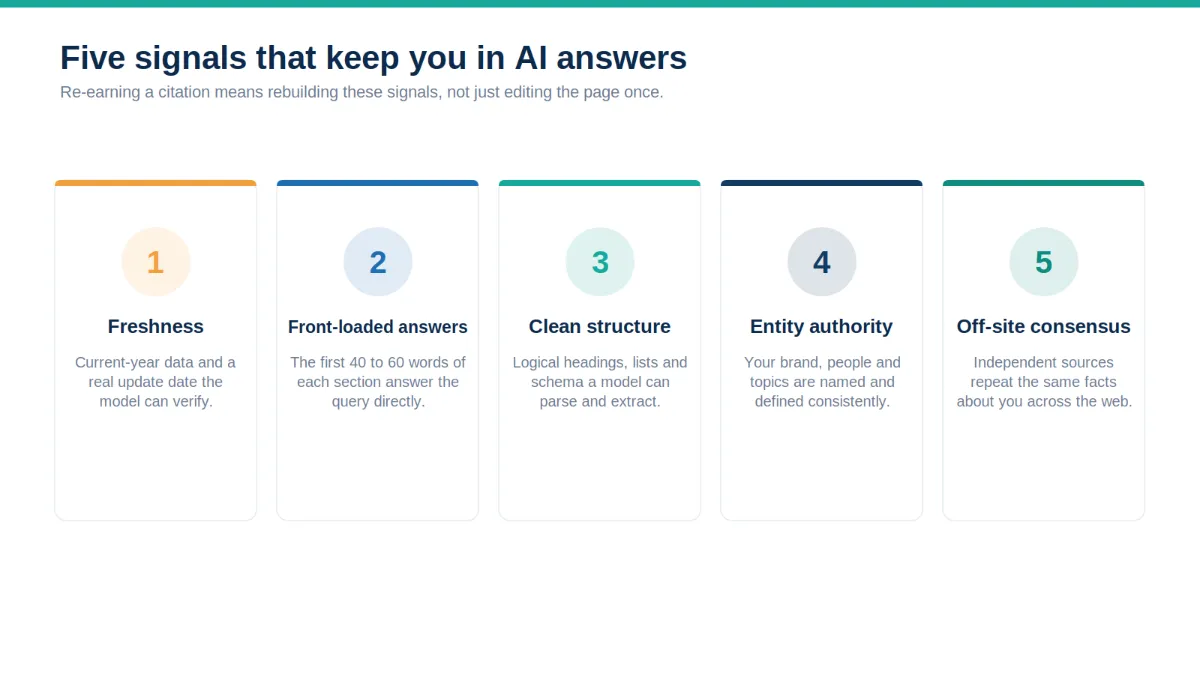
Freshness. Current-year data and a real update date the model can verify. This is the single most controllable signal, and it decays the fastest.
Front-loaded answers. Because these systems extract short passages, the first 40 to 60 words of each section carry outsized weight. One April 2026 analysis found about 44 percent of all AI citations come from the first 30 percent of a page. Lead each section with a direct answer, then expand.
Clean structure. Logical headings, lists, and schema make a page easy to parse and extract information from. Pages with sequential heading hierarchies are cited far more often than fragmented ones, which is a core part of AI search optimization.
Entity authority. The system evaluates your brand, people, and topics across the entire web, not just a single page. Clearly naming and defining your entities is the heart of generative engine optimization. Princeton researchers behind the GEO study found that adding statistics, citations, and quotations can increase the visibility of AI answers by up to 40 percent.
Off-site consensus. When independent sources repeat the same facts about you, the model gains confidence to cite you. For many topics, most brand mentions in AI answers come from third-party content rather than your own site, so the mentions and reviews spread across the web do real work here.
How to Spot AI Content Decay Before it Costs You #
Because rankings stay steady, your usual SEO dashboard will not warn you. Watch for three patterns: traffic or conversions slipping on pages whose positions have not moved, impressions holding while clicks fall (a sign an AI answer is intercepting the query), and your brand dropping out of AI answers you used to appear in.
The blunt reality is that AI answers compress clicks even when you rank well. Pew Research Center, tracking the browsing of 900 US adults in March 2025, found people clicked a traditional result on just 8 percent of searches that showed an AI summary, compared with 15 percent without one, and clicked a source inside the summary only 1 percent of the time. A citation is worth less in raw clicks, which is one reason teams are rebalancing how they split effort between organic and paid search, and which makes holding the citation, and the brand exposure it brings, more important rather than less.
The practical check is simple: run your priority queries in AI answer tools every few weeks and record whether you are cited, mentioned, both, or absent. Treat citation presence as a metric in its own right.
A Refresh System That Re-Earns Citations #
The fix is a loop, not a one-time edit. Run it on your priority pages and repeat on a roughly quarterly cadence.
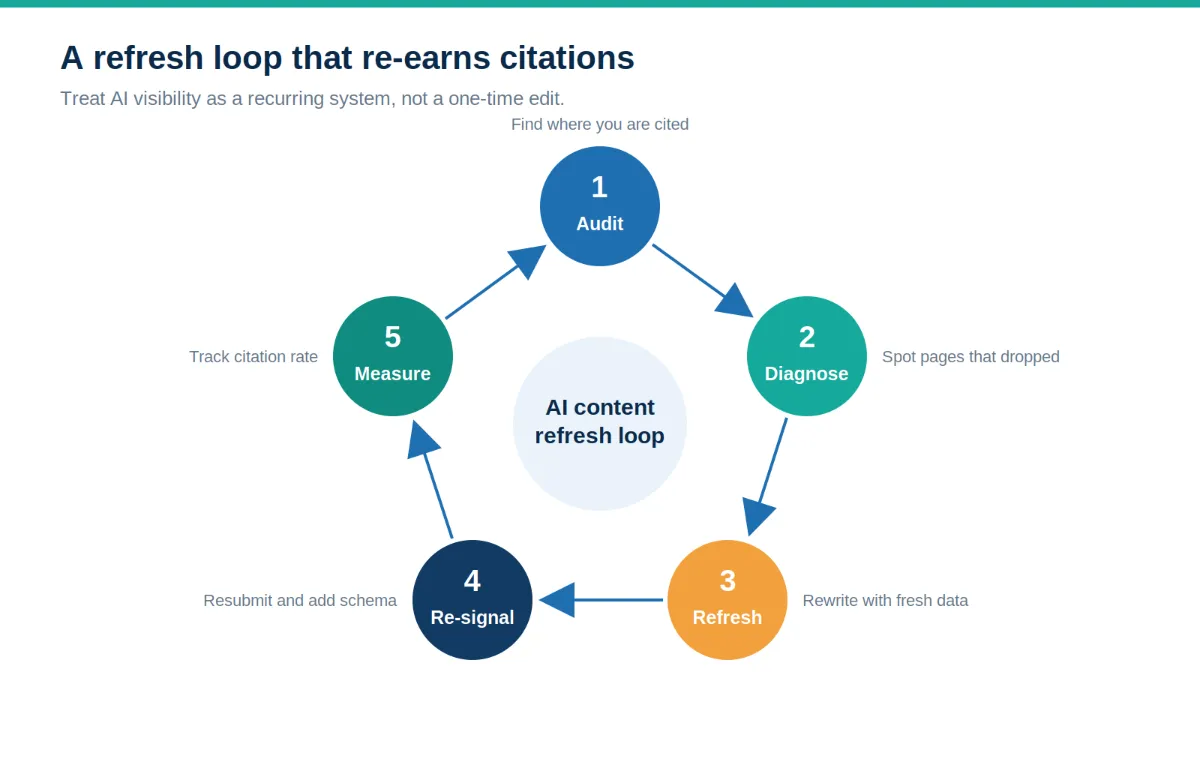
1. Audit. Map where you are cited across AI answers for your priority queries.
2. Diagnose. Find pages that lost citations while rankings held. Those are the ones decaying.
3. Refresh substantively. Replace stale statistics with current-year primary data, rewrite each section opener to answer the query in 40 to 60 words, add self-contained FAQ answers, and tighten headings and schema.
4. Re-signal. Update the real modified date, refresh internal links, confirm your schema, and resubmit so crawlers re-read the page.
5. Measure. Track citation rate and share of voice, then start the loop again.
Prioritize by value, not by traffic alone. The pages worth protecting first are the ones tied to revenue and to the questions your buyers actually ask.
How to Measure AI Visibility, Not Just Rankings #
Rankings tell you where you sit on a results page. They do not tell you whether an AI answer cited you. Track three things instead: citation rate (how often you are cited for your target prompts), share of voice (your citations versus competitors on the same prompts), and citation quality (whether the mention includes your brand name and a link). Pair that with your existing analytics to see which AI sessions reach the site and what they do next. Since AI-referred visitors tend to arrive with clear intent, the value sits in what happens after the click, which is where conversion rate optimization earns its keep.
The Takeaway #
AI content decay is not a sign your content went bad. It is a sign the systems deciding what to show changed their minds, and they will keep changing them. The pages that hold their place are the ones kept genuinely current, written to be quoted, structured to be parsed, and backed by consistent signals across the web. Treat AI visibility as something you maintain on a cycle. The teams that build that habit now will be the ones still showing up in answers when the next model update lands.
Frequently Asked Questions #
What is AI content decay?
AI content decay occurs when a page that once appeared in AI-generated answers stops being cited, often suddenly, even though its search rankings have not changed.
Why did my traffic drop when my rankings did not change?
An AI answer is likely intercepting the query and answering it before the click, so you keep the ranking but lose the visit.
How often do AI answers change?
Frequently. Studies show the content of an AI answer changes around 70 percent of the time when the same question is asked again, with nearly half the citations swapped.
Does updating the publish date help with AI citations?
On its own, no. AI systems re-read the actual content, so only a real, substantive update gives them a reason to cite you again.
How often should you refresh content for AI search?
Aim for a quarterly cycle on priority pages. Content updated within three months is roughly three times more likely to be cited.
Why does ranking first no longer guarantee an AI citation?
AI systems select sources differently from ranking algorithms, so in 2026, only a minority of cited pages also rank in the top ten.
Can you recover lost AI citations?
Often yes. Refreshing the content substantively, sharpening the structure, and rebuilding off-site signals can bring a page back into AI search results.
What is citation drift?
Citation drift is the steady turnover in which sources an AI answer cites over time, even for the same query, as models rebalance for freshness and trust.
Is AI content decay the same as traditional content decay?
No. Traditional decay is a gradual loss of rankings and traffic. AI content decay refers to the loss of AI citations, even when rankings remain flat.