AI Search Engine Optimization: Grounding, Citation, and Mention

Tuba
July 3, 2026
Table of Contents
- AI Search Engine Optimization: Grounding, Citation, and Mention in the AI Discovery Funnel
- What AI search engine optimization means
- The AI discovery funnel: three layers of visibility
- What is a grounding in GEO?
- What is a citation in GEO?
- What is a mention in GEO?
- Grounding vs Citation vs Mention: How they differ
- What the 2026 Data Says
- How to Optimize for all three
- How to Measure it
- Frequently Asked Questions
- Conclusion
AI Search Engine Optimization: Grounding, Citation, and Mention in the AI Discovery Funnel #
Search has quietly turned into an answer machine. When someone asks a question, an AI often writes a reply and cites only a few sources. For your brand, three different things can happen inside that answer. The AI can pull your page in to help build the reply, credit your page as a source, or name your brand outright. These are not the same, and treating them as one thing is where most teams go wrong.
This guide breaks the AI answer into a simple funnel with three layers: grounding, citation, and mention. You will see what each one is, where it comes from, what it earns you, and what the latest data says about how they behave. By the end, you will know what to change on your site and how to tell whether it is working.
What AI search engine optimization means #
AI search engine optimization is the practice of shaping your content and broader presence so AI answer tools find it, trust it, and use it correctly. It builds on classic search work, but the target moves. You are no longer only trying to rank a page. You are trying to be retrieved, credited, and named inside an AI answer. Many teams now treat this as its own field, which is why AI SEO services have grown alongside traditional ranking work.
The clearest way to understand it is to stop thinking about one outcome and start thinking about three. An AI answer can use your page without crediting it, credit it without naming your brand, or name your brand without crediting any page at all. Each of those is a different lever, and each needs a different play.
The AI discovery funnel: three layers of visibility #
Picture how an AI builds an answer as a funnel. At the top, it gathers a pool of pages to work from. In the middle, it credits a few of them as sources. At the narrow end sits the prize: your brand named, and sometimes recommended, in the reply. Each layer has its own name.
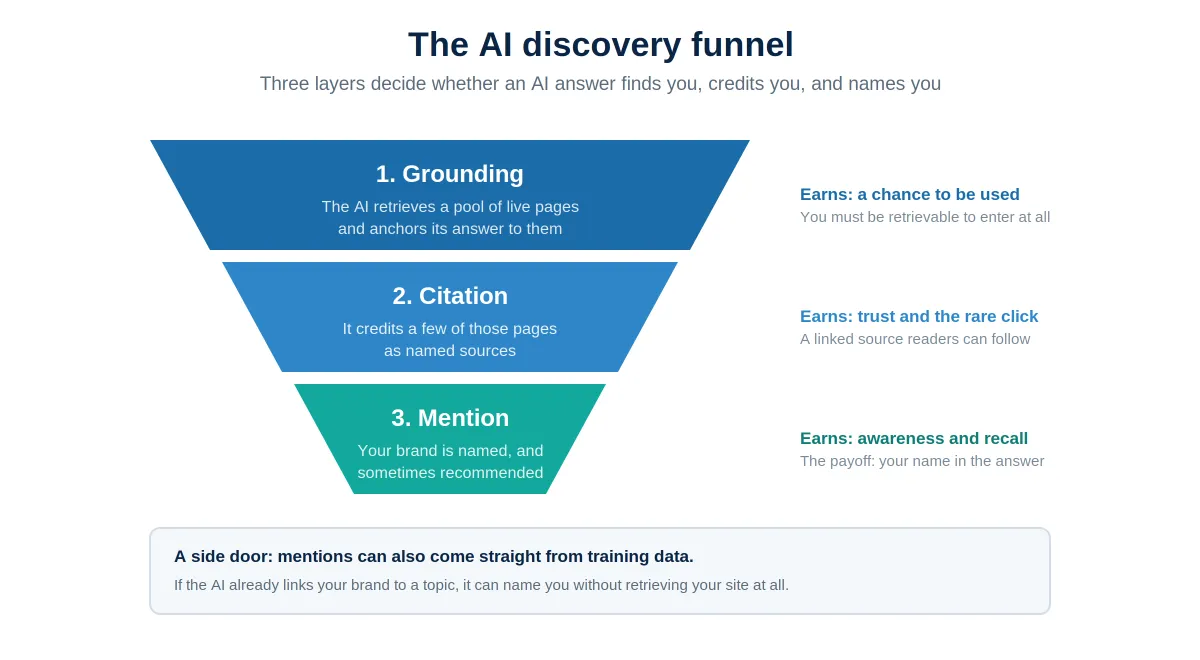
One important catch sits underneath this. A mention does not always travel through the funnel. If the AI already links your brand to a topic from its training, it can name you without retrieving your site at all. So you are really managing two paths at once: the live one, where retrieval decides everything, and the learned one, built from how often and how clearly your brand shows up across the web.
What is a grounding in GEO? #
Grounding is the retrieval step. When an AI needs facts it is not sure about, it runs its own searches, reads the pages that come back, and anchors its answer to them. Microsoft describes the difference plainly: classic search asks which pages a person should visit, while grounding asks what information an AI can safely use to build a response. You can rank well and still not be grounded, and you can be grounded without holding the top spot.
Two things make grounding work the way it does. First, the AI rarely runs one search. It breaks your question into several smaller ones, a habit often called query fan-out, then pulls pages for each. Second, it reads in chunks, lifting small, self-contained passages rather than whole articles. The takeaway for search engine optimization services is simple: if a page cannot be crawled, read, or cleanly chunked, it cannot enter the answer. Grounding is the gate. Everything else depends on getting through it.
What is a citation in GEO? #
A citation is a source the AI credits to back up a specific claim, usually shown as a link or a small numbered reference. Citations come from live retrieval, so they tend to appear when the answer needs fresh or specific facts. They are the closest thing AI answers have to a link, which is why people chase them. They are also rarer and more competitive than mentions, and they shift from one query to the next.
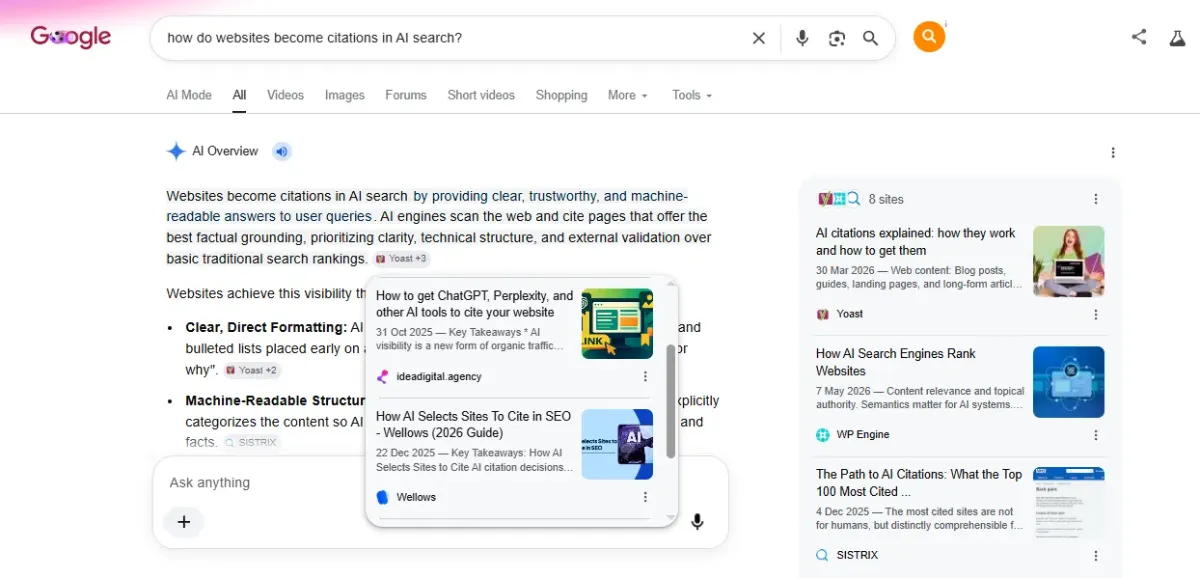
How a page becomes a citation is no mystery. It has to be retrievable, match the question, and contain a passage the model can lift cleanly. Position helps too. Ahrefs found that 38 percent of AI Overviews cite a page from the top 10 search results, so ranking still feeds citation. Fresh, dated content also tends to get picked more often than stale pages.
What is a mention in GEO? #
A mention of your brand name inside the answer, with or without a link. This is the layer most people actually want because it shapes a buyer's shortlist. Unlike a citation, a mention can come straight from training data. If the AI has seen your brand tied to a topic repeatedly across the web, it learns the association and repeats it, even when it does not retrieve your site for that answer.
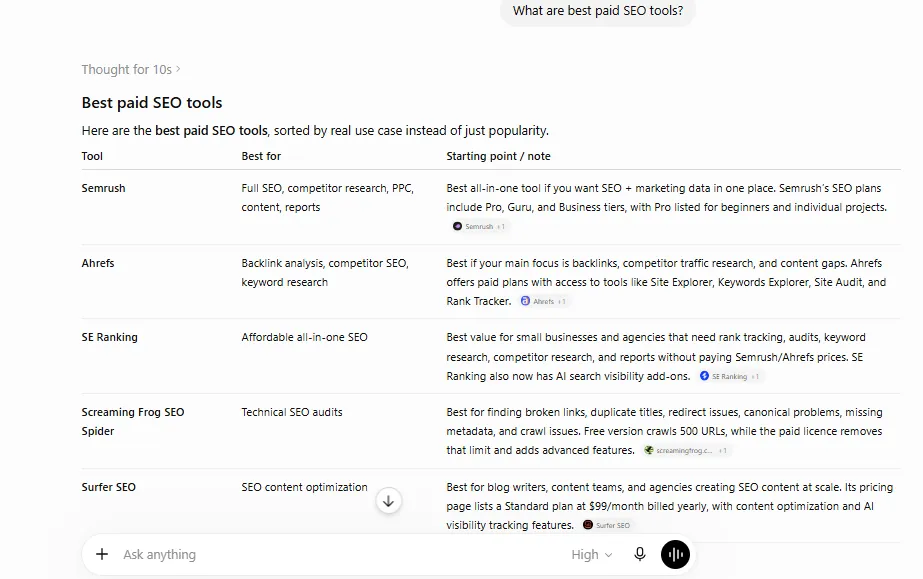
Because mentions are learned from repetition across trusted, independent sources, they are won off your own site as much as on it. Steady, positive references in industry coverage, reviews, and respected publications all feed the association. This is also where online reputation management and AI visibility meet, since the sources that shape your reputation are the same ones the model reads to decide what to say about you.
Grounding vs Citation vs Mention: How they differ #
Side by side, the three layers are easy to tell apart once you see what triggers each one and what it earns.
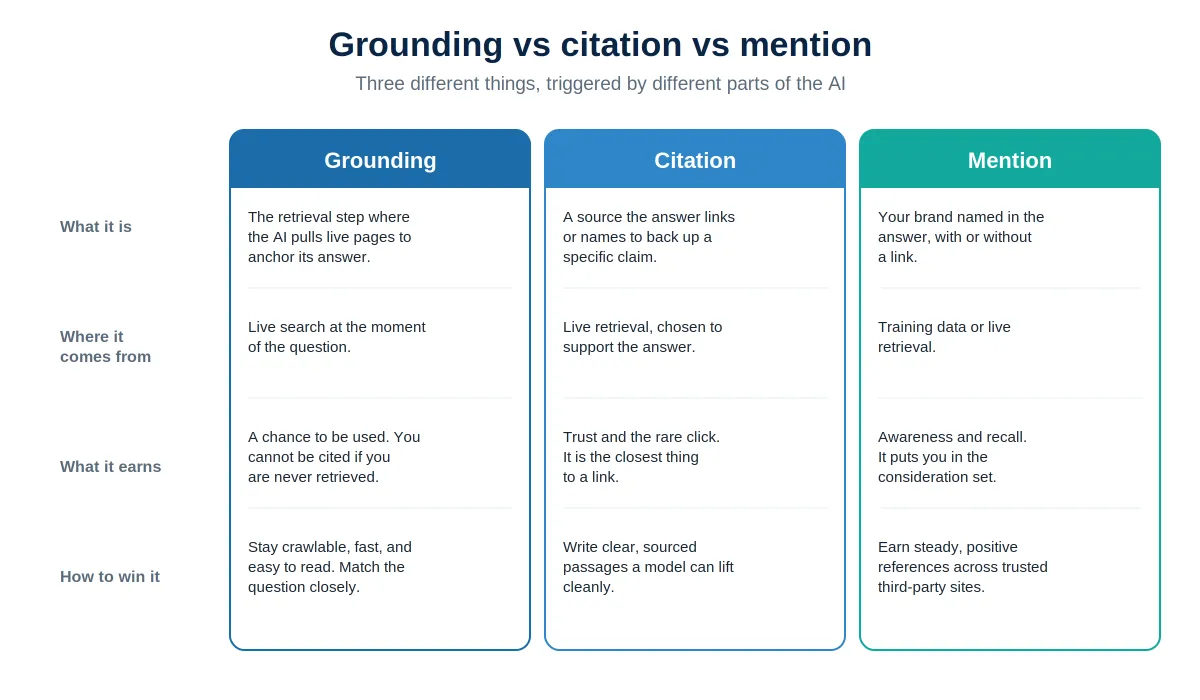
The short version: grounding is the gate, citation is the credit, and mention is the name. Grounding gives you a chance to be used. A citation earns trust and the occasional click. A mention earns awareness and a place on the shortlist. You need all three working together because strength in one does not guarantee strength in the others.
What the 2026 Data Says #
The numbers explain why this matters. Clicks from AI answers are scarce. A Pew Research study found that when an AI summary appeared, only about 1 percent of people clicked a link inside it. So if your whole plan rests on citation clicks, the math is hard.
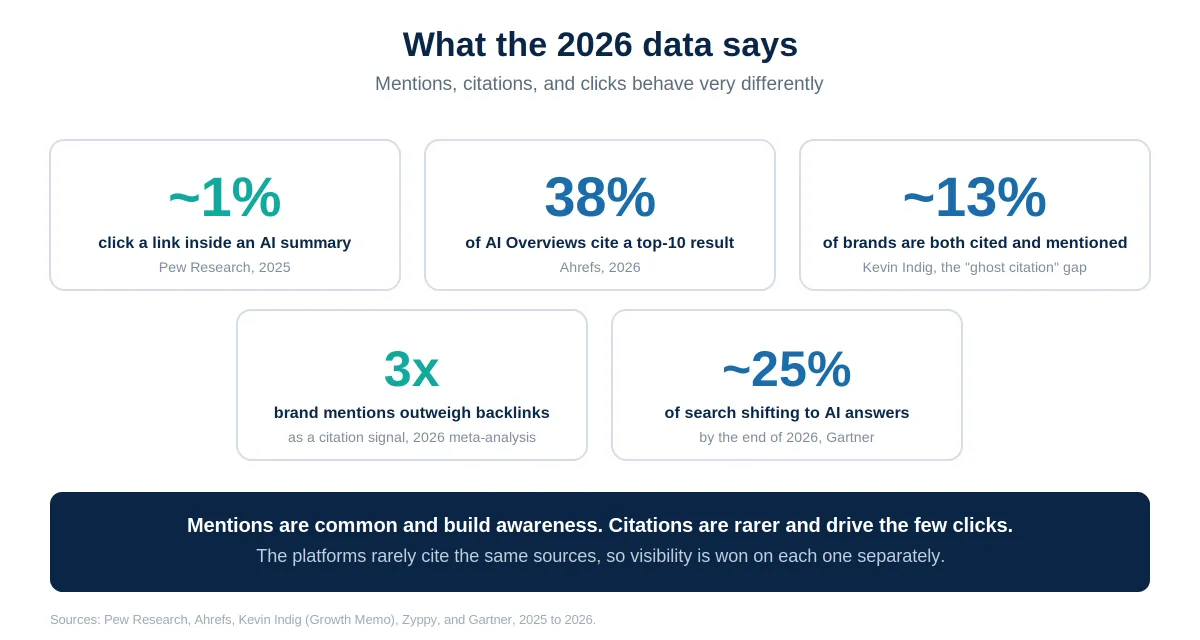
Mentions and citations also do not line up the way you would hope. Analysis by Kevin Indig describes a ghost-citation problem, in which only about 13 percent of brands are both cited and mentioned simultaneously. A brand can be named with no source credited, and a page can be cited with no brand named. On top of that, the platforms rarely agree on sources, so a citation on one tool says little about the next.
There is a clear signal in all of this. A 2026 meta-analysis of citation studies by Zyppy found that brand mentions outweigh backlinks by roughly 3-to-1 as a signal tied to being cited. With analysts expecting about a quarter of search to shift toward AI answers by the end of 2026, the brands building steady mentions now are the ones AI will lean on later.
How to Optimize for all three #
The work splits cleanly along the funnel, and most of it also helps the people who still visit your site.
• Be retrievable first. Keep pages crawlable, fast, and free of blocks. If an AI cannot fetch and read a page, none of the rest happens.
• Write in clean chunks. Lead with the answer, use clear headings, and keep one idea per section so a model can lift a tidy passage. This is what earns citations.
• Lead with specifics and sources. Dated facts, real numbers, and outbound references to credible sources are exactly what AI answers like to quote. Strong content strategy here does double duty for readers and machines.
• Earn mentions on your site. Steady, positive references in industry coverage, reviews, and trusted publications teach the model to tie your brand to its topic. This is the lever for mentions, not on-page tweaks.
• Keep your facts current. Fresh, dated content gets retrieved and cited more often than stale pages, so revisit key pages on a schedule.
• Stay consistent everywhere. Describe your brand consistently across your site and off-site, so the model builds one clear picture of what you do.
How to Measure it #
You cannot manage what you cannot see, and AI visibility is harder to read than rankings. Measure it on a few fronts at once.
• Track mentions and citations separately. Ask the AI tools the questions your customers ask, and note whether you are named, credited, both, or neither. Each tells a different story.
• Watch branded search and direct traffic. When more people meet your brand inside AI answers, a share of them come back later by name. A rise in branded queries is often the first visible sign that it is working.
• Set up an AI referral segment. Tools that pass referral data let you see how much traffic and revenue come from AI sources, and how well they convert.
• Check every platform. Because the tools rarely cite the same sources, test the ones your customers actually use rather than assuming one result carries over.
Frequently Asked Questions #
What is AI search engine optimization?
It is the work of shaping your content and online presence so AI answer tools find it, trust it, and use it correctly. The goal is to be retrieved, credited, and named inside AI answers, not only to rank a page.
What is the difference between a citation and a mention in AI search?
A citation is a source the AI credits to support a claim, usually with a link. A mention is your brand named in the answer, with or without a link. Citations signal trust and drive the rare click, while mentions build awareness.
What is grounding in AI search?
Grounding is the step where an AI retrieves live pages and anchors its answer to them. If your page cannot be crawled, read, and cleanly chunked, it will not be grounded, and it cannot be cited.
Can a brand be mentioned without being cited?
Yes, and it happens often. A brand can be named from training data alone, with no source credited. One 2026 analysis found that only about 13 percent of brands are both cited and mentioned simultaneously.
Do AI citations bring traffic?
Some, but less than many expect. Pew Research found that only about 1 percent of people clicked a link inside an AI summary. Citations matter more for trust and visibility than for raw clicks.
How do I get cited by AI search engines?
Be retrievable, match the question closely, and write clear, sourced passages that a model can lift cleanly. Ranking still helps, since a large share of AI citations go to pages already in the top results.
How do I get mentioned by AI?
Build steady, positive references to your brand across trusted third-party sites, since mentions are learned from repetition. Describe your brand consistently across all channels so the model can clearly tie it to your topic.
Is AI search engine optimization the same as GEO or AEO?
They overlap heavily and are often used interchangeably. Generative engine optimization and answer engine optimization both aim to improve visibility for AI answers, which is central to AI search engine optimization.
How do I track AI mentions and citations?
Test your customer questions in the AI tools and record whether you are named, credited, or both. Then watch branded search, direct traffic, and an AI referral segment in your analytics to see the downstream effect.
Does schema markup help with AI citations?
It helps AI tools read and trust your page, but it is not a shortcut. Clear answers, credible sources, and a crawlable, well-structured page do the heavy lifting.
Conclusion #
AI search is not one thing happening to your brand. It is three. Grounding determines whether you are even in the room, citation determines whether you are credited, and mention determines whether you are named when it counts. Pull them apart, and the work gets clear: earn retrieval with crawlable, well-built pages, earn citations with sharp, sourced passages, and earn mentions with a steady presence across the web that the model can learn from.
The data points are consistently in the same direction. Clicks are scarce, mentions outweigh links, and no single platform speaks for the rest. The brands treating AI visibility as a layered system, rather than a single trick, are the ones that will show up when their customers ask.