AI SEO Guide: How to Grow AI Citations and Visibility

Tuba
June 29, 2026
Table of Contents
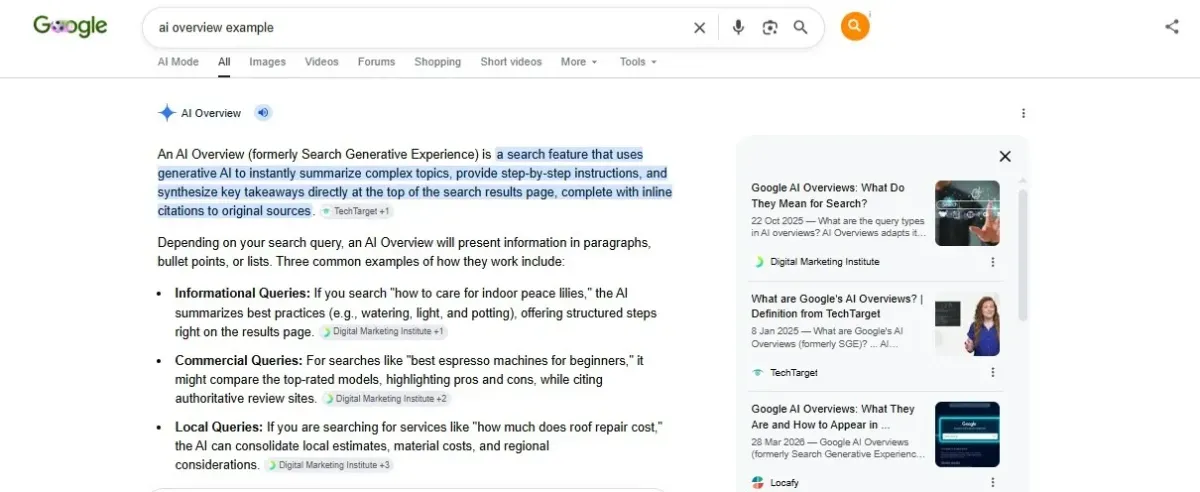
Ranking number one on Google used to be the goal. In 2026, it is only half the picture. A large share of searches now end with an AI answer at the top of the page, and that is often where people stop reading. Google AI Overviews now appear in roughly 48 percent of all search queries as of early 2026, a 58 percent year-over-year jump. If your brand is not part of that answer, a good ranking lower down matters far less than it did a year ago.
This guide walks you through what AI SEO is, how AI tools choose what to cite, and a practical framework to get your brand mentioned. Everything here is built on up-to-date data, and we cite the sources so you can verify them yourself.
What Is AI SEO and Why It Matters Now #
AI SEO is optimizing your content so it appears as a citation or a mention in AI-generated answers, not just as a blue link. Traditional SEO is about ranking in the top ten organic results. AI SEO is about being the source that the AI used to write its answer.
The shift is real and measurable. Organic click-through rates dropped sharply on queries where an AI Overview appears, falling from about 1.76 percent to 0.61 percent in one widely cited study, though early 2026 data shows some recovery. At the same time, the upside of being named is clear. Brands cited in AI Overviews earn roughly 120 percent more organic clicks per impression than brands not cited in the same queries.
People are also using these tools to make decisions. In one analysis, 42 percent of B2B decision-makers said they use an AI tool in the first step of the buying process. When a buyer asks an AI which provider to trust, the answer instantly builds a shortlist. You want to be on it.
How AI Tools Choose What to Cite #
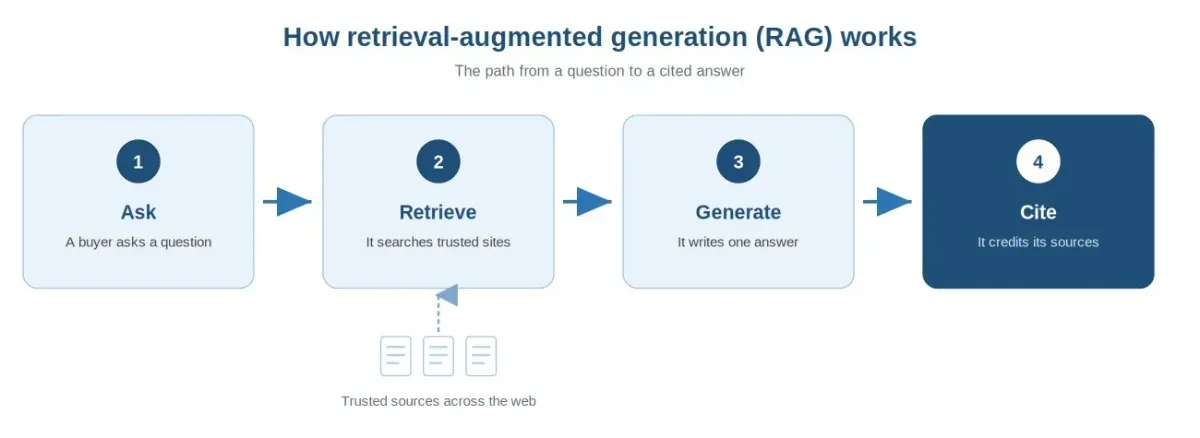
AI tools do not stack websites in a list. Many of them use a method called retrieval-augmented generation, or RAG. When you ask a question, the system searches the web for the most relevant information, groups it into a single answer, and credits the sources that best support it.
There is a catch worth knowing. Citations are often added after the fact. The model tends to generate its answer first, pulling brand names from what it already learned during training, and then it retrieves sources to back up those choices. This is why building your brand into the model's memory through outside mentions matters as much as polishing a single page.
A few signals consistently raise your odds of being cited:
Clear, direct answers are placed near the top of a section.
Structured formatting with headings, short paragraphs, lists, and tables.
Freshness. Pages updated within 60 days are about 1.9 times more likely to appear in AI answers.
Authority signals, including author bios and structured data. Websites with author schema are three times more likely to appear in an AI answer.
Brand mentions across the web, which we cover next.
The Insight Most Guides Miss: Earned Media Drives Citations #
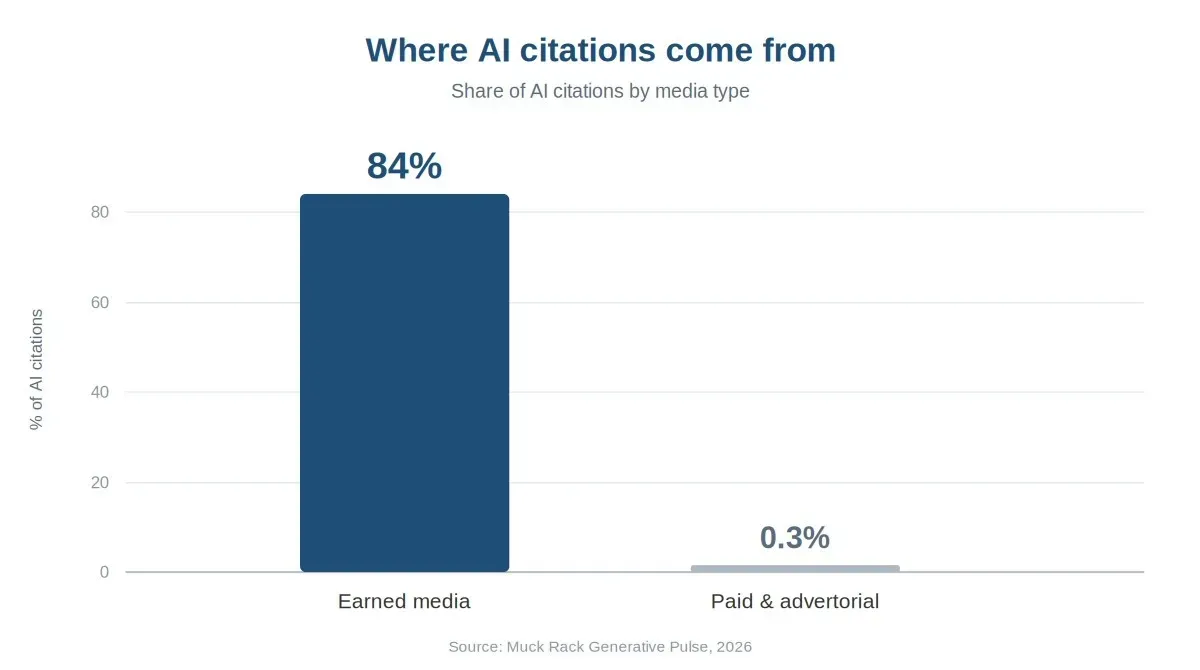
Here is the finding that should change how you spend your time. Most AI citations do not come from your own website. They come from earned media, meaning coverage on trusted third-party sites.
A May 2026 analysis of more than 25 million links from ChatGPT, Claude, and Gemini found that earned media accounts for 84 percent of all AI citations, while paid and advertorial content accounts for just 0.3 percent. That pattern has held steady, with earned media ranging from 82 to 89 percent across studies dating back to mid-2025.
The effect of distribution is large. Distributing your content to a range of publications can increase AI citations by up to 325 percent compared to publishing it only on your own site. Mentions also matter more than links in this world. Ahrefs research found that brand mentions correlate with AI visibility at roughly a 3-to-1 ratio relative to backlinks, which flips the traditional SEO model.
There is even a threshold. A brand mentioned positively across at least four non-affiliated sources is about 2.8 times more likely to appear in ChatGPT responses. Fewer than four, and the model tends to treat your brand as insufficiently validated to cite.
The takeaway is simple. Your own pages still matter, but the bigger lever is being discussed on sites that the AI already trusts.
Latest AI Search Statistics (2026) #
These are the numbers you should know before you plan your strategy.
Statistic | Source | Year | Why It Matters |
AI Overviews appear on ~48% of Google queries, up 58% YoY | 2026 | AI answers are now a default surface, not an edge case | |
Earned media accounts for 84% of AI citations; paid is 0.3% | 2026 | Third-party coverage is the main path to being cited | |
44.2% of LLM citations come from the first 30% of a page's text | 2026 | Front-loading your answer is essential | |
61.7% of AI citations are ghost citations with no brand name shown | 2026 | Counting citations alone misleads. Track brand mentions too | |
Pages updated within 60 days are 1.9x more likely to be cited | 2026 | Freshness is a direct ranking input for AI |
All figures above are dated and sourced. Where studies disagree on a number, that usually reflects different methodologies and keyword sets, so treat these as direction and scale rather than exact gospel.
An 8-Step Framework to Grow AI Citations #
This is the practical part. Work through these steps in order.
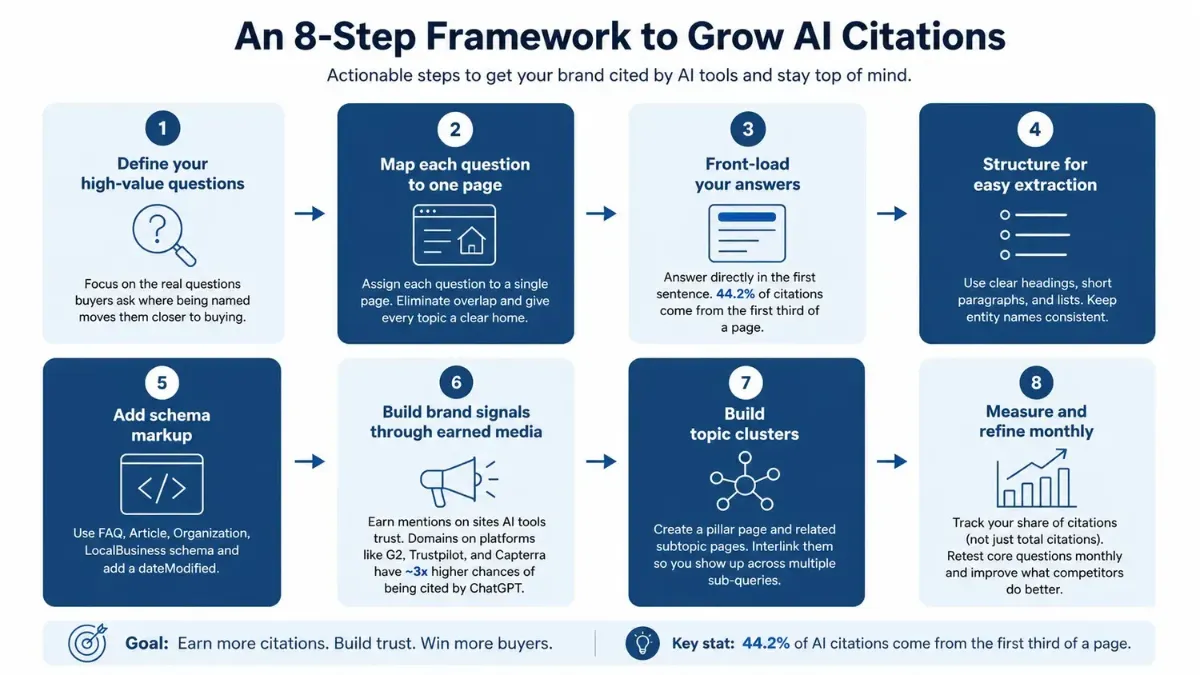
1. Define your high-value questions
Start with the questions real buyers actually ask in calls, chats, and searches. Narrow it to the ones where being named would move someone closer to buying. A question like best service for small businesses is worth far more than a generic definition query.
2. Map each question to one page
Turn each question into a clear written question, then assign it to a single product, service, or resource page. Clean up overlaps so every important topic has one clear home on your site, with a named author or brand attached.
3. Front-load your answers
Open every section with the direct answer in the first sentence, using the same wording as your heading. Keep definitions to two sentences, then add context below. This is not a style choice. With 44.2 percent of citations coming from the first third of a page, the top of your content does the heavy lifting.
4. Structure for easy extraction
Use descriptive headings, short paragraphs, and lists. Make each section understandable on its own, since AI tools read content in segments rather than full pages. Keep entity names consistent. If you call something a Google Business Profile once, do not switch to GBP later.
5. Add schema markup
A schema is code that tells search engines what your content means. Use FAQ, Article, Organization, and LocalBusiness schema where they fit, plus a last updated date using dateModified. Structured data is one of the strongest technical signals for AI visibility.
6. Build brand signals through earned media
This is the highest-leverage step. Earn mentions and coverage on sites AI tools actually pull from, such as industry publications, reputable news outlets, Reddit, and review platforms like G2 or Trustpilot. Domains with profiles on platforms like Trustpilot, G2, and Capterra have about three times higher chances of being chosen by ChatGPT as a source. Publish original research and contribute expert commentary to journalists so others have a reason to cite you.
7. Build topic clusters
Cover a topic in depth rather than writing a single isolated article. Create a main pillar page and supporting pages on related subtopics, then interlink them. When AI breaks a question into sub-queries, pages that appear across several of them are treated as broadly authoritative.
8. Measure and refine monthly
Track two things, not one. Citations alone are misleading because most are ghost citations, where your link is used but your name is not shown. Measure your share of citations, meaning the percentage of AI answers that mention your brand across a set of buyer questions. Retest your core questions monthly. If a competitor replaces you, study what they added, often a clearer table or a fresh statistic, and respond.
Traditional SEO vs AI SEO at a Glance #
Traditional SEO | AI SEO |
Rank higher on the results page | Become a trusted source AI cites |
Focus on keywords | Focus on relevance, clarity, and trust |
Backlinks are the main signal | Brand mentions outweigh backlinks roughly 3 to 1 |
Clicks are the main metric | Citations and brand mentions matter too |
Optimize single pages | Build topic clusters and earn coverage |
Neither replaces the other. The businesses that combine strong traditional SEO with AI visibility will capture the most attention in 2026 and beyond.
A Real Example of What Works #
A founder of an SEO firm reported a clear result from applying these methods. Over 90 days, the brand saw close to a 40 percent increase in citations in AI-generated outputs, with the strongest gains in how-to and comparison queries. The work took about six to eight weeks and involved adding roughly 120 pages and revising around 15 pages, with a focus on direct answers and first-hand data. The lesson is that consistent, structured, original content compounds.
Frequently Asked Questions #
What is an AI citation in SEO?
An AI citation occurs when an AI tool such as ChatGPT, Gemini, or Perplexity cites your page as a source in response to a question. It can show as a linked source, a named mention, or both.
How do I get my site cited by AI?
Write clear, front-loaded answers, structure pages for easy extraction, keep content fresh, add schema, and build brand mentions on trusted third-party sites. Earned media is the strongest single lever.
Does traditional SEO still matter?
Yes. Traditional SEO and AI SEO work together. Strong technical health and rankings still help, and AI tools often pull from pages that already perform in search.
How will I know if this is working?
Track your share of citations, meaning how often AI answers mention your brand across a set of buyer questions, and retest monthly. Watch brand mentions, not just source links, because most citations do not show the brand name.
Do I need to rewrite my whole site?
No. Start with your most important pages and the questions that matter most for revenue. Apply the patterns there first, then expand once you see results.
What is the difference between AI SEO, GEO, and AEO?
These terms overlap a lot. AI SEO is the broad practice of getting your brand surfaced in AI search. Generative engine optimization, or GEO, focuses on being cited or mentioned inside AI-generated answers from tools like ChatGPT, Gemini, and Perplexity. Answer engine optimization, or AEO, focuses on structuring content so it gets pulled as a direct answer. In practice, they share most of the same work: clear answers, strong structure, and trusted brand signals.
Which AI platforms should I optimize for first?
Start with the ones your buyers actually use. For most businesses, that means ChatGPT, Google AI Overviews, AI Mode, and Perplexity. The good news is that the work overlaps. A page that is clear, well-structured, and well-cited tends to perform well across all of them, so you rarely need a separate plan for each tool.
How long does AI SEO take to work?
Plan for two to three months before you see steady movement, with earlier wins on specific questions. The example earlier in this guide saw close to a 40 percent lift in citations over 90 days. Earned media and brand mentions take time to build, and AI tools refresh their sources on their own schedule, so treat this as an ongoing effort rather than a one-time fix.
Do backlinks still matter for AI SEO?
Yes, but they share the stage now. Links still signal authority and help your pages get crawled and ranked. For AI visibility, unlinked brand mentions carry real weight too. Ahrefs research found brand mentions correlate with AI visibility at roughly a 3-to-1 ratio relative to backlinks, so the smart move is to earn both.
Can a small business compete with bigger brands in AI search?
Yes. Big brands often start with more authority, but they do not automatically win. Smaller companies can compete by owning a clear, specific topic, showing up consistently across the sites AI tools trust, and making their content easy to understand and extract. Focus beats size here.
How do Google AI Overviews choose which sources to show?
AI Overviews lean heavily on pages that already perform well in organic search, then favor content that answers the question directly, is well-structured, is fresh, and carries clear authority signals. Strong traditional SEO and clean, structured data both raise your odds of being pulled into the answer.
Why do AI tools give a different answer every time I ask?
AI answers are non-deterministic, so that the same question can produce different results from one query to the next. Studies that track AI search have found a large share of cited sources change from month to month. That is why AI visibility is about frequency, meaning how often you show up across many answers, rather than holding a single fixed position.