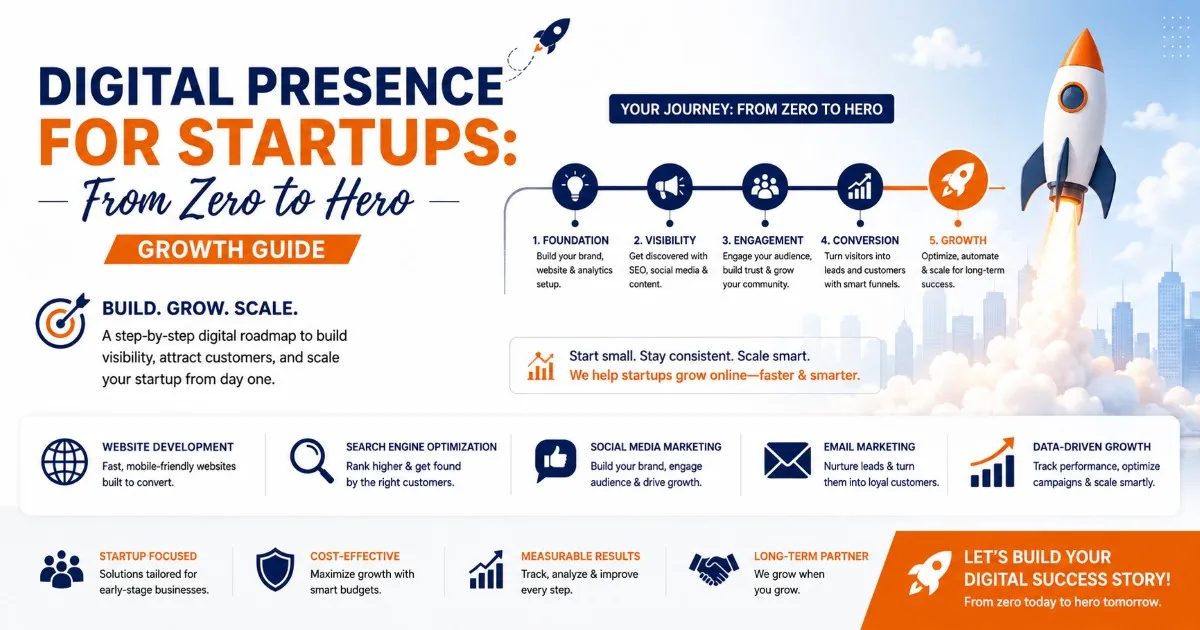
Digital Presence for Startups: Zero to Hero Growth Guide

sadiya
May 8, 2026
Table of Contents
- What is Digital Presence for Startups?
- Digital Presence for Startups vs Random Online Activity
- Top Reasons You Need Digital Presence for Startups
- Root Causes: Why Startups Stay Invisible Online
- How to Get Started
- Solutions and Strategies
- Actionable Framework: Startup Digital Presence Checklist
- The Hidden Impact
- Common Mistakes to Avoid
- Frequently Asked Questions
- Conclusion & Next Steps
A startup can have a strong product, a motivated team, and a clear vision but still struggle to get noticed. That is the painful part. The market may need what you offer, but if people cannot find you, trust you, or understand you quickly, growth becomes harder than it should be.
This is where digital presence for startups becomes more than a website or a few social media posts. It becomes the system that helps your startup look credible, reach the right people, and turn attention into leads, inquiries, sales, or partnerships.
In 2026, this matters even more because website, blog, and SEO remain the top ROI-generating marketing channel according to HubSpot’s 2026 marketing statistics. Paid social media follows closely, which shows that startups need both organic visibility and paid reach working together.
The target audience for this guide includes startup founders, early-stage teams, small business owners, SaaS startups, service-based startups, D2C brands, local startups, and growth teams that need to build online credibility from the ground up.
What is Digital Presence for Startups? #
Digital presence for startups means building a clear, trustworthy, and discoverable online identity through branding, website design, SEO, social media, content, analytics, and digital marketing systems.
It is not just about being online. It is about showing up in the right places with the right message. A startup with strong digital presence has a consistent brand identity, a professional website, search visibility, active social media, clear messaging, and a process for turning visitors into leads.
In the original startup transformation story, the business had a promising product but no digital identity, weak visibility, no SEO foundation, no social engagement, and limited reach. That is a common startup problem: the idea is strong, but the market cannot see it clearly.
Digital Presence for Startups vs Random Online Activity #
Many startups confuse digital presence with activity. They post sometimes, launch a quick website, run a few ads, and hope something works.
A real startup digital marketing strategy is more structured.

Random activity creates noise. A strong digital presence creates recognition.
Top Reasons You Need Digital Presence for Startups #
You may need to build online presence for startup growth if your business is struggling to be seen, trusted, or remembered. Common signs include:
People do not understand what your startup does
Your website looks unfinished or outdated
Your social media profiles are inactive
Your brand visuals are inconsistent
Your startup is not ranking for relevant searches
You rely only on referrals
Your ads get clicks but few leads
Your audience does not engage with your content
Investors, partners, or customers cannot quickly verify your credibility
Your competitors look more established online
Digital visibility is not optional anymore. DataReportal reported that global social media user identities reached 5.79 billion by April 2026, equal to 69.9% of the global population, while noting that user identities may not represent unique individuals.
That means your audience is already spending time online. The question is whether your startup appears credible when they search, scroll, compare, or click.
Root Causes: Why Startups Stay Invisible Online #
Startups often stay invisible because they treat marketing as something to “do later.” At the beginning, teams focus on product, funding, hiring, and operations. That makes sense, but the result is often a weak public presence when customers start researching the brand.
The most common root causes include:
No clear brand positioning
No defined customer persona
No SEO plan
No conversion-focused website
No social media system
No content calendar
No paid acquisition structure
No analytics setup
No consistent message across platforms
Google’s Core Web Vitals measure real-world user experience across loading performance, interactivity, and visual stability, and Google recommends good Core Web Vitals for Search success and user experience.
That matters because a startup website is not only judged by design. It is judged by speed, clarity, mobile usability, content, and trust.
Warning: A startup can waste months creating content and running ads if the brand message, website, tracking, and offer are not clear first.
How to Get Started #
Before investing in design, SEO, or ads, diagnose where your startup currently stands.
Review your brand clarity
Write down what your startup does, who it helps, what problem it solves, and why someone should choose it.Audit your website
Check whether your homepage explains your offer clearly, loads fast, works on mobile, and has a visible call to action.Check your search visibility
Search your brand name, service keywords, product category, and competitor terms to see where you appear.Review your social media profiles
Look at consistency across logo, bio, links, visuals, posting frequency, and messaging.Map your customer journey
Identify how someone discovers you, evaluates you, contacts you, and becomes a customer.Check analytics and tracking
Confirm whether GA4, Search Console, pixels, conversion events, and form tracking are properly installed.Identify quick wins
Prioritize fixes that directly affect trust and conversions: homepage clarity, service pages, lead forms, social proof, and basic SEO.
Solutions and Strategies #
Foundational Strategy #
The first step is to build the base. A startup needs:
Clear brand positioning
Consistent logo, colors, fonts, and tone
Professional website
SEO-friendly page structure
Mobile-first design
Strong calls to action
Basic analytics
Social media profile setup
Customer-focused copy
This gives people confidence when they search your startup online. It also gives your marketing campaigns somewhere strong to send traffic.
Tools Strategy #
The right tools make execution easier, but tools should not replace strategy. Useful tools include:
Website: WordPress, Webflow, Shopify, Framer, custom development
SEO: Google Search Console, Ahrefs, Semrush, Screaming Frog
Analytics: GA4, Microsoft Clarity, Looker Studio
Design: Figma, Canva, Adobe tools
Social planning: Buffer, Later, Hootsuite, Notion
CRM: HubSpot, Zoho, Pipedrive
Paid ads: Google Ads, Meta Ads, LinkedIn Ads
Automation: Zapier, Make, native CRM workflows
Google Search Console’s Core Web Vitals report helps site owners identify poor user experiences using real-world usage data.
For startups, this is useful because performance problems often hide behind attractive design.
Professional Strategy #
A professional startup digital presence project should not begin with “let’s make a logo.”
It should begin with positioning, audience research, competitor review, brand identity, website strategy, SEO setup, content planning, social media direction, analytics, and performance marketing. A practical transformation usually includes:
Brand identity creation
SEO structure
Social media setup
Content calendar
Paid marketing strategy
Landing page optimization
Lead tracking
Monthly reporting
That is how a startup moves from invisible to credible.
Actionable Framework: Startup Digital Presence Checklist #
Use this checklist before launching or rebuilding your startup’s online presence.

The Hidden Impact #
A weak digital presence does not only reduce traffic. It changes how people judge your startup. Potential customers may assume the company is too new, too risky, or not serious enough. Investors may struggle to understand the opportunity. Partners may hesitate because the brand looks underdeveloped.
There is also an internal impact. When a startup lacks clear messaging, every sales call, pitch deck, ad, post, and landing page becomes harder to create. A strong digital presence creates alignment. The team knows what the brand stands for, who it serves, and how to explain the value clearly.
Common Mistakes to Avoid #
Avoid these common mistakes when building digital presence for startups:
Starting ads before fixing the website
Using inconsistent branding
Copying competitors without positioning
Posting on every platform without strategy
Ignoring SEO in the early stage
Writing copy that talks only about the company
Skipping analytics setup
Measuring only likes and impressions
Using generic stock visuals
Having no clear CTA
Not building landing pages for campaigns
Stopping content after a few weeks
The biggest mistake is treating digital presence as decoration. It should support trust, visibility, and revenue.
Frequently Asked Questions #
What is digital presence for startups? #
Digital presence for startups is the online identity that helps a startup get discovered, trusted, and contacted. It includes branding, website, SEO, social media, content, analytics, and paid marketing.
Why is digital presence important for startups? #
Digital presence helps startups build credibility before customers speak to the team. It also supports visibility, lead generation, investor confidence, and long-term brand trust.
How do you build online presence for startup growth? #
Start with brand positioning, then create a professional website, SEO-friendly content, active social media profiles, analytics, and a simple lead capture system. Once the foundation is ready, add paid campaigns and retargeting.
What should a startup digital marketing strategy include? #
A startup digital marketing strategy should include audience research, brand positioning, website development, SEO, content marketing, social media, paid ads, lead tracking, and regular reporting. The goal is to connect visibility with measurable growth.
How long does it take to build a strong digital presence? #
A basic foundation can often be built in 8 to 12 weeks, depending on branding, website scope, content, and marketing setup. Real traffic, leads, and recognition usually improve over time with consistent execution.
Should startups invest in SEO or paid ads first? #
Startups should usually build the website and tracking foundation first. After that, SEO supports long-term visibility while paid ads help test offers, audiences, and landing pages faster.
How can Vynce Digital help startups grow online? #
Vynce Digital can help startups with branding, website development, SEO, social media, content strategy, paid marketing, and analytics. The focus is to build a digital presence that looks credible and supports measurable growth.
Conclusion & Next Steps #
A startup does not become visible by accident.
It needs a clear digital foundation that helps people discover, understand, trust, and contact the business.
Key takeaways:
Digital presence for startups includes branding, website, SEO, social media, content, analytics, and paid marketing.
A strong startup digital marketing strategy connects visibility with measurable growth.
To build online presence for startup success, start with clarity before spending on ads.
Your website should explain your value, load fast, work on mobile, and capture leads.
Social media and content help people see the human side of your startup.
Paid marketing works better when the brand, offer, landing page, and tracking are ready.
Start by auditing your current brand, website, search visibility, social profiles, and lead capture process. Then fix the gaps that directly affect trust and conversion.
For startups ready to move from invisible to visible, Vynce Digital can help build a complete digital presence through branding, website development, SEO, social media, and performance marketing.
Your startup does not need to be everywhere online. It needs to show up clearly, consistently, and confidently where your customers are already looking.