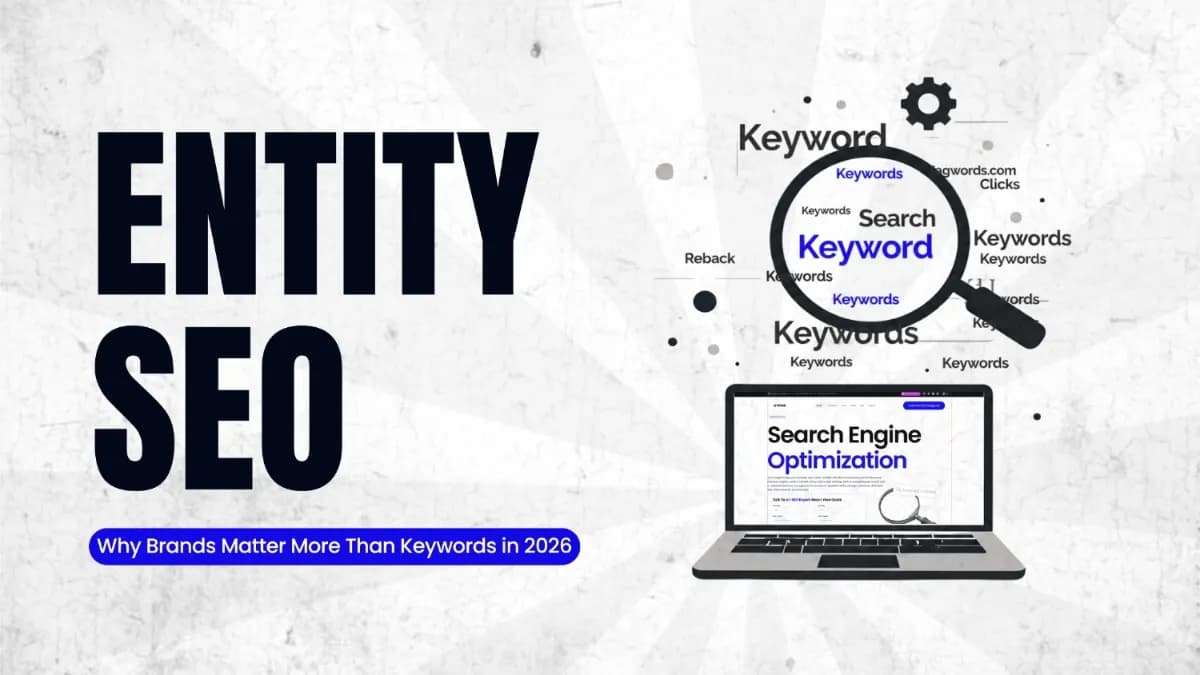
Entity SEO: Why Brands Matter More Than Keywords in 2026

Tuba
July 10, 2026
Table of Contents
For years, SEO meant picking keywords and repeating them. You found a phrase people searched for, wrote a page around it, and tried to rank for it. That playbook still has its place. But it is no longer where the real gains are.
Search engines have shifted from matching words to understanding things. Google does not just read the letters in a query. It tries to work out the person, place, product, or company behind it. These real-world subjects are called Entities. The work of helping Google understand your brand as a clear, trusted entity is called entity SEO.
The reason this matters in 2026 is simple. Brand signals now predict visibility better than keyword tricks, both in normal search and in AI answers. People search for brands by name more than you might think. And AI tools decide who to mention based on how often and how clearly your brand shows up across the web. This guide explains what entity SEO is, why brands now beat keywords, and the practical steps to build your brand so search engines recognize and trust it.
What Entity SEO Actually Means #
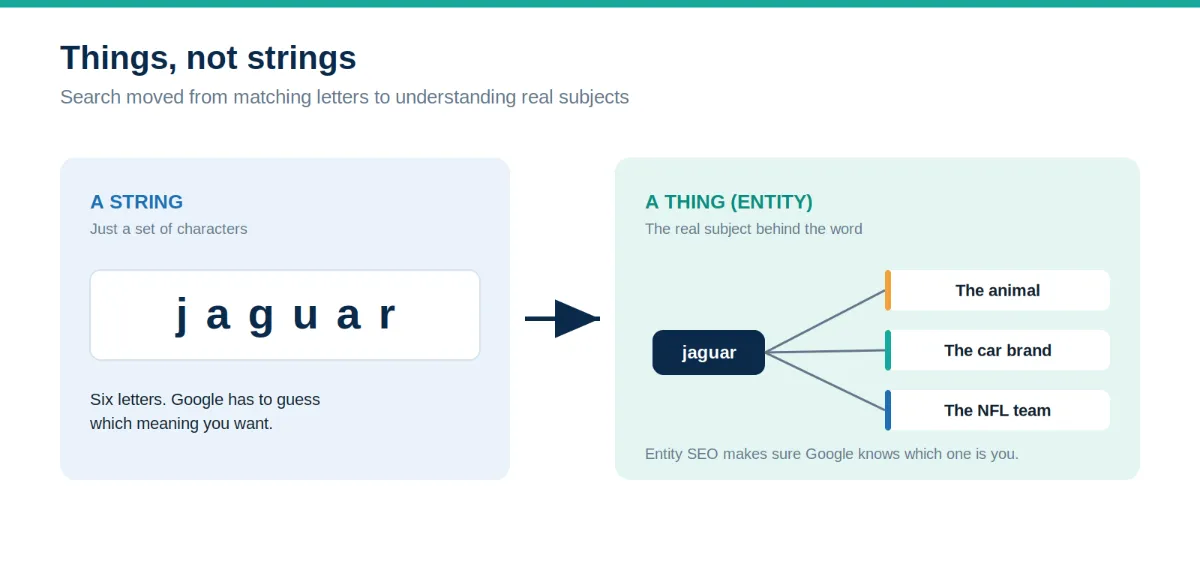
Start with the idea Google has repeated since 2012: things, not strings. A string is a sequence of characters, such as the letters in “jaguar.” A thing is the actual subject those letters point to. Jaguar the animal. Jaguar the car brand. Jaguar the football team. Same string, three very different things. Entity SEO is the practice of ensuring Google knows what you are and trusts what it knows about you.
Google stores what it knows about the world in a giant database called the Knowledge Graph. Google describes it as a database of billions of facts about people, places, and things. When Google launched it in May 2012, it held about 500 million objects. By May 2020, Google reported 500 billion facts about 5 billion entities. By May 2024, industry estimates put it at roughly 1.6 trillion facts about 54 billion entities. That is far bigger than all the articles on Wikipedia combined.
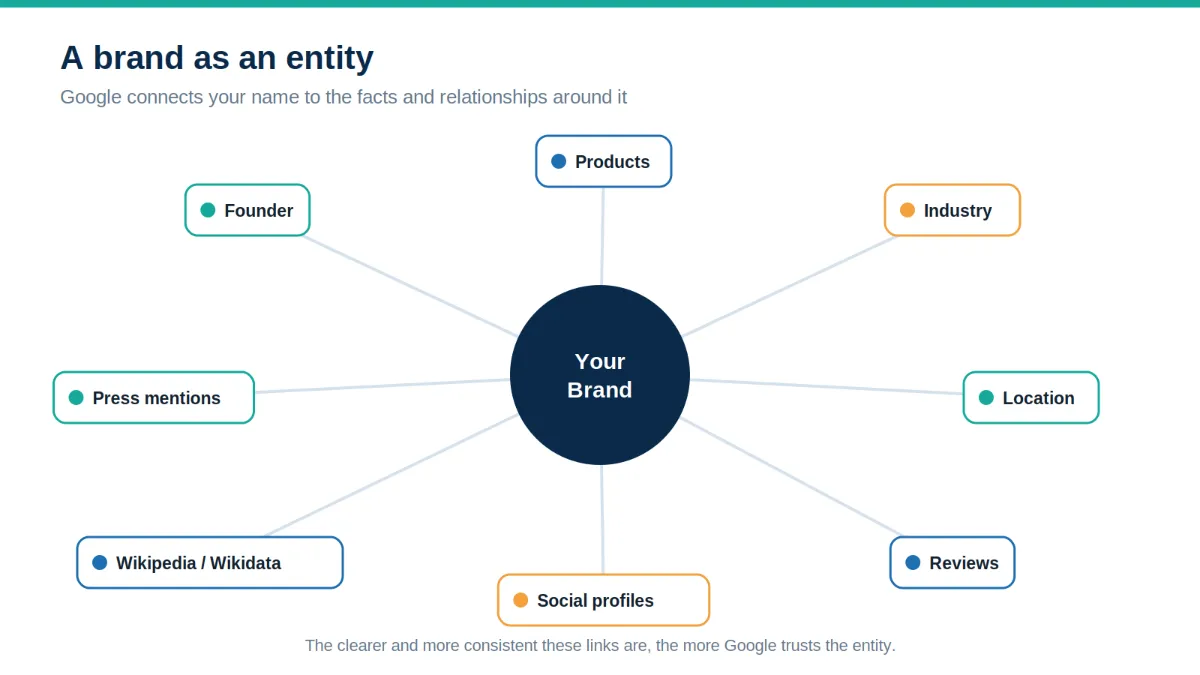
Every brand, founder, product, and location can be an entity in this graph. When Google associates your brand name with a clear entity, it can show a knowledge panel, surface you in search results, and treat your entire site with greater trust. When it cannot, you are just a string of words competing with everyone else who used the same words. Good search engine optimization strategy now starts with being understood, not just being found.
Why Brands Now Beat Keywords #
Here is the part most keyword guides skip. A huge share of search is people looking for brands by name. An Ahrefs study published in May 2025 found that 36.9% of search queries are branded, and, when weighted by search volume, branded searches account for 45.7% of all Google searches. Close to half of everything typed into Google is a brand name, a product name, or a trademarked term.
That matters because branded search is a strong signal of trust. When lots of people search for your name, click your result, and stay, Google learns that you are a known, wanted entity. Court documents from the 2023 to 2024 US antitrust trial confirmed that Google uses a system, often called Navboost, that re-ranks results based on how people actually click and behave. Real demand for your brand feeds that loop.
Google is also starting to treat brands as entities in its own tools. In November 2025, Google added a branded queries filter to Search Console. The notes explain that an AI-assisted system decides what counts as branded. It does not just match your brand name as text. It recognizes the brand entity and the products associated with it, so a search for “Gmail” can be interpreted as a Google brand query. That is entity thinking built straight into Google’s own reporting.
The takeaway is direct. You can chase a hundred keywords and still lose to a brand people already trust. Or you can build the kind of demand that makes those keywords easier to win.
Entity SEO in AI Search #
The brand-over-keyword shift is even sharper in AI search. Tools like ChatGPT, Google AI Overviews, and Perplexity do not rank ten blue links. They read the web, learn which brands are real and trusted, and name a few in their answers. If they do not see your brand, you do not exist in that answer.
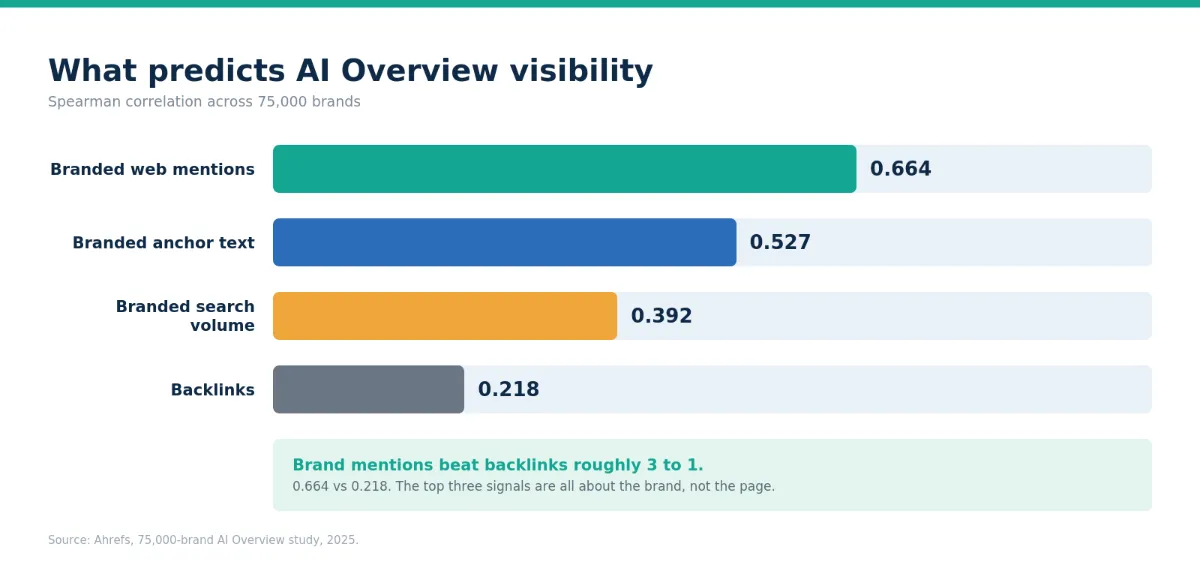
The data here is striking. In August 2025, Ahrefs studied 75,000 brands to see what predicted appearing in Google AI Overviews. Branded web mentions had the strongest correlation, at 0.664. Plain backlinks came in at just 0.218. That is roughly three times stronger for mentions than for links. Branded anchor text scored 0.527 and branded search volume scored 0.392. The top three signals were all about the brand, not the page.
A follow-up Ahrefs study in December 2025 extended this to ChatGPT and Google’s AI Mode, reaching the same conclusion. Off-site brand signals led the way, with YouTube mentions and branded web mentions at the top. Separate research by Kevin Indig found that brand search volume was the strongest predictor of ChatGPT visibility, with a correlation of about 0.334.
There is a clean way to read all of this. A backlink tells an AI system where to go. A brand mention tells it what to trust. AI answers reward trust. This is why optimizing for AI search and generative engine optimization now leans far more on brand presence than on link counts.
Rankings alone will not save you either. In a separate analysis of 863,000 keywords, Ahrefs found that only 38% of AI Overview citations now come from pages ranking in Google’s top ten, down from 76% in mid-2025. Being on page one is no longer enough to be quoted.
How Google Connects Your Brand to an Entity #
So how does Google decide you are a real entity worth trusting? It looks for the same brand, described the same way, in many trusted places.
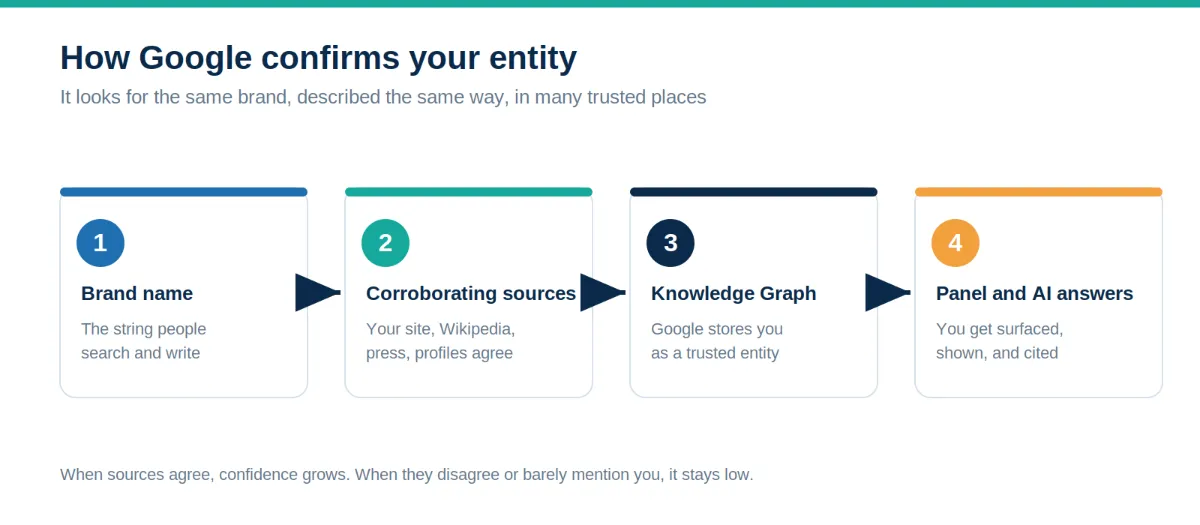
It starts with your own site. A clear “about” page, Organization markup in your structured data, and consistent name and details all help. A clean, well-organized website with correct markup makes this far easier for Google to follow. Then it looks outward. Does Wikipedia, Wikidata, Crunchbase, LinkedIn, or your industry press mention you with the same facts? Do those facts agree? When the picture is consistent, Google grows confident. When sources disagree or barely mention you, confidence stays low.
A practical tool here is the sameAs property in schema. It lets you tell Google that your website, LinkedIn page, Wikidata entry, and social profiles all describe the same brand. The visible payoff is the knowledge panel, the box that appears when you search a known brand. A panel is a sign that Google has accepted you as an entity, and you can claim it to help keep it correct. But the panel is the result, not the goal. The goal is a brand that is clearly described and consistent everywhere Google looks. Keeping that picture clean is part of managing how your brand shows up across the web.
How to Build Your Brand Entity #
Entity SEO sounds technical, but most of the work is brand building done in a way machines can read. Here is the practical path.
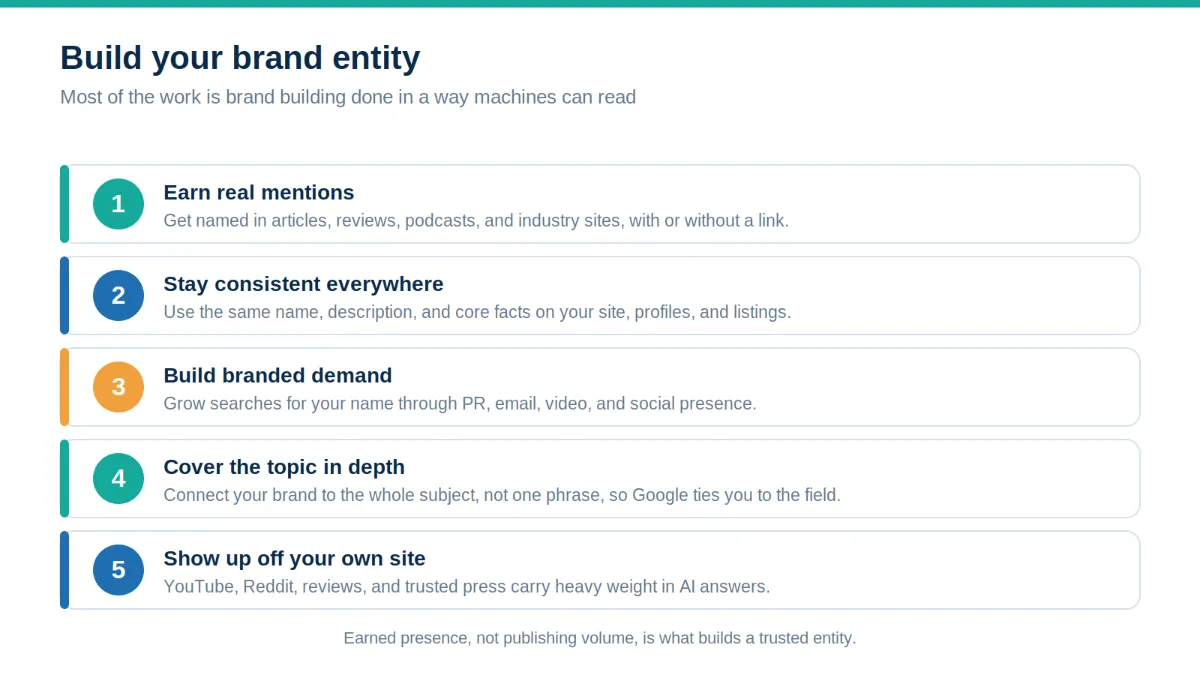
Earn real mentions
Get your brand named in articles, reviews, podcasts, and industry sites, with or without a link. According to Ahrefs data, brands in the top quarter for web mentions earned over 10 times as many AI Overview mentions as the next-highest group. Mentions, not just links, move the needle.
Be consistent everywhere
Use the same brand name, description, and core facts on your site, your profiles, and every listing. Mixed details confuse Google and weaken your entity. Clear, well-structured content that states who you are and what you do gives Google clean facts to learn from.
Build branded demand
The more people search for you by name, the stronger your signal. You grow this with PR, email, video, and an active presence on social platforms, not with keyword tricks. Awareness today becomes branded search tomorrow.
Cover your topic in depth
Entities are built on relationships, so connect your brand to the subjects you want to own. Write about the whole topic, not one phrase, so Google ties your name to that field.
Show up off your own site
YouTube, Reddit, review sites, and trusted publications carry heavy weight in AI answers. Being talked about in those places teaches both Google and AI tools what you do and who you serve.
Keywords Are Not Dead #
None of this means keywords no longer matter. People still type phrases, and your pages still need to answer them clearly. Keywords tell search engines what a page is about. Entities tell them who is behind it and whether to trust that source.
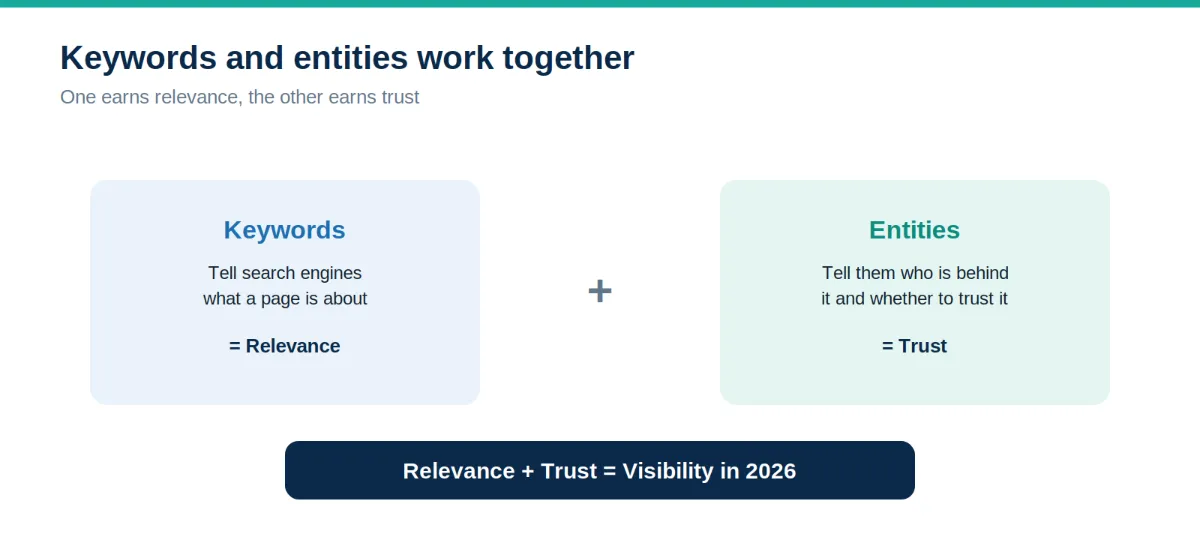
The winning approach in 2026 uses both. You write helpful pages that cover real topics, and you build a brand that search engines and AI tools recognize as a trusted entity. The page earns relevance. The brand earns trust. Pages without a trusted brand behind them struggle to rank and rarely get cited in AI answers. Brands with weak pages miss the relevance side. You need the pair. Stop thinking in single keywords and start thinking in topics and entities.
Conclusion #
The shift is straightforward. Search has moved from matching words to understanding things, and AI answers have pushed that change even further. Brand signals now predict visibility better than keyword tactics or raw backlinks, in both Google and AI tools.
Entity SEO is how you respond. Help search engines understand your brand as a clear, trusted entity. Earn genuine mentions, stay consistent across channels, build real demand for your name, and cover your topic in depth. Keep writing useful pages, but build the brand behind them too. The brands that invest in being understood, not just found, are the ones that will keep showing up on the results page and inside the AI answer. If you are still optimizing one keyword at a time, this is the moment to widen the lens.
Frequently Asked Questions #
What is entity SEO?
Entity SEO is the practice of helping search engines understand your brand, people, and products as real-world entities, not just keywords, so they recognize and trust you.
Why do brands matter more than keywords in 2026?
Brand signals now predict search and AI visibility better than keyword tactics. Almost half of Google searches are branded, and AI tools mention brands they recognize and trust.
What is an entity in SEO?
An entity is a specific real-world thing such as a person, place, company, or product that search engines can identify and store facts about, separate from the words used to describe it.
What is the Google Knowledge Graph?
It is Google’s database of facts about people, places, and things. By May 2024, it held an estimated 1.6 trillion facts about 54 billion entities and powered knowledge panels and AI answers.
Are keywords still important for SEO?
Yes. Keywords still tell search engines what a page is about. They now work best alongside strong brand and entity signals rather than on their own.
How do brand mentions affect AI search visibility?
Brand mentions are the strongest known signal for AI visibility. Ahrefs found that branded web mentions correlate with AI Overview presence about 3 times as strongly as backlinks.
How do I build a brand entity for SEO?
Earn mentions in trusted sources, keep your name and facts consistent everywhere, use Organization and sameAs schema, and grow branded search demand through PR, video, and social.
What is a knowledge panel and how do I get one?
A knowledge panel is the info box Google shows for known brands. You earn one by being a clear, consistent, well-corroborated entity; then you can claim and help correct it.
Does branded search volume help rankings?
It is not a confirmed direct ranking factor, but more branded searches signal trust and feed Google’s behavior-based systems, which support stronger visibility over time.