Shopify Vs Custom Ecommerce Development: 2026 Business Guide

sadiya
May 7, 2026
Table of Contents
- What is Shopify Vs Custom Ecommerce Development?
- Shopify vs Custom E-commerce Development
- Top Signs/Reasons You Need Shopify Vs Custom Ecommerce Development
- Root Causes/Mechanics: Why This Decision Matters in 2026
- How to Get Started / Diagnose
- Solutions & Strategies
- Actionable Framework: Shopify vs Custom E-commerce Decision Checklist
- The Hidden Impact
- Common Mistakes to Avoid
- Frequently Asked Questions
- Conclusion & Next Steps
Choosing an e-commerce platform feels simple at first. You want to sell products online, so you look at Shopify, WooCommerce, or a custom-built store and compare prices. Then the real questions start.
Will the store handle more products later? Can it support SEO properly? Will checkout be flexible enough? What happens when you need ERP integration, custom shipping logic, B2B pricing, multi-region pages, or a faster mobile experience?
That is why the Shopify Vs Custom Ecommerce development decision matters in 2026. The US Census Bureau estimated total US e-commerce sales at $1,233.7 billion in 2025, with e-commerce accounting for 16.4% of total retail sales.
The same shift is visible globally. The UAE e-commerce market is projected to reach US$17.2 billion by 2027, while Eurostat reported that 78% of EU internet users aged 16 to 74 bought or ordered goods or services online in 2025.
The target audience for this guide includes Dubai retailers, European D2C brands, US e-commerce businesses, SaaS founders selling digital products, B2B suppliers, growing Shopify merchants, WooCommerce store owners, and brands planning international expansion.
What is Shopify Vs Custom Ecommerce Development? #
Shopify Vs Custom Ecommerce development means deciding whether your business should use a hosted e-commerce platform like Shopify or build a custom online store around your exact product catalog, checkout flow, integrations, SEO structure, and growth plans.
Shopify is a hosted e-commerce platform. It gives businesses a managed setup for products, payments, checkout, themes, apps, and store operations.
Custom e-commerce development means building a store with more control over design, architecture, performance, integrations, and user experience. This may use technologies like Next.js, Laravel, Magento, WooCommerce, headless CMS platforms, custom APIs, or a fully custom backend.
Your draft already frames Shopify as strong for speed and simplicity, while custom e-commerce offers more freedom around brand identity, SEO control, integrations, scalability, and ownership.
Shopify vs Custom E-commerce Development #
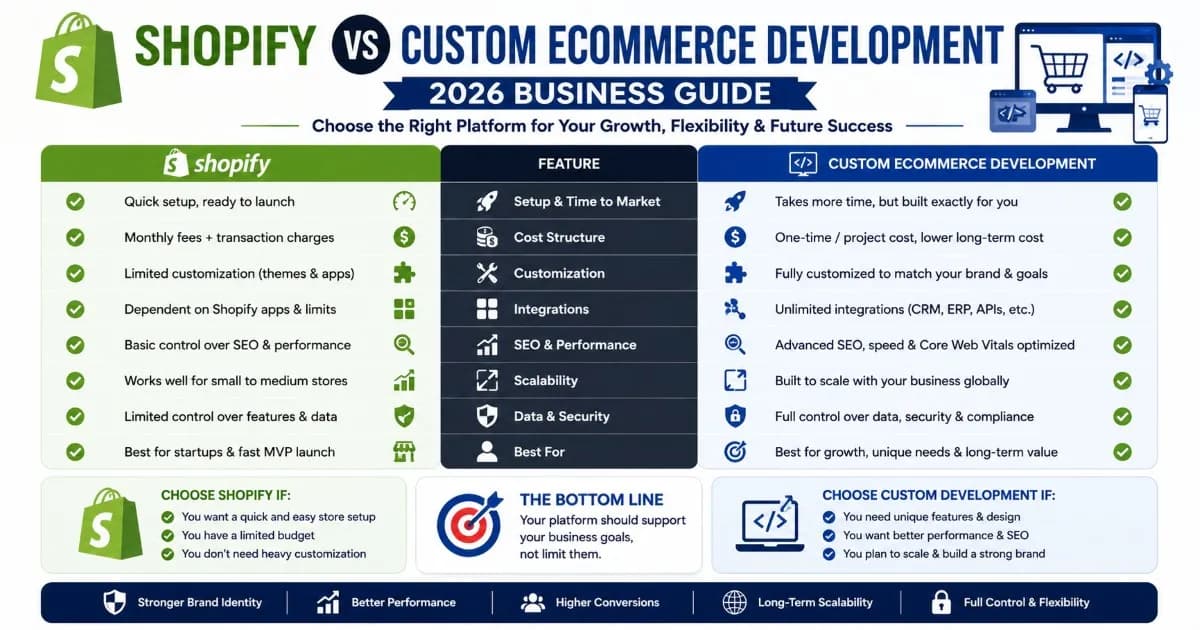
The real comparison is not “cheap vs expensive.” It is speed and convenience vs control and long-term flexibility.

Shopify’s official pricing page states that third-party transaction fees apply when using a third-party payment provider, with rates depending on the plan. Shopify also states it is certified Level 1 PCI DSS compliant, which is one reason many merchants like the hosted model.
Top Signs/Reasons You Need Shopify Vs Custom Ecommerce Development #
You need this comparison when your store decision will affect growth, not just design. Common signs include:
You are launching a new online store
Your current Shopify store depends on too many apps
Your WooCommerce store feels hard to maintain
Your checkout needs custom rules
Your product catalog is becoming complex
Your SEO pages are difficult to scale
You need B2B, wholesale, or subscription logic
Your store must support Dubai, Europe, and US customers
You need CRM, ERP, inventory, or logistics integrations
Your mobile conversion rate is weaker than expected
Shopify is still a very strong choice for many businesses. Shopify reported that merchants cleared over $100 billion in GMV in Q1 2026, showing the platform remains a major part of global commerce infrastructure.
But popularity alone does not make it the right fit for every business. A fast-moving D2C brand may love Shopify, while a multi-region B2B supplier may need custom rules that Shopify apps cannot handle cleanly.
Root Causes/Mechanics: Why This Decision Matters in 2026 #
E-commerce stores now do more than process orders. They support SEO, paid ads, personalization, inventory syncing, international payments, loyalty programs, customer support, analytics, and retention campaigns. That creates pressure on the platform behind the store.
Shopify works well because it removes much of the technical burden. You get hosting, checkout, security, apps, themes, and a familiar admin system.
Custom e-commerce works well when the business model is too specific for standard platform rules. For example, a company selling industrial products may need quote-based checkout, customer-specific pricing, approval workflows, warehouse logic, and custom dashboards.
The Shopify vs WooCommerce question also sits inside this wider decision. WooCommerce is an open-source e-commerce platform for WordPress, and WooCommerce describes it as giving merchants control over checkout, data, costs, payments, features, and hosting.
Google’s Core Web Vitals also matter because they measure real-world user experience for loading performance, interactivity, and visual stability. Google recommends good Core Web Vitals for Search success and general user experience.
Warning: Do not choose Shopify just because it is faster to launch, and do not choose custom development just because it sounds more advanced. The wrong platform becomes expensive when it blocks SEO, slows checkout, breaks integrations, or forces your team into daily workarounds.
How to Get Started / Diagnose #
Use this step-by-step process before choosing Shopify, WooCommerce, or custom e-commerce development.
1. Define your business model #
Decide whether you are selling D2C, B2B, subscriptions, digital products, wholesale, services, or marketplace-style products.
2. Map your product catalog #
Count SKUs, variants, bundles, categories, filters, collections, and regional product rules.
3. Review your checkout requirements #
Check whether you need one-step checkout, quote requests, custom fields, delivery slots, subscriptions, split payments, or customer-specific pricing.
4. List required integrations #
Include CRM, ERP, accounting, email, inventory, warehouse, payment gateways, shipping, analytics, and customer support tools.
5. Study your target regions #
Dubai may need Arabic support, local payment preferences, WhatsApp, and premium product storytelling. Europe may need GDPR-aware tracking, local languages, and VAT handling. The US often needs fast checkout, discounts, reviews, and retention flows.
6. Audit SEO needs #
Decide whether you need blog content, category SEO, product schema, city pages, comparison pages, buying guides, or programmatic landing pages.
7. Calculate total cost over 24 months #
Include platform fees, apps, transaction fees, development, maintenance, SEO work, redesigns, integrations, and support.
8. Decide what cannot be compromised #
If speed, ownership, integration depth, or custom checkout matters most, that decision should guide the platform.
Solutions & Strategies #
Foundational Strategy #
Choose Shopify when your priority is speed, simplicity, and lower technical maintenance. Shopify is usually the practical option when:
You need to launch quickly
Your product catalog is simple
Standard checkout works fine
You want a managed admin
You do not have an internal development team
You are testing a new product line
You prefer apps over custom development
Choose custom e-commerce when your priority is control, flexibility, and long-term scalability. Custom development is usually better when:
Your store has complex workflows
SEO architecture matters heavily
You need full Website Design freedom
You need direct API integrations
You sell across multiple regions
You need custom checkout logic
You want deeper ownership of the platform
Tools Strategy #
For Shopify, the key tools are usually:
Shopify admin
Shopify Checkout
Shopify Payments or third-party gateways
Theme editor
Shopify apps
Email and retention apps
Analytics and reporting apps
ERP or inventory connectors
Shopify’s enterprise documentation also describes modular commerce infrastructure, APIs, integrations, apps, partner ecosystem, and B2B support for larger brands. For custom e-commerce, the stack may include:
Frontend: Next.js, React, Vue
Backend: Laravel, Node.js, Django
Commerce engine: Magento, WooCommerce, custom backend, headless commerce
CMS: WordPress, Sanity, Strapi, Contentful
Payments: Stripe, PayPal, local gateways
Search: Algolia, Elasticsearch, custom search
Analytics: GA4, Microsoft Clarity, server-side tracking
Infrastructure: Cloud hosting, CDN, monitoring, backups
Professional Strategy #
A professional team should not push one platform before understanding the business. The right process starts with discovery, catalog review, SEO planning, UX mapping, technical architecture, integration planning, and cost forecasting. After that, Shopify, WooCommerce, or custom development becomes easier to judge.
For Vynce Digital, the better approach is to position this service as a platform-fit decision, not a “Shopify is bad” argument. Many brands should start with Shopify. Others should move custom when the store becomes a serious revenue system.
Actionable Framework: Shopify vs Custom E-commerce Decision Checklist #
Use this checklist before choosing your platform.

The Hidden Impact #
The platform decision affects more than the website.
A poor fit can create hidden operational problems. Your marketing team may struggle to launch landing pages, your SEO team may fight URL limitations, your operations team may manually fix orders, and your developers may spend too much time patching apps.
There is also a customer experience cost. Slow product pages, limited filters, confusing checkout, and broken tracking can reduce sales without making the problem obvious.
For founders and managers, the mental load is real. When every campaign needs another plugin, workaround, or developer fix, the store starts to feel fragile.
Custom e-commerce can solve these problems, but only if planned properly. A badly built custom store can be worse than Shopify because it creates technical debt without the safety of a managed platform.
Common Mistakes to Avoid #
Avoid these mistakes before choosing Shopify, WooCommerce, or custom e-commerce development:
Choosing only based on upfront cost
Ignoring long-term app fees
Building custom when Shopify is enough
Using Shopify when checkout logic is too complex
Ignoring SEO structure before launch
Adding too many apps too early
Skipping mobile speed testing
Not planning product migration
Forgetting analytics and conversion tracking
Treating Shopify vs WooCommerce as the whole decision
Choosing a platform before mapping operations
Ignoring support and maintenance after launch
The biggest mistake is thinking the platform alone will fix sales. Platform choice matters, but offer, pricing, product quality, copy, traffic, trust, and checkout experience still decide performance.
Frequently Asked Questions #
Is Shopify still a good choice in 2026? #
Yes, Shopify is still a strong choice for startups, SMBs, D2C brands, and stores that need fast setup with reliable hosting and checkout. It becomes less ideal when your store needs heavy customization, complex integrations, or deep control over backend logic.
When should I choose custom e-commerce development? #
Choose custom e-commerce development when your store needs unique checkout flows, advanced SEO architecture, ERP integration, B2B features, complex product filtering, or multi-region experiences. It is better for businesses that see e-commerce as a core revenue system, not just a sales page.
What are the Shopify vs Custom eCommerce development pros and cons? #
Shopify’s main pros are speed, simplicity, hosting, security, and app availability. Its cons include platform dependency, recurring costs, app reliance, and limits around deep customization, while custom development gives more control but needs more planning, budget, and technical support.
Shopify vs WooCommerce: which is better? #
Shopify is better if you want a hosted, easier-to-manage e-commerce system. WooCommerce is better if you already use WordPress and want more control over hosting, data, plugins, and customization.
Is custom e-commerce better for SEO? #
Custom e-commerce can be better for SEO when the site needs advanced technical control, clean architecture, custom schema, faster performance, and scalable landing pages. Shopify can still perform well for SEO when the theme, content, apps, and site structure are handled properly.
Can I migrate from Shopify to a custom store later? #
Yes, you can migrate products, customers, orders, URLs, content, and SEO data from Shopify to a custom store. The migration must be planned carefully with redirects, metadata checks, analytics setup, and testing before launch.
What is best for a Dubai, Europe, or US e-commerce brand? #
For a simple launch, Shopify is usually the safer first step. For a brand targeting multiple regions with custom pricing, multilingual content, local payment flows, SEO landing pages, and ERP integration, custom e-commerce development is often the better long-term fit.
Conclusion & Next Steps #
The Shopify Vs Custom Ecommerce development decision should come down to how your business sells, scales, and operates.
Key takeaways:
Shopify is best when you need speed, ease of use, managed hosting, and standard e-commerce features.
Custom e-commerce development is best when you need flexibility, ownership, advanced SEO, custom checkout, and deep integrations.
Shopify vs WooCommerce is part of the decision, but not the whole picture.
Shopify vs Custom eCommerce development pros and cons depend on product catalog, checkout logic, regional needs, budget, and maintenance capacity.
A fast launch is useful, but a platform that supports long-term growth is better.
Before choosing, audit your product catalog, checkout needs, SEO goals, integrations, regional strategy, and 24-month cost. If the store is simple, Shopify may be enough. If the store is becoming a serious growth engine, custom development may be the smarter investment.
For businesses in Dubai, Europe, and the US, Vynce Digital can help you choose the right e-commerce direction and build a store that connects design, development, SEO, performance, and conversion strategy.
The right e-commerce platform is not the one with the most features. It is the one that fits how your customers buy and how your business needs to grow.