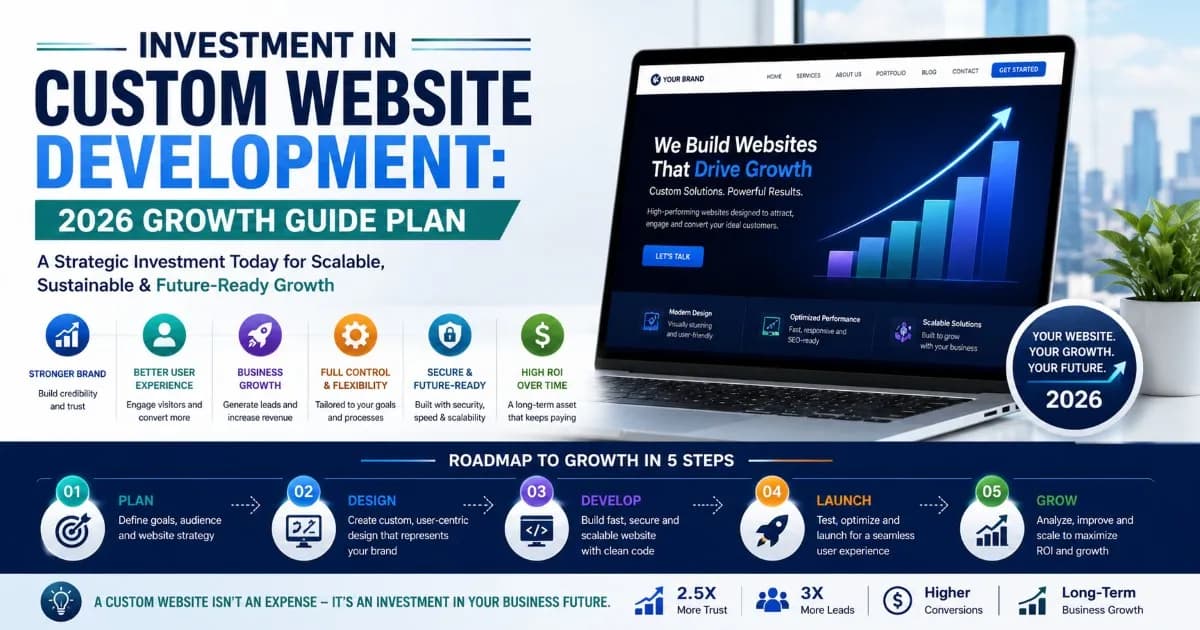
Investment in Custom Website Development: 2026 Growth Guide Plan

sadiya
May 7, 2026
Table of Contents
- What is Investment in Custom Website Development?
- Custom Website Development vs Website Builder
- Top Signs/Reasons You Need Investment in Custom Website Development
- Root Causes/Mechanics: Why Businesses Are Moving Away From Templates
- How to Get Started / Diagnose:
- Solutions & Strategies
- Actionable Framework: Custom Website Investment Checklist
- The Hidden Impact
- Common Mistakes to Avoid
- Frequently Asked Questions
- Conclusion & Next Steps
A few years ago, many businesses could get away with a basic website. Pick a template, add some copy, upload a few images, and the job looked done. That is not enough in 2026.
Businesses in Dubai, Europe, and the US are competing in markets where customers compare brands faster, expect smoother digital experiences, and leave websites that feel slow, generic, or confusing. In the UAE, digital commerce is growing fast, with Dubai Chamber of Digital Economy reporting the UAE e-commerce market is projected to reach US$17.2 billion by 2027 at an 8.4% CAGR between 2023 and 2027.
The target audience for this article includes Dubai entrepreneurs, European SaaS and service businesses, US e-commerce brands, B2B companies, professional service firms, funded startups, and growing SMEs that need more than a basic online brochure.
This guide explains why Investment in Custom Website Development is becoming a practical business decision, not just a Website Design upgrade.
What is Investment in Custom Website Development? #
Investment in Custom Website Development means building a website around your business goals, audience behavior, brand identity, integrations, SEO strategy, and future growth instead of forcing your business into a ready-made template.
A custom website is planned around how your users search, compare, trust, buy, book, subscribe, or contact your business. It gives you more control over Website Design, performance, content structure, user experience, conversion flow, and backend integrations.
For a Dubai luxury brand, that may mean multilingual pages, premium visuals, WhatsApp lead capture, and regional payment options. For a European SaaS company, it may mean GDPR-friendly tracking, fast product pages, and CRM integration. For a US e-commerce company, it may mean speed, mobile-first checkout, product filtering, and conversion testing.
Your original draft already positioned custom websites as a shift from cookie-cutter templates toward branding, user experience, integrations, scalability, and long-term ROI.
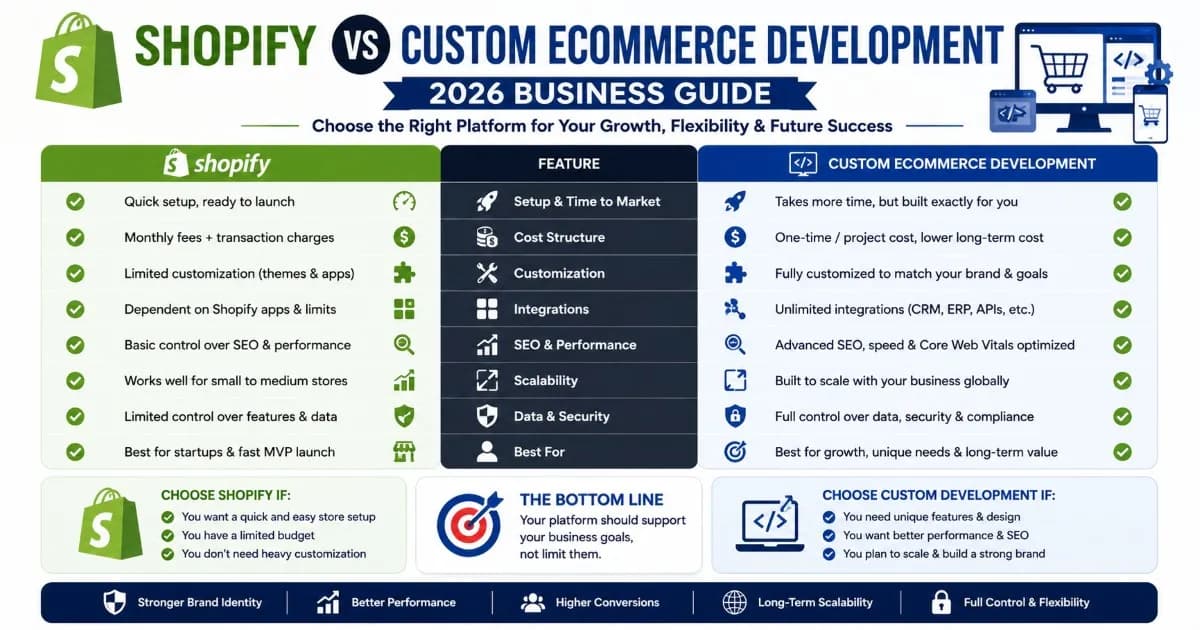
Custom Website Development vs Website Builder #
A Website builder can work for very small businesses that need something fast and simple. But once your website needs to support SEO, paid ads, regional targeting, automation, lead quality, or complex customer journeys, the limits show quickly.

Google defines Core Web Vitals as real-world user experience metrics covering loading performance, interactivity, and visual stability, and recommends strong performance for both search success and user experience.
That is one reason custom builds matter. They allow technical decisions to support business goals instead of depending on whatever a template or plugin stack allows.
Top Signs/Reasons You Need Investment in Custom Website Development #
You do not need a custom website just because it sounds premium. You need it when your current website is holding the business back. Common signs include:
Your website looks like every competitor
Leads are coming in, but quality is weak
Pages load slowly on mobile
SEO pages are hard to scale
Your website cannot support multiple locations
Your CRM or sales process is disconnected
Paid traffic is landing on weak pages
Your team depends on too many plugins
Your brand has outgrown its old design
For European businesses, this is especially relevant because digital selling is already part of the mainstream business environment. Eurostat reported that in 2025, 21% of EU businesses used websites or apps to sell goods or services, while 18% sold through their own website or app.
For US businesses, online buying is not a side channel anymore. The US Census Bureau reported that e-commerce sales accounted for 18.3% of total retail sales in Q4 2025.
Root Causes/Mechanics: Why Businesses Are Moving Away From Templates #
The move toward Custom Website Services is not just about better visuals. It is happening because the job of a business website has changed. A modern website now needs to support:
SEO visibility
Paid campaign landing pages
Lead qualification
CRM integration
Content marketing
Conversion tracking
Localization
Data privacy
Mobile performance
Trust-building
Dubai businesses are also operating in a market where the digital economy is being actively pushed at a national level. The UAE Digital Economy Strategy aims to grow the digital economy from 12% of non-oil GDP to 20% by 2030.
Europe adds another layer: users are privacy-conscious, multilingual, and often compare providers carefully before speaking to sales. In 2025, Eurostat also reported that 52.74% of EU enterprises used paid cloud computing services, which shows how deeply digital tools are becoming part of business operations. In the US, the pressure is different. Competition is often driven by speed, conversion rate, paid ads, SEO content, and better funnels.
Warning: A cheap template can look affordable at the start, but it becomes expensive when it slows down SEO, limits campaigns, blocks integrations, or makes every redesign feel like a patch job.
How to Get Started / Diagnose: #
Before investing in a custom website, diagnose the real problem. Do not redesign blindly.
1.Audit your current website performance #
Check mobile speed, Core Web Vitals, broken pages, crawl issues, and conversion paths.
2.Review your best and worst pages #
Look at pages that bring traffic but no leads. These usually reveal weak messaging, poor layout, or unclear calls to action.
3.Study your audience by region #
Dubai users may expect WhatsApp, premium visuals, and fast contact options. European users may care more about trust, compliance, and detail. US users often respond well to clear offers, proof, pricing guidance, and fast forms.
4.Map your sales journey #
Identify what happens after someone submits a form, books a call, downloads a guide, or starts checkout.
5.Check your integration needs #
List your CRM, analytics, email platform, payment system, booking tool, chatbot, and reporting dashboard.
6.Review your SEO structure #
Check whether your website can support city pages, service pages, industry pages, comparison pages, FAQs, and blogs.
7.Decide what must be custom #
Not every section needs complex development. Focus custom work on pages and features that affect growth.
Solutions & Strategies #
Foundational Strategy #
Start with the basics before thinking about advanced design. Your website should have:
Clear service positioning
Fast mobile experience
Strong homepage structure
Dedicated service pages
Conversion-focused contact forms
Clean navigation
Trust signals
SEO-friendly page hierarchy
For many businesses, the first win is not animation or fancy design. It is making the offer clear in the first screen.
Tools Strategy #
The right tools depend on your business model. For a custom website, common tool categories include:
CMS: WordPress custom build, Webflow, headless CMS
Frontend: Next.js, React, custom HTML/CSS
Analytics: GA4, Microsoft Clarity, Google Search Console
CRM: HubSpot, Zoho, Salesforce, Pipedrive
Automation: Zapier, Make, custom API workflows
SEO: Screaming Frog, Ahrefs, Semrush, schema tools
Performance: PageSpeed Insights, Lighthouse, CDN tools
A good custom build does not add tools for the sake of looking advanced. It connects only what your team will actually use.
Professional Strategy #
Professional Custom Website Services are best when the website needs to directly support revenue. That includes:
International service pages
Dubai, Europe, and US landing pages
Custom lead forms
CRM-connected funnels
E-commerce flows
Multilingual structure
Programmatic SEO pages
Custom dashboards
Booking or quote systems
This is where Investment in Custom Website Development becomes easier to justify. The website is no longer a design expense. It becomes part of your sales and marketing system.
Actionable Framework: Custom Website Investment Checklist #
Use this checklist before approving a redesign or custom build.

The Hidden Impact #
The hidden cost of a weak website is not only poor design. It affects sales, hiring, brand trust, and marketing confidence.
A slow or unclear website can make paid ads more expensive because users do not convert. It can make SEO underperform because pages are not structured properly. It can also make your sales team work harder because leads arrive with low intent or wrong expectations.
There is also a mental cost for business owners. When the website does not reflect the quality of the company, every campaign feels risky.
For international businesses, the risk is bigger. A generic website may fail to speak to Dubai buyers, European compliance-conscious users, and US conversion-focused audiences at the same time.
Common Mistakes to Avoid #
Avoid these mistakes before starting a custom website project:
Choosing design before strategy
Copying a competitor’s layout too closely
Ignoring mobile speed
Using too many plugins
Building pages with no SEO plan
Writing vague service copy
Forgetting CRM and analytics setup
Skipping regional landing pages
Launching without conversion tracking
Treating the website as a one-time project
The worst mistake is building a website that looks finished but cannot be measured. Every key form, button, call, checkout, and booking action should be tracked.
Frequently Asked Questions #
Q1.Why are businesses investing in custom website development in 2026? #
Businesses are investing in custom website development because templates often limit SEO, speed, integrations, and conversion control. In competitive markets like Dubai, Europe, and the US, companies need websites that support sales, marketing, automation, and regional growth.
Q2.Is a custom website better than a Website builder? #
A Website builder is fine for a simple early-stage website. A custom website is better when you need stronger Website Design, advanced SEO, CRM integration, faster performance, multilingual pages, or custom conversion flows.
Q3.Who needs Custom Website Services the most? #
Custom Website Services are best for businesses that rely on online leads, bookings, sales, demos, or international visibility. This includes SaaS companies, e-commerce brands, agencies, clinics, consultants, real estate firms, hospitality brands, and professional service companies.
Q4.How much should a business invest in a custom website? #
The cost depends on page count, design complexity, integrations, content, and functionality. A small custom business website may cost far less than a multilingual e-commerce platform or SaaS website with dashboards and API connections.
Q5.Is custom website development good for SEO? #
Yes, if it is planned correctly. Custom development can improve SEO through clean code, faster load times, structured data, scalable page templates, better internal linking, and content layouts built around search intent.
Q6.Can a custom website help international businesses? #
Yes. A custom website can support region-specific pages, currencies, languages, trust signals, local CTAs, and market-specific messaging for Dubai, Europe, the US, and other regions.
Q7.When should I redesign my current website? #
Redesign your website if it loads slowly, looks outdated, fails to convert visitors, cannot support SEO growth, or does not connect with your sales tools. If your team keeps finding workarounds, the website is probably limiting growth.
Conclusion & Next Steps #
A custom website is not about making your brand look expensive. It is about building a digital system that supports how your business actually grows.
Key takeaways:
Investment in Custom Website Development makes sense when your website affects leads, sales, trust, and expansion.
Website Design should be tied to user behavior, not just visual preference.
A Website builder can work for simple sites, but it becomes restrictive as the business grows.
Custom Website Services help connect SEO, performance, integrations, and conversion strategy.
Dubai, Europe, and the US each need different website decisions because users, regulations, and buying behavior are not the same.
If your current website feels slow, generic, hard to scale, or disconnected from your sales process, start with a proper website audit. Then decide what needs to be redesigned, rebuilt, integrated, or optimized.
For a business targeting Dubai, Europe, or the US, Vynce Digital can help plan and build a custom website that connects strategy, design, SEO, performance, and conversion into one clear system.
Your website should not just exist online. It should explain your value clearly, earn trust quickly, and make it easier for the right customers to take action.