Why AI Trusts Some Sites More Than Others

Tuba
July 13, 2026
Table of Contents
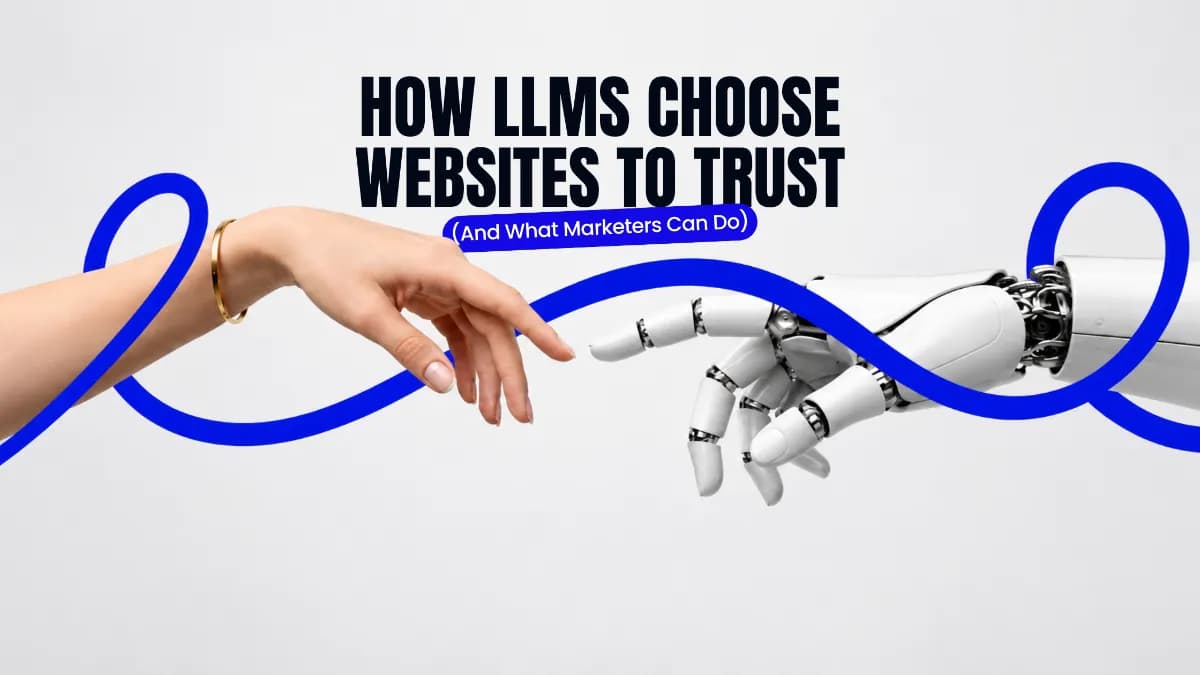
Ask ChatGPT, Perplexity, or Google for a recommendation, and you get a short answer with a few sources to back it up. Your competitor is named. You are not. The obvious question follows: how do these tools choose which websites to trust, and what can you do to be one of them?
The short version is that large language models do not pick sources the way old search did. They are not just ranking ten blue links by backlinks. They learn which brands and pages are credible from patterns across the entire web, and then, at answer time, they pull and prefer the sources that fit those patterns. Once you understand that, the marketing work becomes a lot clearer. This guide walks through how the choice actually happens, what the data says models reward, and a practical plan to earn more of those citations.
Trust is a Pattern, Not a Page #
Here is the idea most guides skip. A model does not read your single best page and decide you are trustworthy. It has already read a huge slice of the web. Cloudflare, which sits in front of a large share of internet traffic, reported in August 2025 that training accounted for about 79 percent of all AI crawling, up from 72 percent a year earlier. For context, one major provider crawled roughly 38,000 pages for every visitor it sent back. Models consume the web at enormous scale, and most of that reading is about learning, not sending you traffic.
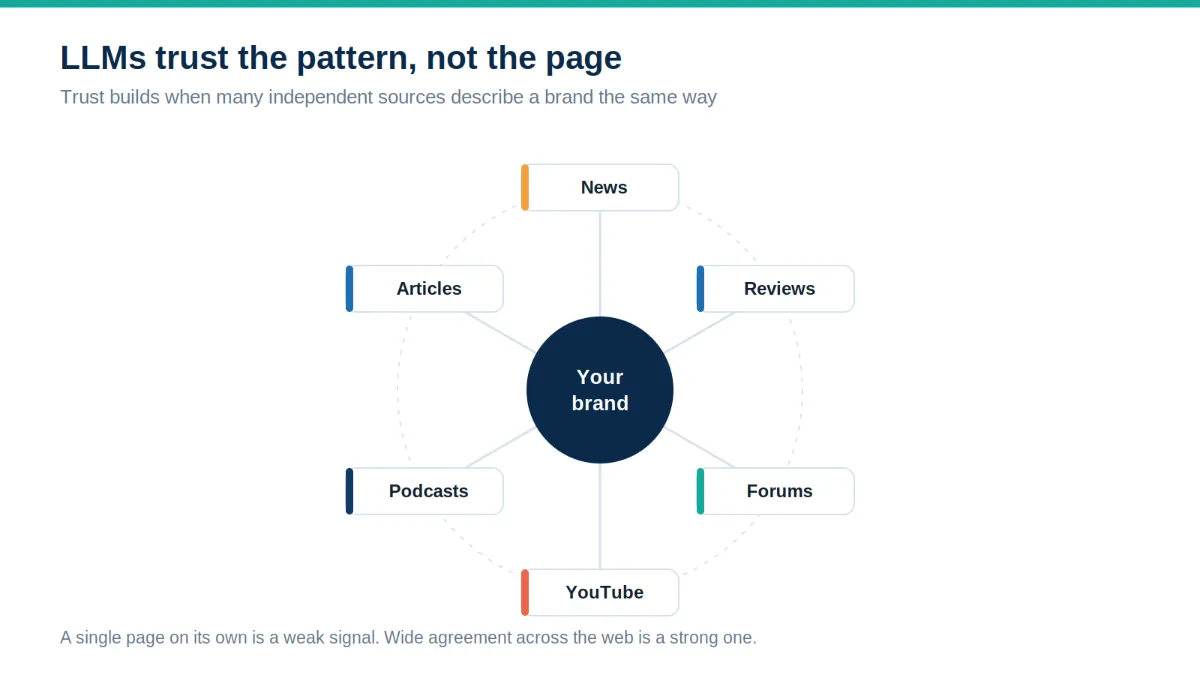
That scale changes what trust means. When many independent sources describe your brand the same way, in news, reviews, forums, and video, the model learns that you are a known and credible thing worth mentioning. A single page that praises you is a weak signal on its own. Wide agreement across the web is strong. You can read the full Cloudflare crawl data if you want the platform-by-platform numbers.
A quick example makes this concrete. Imagine two tools in the same category. One has a polished website and little else. The other is reviewed on a few independent sites, discussed in a couple of forum threads, and mentioned in a handful of videos, all of which describe it in similar terms. When someone asks an AI tool for a recommendation, the second brand is the one the model has seen described, again and again, by sources that do not belong to it. That repetition is what reads as trust. The first brand may have the better page, but the model has almost nothing outside that page to go on.
How An Answer Engine Actually Picks Sources #
When you ask a current AI tool something, four things happen in quick succession. First, it reads your question and decides whether it even needs to search the web or can answer from memory. Then it pulls a set of candidate pages from search, its own index, and trusted sources. Next, it ranks those candidates, favoring those that are authoritative, on-topic, and easy to verify. Finally, it writes the answer from the sources it kept and links the ones it leaned on.
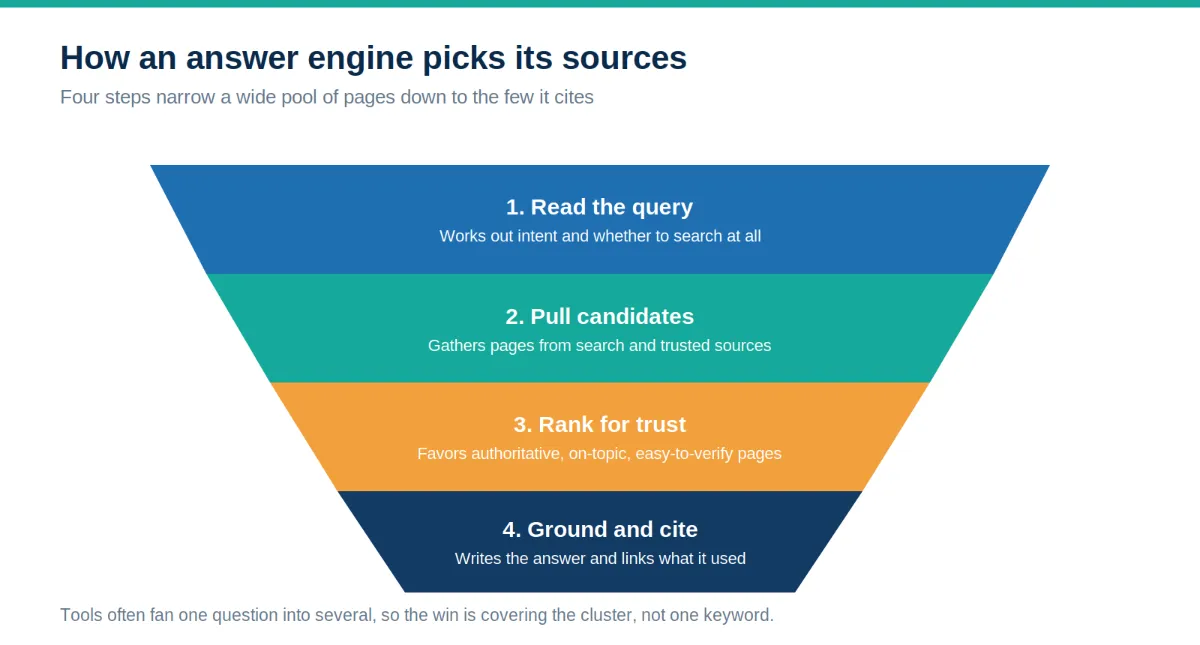
One detail matters for marketers. These tools rarely run your exact question as one search. They break it into several smaller questions, a process Google calls query fan-out, and pull sources that answer those pieces. So your page does not need to win one head term. It needs to be a strong answer to the cluster of related questions around it. This is also why simply ranking on Google is no longer enough. An Ahrefs study of 863,000 keywords found that only 38 percent of AI Overview citations now come from pages ranking in Google’s top ten, down sharply from about 76 percent in mid-2025. Many cited pages never appear in the standard results at all.
Two things about this process surprise most marketers. The first is that the tool does not always search. For many questions it answers straight from memory, from what it absorbed during training, and never looks at a live page at all. Questions that include a year, a price, or a comparison are the ones most likely to trigger a real search. So part of being citable is being well-known enough to live in that training memory, and part is being retrievable when a search runs.
The second surprise is that being cited by one tool does not mean you will be cited by another. Different engines use different methods and often return completely different sources for the same question. A brand that shows up in Google AI Overviews may be missing from ChatGPT, and vice versa. That is why it pays to check your visibility in each tool separately rather than assuming a win in one carries over.
What the Data Says Models Reward #
The clearest evidence on what earns AI visibility comes from brand signals. Ahrefs studied 75,000 brands in August 2025 and measured which factors correlate with showing up in Google AI Overviews. Branded web mentions led at 0.664. Branded anchor text followed at 0.527, branded search volume at 0.392, and domain rating at 0.326. Plain backlinks came last at 0.218. In other words, how often people mention your brand across the web predicts AI visibility roughly three times as well as how many links you have.
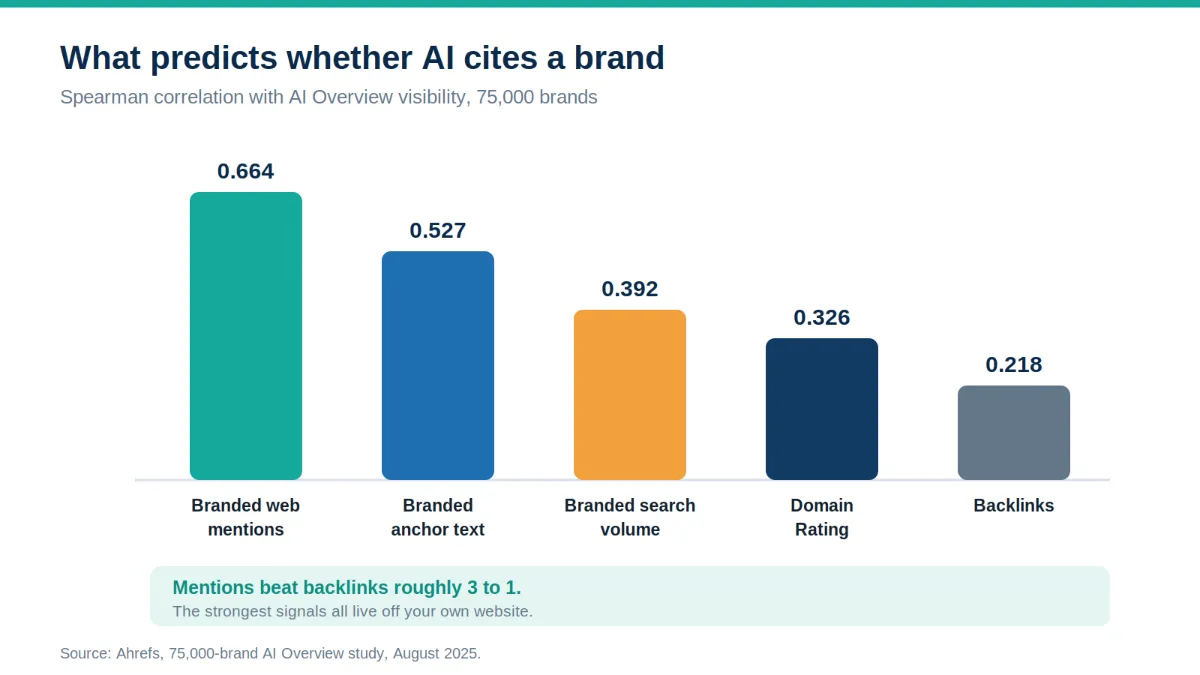
The gap at the extremes is larger still. Brands in the top quarter by web mentions earned up to 10 times as many AI Overview mentions as the next group. A December 2025 follow-up from Ahrefs extended the work to ChatGPT and Google AI Mode and reached the same conclusion, with mentions on YouTube standing out as one of the strongest signals. The pattern is consistent across tools. Models reward brands the wider web already talks about, and they care far less about your link count than a decade of SEO advice would suggest. This is why optimizing your site for AI search now leans so heavily on off-site presence.
Two findings from the same research are worth pulling out, because they redirect the budget. First, the number of pages on your site has almost no relationship with AI visibility, so publishing thinner content does not move the needle. Earned presence does. Second, the gating is uneven across tools. Google’s AI products lean on decades of ranking signals, which favors established brands, while ChatGPT appears less tied to traditional authority. For a smaller brand that has not reached household-name status, ChatGPT is often the easier place to break in first.
What Makes a Single Page Easy to Cite #
Off-site reputation gets you into the candidate pool. The page itself decides whether the model can actually use you. The most-cited academic work here is the Princeton-led Generative Engine Optimization study, presented at the KDD conference in 2024 and tested on 10,000 queries. It found three changes that lifted visibility in AI answers by up to 40 percent: adding relevant statistics, adding direct quotations, and citing credible sources inside your content. Stuffing keywords and padding length did nothing. Verifiable substance did.
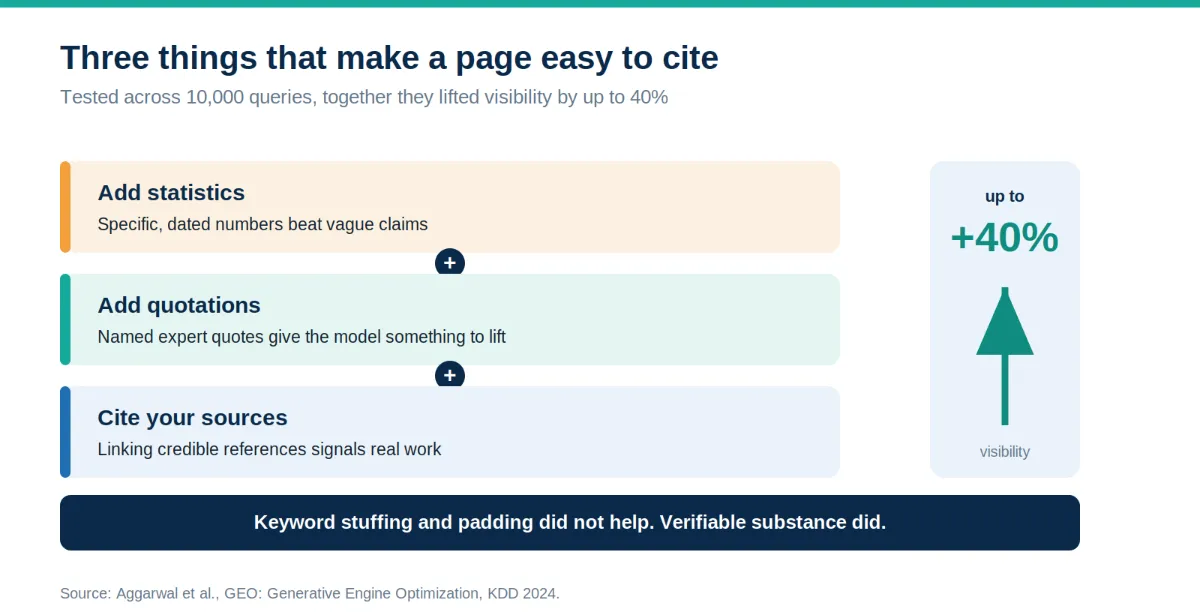
There is a practical reason these work. A model needs to lift a clear, self-contained claim and feel safe attaching it to your name. A specific dated number is easy to lift. A vague sentence is not. Beyond the three additions, the same logic rewards a clean structure: lead with the answer, use clear headings, and keep each section self-contained. The page should read well for a person and still hand a machine an easy quote. Strong, clear and well-structured content does both jobs at once, and a clean, well-built website makes that content easy for a crawler to reach in the first place.
Two more points from the same study are encouraging for smaller sites. Making content more readable and easier to understand also lifted visibility by 15 to 30 percent, so plain writing is not just nicer to read; it gets cited more. And pages that did not already rank near the top gained the most from these changes. If you are not the biggest name in your space, clean and well-evidenced pages are one of the few levers that can pull you into AI answers anyway.
Getting Cited Is Not the Same As Being Trusted #
Here is the part most guides leave out. A citation means a model reached for you. It does not mean the model quoted you correctly. A large study published in Nature Communications in April 2025 evaluated seven popular models across 58,000 statement-source pairs. Between 50 and 90 percent of cited answers were not fully supported by the sources they cited, and some were contradicted by those sources. Even a leading model with live web search left around 30 percent of its statements unsupported.
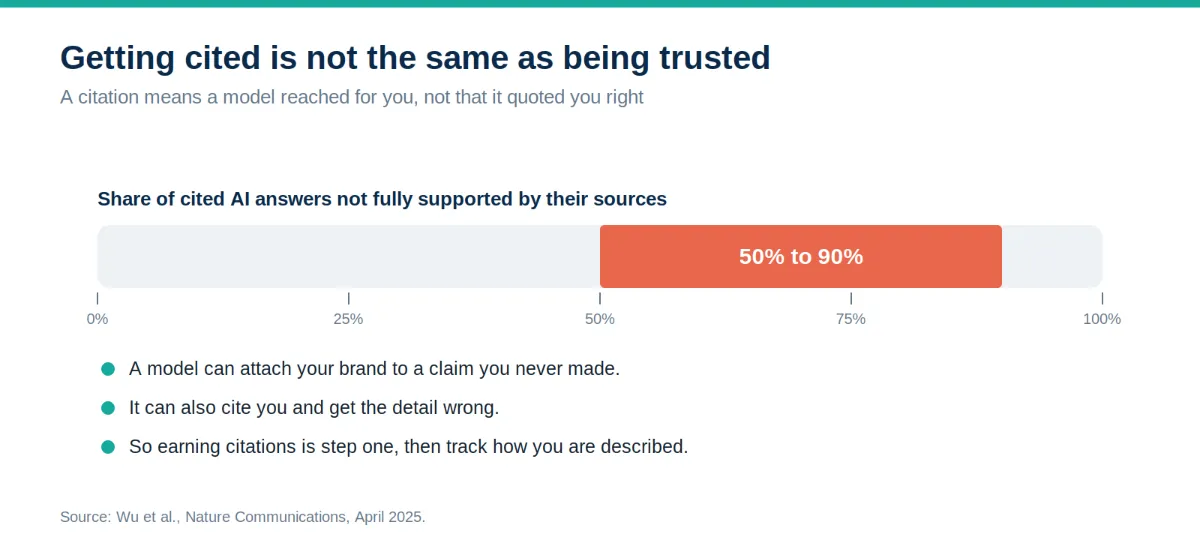
For a marketer, this cuts two ways. A model can attach your brand to a claim you never made and cite you while getting the details wrong. So earning citations is the start, not the finish line. It is worth checking how the major tools describe your brand, then fixing what is off by correcting the underlying source pages and earning cleaner coverage. Watching how your brand is described online is now part of the same job as earning the mention in the first place.
In practice, this means running your own brand and your key product names through ChatGPT, Perplexity, and Google’s AI answers every so often, the way you would check your rankings. Note what each tool says, where it is right, and where it is out of date or simply wrong. If a tool keeps repeating an old price, a retired feature, or a mistaken claim, the fix is upstream: update the pages and sources the model is most likely reading, and earn fresh coverage that clearly states the correct version. Over time, the answers tend to follow the weight of what trusted sources say, so the goal is to make the accurate version the most common one on the web.
What Can Marketers Do About It? #
Put the findings together, and a simple playbook falls out. None of it is a trick. It is the work of becoming the kind of brand a model has good reason to trust.
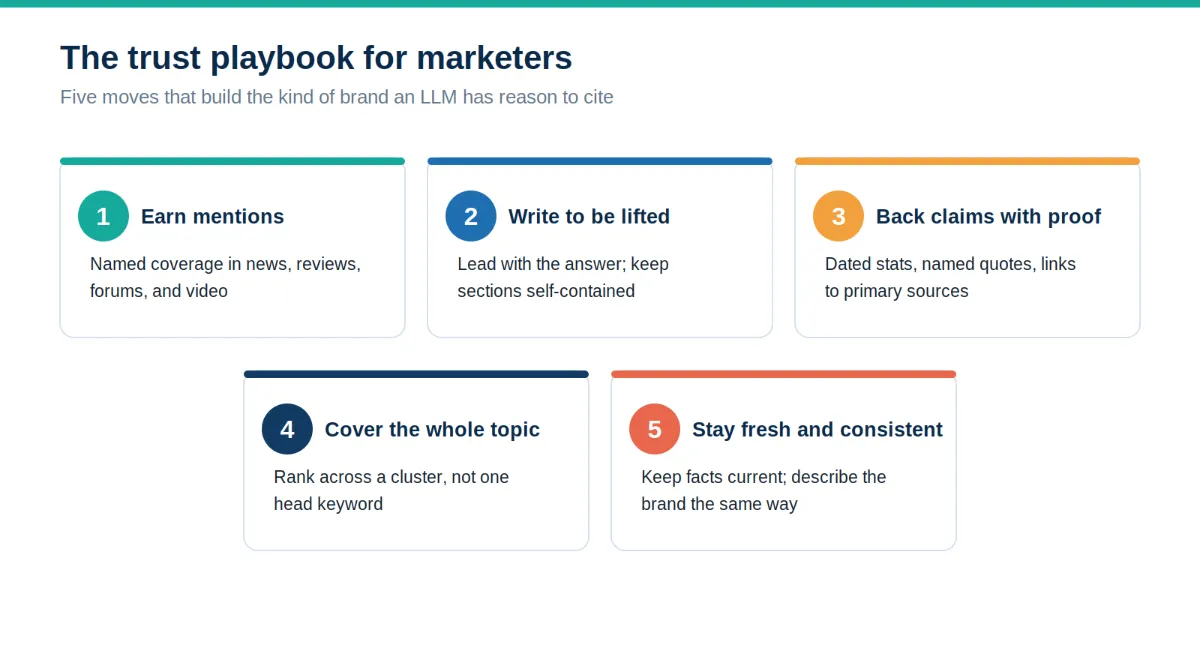
Earn mentions, not just links
Aim for your brand to be named in places models read often: news coverage, review sites, community threads, podcasts, and video. Because YouTube mentions correlate so strongly with AI visibility, video deserves real attention, and an active presence on social platforms helps seed the mentions that get picked up elsewhere.
Write so a machine can lift you
Lead each section with a direct answer, use clear question-style headings, and add a dated statistic or a named quote where it helps. Keep sections self-contained so a model can take one without needing the rest.
Cover the whole topic, not one keyword
Because answer engines fan a question out into many smaller ones, ranking across a cluster of related questions beats ranking once for a head term. A solid search engine optimization foundation and a planned content cluster give you more surfaces to be pulled from.
Treat AI search as its own channel
The signals that win AI citations overlap with SEO but are not identical, which is why generative engine optimization has become its own discipline. Track where you appear across ChatGPT, Perplexity, and AI Overviews, and check that what they say about you is right.
Stay fresh and consistent
Keep your facts up to date and describe your brand consistently across all channels. Models pick up new information in cycles, so consistency over time is what turns scattered mentions into a recognized, trusted entity.
The Takeaway #
LLMs do not trust a clever page. They trust a pattern. They learn which brands are credible from the whole web, prefer pages that are easy to verify and easy to lift, and pull from whoever answers the smaller questions behind a query. The brands that win AI citations are the ones the web already talks about, described clearly and consistently, on pages built to be quoted. Earn the mentions, make your pages easy to cite, and then watch how you are described so that the trust you build shows up in the answer.
Frequently Asked Questions #
How do LLMs choose which websites to trust?
They learn which brands are credible from patterns across the whole web, and then, at answer time, they pull and prefer sources that are authoritative, on-topic, and easy to verify.
Do LLMs just use Google rankings to pick sources?
No. Only about 38 percent of AI Overview citations now come from Google’s top ten results, so ranking helps but is no longer enough on its own.
What matters more for AI citations, backlinks or brand mentions?
Brand mentions. Ahrefs found that branded web mentions predict AI Overview visibility roughly three times as strongly as backlinks.
What is a query fan-out?
It is when an AI tool breaks your question into several smaller questions and pulls sources that answer each piece, instead of running your exact query once.
How do I make a page easier for an LLM to cite?
Lead with a clear answer, add dated statistics and named quotes, cite credible sources, and keep each section self-contained so a model can lift it.
Does getting cited mean an AI described my brand correctly?
Not always. One study found 50 to 90 percent of cited AI answers were not fully supported by their sources, so you should check how you are described.
Why does YouTube matter for AI visibility?
Mentions in YouTube titles, transcripts, and descriptions are among the strongest signals correlating with AI brand visibility across major tools.
How long does it take to show up in AI answers?
It varies. Models pick up new web content in cycles, so consistent mentions usually take a few months to influence what AI tools say about you.
Is optimizing for LLMs different from SEO?
It overlaps but is not identical. AI visibility relies more on off-site brand mentions and machine-readable content, which is why it is treated as a separate discipline.