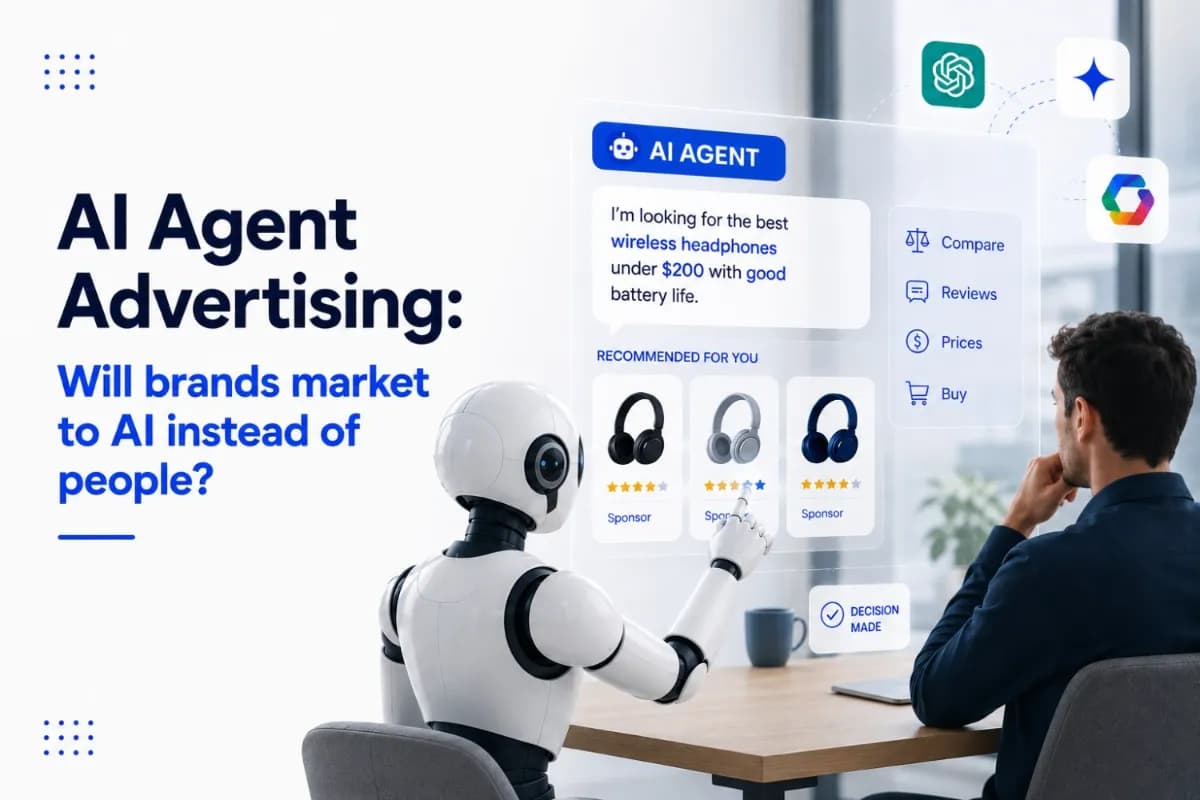
AI Agent Advertising: Will Brands Market to AI Instead of People?

Tuba
September 15, 2026
Table of Contents
- Key takeaways
- What AI Agent Advertising Actually Means
- Why 2026 is the year it stopped being theoretical
- The Paid Layer: Ads Are Already Inside AI Assistants
- The Bigger Prize: Getting Chosen By the Agent
- So Will Brands Market to AI Instead of People?
- What Changes for Measurement
- How to Prepare: A Six-Step Playbook
- Risks and Open Questions
- Where to Start This Quarter
- Frequently Asked Questions
Key takeaways #
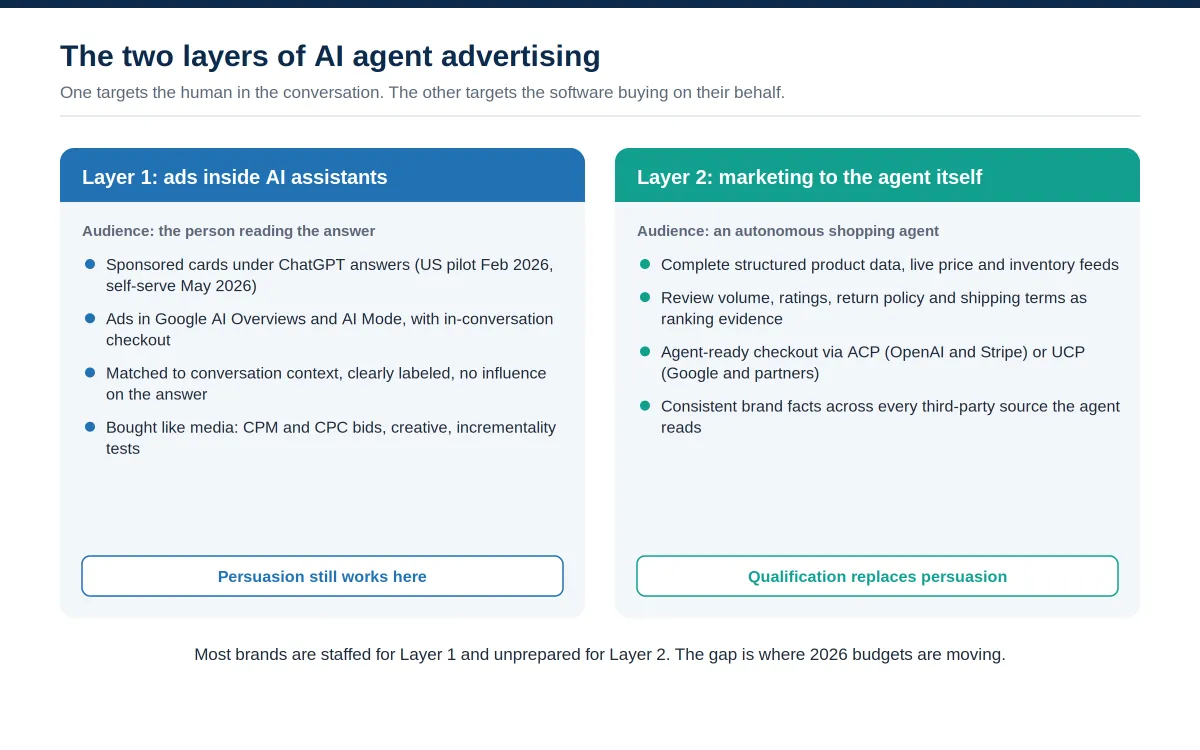
AI agent advertising has two layers: paid placements inside AI assistants that target the person reading the answer, and machine-facing optimization that persuades an autonomous shopping agent to pick your brand.
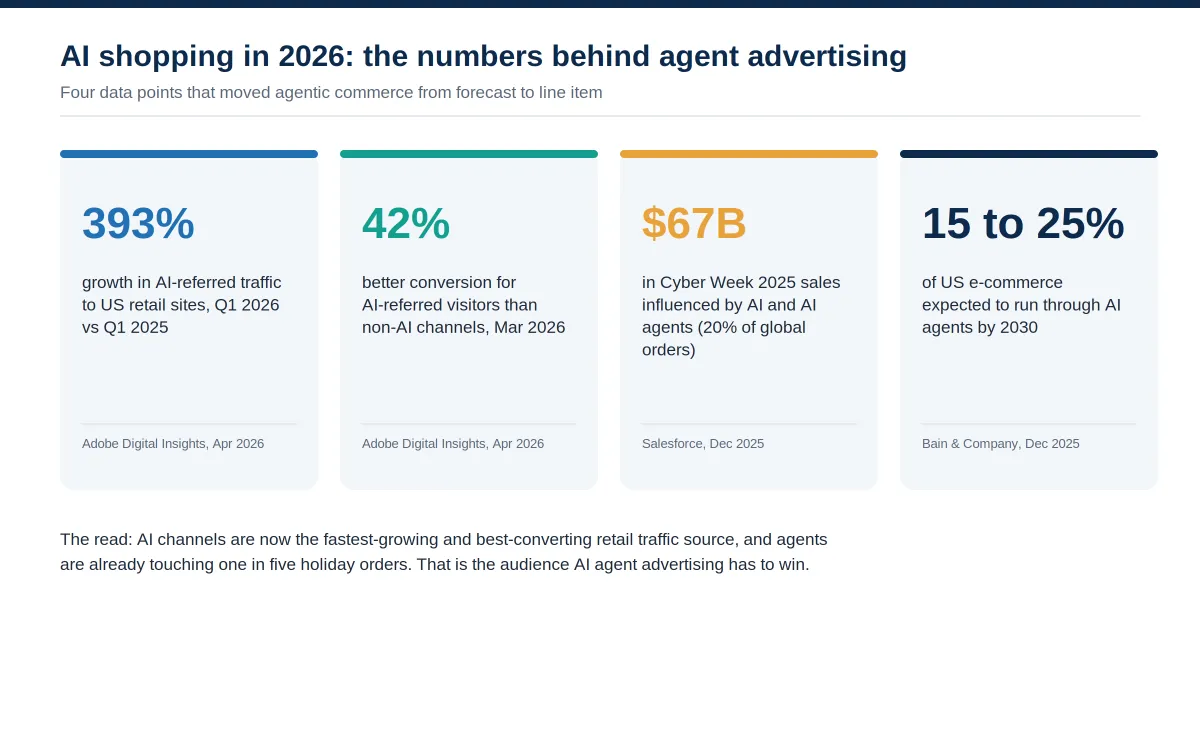
AI-referred traffic to US retail sites grew 393% year over year in Q1 2026 and converted 42% better than non-AI channels by March, so the audience is already here.
Brands will market to both humans and agents, but for different jobs: emotional brand-building moves upstream, structured data and protocol readiness move downstream, and interruptive performance ads get squeezed in between.
During Cyber Week 2025, AI and AI agents influenced 20% of all orders, worth $67 billion in global sales according to Salesforce. In the first quarter of 2026, Adobe Digital Insights measured a 393% year-over-year jump in AI-referred traffic to US retail sites, and by March those visitors were converting 42% better than traffic from paid search, email, and affiliates combined. Twelve months earlier, the same channel converted 38% worse.
That reversal is the whole story of AI agent advertising in one number. A channel that was a curiosity in early 2025 became the best-converting traffic source in US retail by spring 2026. And the software behind it doesn't scroll, doesn't remember your jingle, and doesn't click retargeting ads.
AI agent advertising is the practice of positioning a brand to be found, evaluated, and recommended by AI assistants and autonomous shopping agents. It sits somewhere between media buying and data engineering, and it raises a question every brand team is quietly asking: is the discipline of persuading people about to be joined, or even overtaken, by the discipline of persuading machines?
What AI Agent Advertising Actually Means #
The term covers two activities that are converging fast but still require different skills.
Layer one is advertising inside AI assistants. These are paid placements that appear where people now start their buying journeys: conversational tools like ChatGPT and Google's AI Mode rather than ten blue links or a social feed. The buyer is a human reading an answer, so the familiar rules of creative, targeting, and incrementality still apply, just with new constraints around context and labeling.
Layer two is marketing to the agents themselves. When someone tells an assistant to find the best running shoes under $120 and order them, the software compares options on the person's behalf. Winning that comparison depends on your product data, your live pricing and inventory, your review evidence, and whether the agent can complete the purchase without friction. No hero image to admire and no FOMO to trigger. The agent parses, weighs, and executes.
The first layer evolves the paid search program most brands already run. The second is something new, and it is where most teams are least prepared.
It helps to be clear about what this is not. It is not retail media, although retail media networks are racing to sell agent-visible placements. It is not classic SEO, although the two share a spine of structured data and authority signals. And it is not chatbot marketing in the 2018 sense. The distinguishing feature is that a piece of software with a budget and a brief is now part of the purchase decision, and sometimes the only participant your brand ever meets.
Why 2026 is the year it stopped being theoretical #
Three forces lined up between late 2025 and mid 2026 to make agentic commerce operational, not speculative.
Consumers moved first #
Adobe's April 2026 survey found that 39% of consumers have already used AI for online shopping, and 85% said it improved the experience. Bain estimates 30% to 45% of US consumers now use generative AI to research products or compare options before they buy. Pew Research Center's June 2026 report found that six in ten US adults read the AI summaries at the top of search results. The behavior is mainstream. What is still forming is trust in letting an agent finish the transaction.
The pipes got built #
In September 2025, OpenAI and Stripe released the Agentic Commerce Protocol (ACP), the open standard behind Instant Checkout in ChatGPT, with US Etsy sellers live at launch and more than a million Shopify merchants to follow. Google answered at NRF in January 2026 with the Universal Commercwwe Protocol (UCP), co-developed with Shopify, Etsy, Wayfair, Target, and Walmart, and endorsed by Visa, Mastercard, Stripe, and more than 20 other partners. By Google Marketing Live in May 2026, UCP powered a Universal Cart across Search, Gemini, and other Google surfaces, with Google Pay checkout in a few taps.
These standards mean an agent does not just recommend a product. It can transact end-to-end without a human ever seeing the checkout flow your conversion rate optimization team spent two years tuning.
The money followed #
Bain projects the US agentic commerce market at $300 billion to $500 billion by 2030, roughly 15% to 25% of e-commerce, with specification-driven categories like household essentials shifting first. On the discovery side, IDC forecasts that companies will spend upww to five times as much on LLM optimization as on traditional SEO by 2029. Budgets are rotating toward whatever gets a brand cited, selected, and bought inside an AI system.
The Paid Layer: Ads Are Already Inside AI Assistants #
If you are waiting for AI advertising to arrive, it already has, unevenly.
OpenAI began testing ads in ChatGPT on February 9, 2026, for logged-in adult users on the Free and Go tiers in the United States. Placements appear as clearly labeled sponsored cards beneath the answer, matched to the conversation topic rather than a user profile, and OpenAI states that ads do not influence the answer itself. Trade press reported launch pricing around $60 CPM with six-figure minimum commitments; by May a self-serve Ads Manager had opened with CPC bidding, and by August 2026 the program had expanded to the United Kingdom, Mexico, Brazil, Japan and South Korea. Google has meanwhile been folding sponsored results into AI Overviews and AI Mode, and its Direct Offers pilot puts offer-level value directly inside AI Mode conversations. With UCP-powered checkout live in AI Mode, and Gemini, a Google shopping ad can now move from impression to completed order without a single page load on the advertiser's site, which changes what "landing page" even means for a paid search team.
Perplexity went the other way. In February 2026, the company confirmed it had phased out advertising entirely, with executives arguing that even labeled sponsored placements make users start doubting every answer. That split matters. The industry has not settled whether AI assistants are an ad medium at all, and consumers are skeptical: an Ipsos Consumer Tracker wave from January 2026 found 63% of US adults say ads in AI search results would make them trust those results less.
The practical takeaway: paid AI placements are a real channel, but a contested one. Treat them as high-cost, high-intent experiments with strict incrementality and trust measurement, not as the center of your AI strategy.
The Bigger Prize: Getting Chosen By the Agent #
Here is the uncomfortable truth for advertisers. A truly autonomous shopping agent is the worst ad audience ever created. It does not browse. It has no loyalty to a tagline. If it is acting on an instruction to optimize for price, reviews, and delivery speed, a banner is noise it never renders.
Winning with agents is less like advertising and more like being the best answer to a database query. Adobe's April 2026 visibility benchmark found that roughly a quarter of the content on US retail homepages, and about a third on individual product pages, cannot be read by LLMs at all. Agents favor brands that offer:
Machine-readable everything. Complete schema.org markup, accurate product feeds, clear specs, and transparent pricing and shipping. If the agent cannot parse it, you do not exist. Our AI SEO work increasingly starts here.
Verifiable reputation. Review volume, ratings, return rates, and third-party citations. Agents weigh evidence, not adjectives, which makes online reputation management a ranking input rather than a PR function.
Agent-ready transactions. ACP or UCP support so an agent can complete a purchase without leaving the conversation. Salesforce found that retailers using branded AI agents grew Cyber Week sales 32% faster than those without.
Answer-engine visibility. Content structured so LLMs cite you: clear FAQs, comparison pages, spec sheets, and consistent entity facts across the web. This is the core of generative engine optimization services.
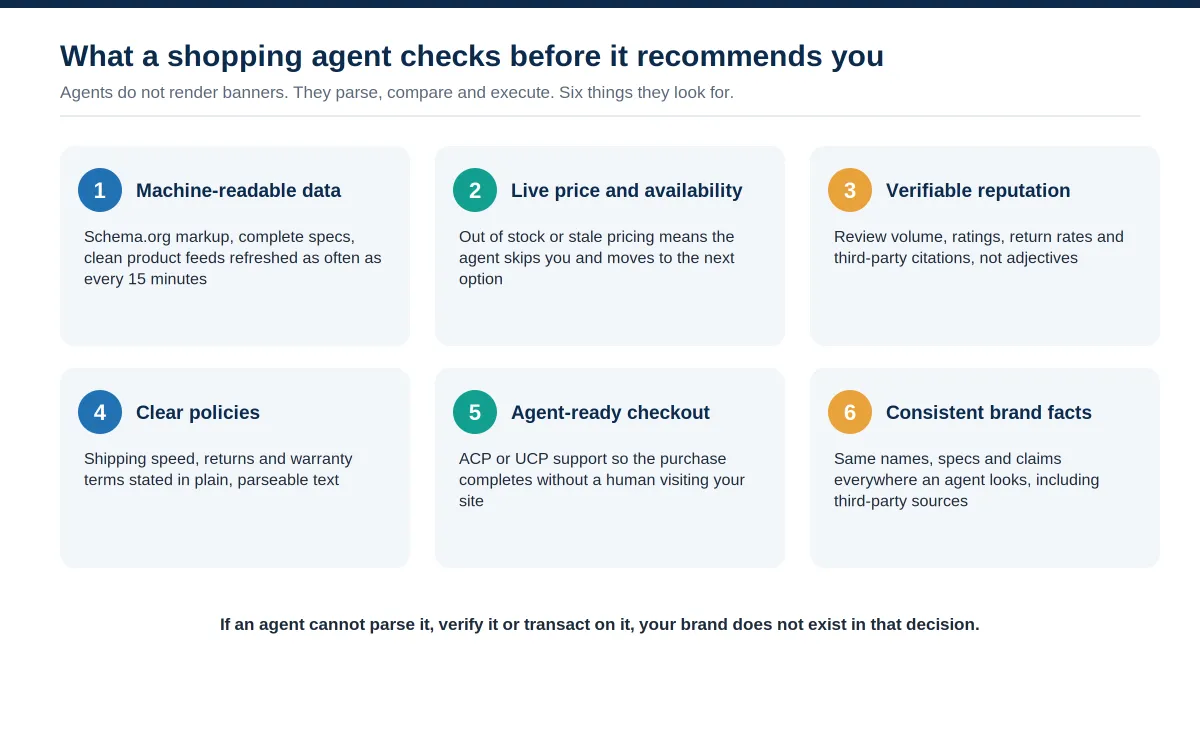
Six things a shopping agent checks before it recommends a brand.
So Will Brands Market to AI Instead of People? #
The honest answer is that brands will market to both, but to different ends.
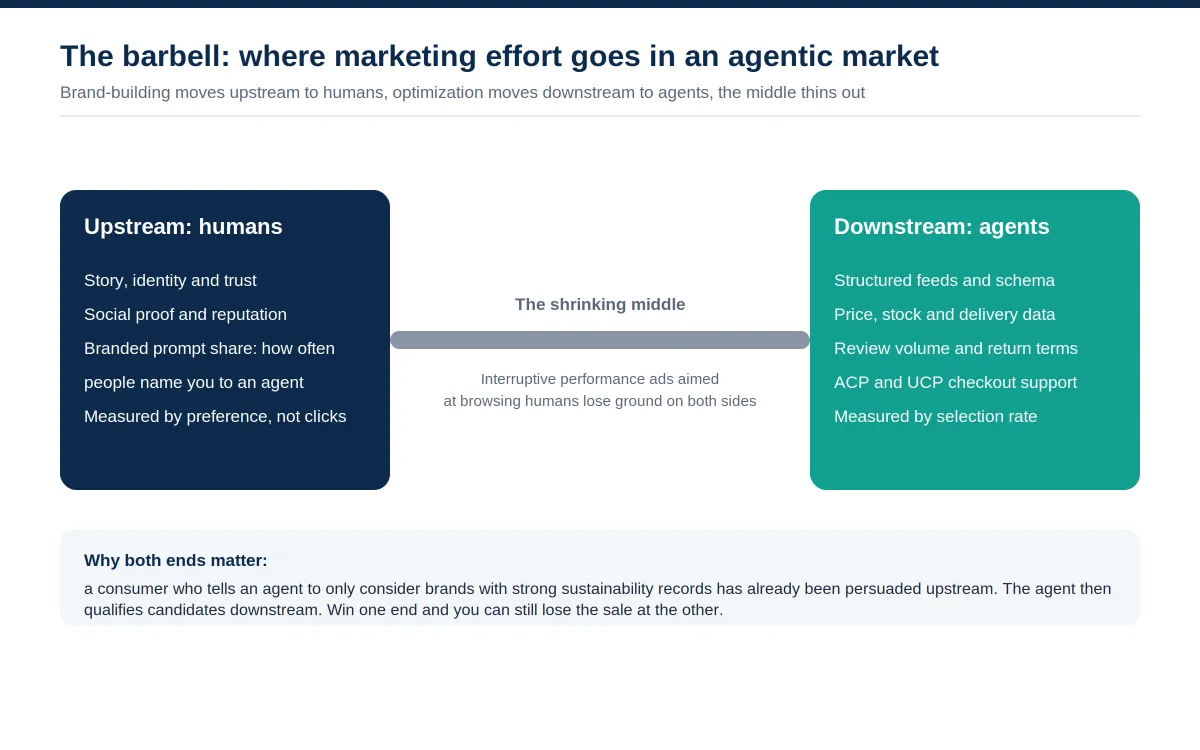
Humans stay upstream. People still tell their agents what to want. A shopper who says "reorder my usual protein powder" or "only consider brands with strong sustainability records" has already been influenced by years of brand-building, social proof, and emotional association. Brand marketing does not die in an agentic world. It moves upstream, shaping preferences and named-brand requests that constrain what an agent can do.
Agents become the downstream gatekeeper. For the growing share of purchases that get delegated- replenishment, comparison-heavy categories, and price-driven buys- the machine layer decides. There, "advertising" looks like data hygiene, protocol adoption, competitive pricing, and reputational proof. Persuasion gives way to qualification.
The likely equilibrium is a barbell. Emotional brand-building aimed at humans on one end, rigorous machine-facing optimization on the other, and a shrinking middle where interruptive performance ads aimed at browsing humans lose ground on both sides. Bain describes the same shift as a move from brand loyalty to outcome loyalty: the agent is loyal to whoever best satisfies the instruction.
What Changes for Measurement #
Agentic commerce breaks the metrics most teams report on, so it is worth naming the replacements early.
Branded prompt share replaces branded search volume as the leading indicator of upstream demand. It measures how often people name your brand when they brief an assistant, whether that is a full instruction or a constraint like "from a brand I already own." It cannot be read directly from any platform yet, so most teams estimate it through prompt panels, survey questions, and the share of AI-referred sessions that arrive on branded pages.
Agent selection rate is the downstream equivalent: of the times an agent evaluated your category, how often did it recommend or buy you? Repeated, structured prompting across ChatGPT, Gemini, Copilot, and Perplexity is the practical proxy today, and several visibility platforms now automate it.
Revenue per AI-referred visit keeps the finance team grounded. Adobe's March 2026 data put revenue per visit from AI sources 37% above non-AI traffic, with those shoppers spending 48% longer on site and viewing 13% more pages. If your own analytics show the opposite, the problem is almost always readability or price and stock parity, not the channel.
The overall lesson is to report on influence and selection, not clicks. As in-chat checkout grows, referral traffic from AI can fall while AI-influenced revenue rises, and a dashboard built on sessions will read that as decline.
How to Prepare: A Six-Step Playbook #
None of this requires a rebuild. It requires sequencing.
Audit your AI visibility. Ask the major assistants your category's buying questions, such as "best CRM for a ten-person team" or "most durable kids' backpack." Log whether you are cited, how you are described, and who wins instead. Adobe's AI Content Visibility Checker and similar tools show what an LLM can and cannot read on your pages.
Fix your structured data. Complete schema markup, clean feeds, accurate specs, live price and inventory. OpenAI's ACP product feed spec expects refreshes as often as every 15 minutes. This is the new packaging.
Adopt agentic commerce protocols. Evaluate ACP and UCP support through your commerce platform so agents can transact with you directly. Shopify, Salesforce Commerce, and others have shipped integrations, and Google's Merchant Center added conversational attributes for question answering and compatibility context. If you sell through Amazon or Walmart, extend the same discipline to your marketplace marketing listings, because Rufus and Sparky are agents too.
Invest in GEO alongside SEO. Build citable, factual, well-structured content: comparison tables, FAQs, spec pages, and honest head-to-head pages that answer the exact questions people put to assistants. Maintain consistent brand facts across every third-party surface an agent consults, from marketplace listings to review sites to Wikipedia-style entity sources, because agents cross-check and disagreement reads as risk.
Protect and grow branded demand. Measure branded prompt share, meaning how often people name you in their instructions to an agent, alongside branded search. Brand campaigns are now agent-instruction campaigns.
Experiment carefully with AI-native ads. Test conversational placements where budgets allow, but track trust metrics and incrementality against your existing ecommerce marketing channels. The rules of this medium are still being written.
Risks and Open Questions #
Walk in with clear eyes. Pay-to-play recommendation layers could blur the line between organic agent choices and sponsored ones, which invites regulatory attention to disclosure. Brands face disintermediation: when the agent completes checkout, you lose the browsing session, the upsell, and much of your first-party data. Bain advises retailers to keep as much ownership of data, fulfillment, and checkout as the protocols allow. And measurement is immature. Attribution across conversational sessions and agent-completed orders is partially solved, and Adobe data suggests referral traffic may fall as in-chat checkout grows, even as influenced revenue rises.
Over-rotating also poses a strategic risk. Ipsos data on ad skepticism, Perplexity's exit, and Pew's finding that only a minority of chatbot users trust what they read all point the same way: assistants that keep answers independent will keep their audiences. OpenAI has been explicit that ads cannot influence ChatGPT's response. Brands that try to buy their way around that principle, or that flood agents with thin, machine-optimized pages, are betting against the incentives of every platform in the market.
None of these are reasons to wait. They are reasons to build capability now, while the share of agent-mediated purchases is small enough to learn cheaply.
Where to Start This Quarter #
AI agent advertising is not a rebrand of digital marketing. It is a fork in it. One path still leads to human hearts: story, identity, trust, the reasons people name your brand when they brief an assistant. The other leads to machine logic: feeds, protocols, proof and price. The brands that win the next five years will refuse to choose between them.
The simplest first step is also the most revealing. Ask an AI assistant to buy what you sell and see whether it picks you. If it does not, the reasons will be in your data, your reviews, or your checkout, and every one of them is fixable. If you would like a second set of eyes on that audit, Vynce Digital runs AI visibility assessments for brands that want to know where they stand before the next holiday season.
Frequently Asked Questions #
What is AI agent advertising?
AI agent advertising is the practice of marketing both inside AI assistants, through paid placements in tools like ChatGPT and Google AI Mode, and to AI agents themselves, by optimizing product data, content, and reputation so autonomous shopping agents select your brand when buying on a consumer's behalf.
Can AI agents actually see ads?
Mostly no. Agents evaluate structured data, prices, reviews, and availability rather than rendering display ads. Paid placements in AI assistants target the human in the conversation. Influencing the agent itself requires machine-readable optimization, not creative.
Is SEO dead in the age of AI agents?
No, but it is being absorbed into something broader. Generative engine optimization, meaning earning citations and recommendations inside AI-generated answers, is growing fast, with IDC projecting LLM optimization budgets could reach five times SEO spend by 2029. The fundamentals of structured data, authority, and accuracy carry over. The surfaces change.
When will agent-driven purchases matter for my brand?
They already do in replenishment and comparison-heavy e-commerce categories. Bain projects 15% to 25% of US e-commerce will flow through AI agents by 2030, but because AI-referred traffic already converts 42% better than other channels, the revenue impact is arriving ahead of the volume.
How much do ChatGPT ads cost in 2026?
Trade reports put launch pricing in February 2026 at around $60 CPM with a $200,000 minimum commitment. By May 2026, OpenAI had opened a self-serve Ads Manager with CPC bidding and removed the minimum, and CPMs were reported in the $25 to $60 range. Rates change frequently, so verify current pricing directly with OpenAI.
What are ACP and UCP?
ACP is the Agentic Commerce Protocol, an open standard from OpenAI and Stripe that lets AI agents complete purchases with merchants; it was first used for Instant Checkout in ChatGPT. UCP is the Universal Commerce Protocol, an open standard led by Google with Shopify, Walmart, Target, and others that powers checkout inside AI Mode, Gemini, and Google's Universal Cart. Both let an agent transact without sending a shopper to your website.
Does advertising in AI assistants hurt consumer trust?
It can. An Ipsos survey from January 2026 found 63% of US adults say ads in AI search results would make them trust those results less, and Perplexity dropped advertising altogether in February 2026 for that reason. OpenAI addresses the concern by labeling ads and keeping them separate from the answer, but brands should measure trust and incrementality, not just clicks.
What is branded prompt share?
Branded prompt share is the proportion of instructions people give to AI assistants in your category that name your brand specifically. It is the agentic equivalent of branded search volume and a leading indicator of how much upstream brand demand constrains what agents choose.
Do small businesses need to worry about AI agent advertising?
Yes, though the entry point is different. Small brands rarely need paid AI placements yet, but they do need clean structured data, accurate feeds, and strong review evidence, because agents compare on those signals regardless of company size. Platforms like Shopify have made ACP and UCP support largely a settings decision rather than an engineering project.
What is the first thing a brand should do?
Run an AI visibility audit. Ask ChatGPT, Gemini, Copilot, and Perplexity your category's buying questions, record whether you appear and how you are described, then check what percentage of your key pages an LLM can actually read. That audit tells you whether your gap is data, reputation, or checkout, and each has a clear fix.