AI Entity Footprint: Audit Yours Before Competitors Do

Tuba
July 30, 2026
Table of Contents
Key takeaways #
Your AI entity footprint is the full body of online evidence that systems like ChatGPT, Gemini, and Perplexity use to understand and describe your business. With ChatGPT alone passing 900 million weekly users in February 2026, those machine-written descriptions now shape buying decisions before anyone reaches your website. This guide gives you a seven-step audit that reveals where AI gets you wrong, which competitors it recommends instead, and exactly what to fix first.
Somewhere right now, a potential customer is asking an AI assistant a question your business should be the answer to. They are not scanning ten blue links. They are reading a single synthesized answer, assembled from whatever evidence the AI trusts about you, your rivals, and your category. If that evidence is thin, stale, or contradictory, the answer quietly routes buyers elsewhere, and no ranking report will ever show it happening.
That is why the entity footprint audit is fast becoming the first deliverable of a serious search program. Search Engine Land formalized the framework in July 2026, and the underlying idea is simple: stop asking how each page performs and start asking what understanding all of your digital assets create together. The better news is that the audit is systematic, repeatable, and something most of your competitors have not run yet. Here is the complete process.
What an AI Entity Footprint Actually is #
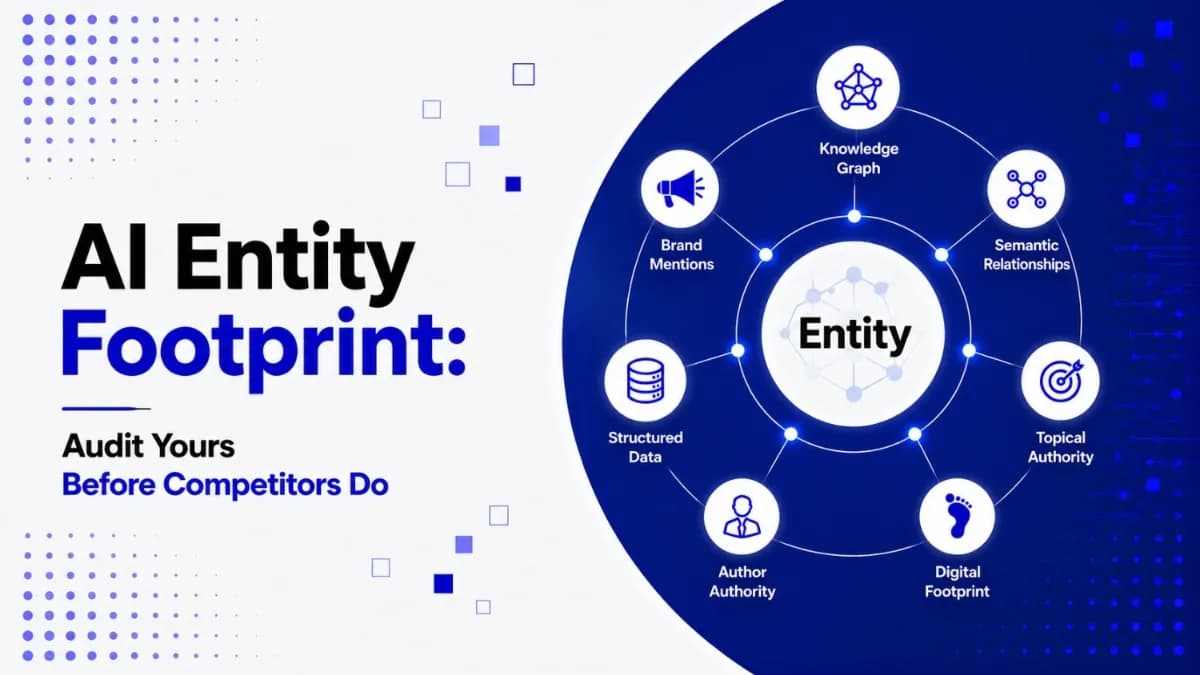
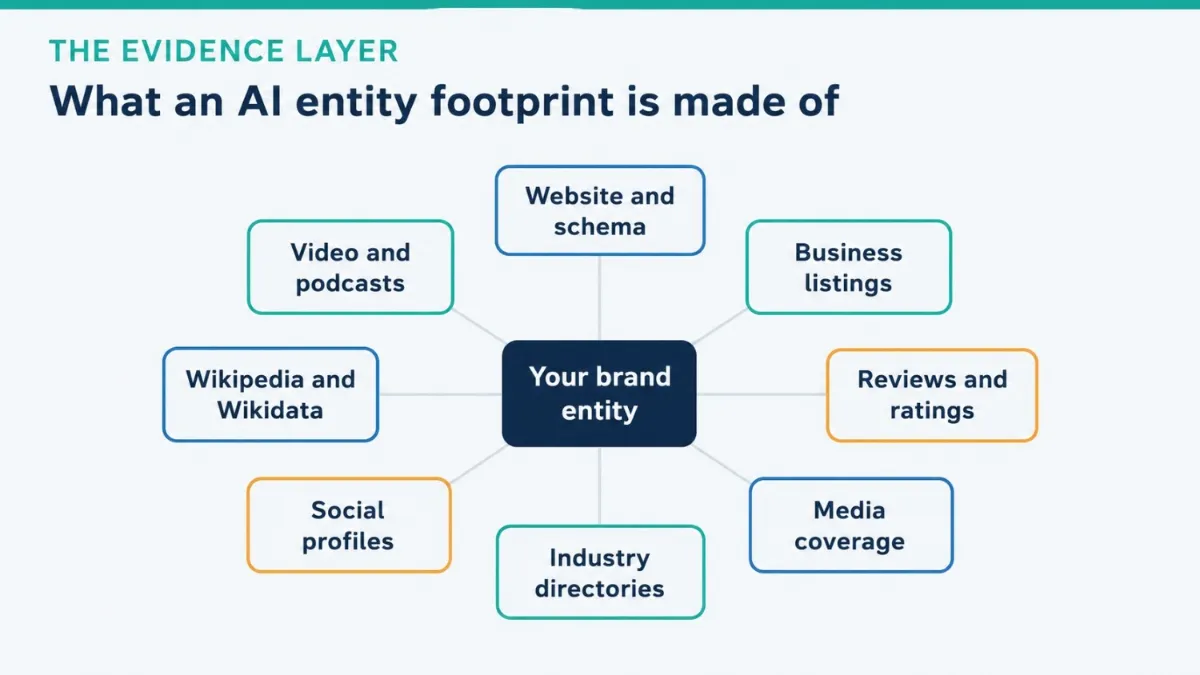
An AI entity footprint is the cumulative body of digital evidence that teaches AI systems who you are, what you do, and whether to recommend you. Every webpage, business listing, review, news article, podcast appearance, video, dataset, and third-party mention contributes a fragment of that understanding.
The word entity matters. AI systems do not process your brand as a keyword to be matched. They treat it as an entity: a distinct thing with attributes, relationships, and a track record that can be cross-checked across sources. Google has worked this way since the Knowledge Graph era, which is why structured data and consistent business facts have long been part of good search engine optimization. What has changed is the consequence. The same entity understanding that once decided a knowledge panel now writes the answer your buyer reads, in full sentences, with a recommendation attached.
One more distinction saves a lot of confusion: the footprint is not a channel you post to. It is the byproduct of everything else you already do, from SEO and PR to reviews and content. The audit does not replace those programs. It measures what they have collectively taught the machines, then tells you where the teaching failed.
Why the Audit Cannot Wait Another Quarter #
The scale argument is settled. OpenAI announced that ChatGPT passed 900 million weekly active users in February 2026, more than double its count a year earlier, and Google now layers AI answers over a large share of its own results pages. AI-mediated answers are a mainstream discovery surface, not an early-adopter experiment.
The behavior argument is just as sharp. Pew Research Center tracked nearly 69,000 real Google searches and found that when an AI summary appeared, users clicked a traditional result on only 8 percent of visits, roughly half the 15 percent rate on pages without one. Just 1 percent clicked a source inside the summary itself. For a growing slice of your market, the AI answer is not a doorway to your site. It is the entire impression.
The visits that do survive are worth more, not less. SEMrush found in 2025 that AI search visitors convert at 4.4 times the rate of traditional organic visitors, because they arrive pre-sold by the answer that sent them. Losing those referrals hurts more than the raw session counts suggest, which is also why pairing this work with conversion rate optimization pays twice.
And the invisibility problem is bigger than most teams assume. When Ahrefs analyzed 75,000 brands in 2025, 26 percent had zero mentions in AI Overviews, while the top quartile of brands by web mentions earned up to ten times more AI mentions than the next tier. Visibility in this channel compounds. Every quarter, a competitor spends strengthening their footprint while you wait, making their version of the category answer harder to displace. That head start is the entire premise of generative engine optimization as a discipline.
Where AI systems Actually Get their Evidence #
Two of the most cited studies in this space appear to contradict each other, and understanding why is the key to a complete audit.
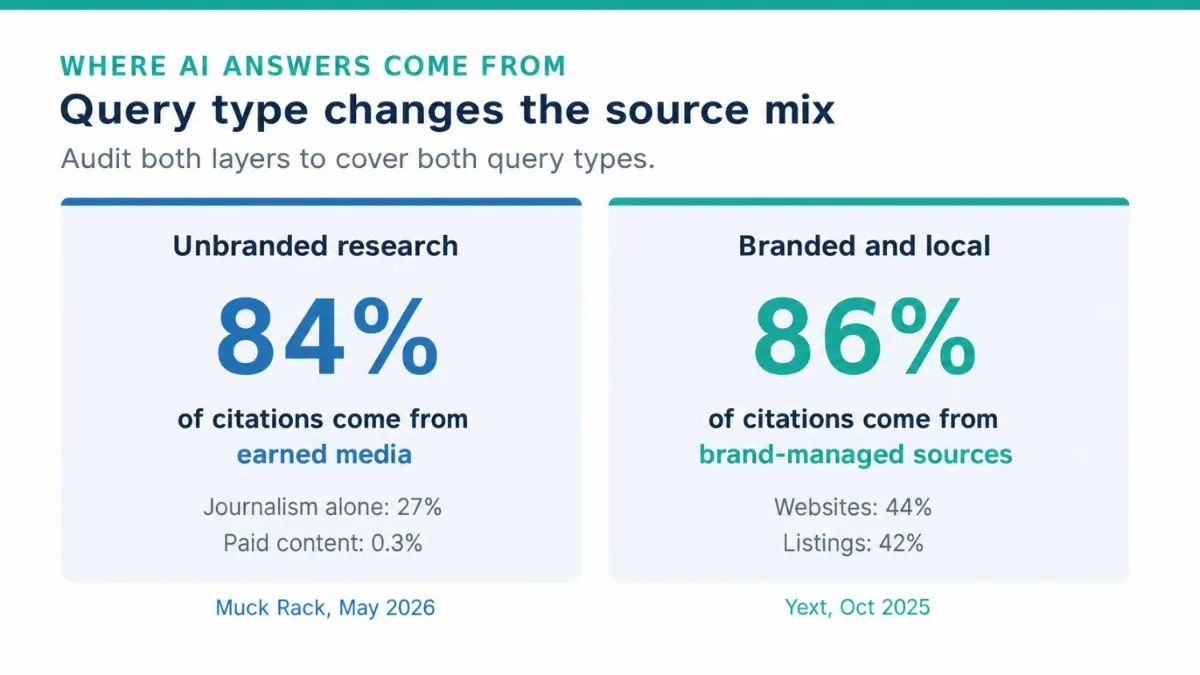
Muck Rack analyzed more than 25 million links cited by ChatGPT, Claude, and Gemini and reported in May 2026 that 84 percent of citations come from earned media, with journalism alone supplying 27 percent and paid placements just 0.3 percent. Meanwhile, Yext analyzed 6.8 million citations in October 2025, anchored to real queries with location and intent, and found 86 percent came from brand-managed sources: first-party websites supplied 44 percent and business listings 42 percent.
Both are right, because they measured different questions. Broad, unbranded research prompts pull heavily from earned coverage, since the AI needs independent voices to compare options. Branded and local prompts pull from the sources you control, since the AI needs operational facts like services, locations, and hours. Your footprint has two layers, and an audit that checks only one will miss half your exposure. The same data holds a useful surprise about community platforms: for all their headlines, forums supplied only about 2 percent of citations in the intent-anchored Yext sample, a reminder to weight your effort by evidence rather than by noise.
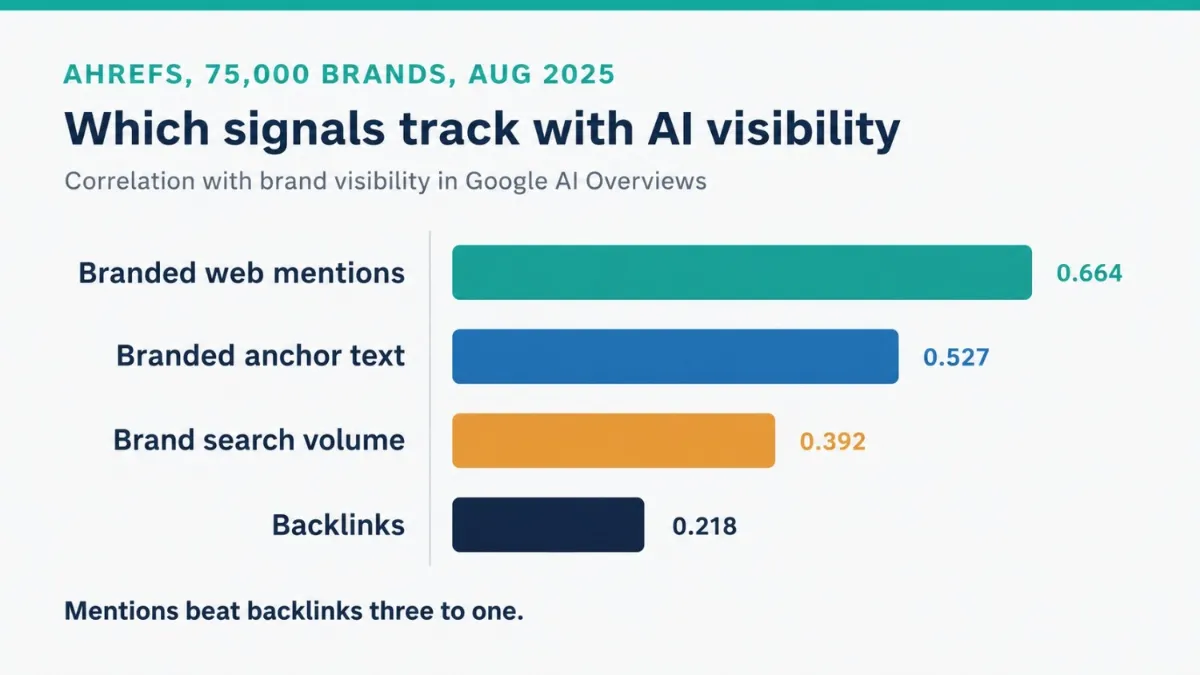
The Ahrefs correlation data shows which signals matter most across that whole evidence base. Branded web mentions, linked or not, correlated with AI Overview visibility at 0.664, roughly three times the 0.218 correlation for backlinks, with branded anchor text at 0.527 and brand search volume at 0.392. Correlation is not causation, and Ahrefs says so itself, but the direction is consistent across every follow-up study: the AI layer rewards being talked about, accurately and often, more than being linked to. Review volume and sentiment feed this same layer, which is where disciplined online reputation management quietly becomes an AI visibility program.
The Seven-Step AI Entity Footprint Audit #
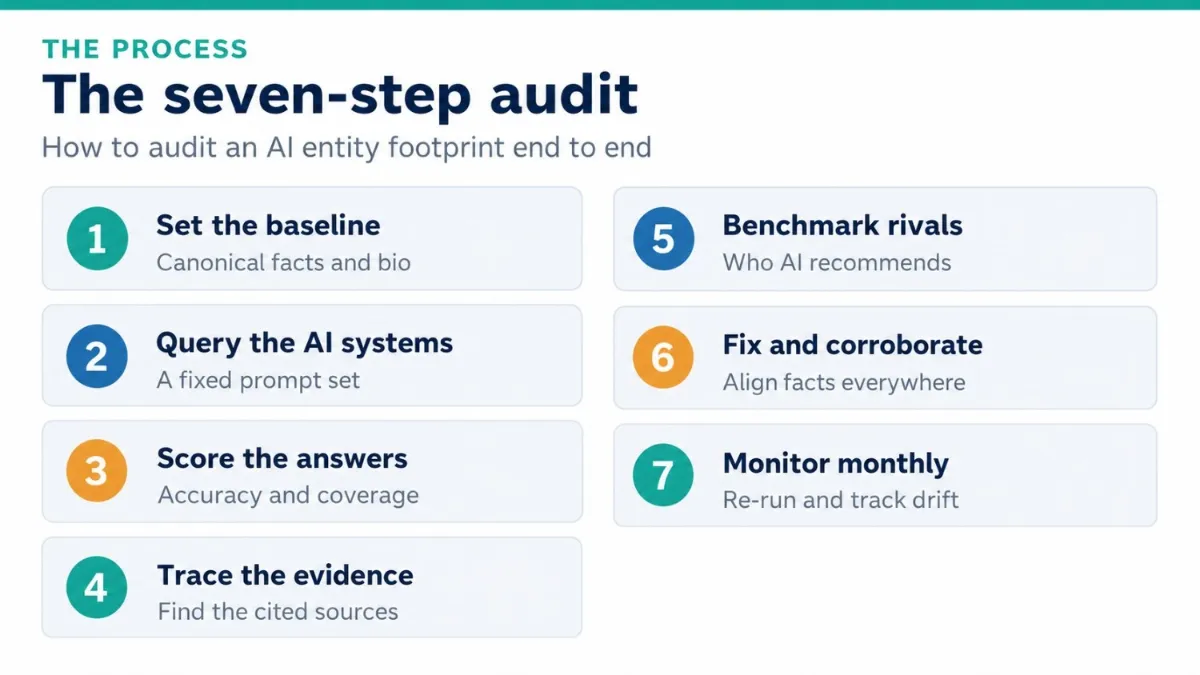
The full audit runs in seven steps. A focused team can complete the first pass in a week and repeat it in an afternoon once the templates exist.
Step 1: Set your entity baseline #
Before you ask the machines anything, write down the correct answers. Document your canonical business name and every variant in circulation, founding facts, leadership, service lines, locations, pricing model, and the two or three claims that genuinely differentiate you. Distill it into a 50-word canonical description. This document is your answer key: every AI response gets graded against it, so disagreements inside your own team surface now instead of mid-audit.
Step 2: Query the AI systems the way buyers do #
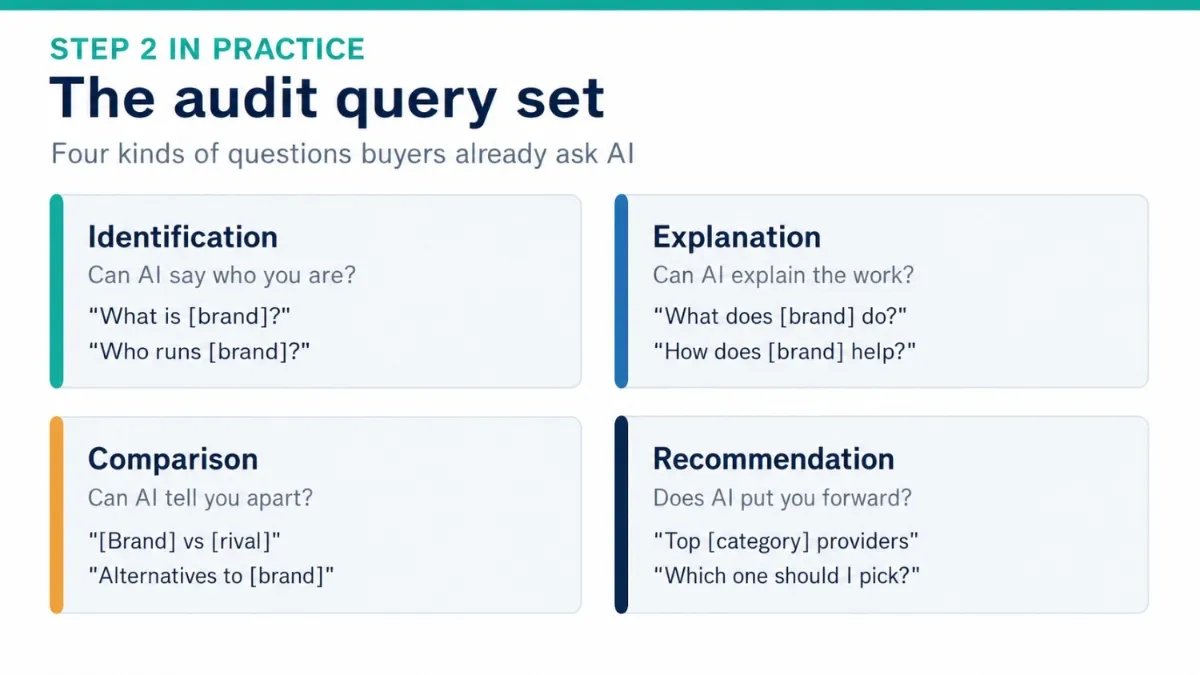
Build a fixed prompt set and run it, unchanged, across ChatGPT, Google AI Overviews and AI Mode, Gemini, Perplexity, and Copilot. Use clean sessions without account history so personalization does not flatter the results, and record every answer verbatim with the date and platform. The prompts fall into four categories: identification, explanation, comparison, and recommendation. The recommendation prompts matter most, because they are where revenue changes hands, and they are the ones teams most often forget to test. Fifteen to twenty-five prompts is enough for a first pass: swap in your real service lines and cities, keep the wording plain, and resist the urge to coach the AI with context a stranger would never provide.
Step 3: Score what comes back #
Grade each answer against the baseline on five dimensions: accuracy of facts, completeness of the service picture, differentiation from competitors, sentiment, and share of voice in recommendation answers. A simple 1 to 5 scale per dimension per platform is enough. Copy any fabricated claim word for word into a hallucination log, because these are your highest-risk findings and the exact text helps you trace where the machine learned it.
Step 4: Trace the evidence behind each answer #
Wherever a platform shows citations, expand them and record which domains supplied each claim. Wrong facts almost always have a findable source: an abandoned directory profile, an old press mention, a stale listing with a defunct address. While you are here, check your own robots.txt and confirm you are not blocking GPTBot, Perplexity Bot, Google-Extended, or other AI crawlers, because a blocked crawler forces the AI to rely entirely on what third parties say about you.
Step 5: Benchmark competitor footprints #
Your AI-era competitors are whoever the machines recommend, and that list often differs from your traditional SERP rivals. For every recommendation prompt, log which brands appear, in what order, and with what supporting evidence: review counts, comparison articles, category listicles, community threads. The gap between their evidence and yours is your build list, and it tells you whether you are losing on facts, on coverage, or on differentiation. Watch for recurring third places as well: if one comparison site backs every rival answer, a complete profile there may be worth more than another post on your own blog.
Step 6: Fix, corroborate, and strengthen #
Now work the findings. Correct conflicting core facts everywhere they live, from your About page to the last directory you forgot existed, because AI systems weigh corroboration: the same fact repeated consistently across many sources earns confidence, while contradictions lower it. Add or repair Organization schema with sameAs links so your scattered profiles resolve into one verifiable entity. Then feed the earned layer deliberately: publish original data worth citing, pursue coverage in the publications your audit showed the machines already trust, and brief your content writing services partner or in-house team to structure key claims in short, liftable, source-backed passages that AI systems can quote cleanly.
Step 7: Put monitoring on a monthly cadence #
AI answers drift as models update and new sources enter the mix, so a one-time audit expires quickly. Re-run the identical prompt set monthly, track your accuracy score, share of voice, and sentiment over time, and treat any new hallucination as an incident with an owner and a deadline. The fixed prompt set is what turns a subjective impression into a metric your leadership can follow.
What to Fix First #
A first audit typically surfaces more findings than any team can action at once. Sort them by business impact and effort, and the plan writes itself.
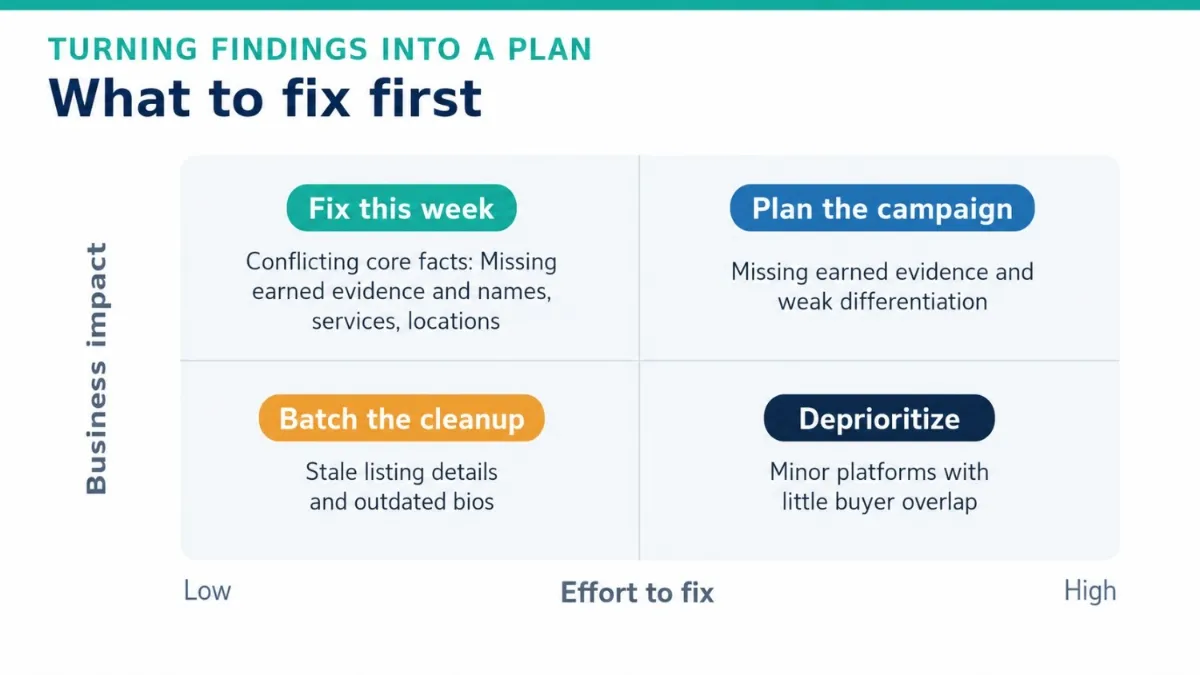
Conflicting core facts, such as wrong services, locations, or leadership, are high impact and low effort: fix them in week one. Stale listing details are a batch cleanup job. Missing earned evidence and weak differentiation are your real campaign, built over a quarter of PR, original research, and review generation. Gaps on minor platforms your buyers never touch can wait indefinitely. In practice a simple sequence works: week one for fact corrections, weeks two through four for the listing and schema cleanup, then a rolling quarter for earned coverage, reviews, and differentiation content, with the monthly prompt re-run keeping score.
One more finding should shape how you staff this. The SEMrush 2026 AI Visibility Index, built on 126 million United States AI prompts analyzed between January and April 2026, found that 81 percent of organizations that run SEO and AI visibility as one integrated workflow reported increased traffic or leads from AI platforms, against 36 percent of those managing them separately. The audit belongs inside your existing search program, not in a silo beside it, which is exactly how mature AI SEO services are structured.
Frequently Asked Questions #
What is an AI entity footprint?
It is the complete body of online evidence, including your website, listings, reviews, coverage, and third-party mentions, that AI systems use to understand and describe your business.
How is this different from an SEO audit?
An SEO audit checks how individual pages perform in rankings. An entity footprint audit checks what understanding all your assets create together inside AI-generated answers.
Which AI platforms should I audit?
At minimum, ChatGPT, Google AI Overviews and AI Mode, Gemini, Perplexity, and Copilot, because each one weighs different sources and can describe you differently.
How often should I re-run the audit?
Run the full audit quarterly and the fixed prompt set monthly, since AI answers drift as models and sources update.
Do backlinks still matter for AI visibility?
They still support rankings, but Ahrefs found branded web mentions correlate with AI visibility at 0.664 versus 0.218 for backlinks, roughly a three-to-one gap.
Why does AI describe my business incorrectly?
Wrong answers usually trace to conflicting or stale facts across your listings and profiles. AI systems weigh corroboration, so inconsistency lowers both confidence and accuracy.
Does schema markup improve AI visibility?
Yes. Organization schema with sameAs links ties your scattered profiles into one verifiable entity that machines can confirm against other sources.
How long until AI descriptions change after fixes?
Platforms that retrieve live web data can reflect corrections within weeks. Facts baked into model training take longer, which is why consistency now pays later.
Can a small business compete with big brands in AI answers?
Yes, especially on branded and local queries, where Yext found 86 percent of citations come from sources businesses directly control.
Which tools help track AI visibility?
Ahrefs Brand Radar, the SEMrush AI Visibility Toolkit, Muck Rack Generative Pulse, and Yext Scout all track AI mentions, and a manual prompt log works fine to start.