
AI Max vs Search Campaigns: Which Delivers Better ROI?

Tuba
July 16, 2026
Table of Contents
- Key Takeaways
- AI Max or Keyword Search: Where the Better Return Actually Comes From
- What AI Max Actually Is
- How AI Max Decides Where to Show Your Ads
- The Control Trade-Off
- What the ROI Data Actually Says
- Why the Average Hides the Truth
- When AI Max Wins, and When it Does Not
- The Safe Way to Test it
- Measure the Thing that Pays, Not the Thing that Moves
- So Which Delivers Better ROI?
- Frequently Asked Questions
Key Takeaways #
AI Max is a reach-and-automation layer that reliably finds more queries and, for the median advertiser, charges more to convert them. Standard Search is a precision tool that protects efficiency but leaves untapped demand on the table. The better return does not come from picking a camp. It comes from knowing which problem you actually have, testing against a real baseline, and keeping only the settings that drive profit, not just volume.
AI Max or Keyword Search: Where the Better Return Actually Comes From #
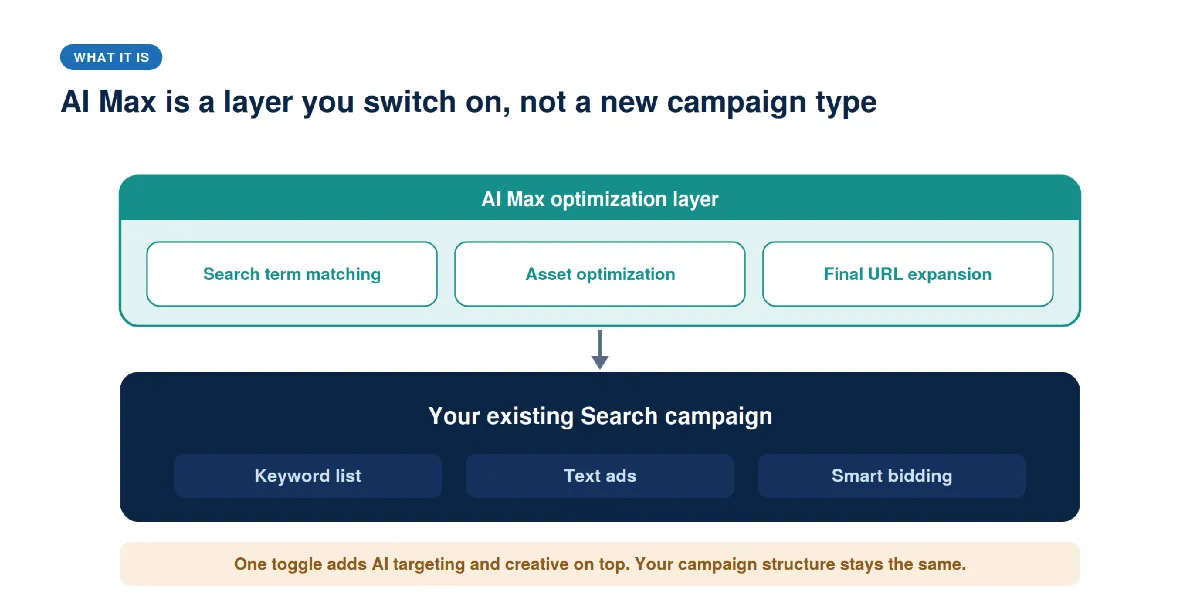
The phrase “AI Max vs Search campaigns” has a trap built into it. AI Max is not a rival campaign type you choose instead of Search. It is a set of AI features you switch on inside a Search campaign you already run. So the useful question is narrower: does turning AI Max on earn more profit than leaving your keyword-driven campaign as it is? Google says yes, by a comfortable margin. Independent data says sometimes, and it depends. Here is what both sides show, and how to decide for your own pay-per-click management setup.
What AI Max Actually Is #
AI Max for Search is an optimization layer, not a new campaign. Switch it on and three things change. Search term matching uses broad match and keyword-less technology to reach queries your keyword list would miss. Asset optimization lets AI generate headlines and descriptions from your pages and existing ads, which is why your ad copywriting guardrails start to matter more, not less. And final URL expansion can route a click to a more relevant page than the one you set, so weak landing page design gets exposed fast. Everything else about your campaign stays put.
That distinction decides how you should read every ROI number that follows. You are not comparing two products. You are comparing your campaign with the layer off against the same campaign with the layer on.
How AI Max Decides Where to Show Your Ads #
Two engines drive the matching, and only one of them starts from your keywords. The first expands your existing terms outward, treating an exact-match keyword as if it were also broad. The second is keyword-less: it reads your landing pages and ad content directly and matches queries on what the model thinks your business is about. The same March 2026 analysis found that these two arms split traffic roughly in half, meaning about 50% of AI Max matching is not driven by your keyword list at all.
That reframes the ROI question. You are no longer buying clicks against words you chose. You are buying clicks against a model’s reading of your site, and the next conversion it finds tends to cost more than the last. Google’s own liaison has described this as the cost of incrementality: once your curated keywords already capture high-intent demand, additional volume comes from broader, less efficient queries. More reach is real. Cheaper reach is not the promise.
The Control Trade-Off #
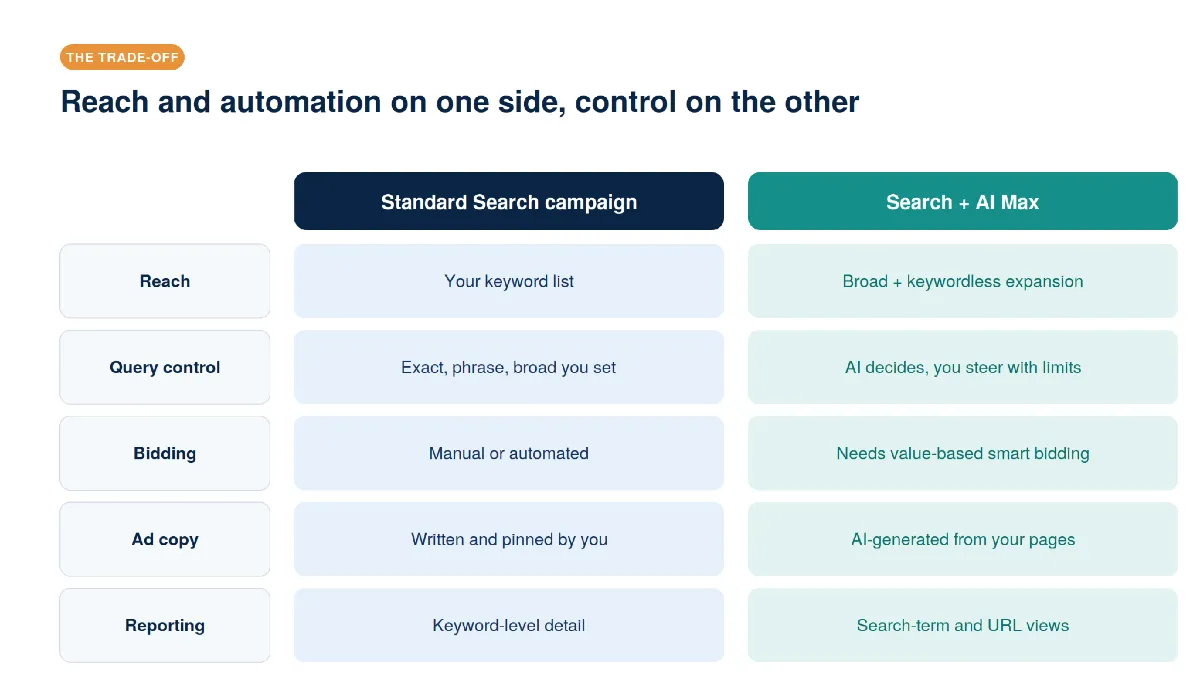
Standard Search rewards precision. You choose the keywords, you see performance at the keyword level, and you write the ad copy. AI Max trades some of that granular control for reach into queries you never listed. It also changes the rules quietly. It treats your keywords more like broad match regardless of the match type you assigned, a pattern confirmed across a million-impression analysis published in March 2026. And its search-term matching relies on value-based smart bidding, so manual CPC strips out most of the benefit, as Google states plainly in its own help documentation.
Google has handed back some of that control. Text guidelines, available globally to advertisers in early 2026, let you exclude specific terms and set a tone so that AI-written copy stays on-brand and compliant, and brand controls let you include or exclude the brands your ads appear alongside. Those levers matter, but they are guardrails on an automated system, not the direct steering you get from a keyword. If your edge is a tightly controlled, high-intent keyword set feeding disciplined conversion rate optimization, then that precision is exactly what AI Max loosens. Reach is not free. It is paid for in control.
What the ROI Data Actually Says #
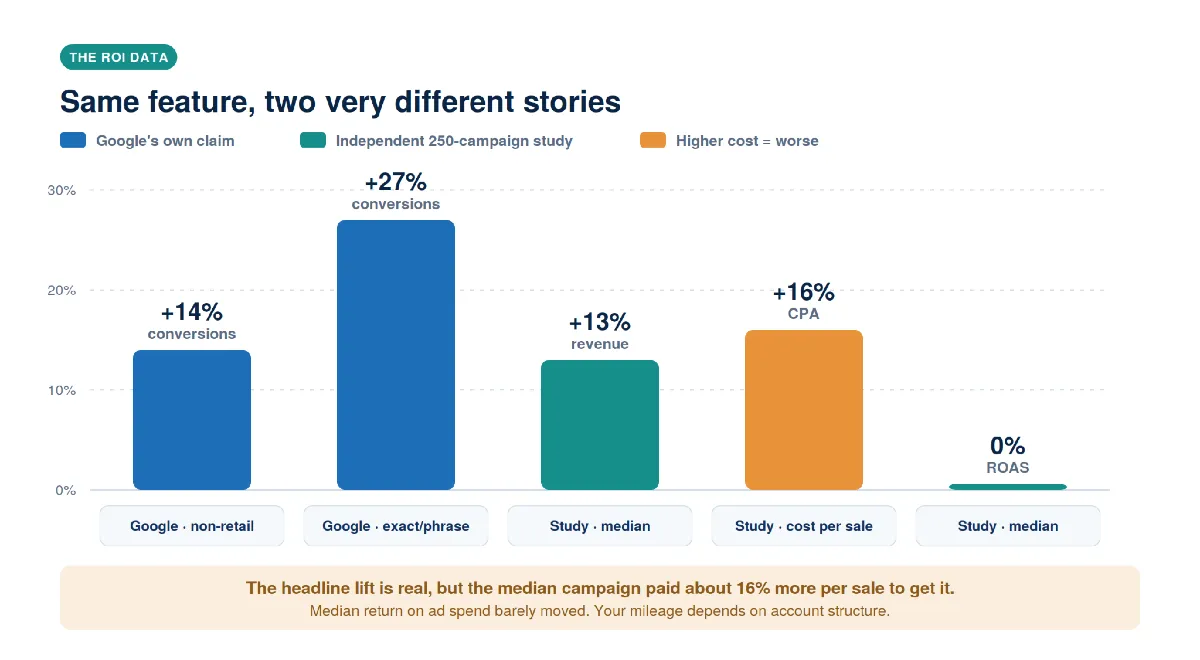
Google’s headline is up 14%. Advertisers who switch on AI Max typically see 14% more conversions or conversion value at a similar CPA or ROAS, rising to 27% for campaigns still leaning on exact and phrase match, according to Google’s May 2025 announcement. Its case studies go further. In January 2026 case data, ClickUp reported a 20% lift in incremental conversions, 16% higher incremental ROAS and a 22% lower CPA after scaling AI Max across more than 400 campaigns, and a Royal Canin A/B test in the Czech Republic drove a 263% jump in conversions at 73% lower CPA on the same spend.
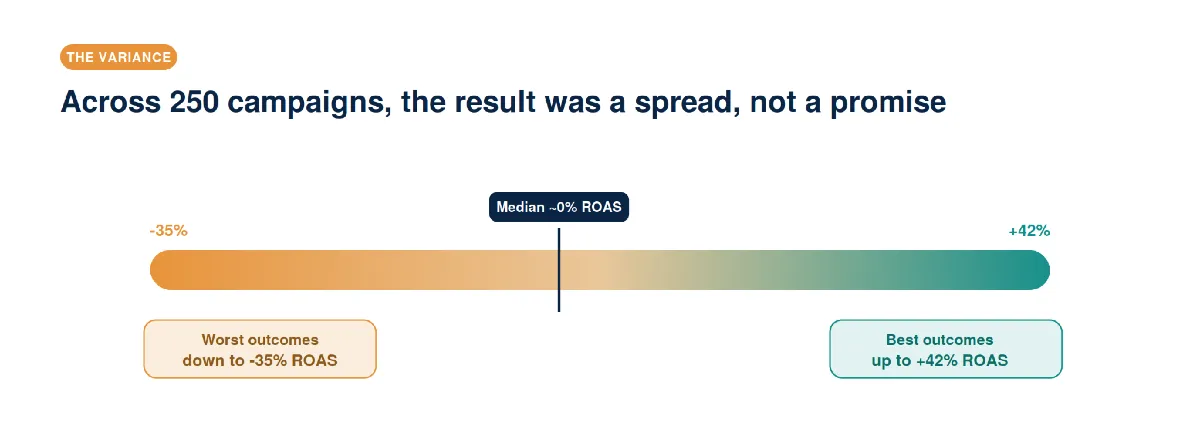
Then the independent numbers arrived. An analysis of more than 250 retail campaigns by Smarter Ecommerce, published in early 2026, found a median revenue uplift of 13%, close to Google’s figure, but a median CPA increase of 16% and a median change in ROAS of roughly zero. The lift is real. For the middle campaign, the efficiency is not. That gap matters most for ecommerce advertising, the exact vertical Google left out of its own 14% claim.
Even Google’s own number softened with scale. When AI Max moved out of beta in April 2026, the company reported an average of 7% more conversions or conversion value at a similar CPA or ROAS for accounts using the full feature suite, down from the 14% quoted during the beta, when many testers were working directly with Google representatives. General rollout results tend to be lower than early-access results, which is worth remembering whenever a platform quotes its own benchmark.
Why the Average Hides the Truth #
A median can flatter. The same study reported outcomes ranging from a 42% gain in ROAS to a loss of about a third, a spread Search Engine Land covered in March 2026. Switching AI Max on is not a guaranteed lift. It is a bet whose payoff depends on your account.
Part of the reason is cannibalization. Up to 63% of the “new” queries AI Max found were recycling coverage the account’s existing keywords already had, so the extra budget bought traffic the campaign was winning anyway. Expansion can also drift somewhere expensive. In one documented account, AI Max drove more than 8,000 impressions to a single competitor’s brand terms, compared to just 77 from traditional broad match, until competitor queries accounted for 69% of Search impressions. Reach without intent is just cost.
Where the traffic runs is the other quiet leak. In the same dataset, one account converted Search Partner Network traffic at 0.07%, compared with 3.04% on Google Search itself, which is why many practitioners now exclude Search Partners by default. Adoption has stayed cautious for exactly these reasons. Months after launch, most advertisers were still testing rather than committing budget, and few had gone all in. That is not fear of automation. It is a rational response to a spread this wide.
When AI Max Wins, and When it Does Not #
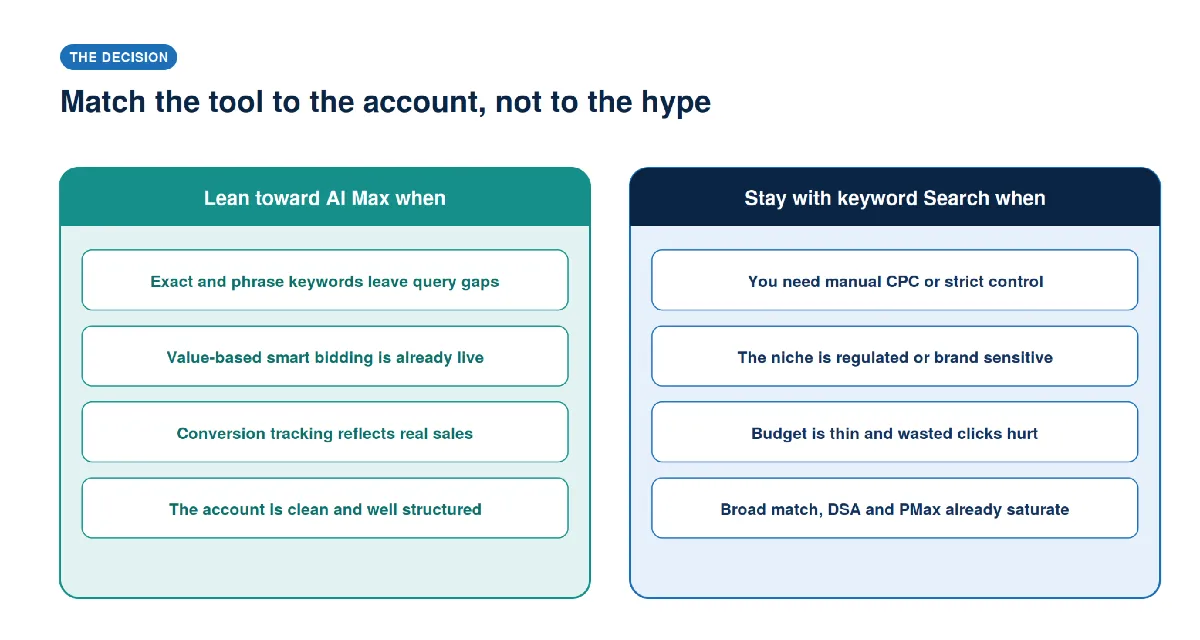
A pattern runs through all of this. AI Max earns its keep where there is genuine, untapped coverage to find: campaigns that are still heavy on exact and phrase keywords, with value-based bidding, clean conversion tracking, and room to grow. Those are the accounts with gaps for the AI to fill profitably.
It's disappointing when the account is already saturated with broad match, Dynamic Search Ads, and Performance Max, because little new ground remains, so the layer mostly cannibalizes and inflates costs. It is also a poor fit for regulated or brand-sensitive niches, thin budgets where every wasted click stings, and lead-gen accounts that only measure form fills rather than qualified leads, where the AI cheerfully optimizes for cheap volume over quality.
There is an irony worth naming. The advertisers most eager to switch AI Max on are usually the ones already running aggressive automation, and those are precisely the accounts Google’s own data says will see the smallest incremental gain. The clean, keyword-disciplined account with obvious coverage gaps stands to benefit most, yet it is often the last to try it. If you want to know which group you are in, look at how much of your Search spend already flows through broad match and automated expansion. The more it does, the less new territory there is for AI Max to find.
The Safe Way to Test it #
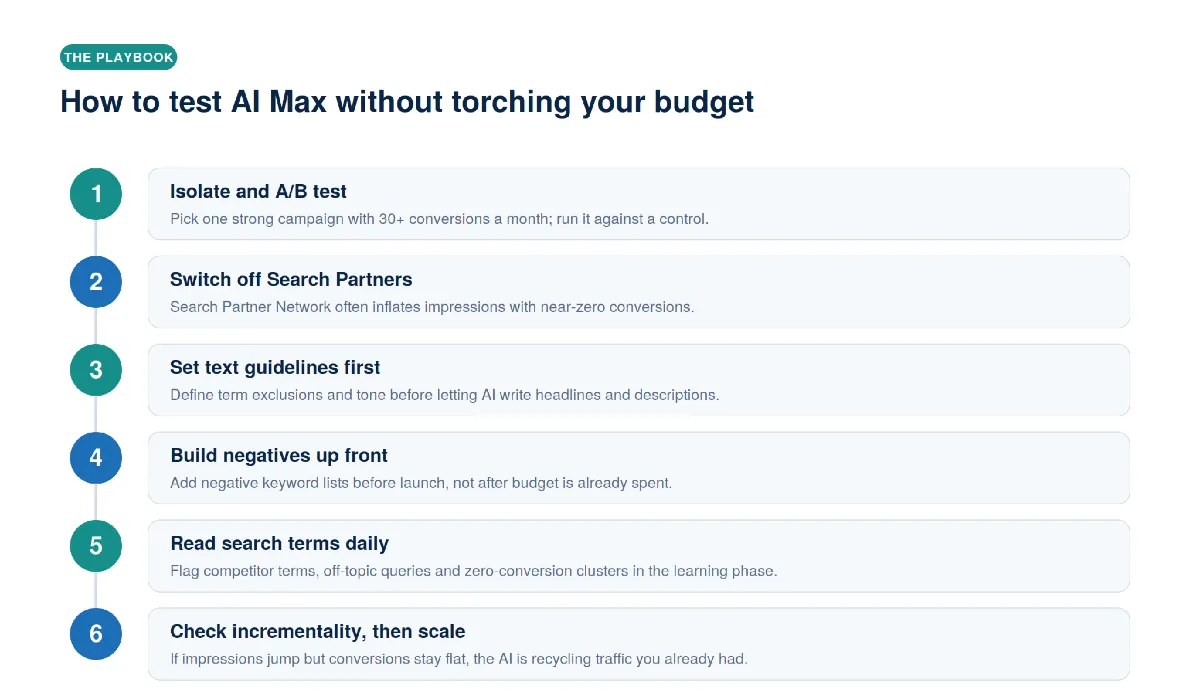
Treat AI Max as an experiment, not a switch you flip account-wide. Isolate one strong campaign with at least 30 conversions per month and run it against a control for 2 to 4 weeks. Turn off the Search Partner Network, which repeatedly shows up as impression volume with almost no conversions. Set text guidelines before you let AI write copy, so headlines stay on brand and compliant.
Build your negative keyword lists before launch, because adding them afterward means paying for the lesson first. Read the search terms report daily during the learning phase, and quickly cut competitor terms, off-topic queries, and zero-conversion clusters. Then check incrementality before you scale. If impressions jump but conversions stay flat, the AI is claiming traffic you already had rather than finding new demand.
Measure the Thing that Pays, Not the Thing that Moves #
Most disappointing AI Max results trace back to a measurement gap, not a targeting one. If your conversion signal is a form fill or a raw lead, the AI will faithfully find you more of them at a lower cost per lead, while cost per qualified lead quietly climbs. Feed it thin data, and it optimizes for cheap volume, because that is the only goal it can see.
So before the test tells you anything trustworthy, the plumbing has to be right. Track down-funnel outcomes, not just clicks: qualified leads, revenue, and where possible profit fed back into value-based bidding. Compare total impressions and conversions before and after you enable the layer to separate incremental growth from recycled coverage. Judged on volume alone, AI Max almost always looks like a win. Judged on the metric that actually pays the bills, it earns a much more honest verdict.
So Which Delivers Better ROI? #
Neither wins by default, because they are not really opponents. For a well-structured account with coverage gaps, value-based bidding, and clean data, switching AI Max on tends to add profitable volume; the smart move is to test it and keep what works. For a tightly controlled, high-intent or budget-limited account, a disciplined keyword campaign usually protects return better, and AI Max mostly adds cost dressed up as reach.
The feature that delivers better ROI is the one that matches your account’s shape, and the only way to know yours is a clean, controlled test with efficiency watched as closely as volume. That discipline is the same one that keeps organic search strategy and paid search working together, not against each other. Google is also removing the choice over time: Dynamic Search Ads, automatically created assets, and campaign-level broad match are being folded into AI Max through 2026 and into 2027, so learning to steer it now is worth more than debating whether to do so.
Frequently Asked Questions #
Is AI Max a replacement for Search campaigns?
No. It is a feature layer you switch on inside an existing Search campaign, not a separate campaign type.
Does AI Max really deliver 14% more conversions?
Google reports a typical 14% lift, and 27% for exact and phrase-heavy accounts, but independent data shows results ranging from strong gains to real losses.
Does AI Max improve ROAS?
Often not. An independent 250-campaign study found that median ROAS barely changed, while CPA rose by about 16%.
Does AI Max work with manual CPC bidding?
Not fully. Its search term matching relies on value-based smart bidding, so manual CPC strips out most of the benefit.
Will AI Max show my ads on competitor terms?
It can. Expansion has been documented pushing heavily into competitor brand queries, so tight negatives and monitoring are essential.
Who benefits most from AI Max?
Accounts still heavy on exact and phrase keywords with real coverage gaps, clean conversion tracking, and value-based bidding.
Who should be cautious with AI Max?
Regulated or brand-sensitive niches, thin budgets, and accounts already saturated with broad match, DSA, and Performance Max.
How is AI Max different from Performance Max?
Performance Max runs across all Google channels. AI Max stays inside Search and keeps far more control and transparency.
Do I have to adopt AI Max eventually?
Increasingly yes. Google is folding Dynamic Search Ads, automatically created assets, and broad match settings into AI Max through 2026 and 2027.
What is the safest way to test AI Max?
Run it on one strong campaign against a control, exclude Search Partners, set negatives up front, and watch CPA and ROAS, not just conversions.