ChatGPT Ads: What's New, What They Cost & How to Use Them

Tuba
September 22, 2026
Table of Contents
- Key Takeaways
- ChatGPT Ads in 2026: What's Changed, What a Click Really Costs, and How to Run Your First Test
- What Are ChatGPT Ads?
- What's New in ChatGPT Ads: The 2026 Timeline
- Who Sees ChatGPT Ads, and Who Never Will
- How Much Do ChatGPT Ads Cost?
- Which Businesses Can Advertise on ChatGPT?
- How to Use ChatGPT Ads: A 30-Day Test Plan
- ChatGPT Ads and GEO: Buy the Placement, Earn the Answer
- Risks and Open Questions
- Frequently Asked Questions
- The Bottom Line
Key Takeaways #
ChatGPT Ads went from a US test on February 9, 2026, to a $1 billion annualized revenue run rate in under 200 days, with tens of thousands of advertisers, according to OpenAI's August 31 update.
Self-serve buying through Ads Manager is open in 56 countries as of September 18, 2026, including the US, UK, UAE, Saudi Arabia, India, and most of Europe.
Launch-era gates of roughly $60 CPM and a $200,000 minimum commitment have given way to a $25 minimum daily budget for USD-billed accounts and a choice of CPM, CPC, or conversion-optimized bidding.
OpenAI suggests a $3 to $5 starting maximum CPC, but published advertiser results range from under $3 to nearly $23 per click, and OpenAI says it has no cross-advertiser benchmarks yet.
Ads reach Free and Go users only. Plus, Pro, Business, Enterprise and Edu accounts, under-18 accounts and sensitive conversations are excluded.
Healthcare, legal and financial advertisers need case-by-case US approval, and health and legal services ads outside the US are currently prohibited.
On September 16, OpenAI added Sponsored Agents (in test), an Ads Manager plugin inside ChatGPT, AI creative tools, and HubSpot and Shopify integrations.
ChatGPT Ads in 2026: What's Changed, What a Click Really Costs, and How to Run Your First Test #
In January 2026, buying an ad inside ChatGPT meant a six-figure commitment and a conversation with OpenAI's sales team. Eight months later, a business in Chicago, London, Dubai or Mumbai can sign up for Ads Manager, set a daily budget from the local minimum and submit a campaign for review.
The growth has been just as steep. On August 31, 2026, OpenAI reported that ChatGPT Ads had reached a $1 billion annualized revenue run rate in less than 200 days after launch, that tens of thousands of advertisers now use the platform, and that the ad-supported free tier helps keep ChatGPT available to more than 1 billion weekly active users. A run rate projects the latest period's revenue across a full year, so read it as momentum rather than money already booked.
Speed like that makes the channel hard to ignore and easy to misjudge. Here's what's new, what advertisers actually pay, who can advertise, and a 30-day plan for a first test that ends in a clear decision.
What Are ChatGPT Ads? #
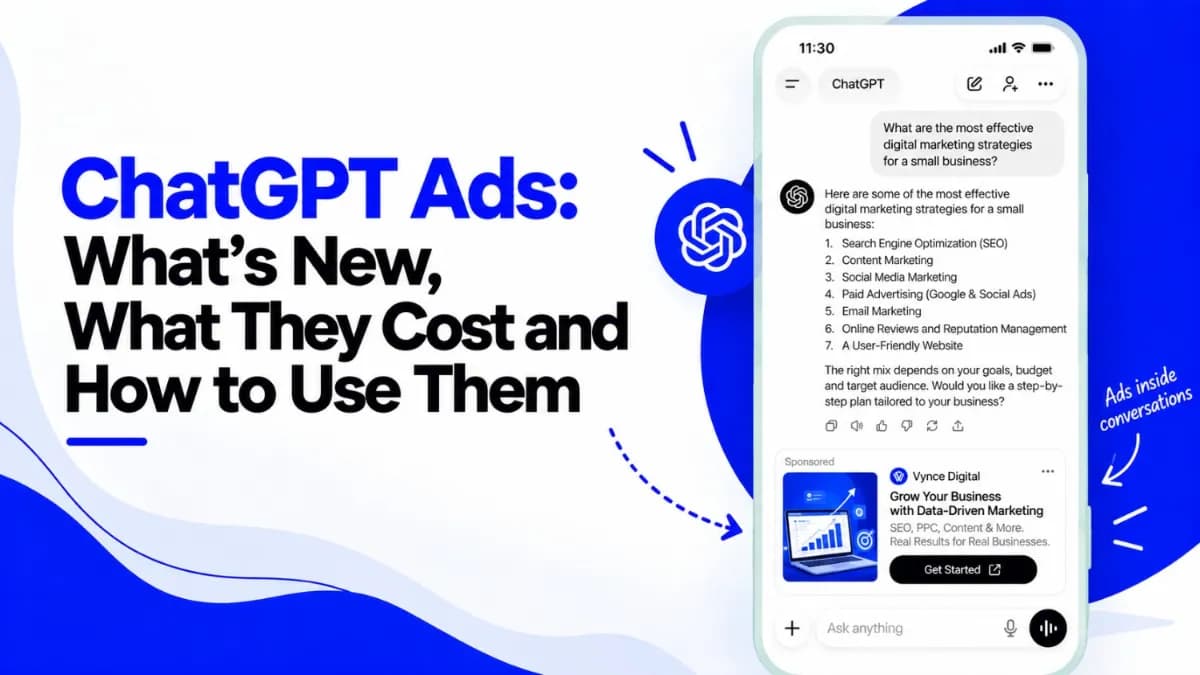
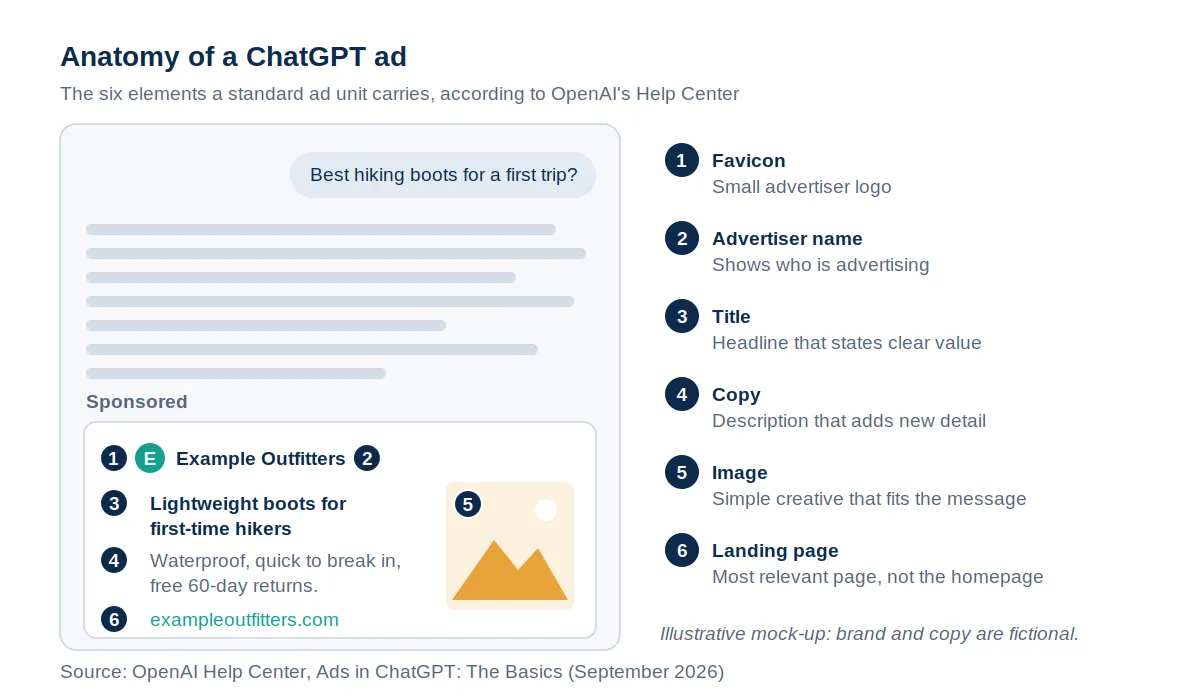
ChatGPT Ads are paid placements that appear below ChatGPT's responses for users on the Free and Go plans. Every unit is labeled as sponsored and visually separated from the answer. According to OpenAI's advertiser documentation, a standard ad carries six elements: the advertiser name, a favicon, a headline, a short description, an image, and a landing page.
Matching works differently from paid search and search engine optimization, where keywords drive the results. There are no keywords to buy. OpenAI's system weighs the conversation's context and intent, the ad's landing page and copy, optional context hints from the advertiser, and, where users allow it, signals from their wider ChatGPT activity. A relevance-weighted, second-price auction then decides which eligible ad appears, so match quality counts alongside the bid.
Two commitments sit underneath the product. OpenAI states that ads do not influence ChatGPT's answers and that advertisers never receive users' chats, chat history, memories, or personal details, only aggregated results such as views and clicks.
What's New in ChatGPT Ads: The 2026 Timeline #
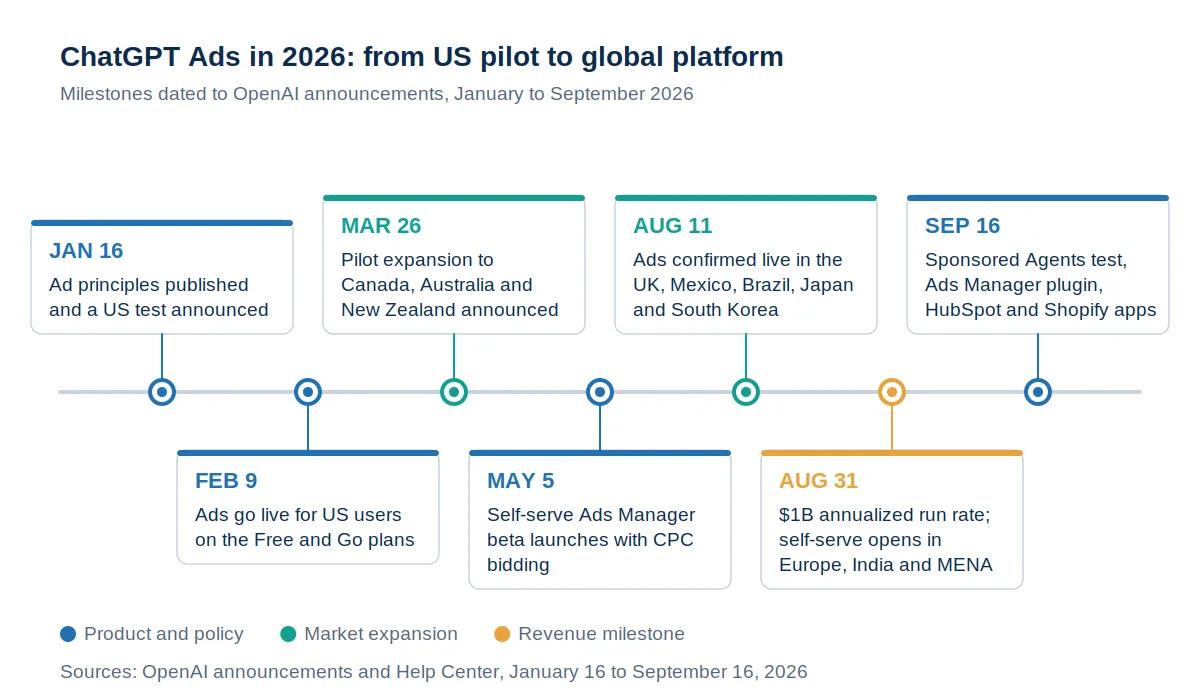
Almost every part of the platform changed between February and September. Figure 1 maps the milestones, and the sections below explain what each one means for advertisers.
Self-serve Ads Manager and CPC bidding arrive (May 2026) #
OpenAI published its advertising principles on January 16, 2026, and began testing ads in the US on February 9, with a small group of advertisers and partners. On May 5, it opened a beta self-serve Ads Manager and added cost-per-click bidding next to the original CPM buying, with OpenAI's Pixel and Conversions API measuring purchases, leads, and sign-ups after a click.
Outcome-based buying becomes the norm (summer 2026) #
Conversion-optimized campaigns now let advertisers pick one standard conversion event and pay either per valid click (oCPC) or per 1,000 impressions (oCPM). OpenAI also made Maximize results, an automated bid strategy, the default for eligible new ad groups. By August 31, OpenAI said CPC and outcome-optimized bidding accounted for most campaigns, with product feeds, platform and geographic targeting, and custom audiences (at least 25,000 matched users for inclusion) all available.
Global expansion to 56 self-serve countries #
Pilots expanded to Canada, Australia and New Zealand in the spring, and on August 11 OpenAI confirmed that ads had launched in the UK, Mexico, Brazil, Japan and South Korea. Next came 31 European countries, sold first through OpenAI's sales team and partners and then, from August 31, through self-serve, which opened the same day across India, the Middle East and North Africa. As of September 18, 2026, OpenAI's availability page lists 56 countries where businesses can buy directly. The legal entity that advertises and is billed must be based in one of them.
Region | Self-serve countries | Count |
|---|---|---|
North America | Canada, Mexico, United States | 3 |
South America | Brazil | 1 |
Europe (EU, EEA, UK, Switzerland) | Austria, Belgium, Bulgaria, Croatia, Cyprus, Czech Republic, Denmark, Estonia, Finland, France, Germany, Greece, Hungary, Iceland, Ireland, Italy, Latvia, Liechtenstein, Lithuania, Luxembourg, Malta, Netherlands, Norway, Poland, Portugal, Romania, Slovakia, Slovenia, Spain, Sweden, Switzerland, United Kingdom | 32 |
Middle East and Turkey | Bahrain, Iraq, Israel, Jordan, Kuwait, Lebanon, Oman, Qatar, Saudi Arabia, Turkey, United Arab Emirates | 11 |
North Africa | Algeria, Egypt, Morocco, Tunisia | 4 |
Asia-Pacific | Australia, India, Japan, New Zealand, South Korea | 5 |
Total | 56 |
Source: OpenAI Help Center, Ads Manager Availability, read September 18, 2026. Regional grouping is ours.
September 16: Sponsored Agents, AI tools and new integrations #
Two days before this update, OpenAI announced its largest advertiser release since self-serve:
Sponsored Agents, in test with select US advertisers. After clicking an ad, a user can open a clearly labeled conversation with a business-sponsored agent, kept separate from ChatGPT's own answers, then visit the site.
An Ads Manager plugin in ChatGPT. Advertisers can create, update, and analyze campaigns with plain-language prompts.
AI creative help. Ads Manager suggests copy and imagery from your landing page, and an opt-in setting adapts headlines to the conversation and translates them.
HubSpot and Shopify integrations. HubSpot customers can create ads and follow up on leads inside HubSpot. US Shopify merchants can run campaigns through the ChatGPT Ads app, which OpenAI says reaches other ChatGPT Ads markets from September 23.
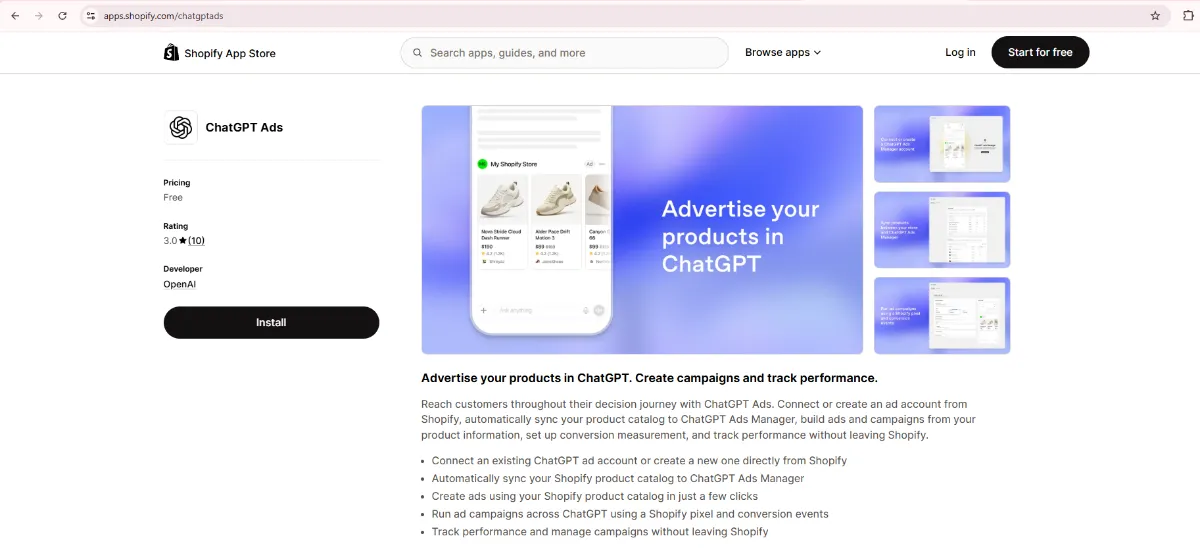
The ChatGPT Ads app listing in the Shopify App Store[19 Sep 2026]
Who Sees ChatGPT Ads, and Who Never Will #
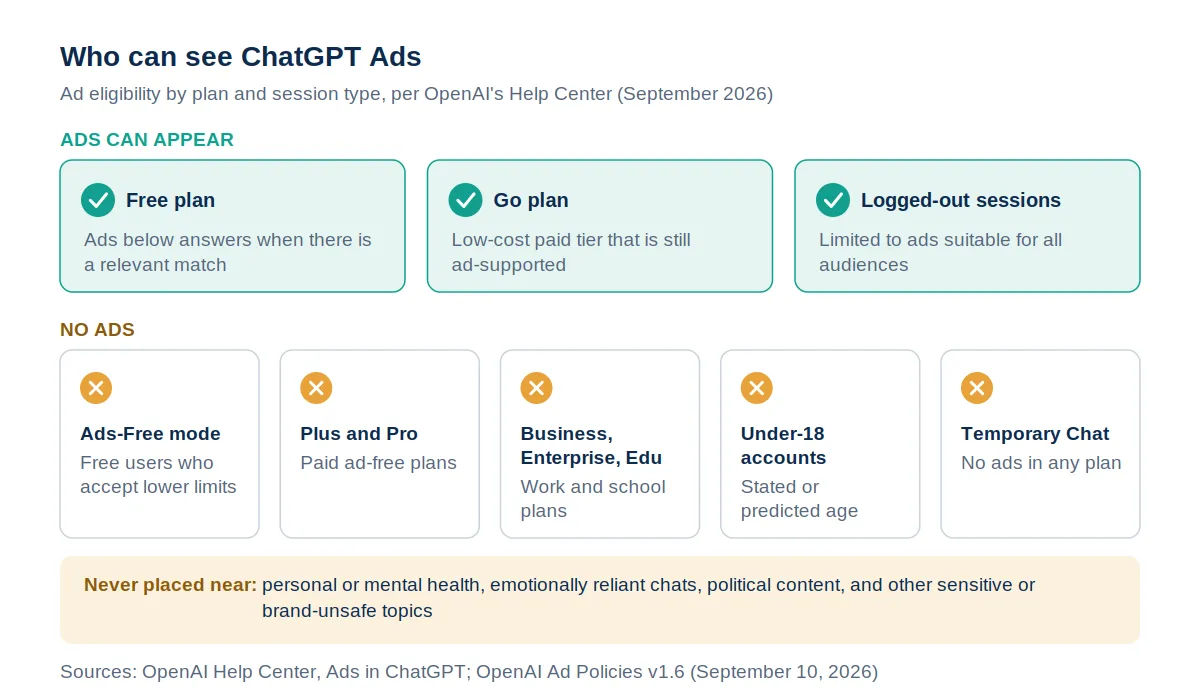
The ad-eligible audience is smaller than ChatGPT's headline user count. Ads can appear for Free and Go users, while Plus, Pro, Business, Enterprise, and Edu accounts never see them. OpenAI also excludes accounts it identifies as belonging to people under 18, using stated age and an age-prediction model. Temporary Chats carry no ads, and any ads shown in logged-out sessions are limited to content suitable for all audiences.
Users have real controls. Free users can switch to an Ads-Free mode with lower message limits and fewer tools, and anyone can turn off ad personalization, hide or report an ad, see why it appeared, and clear their ad data. Personalized ads are not initially available in the European Economic Area or Switzerland.
Placement rules add another filter. Under OpenAI's ad policies, ads are kept away from sensitive user contexts, such as mental and personal health conversations and emotionally reliant exchanges, and from brand-unsafe topics, including political content, hate, violence, and regulated goods.
For sizing, the most useful public signal is still from March, when an OpenAI spokesperson said roughly 85% of US Free and Go users were eligible for ads, but fewer than 20% saw one on a given day, as reported by Campaign Asia. Delivery has expanded since, yet ads still appear only when the system finds a relevant match.
How Much Do ChatGPT Ads Cost? #
From a $200,000 minimum to $25 a day #
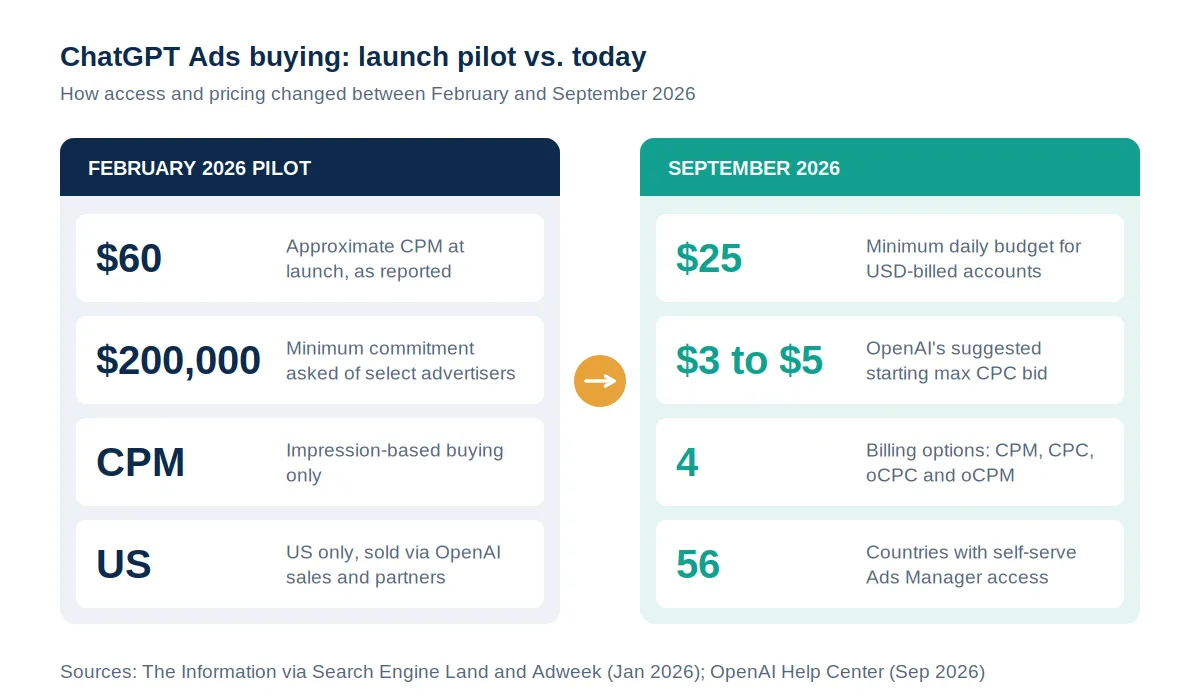
At launch, access was by invitation and priced at a premium. Reporting by The Information in January 2026 put the rate at roughly $60 per 1,000 impressions, and OpenAI confirmed to Adweek that it was asking select advertisers to commit at least $200,000.
Self-serve buyers now face no commitment, only a minimum daily budget, which OpenAI's campaign guide sets by billing currency:
Billing currency | Minimum daily budget | Billing currency | Minimum daily budget |
|---|---|---|---|
USD | 25 | GBP | 15 |
EUR | 15 | CAD | 25 |
AUD | 25 | AED | 65 |
SAR | 50 | INR | 725 |
Source: OpenAI Help Center, Create Campaigns for ChatGPT Ads, read September 18, 2026.
A daily budget averages over a Sunday-to-Saturday week: spend can reach twice the daily amount on one day but never more than seven times it across the week. OpenAI suggests new advertisers start with a daily budget rather than a campaign total.
The three ways to pay #
Every campaign starts with an objective that fixes how you are billed, and it cannot be changed after the campaign is created:
Views (CPM): you pay per 1,000 impressions and set a maximum CPM bid. Suited to reach and awareness.
Clicks (CPC): you pay per valid click and set a maximum CPC bid. For these campaigns, OpenAI recommends starting with a maximum bid of $3 to $5.
Conversions (oCPC or oCPM): delivery optimizes toward one standard conversion event, billed per click or per 1,000 impressions. A Bid Cap guides the auction but doesn't guarantee a cost per acquisition.
Treat $3 to $5 as a starting bid, not a price forecast. In a second-price auction, you typically pay what it takes to win, and relevance weighting means ad and landing page quality affect the price. The default Maximize results strategy sets bids for you but doesn't guarantee a CPA, CPC, or ROAS target, so switch to a manual maximum bid when you need a hard ceiling.
What advertisers are actually paying #
OpenAI's advertiser FAQ says plainly that the platform does not yet have performance benchmarks across advertisers, industries, or campaign types. The most useful public numbers come from advertisers who shared their results, compiled by Search Engine Journal on September 8, 2026:
A high-order-value ecommerce brand spent $9,620, averaged a $4.41 CPC and a 0.94% CTR, and estimated its return on ad spend at 3.3x to 6.8x depending on the attribution model.
A multi-market test averaged a $9.89 CPC: $5.10 in the UK, $10.62 in the US, and $17.59 and $22.89 in Australia and New Zealand on far lower volume.
A B2B campaign that spent roughly CAD 7,000 reported a $9.29 average CPC and a 0.7% CTR. Of 146 organizations identified behind its paid clicks, only 5 matched its ideal customer profile.
Hostinger reported CPMs above $65 after nearly $70,000 of testing, with messaging built around specific use cases outperforming broad messaging.
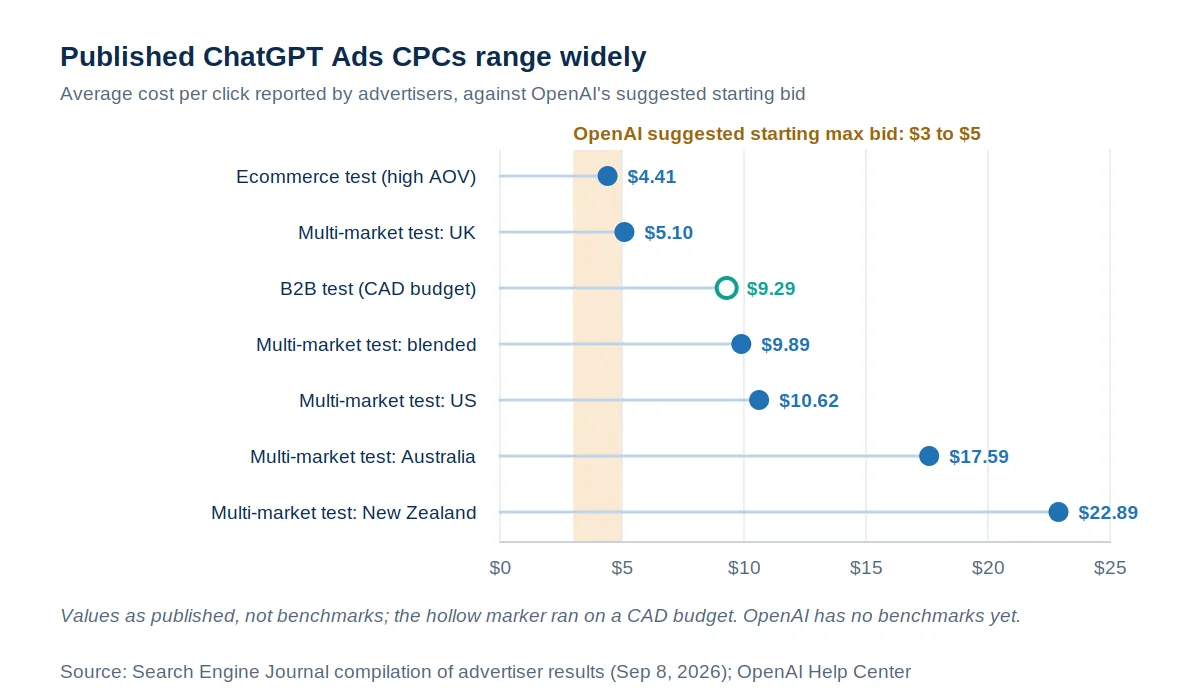
Average CPCs published by advertisers, compared with OpenAI's suggested $3 to $5 starting bid.
OpenAI's own highlights are anecdotes too: its August 31 update cited one ecommerce advertiser with a 3x return on ad spend over 28 days and one technology partner whose ad-driven ChatGPT traffic was more than 80% new customers.
Which Businesses Can Advertise on ChatGPT? #
Category rules decide eligibility before budget does. OpenAI's ad policies, updated September 10, 2026, focus early advertising on household and consumer goods, local services, travel and entertainment, and digital products and education. Beyond that core:
Healthcare: US only, approved case by case for categories such as dental, hospitals and urgent care, vision, health insurance and consumer medical devices. Proof of licensure may be required; health services ads outside the US are generally prohibited.
Legal services: permitted in the US since August 2026, but only when the advertiser is licensed in the jurisdiction where the ad is shown. Legal services ads outside the US are prohibited.
Financial services: US only, case by case, for categories such as credit cards, mortgages, insurance, and brokerages. Credit repair and debt settlement are not allowed.
Not allowed: gambling, alcohol and tobacco, recreational drugs, adult content including dating apps, political advocacy, individual job or housing listings, and unsupported wellness claims.
One newer clause deserves attention: since version 1.6, OpenAI reserves the right to decline ads that conflict with its business interests or competitive position.
How to Use ChatGPT Ads: A 30-Day Test Plan #
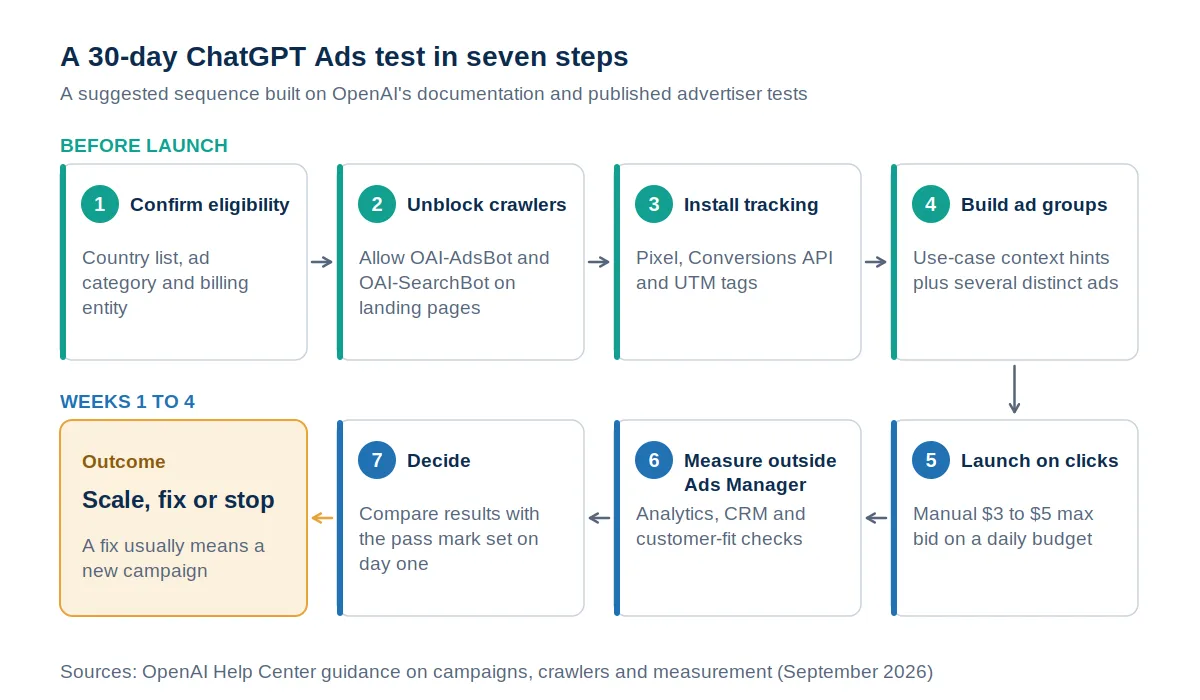
The advertisers learning most from ChatGPT Ads treat the first month as an experiment with a pass mark agreed in advance. This plan draws on OpenAI's documentation and the tests above.
1. Confirm eligibility first #
Check the country list, your category against the ad policies, and where your billing entity is registered. New self-serve accounts may be limited to their home country until identity verification is approved and you reach the required spend level there.
2. Open landing pages to OpenAI's crawlers #
Ads are reviewed with their landing pages, and pages OpenAI cannot review are not eligible to run. Make sure your robots rules and firewall do not block OpenAI's user agents, specifically OAI-AdsBot and OAI-SearchBot, and point each ad at the most relevant page rather than your homepage.
3. Install the Pixel and Conversions API on day one #
Conversion-optimized campaigns need a standard event, such as a purchase, lead, or sign-up, tracked through the Pixel, the Conversions API, or both. Turn on automatic advanced matching, add UTM parameters to every landing URL, and make sure the page converts before you pay for traffic. Landing page conversion work pays off on every channel, not only this one.
4. Build ad groups around real use cases #
Context hints are where targeting skill now lives. OpenAI's guidance on context hints asks for natural phrases describing what you offer, who it helps, and when it is useful; a local plumber might describe after-hours residential repairs and the service-call fee rather than list keywords. Hints inform relevance but are not delivery rules. Give each ad group several distinct title and description variations, since OpenAI says a more varied set of ads helps its system find relevant conversations. Clear, benefit-led ad and landing page copy is the lever you control most.
5. Start with clicks and a controlled bid #
For most first tests, a Clicks campaign with a manual maximum bid in the suggested $3 to $5 range keeps costs easy to read. Once tracking records enough conversions, add a separate Conversions campaign. Ecommerce brands can build campaigns from a product feed or the Shopify app, though new feed campaigns target only at the country level. If you sell online, fold the test into your wider ecommerce marketing plan so product data, pricing, and promotions stay consistent.
6. Measure outside Ads Manager #
Native reporting covers impressions, clicks, spend, CTR, average CPC, average CPM, and conversions, but it lacks auction insights and impression share, and spend can lag behind clicks. Reconcile clicks with sessions in your analytics, follow leads into your CRM, and check who is arriving. The B2B test above only found its customer-fit problem through external visitor data.
7. Decide at a fixed checkpoint #
Write the pass mark down before launch: a target cost per qualified lead, a minimum return on ad spend, or a share of new customers. Avoid large changes until the campaign has meaningful volume, then scale, fix, or stop. Because objectives and conversion events are locked at creation, a fix usually means a new campaign.
ChatGPT Ads and GEO: Buy the Placement, Earn the Answer #
Paying for an ad does not buy a mention in the answer above it. Whether ChatGPT recommends your brand still depends on what the model finds credible about you across the web. That makes ChatGPT Ads and generative engine optimization complements rather than substitutes: the ad reaches someone at the moment of decision, while organic visibility decides whether you are part of the answer itself.
Audit before you buy: ask ChatGPT the questions your customers ask. Where you are already recommended, an ad adds a second touchpoint. Where a competitor is recommended, and you are not, an ad is a short-term patch; the lasting fix is the content, entity, and citation work covered by AI search optimization.
Risks and Open Questions #
Thin diagnostics. Without auction insights or competitive reporting, it is hard to tell whether a rising CPC reflects competition, relevance or inventory.
Audience fit. The highest-paying ChatGPT tiers are excluded, and little public data describes the demographics or spending power of the ad-eligible audience.
Beta volatility. OpenAI warns that delivery and spend can fluctuate while the platform is in beta.
Trust dependency. The channel only works while users trust the answers. In March, OpenAI reported no impact on consumer trust metrics and said fewer than 7% of ads were rated low relevance, according to Campaign Asia, but that balance will be tested as ad volume grows.
Frequently Asked Questions #
What are ChatGPT Ads? #
ChatGPT Ads are sponsored placements that appear below ChatGPT's answers for users on the Free and Go plans. Each ad shows an advertiser name, favicon, headline, description, image, and landing page, and matches the conversation context rather than keywords.
How much do ChatGPT Ads cost? #
There is no fixed price. Ads are sold in a relevance-weighted, second-price auction with CPM, CPC, or conversion-optimized bidding. OpenAI suggests starting CPC bids at $3 to $5, while published advertiser tests have reported average CPCs from under $3 to nearly $23.
Is there a minimum spend for ChatGPT Ads? #
There is no commitment for self-serve buyers, only a minimum daily budget: 25 USD, 15 GBP, 15 EUR, 65 AED, or 725 INR, depending on your billing currency. The $200,000 commitment reported at launch applied to the early managed pilot.
Who sees ads in ChatGPT? #
Users on the Free and Go plans. Plus, Pro, Business, Enterprise, and Edu accounts are ad-free; accounts identified as belonging to people under 18 are excluded; Temporary Chats show no ads, and Free users can choose an Ads-Free mode with lower usage limits.
Do ChatGPT Ads influence ChatGPT's answers? #
OpenAI says no. Ads run on separate systems from the chat model; advertisers cannot shape or rank responses, and every ad is labeled as sponsored and shown separately below the answer.
Which countries can buy ChatGPT Ads through Ads Manager? #
As of September 18, 2026, OpenAI lists 56 self-serve countries, including the US, Canada, Mexico, Brazil, the UK, most of Europe, the UAE, Saudi Arabia, Qatar, India, Japan, South Korea, Australia, and New Zealand. The legal entity that advertises and is billed must be based in a listed country.
Can healthcare or legal businesses advertise on ChatGPT? #
Only in the US and only with approval. Healthcare advertisers in categories such as dental, vision, and urgent care are reviewed case by case, and legal services are allowed when the advertiser is licensed where the ad runs. Both categories are currently prohibited outside the US.
How do ChatGPT Ads target people without keywords? #
The system reads the context and intent of the conversation, the ad and its landing page, and advertiser-written context hints, plus personalization signals where users allow them. Advertisers can add country, location, platform, and custom audience settings on top.
What are Sponsored Agents in ChatGPT? #
Sponsored Agents, announced on September 16, 2026, let users who click an ad start a separate, clearly labeled conversation with a business-sponsored agent to ask questions before visiting the site. They are being tested with select US advertisers.
How do you measure ChatGPT Ads performance? #
Ads Manager reports impressions, clicks, spend, CTR, average CPC, average CPM, and conversions tracked through OpenAI's Pixel or Conversions API. Add UTM parameters and reconcile results in your analytics and CRM, because the platform still doesn't offer auction insights or industry benchmarks.
The Bottom Line #
ChatGPT Ads went from an invitation-only US pilot to a self-serve channel in 56 countries in under eight months, and the entry price fell from a $200,000 commitment to a daily budget most businesses can afford. What hasn't caught up is certainty: prices vary widely, benchmarks don't exist yet, and proof still depends on your own analytics.
That combination rewards disciplined testers: an eligible category, open landing pages, clean conversion tracking, use-case ad groups, and a pass mark set before you spend the first dollar. Pair it with the organic work that shapes what ChatGPT says about your brand, and within a month you'll know whether the channel has earned a place in your plan. If you'd like a second pair of eyes on your test design, our paid search specialists are happy to review it with you.