Content Writing for AI Citations: Get Cited, Not Just Crawled

Tuba
July 14, 2026
Table of Contents
- How to Write Content That AI Cites Instead of Just Crawls
- Crawling and Citing Are Not the Same Thing
- Why So Much Content is Crawled but Never Cited
- Put the Answer First
- Write Passages a Model can Lift Out of Context
- Raise Your Fact Density
- Cite Others to Get Cited
- Keep Pages Fresh and Verifiable
- Match Your Headings to the Questions People Ask
- Build Authority an AI can Recognize
- The Takeaway
- Frequently Asked Questions
How to Write Content That AI Cites Instead of Just Crawls #
Getting your writing into an AI answer takes more than opening the door to crawlers. Assistants already fetch almost every public page, yet they name and link only a small fraction of what they read. To be one of the sources an AI quotes, a page has to answer the question on its own terms, back that answer with a specific and dated figure, and stay easy to lift out of its surroundings. That is a different craft from writing for a patient human reader who scrolls from top to bottom.
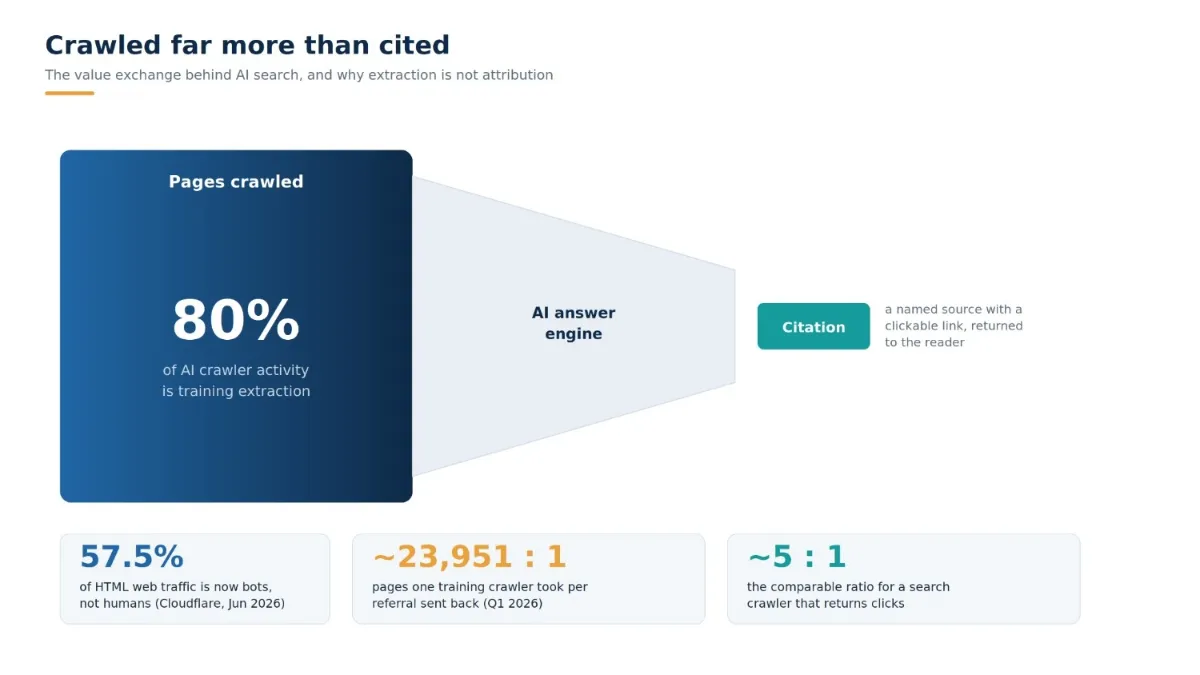
The scale of the mismatch is easy to miss. Bots now generate 57.5% of HTML web traffic, more than humans, according to Cloudflare Radar data reported in June 2026. Most of that machine traffic takes content and sends no reader back. The sections below cover what distinguishes cited writing from merely crawled writing, and how to build that distinction into every piece you publish.
Crawling and Citing Are Not the Same Thing #
Crawling is extraction: a bot fetches your page to train a model or fill an index. Citing is attribution: an AI answer names your page as a source and, more and more often, links to it so a reader can click through. The two happen on very different scales. Training drives roughly 80% of AI crawler activity, while the search-style crawling that can produce a citation accounts for less than a fifth of it, Cloudflare's breakdown of crawl purpose shows.
That imbalance shows up in the crawl-to-refer ratio, the number of pages a platform takes for every visitor it sends back. Reading Cloudflare Radar data from the first quarter of 2026, one training crawler took close to 23,951 pages per referral, while a traditional search crawler that returns clicks sat near five pages per referral. Being crawled is the default setting of the modern web. Being cited is earned, largely by how you write.
Why So Much Content is Crawled but Never Cited #
Being fetched is not the same as being chosen. In one analysis of AI answers, ChatGPT retrieved around six times as many pages as it actually cited, meaning most pages a model reads never make it into the final answer. The cut usually happens for one of three reasons: the answer is buried below hundreds of words of setup, the claim is too vague to quote, or the subject is unclear once a sentence is pulled out of its paragraph.
Traditional search rewarded depth and a slow build toward the payoff. AI retrieval rewards the opposite. A model scans for the passage with the most complete, self-contained answer and lifts it, so anything it cannot understand in isolation gets skipped. Strong SEO fundamentals still get a page into the retrieval pool, but they do not decide which sentence gets quoted. That decision comes down to structure, specificity, and clarity, which the rest of this guide takes one at a time.
Put the Answer First #
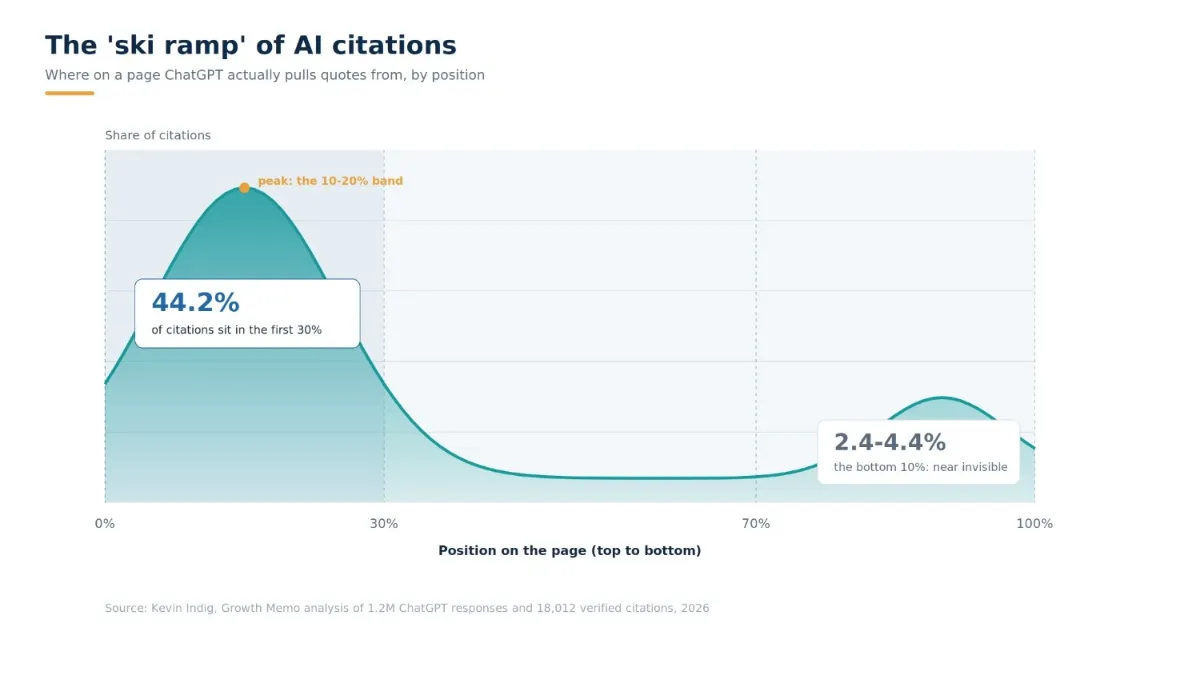
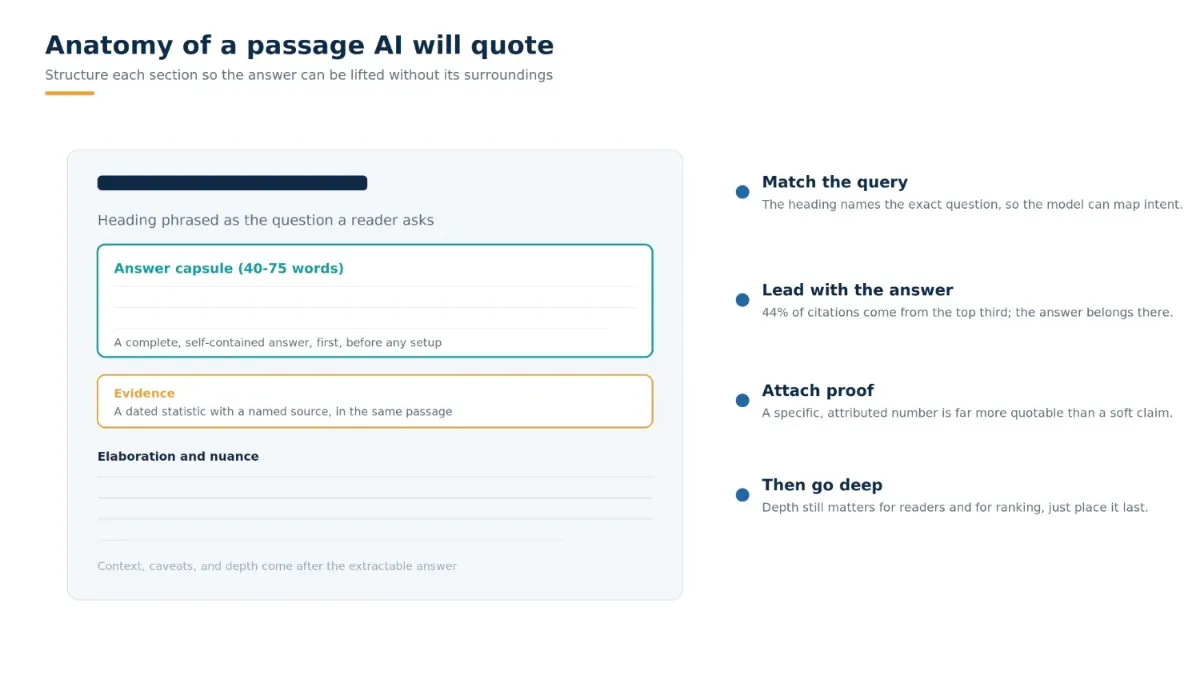
Lead with the answer, at both the article level and inside every section. After studying 1.2 million ChatGPT responses and 18,012 verified citations, Kevin Indig found a "ski ramp" pattern: 44.2% of citations come from the first 30% of a page, with the hardest reading in the 10 to 20% band and only 2.4 to 4.4% pulled from the bottom tenth. Bury your key point in paragraph twelve, and a model is far less likely to reach it. Pages ranking first in Google were cited by ChatGPT 43.2% of the time, about 3.5 times the rate of pages beyond the top 20, so early position on the page and in the results both matter.
The fix is the journalist's inverted pyramid: state the conclusion, support it, then add nuance. This is where good AI content writing diverges most from the classic "ultimate guide" that saves its best insight for the end. You do not need to force the answer into the first sentence of every paragraph, but the most important idea on the page belongs near the top, not the finish line.
Write Passages a Model can Lift Out of Context #
Open every H2 section with a self-contained answer of roughly 40 to 75 words before any preamble. A model reads the first few dozen words under a heading and decides whether to quote; if the answer sits three paragraphs down, it moves on. Keep those opening passages tight, because shorter blocks lose context and longer ones get cut mid-thought during extraction.
Two habits make passages liftable. First, write full-subject sentences: replace "it" and "this" with the actual entity, so a quoted line still makes sense on its own. Second, use structure that maps to how models reformat data. In a 2025 review of 10,000 AI citations, pages with tables were quoted about 4.2 times as often as the same facts in prose, numbered lists about 2.7 times as often, and bullet lists about 1.8 times as often. Tables and steps hand the model something it can restate cleanly, which is why AI SEO work now treats formatting as a citation lever, not just a readability choice.
Raise Your Fact Density #
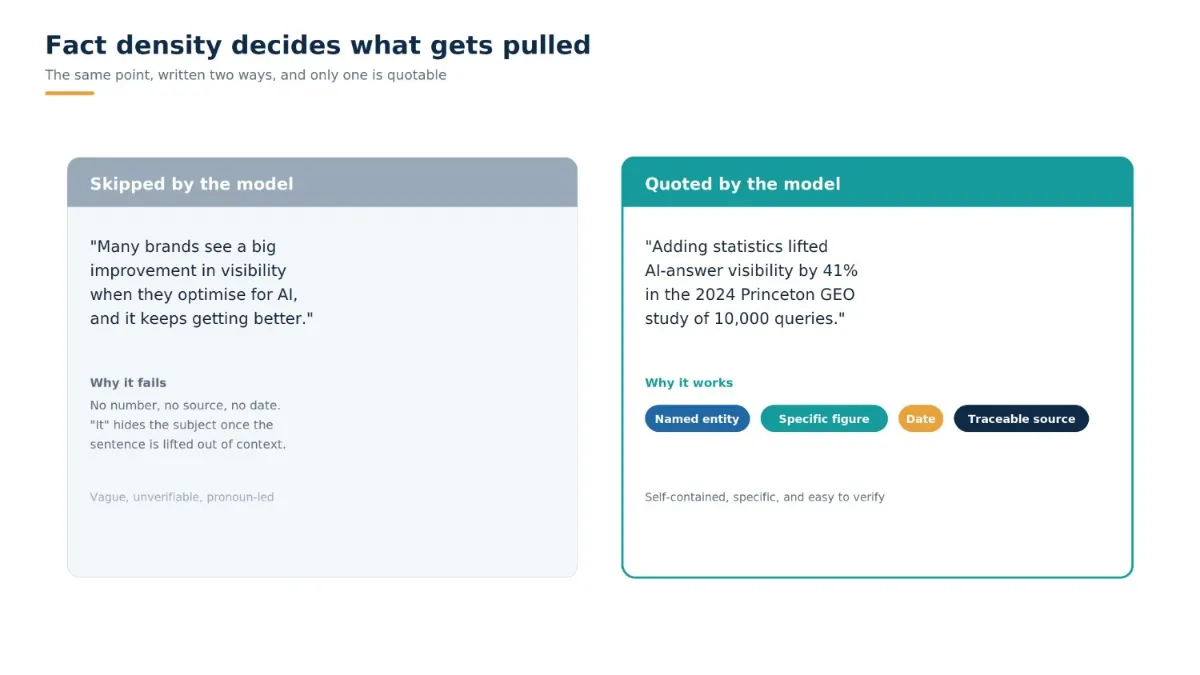
Fact density is what separates a quotable sentence from a skippable one. In Indig's citation analysis, heavily cited text carries about 20.6% entity density, three to four times that of ordinary English. In practice, that means every claim worth making should arrive with a specific number, a named entity, and a date attached. The Princeton GEO study, the first large academic test of these tactics, found that adding statistics lifted visibility in AI answers by about 41% across 10,000 queries.
Compare two versions of the same point. "Many brands see a big improvement" leaves a model with nothing to hold on to. "Adding statistics lifted AI-answer visibility by 41% in the 2024 Princeton GEO study" provides an entity, a figure, a date, and a source, so it can be quoted verbatim and trusted. Much of professional content writing for AI is the discipline of turning soft claims into attributed, checkable ones.
Cite Others to Get Cited #
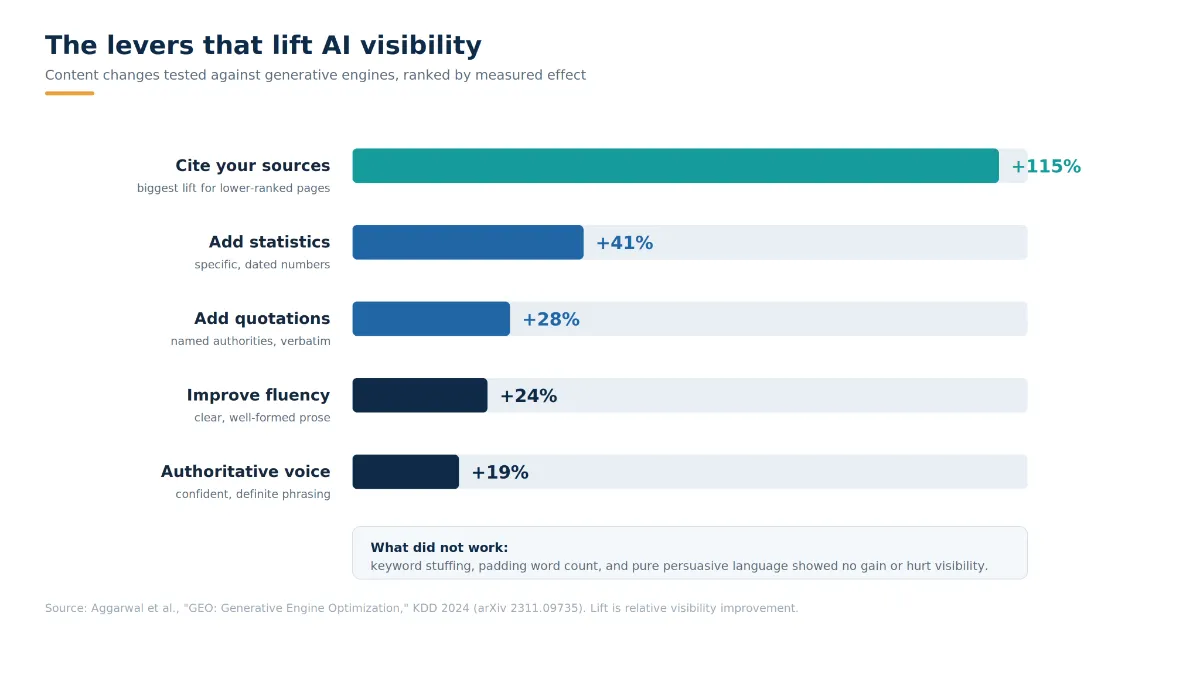
Citing credible sources inside your own text raises the odds that AI will cite you. It reads as counterintuitive, but the Princeton GEO research measured it directly: adding source citations produced the largest gain of any tactic tested, with an 115% lift in visibility for a page that started ranking fifth, and quotations from named authorities adding a further boost of around 28%. Attribution signals thoroughness, and models appear to reward content that shows its work.
Put those references inline, as linked anchor text next to the claim they support, rather than stacked in a list at the bottom, where a model may never connect them. This is a core habit in any generative engine optimization program: every meaningful statistic traces to a primary source, dated, in the sentence that uses it. The tactics that did nothing, or backfired, in the same study were keyword stuffing, padding word count, and pure persuasion, none of which add verifiable substance.
Keep Pages Fresh and Verifiable #
Freshness and verifiability decide whether a strong page keeps its citations. Across roughly 17 million citations, Ahrefs found that AI-cited content averaged about 25.7% fresher than the organic top ten, so a stale date is a reason to be passed over. Give every statistic a visible year, revisit high-value pages on a schedule, and redate them when the numbers change, rather than leaving a 2023 figure in a 2026 guide.
Verifiability matters just as much, because models are under scrutiny for citing sources that do not actually support their claims. A 2025 Nature Communications study of major language models found that a large share of AI answers were not fully backed by the sources they named. That pressure pushes retrieval toward content whose claims are easy to check, which rewards the same habits as strong SEO: clear sourcing, accurate figures, and pages that state plainly where their facts come from.
Match Your Headings to the Questions People Ask #
Phrase headings as the questions a reader would actually type or speak, then answer them immediately underneath. AI answer engines lean heavily on question-shaped queries: Google AI Overviews appeared on 64.7% of question-form searches in 2026 tracking, versus 13.7% of all queries. A heading that mirrors the question helps a model map your section to the prompt's intent.
This is why a clear FAQ block earns its place at the end of a page. Each question is a ready-made prompt, and each concise answer is a ready-made citation. Write those answers to stand alone in one or two sentences, with the specific fact stated explicitly rather than implied, so that a model can lift the whole thing without stitching context back together.
Build Authority an AI can Recognize #
Citations follow recognized entities, not just well-written pages. In Ahrefs' study of 75,000 brands, branded web mentions correlated with AI Overview visibility at 0.664, nearly three times the 0.218 for backlinks, making off-site presence a stronger signal than link count. Kevin Indig's work points in the same direction, with brand search volume and AI mentions correlating at around 0.334. Models cite names they can verify across many independent places.
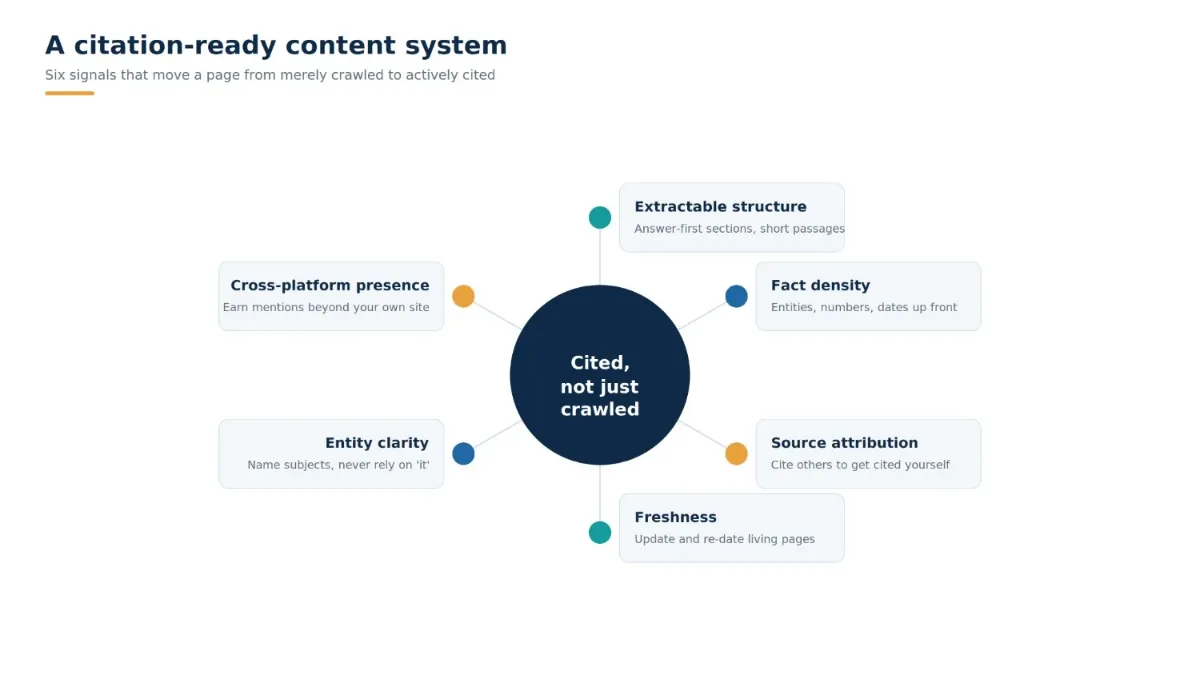
That makes on-page craft and off-page authority two halves of the same job. Name entities clearly on first mention so a model can map your page to the right concept, keep your facts and claims consistent wherever your brand appears, and earn mentions on third-party sites, not only your own domain. A serious GEO strategy treats extractable structure, fact density, source attribution, freshness, entity clarity, and cross-platform presence as one system, because a citation is the payoff for getting all six right.
The Takeaway #
Writing for AI citation is not a separate discipline bolted onto SEO. It is the same work done with more discipline: lead with the answer, make claims specific and dated, cite your sources inline, keep pages current, and build a brand that models can recognize across the web. The payoff is worth the effort, since AI-referred visitors often arrive already informed and convert at higher rates, making both the citation and the subsequent conversion rate optimization worth getting right. Do this consistently, and you stop being just another page in the training set and start being the source an answer is built on.
Frequently Asked Questions #
What is the difference between AI crawling and AI citing content?
Crawling is when a bot fetches your page to train a model or build an index. Citing is when an AI answer names your page as a source and links to it. Most crawled pages are never cited.
How do I get my content cited by ChatGPT or Google AI Overviews?
Lead each section with a direct, self-contained answer; support claims with specific, dated statistics; cite your sources inline; and keep pages current. Structure and specificity matter more than length.
Where on a page should I put my most important point for AI citations?
Near the top. Kevin Indig's 2026 analysis found that 44.2% of ChatGPT citations come from the first 30% of a page, and only 2.4 to 4.4% from the bottom tenth.
How long should an answer passage be to get quoted by AI?
Roughly 40 to 75 words. Shorter passages lose context and longer ones get cut during extraction, so a self-contained paragraph in that range is the most quotable.
Do statistics really help content get cited by AI?
Yes. The 2024 Princeton GEO study found that adding statistics increased the visibility of AI answers by about 41% and that cited text carries a far higher entity density than average writing.
Why does citing other sources help my own content get cited?
Attribution signals thoroughness and lets a model verify claims. The Princeton GEO study found that citing sources yielded the largest gain of any tactic tested, increasing page rank by up to 115% for lower-ranked pages.
Do tables and lists get cited more than plain paragraphs?
Yes. A 2025 analysis of 10,000 AI citations found that tables were quoted about 4.2 times as often as the same facts in prose, with numbered and bulleted lists also outperforming plain text.
Does content freshness affect AI citations?
It does. Across about 17 million citations, Ahrefs found that AI-cited content averaged roughly 25.7% fresher than the organic top ten, so dated, regularly updated pages have an edge.
Are brand mentions more important than backlinks for AI visibility?
For AI Overviews, largely yes. Ahrefs' study of 75,000 brands found that branded web mentions correlated with visibility at 0.664 versus 0.218 for backlinks, close to a three-to-one gap.
Is writing for AI citation different from SEO?
It builds on SEO rather than replacing it. Strong SEO gets a page retrieved; answer-first structure, fact density, and clear attribution decide which passage actually gets quoted.