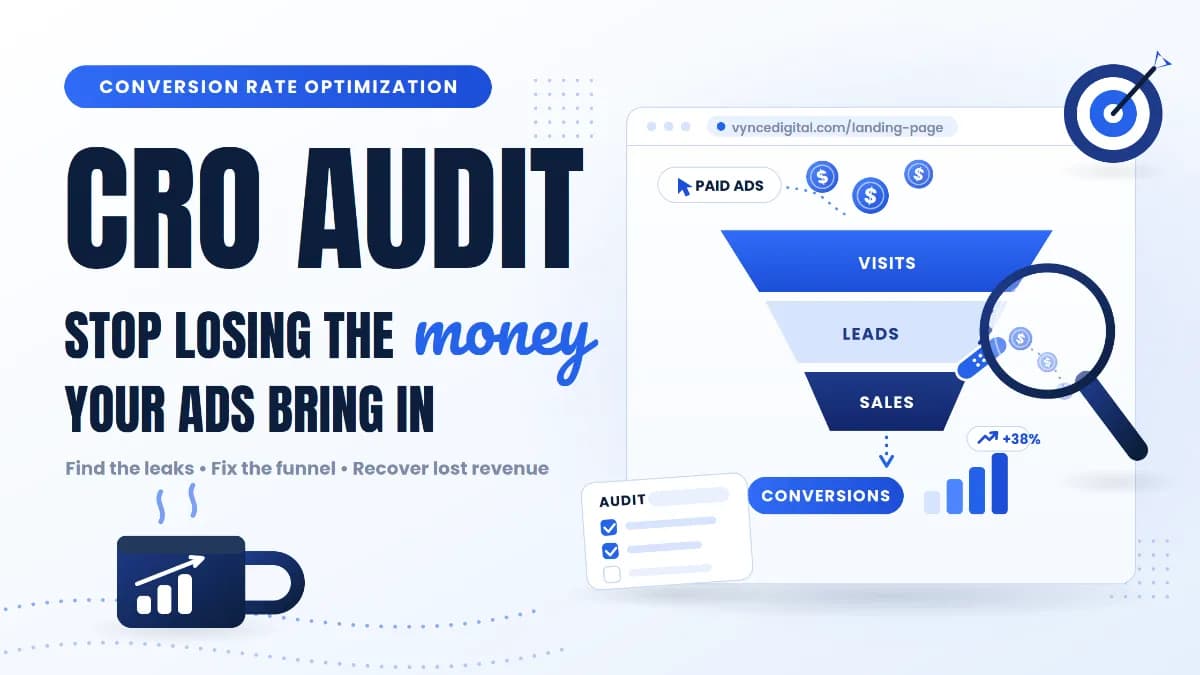
CRO Audit: Stop Losing the Money Your Ads Bring In

Tuba
July 21, 2026
Table of Contents
- Key Takeaways
- You Are Not Wasting Money on Ads. You Are Losing It on Your Website
- The Math Nobody Wants to Run
- What a CRO Audit Actually is
- Where Websites Leak the Money Ads Bring In
- What a CRO Audit Examines
- How a CRO Audit Works, Step by Step
- Fix the Site Before You Scale the Ads
- Six Signs You Need a CRO Audit Now
- Frequently Asked Questions
Key Takeaways #
Rising click costs are not going to reverse. The businesses that keep growing on paid traffic are the ones that stopped asking their ads to compensate for their website. A CRO audit tells you exactly where the money is leaking, what each leak costs, and which fix pays back first. Before you raise next quarter's ad budget, it's worth finding out how much of this quarter's is still on the table. If your traffic is steady and your revenue isn't, an audit is the logical next step, whether you run it yourself or bring in a team that does it every day.
You Are Not Wasting Money on Ads. You Are Losing It on Your Website #
Here's the reflex. Results dip, cost per lead creeps up, and someone says the ads have stopped working. So you pause campaigns, rewrite headlines, or shop for a new agency. Sometimes that's right. Usually it isn't. The clicks are arriving exactly as ordered. They're just walking into a website that can't close. This post explains what a CRO audit is, where sites quietly lose the money ads bring in, and why fixing the destination is the cheapest growth move most businesses never make.
The Math Nobody Wants to Run #
Clicks have never been more expensive. WordStream's 2026 Google Ads benchmarks, drawn from more than 13,000 campaigns running between April 2025 and March 2026, put the average cost per click at $5.42. That's more than double the $2.32 average recorded in the same report series in 2016. The price of a visitor keeps rising, and the trend has held for a decade.
Now the uncomfortable part. WordStream's separate 2025 study of over 250,000 Google Ads accounts found that about 29% recorded zero conversions over a full 90 days, and that the average account wastes $1,127 every month on clicks that never convert. Some of that is bad targeting or broken tracking. A lot of it is something simpler: the ad did its job, and the website didn't.
Good PPC management can trim waste inside the ad account. It cannot make a slow, confusing, or untrustworthy page convert. When traffic shows up on schedule and revenue doesn't, the problem lives after the click.
What a CRO Audit Actually is #
A CRO audit is a structured review of your website that finds where visitors drop off, figures out why, and ranks the fixes by revenue impact. It's the diagnostic step of conversion rate optimization: evidence gathered from your own analytics, recordings, and user behavior, not a designer's opinion about what looks dated.
It matters because the gap between average and good is enormous. Unbounce's Conversion Benchmark Report, built on Q4 2024 data covering 464 million visits to 41,000 landing pages, puts the median landing page conversion rate at 6.6% across industries. Top performers convert at roughly three times their industry median. That spread isn't luck. It's the cumulative result of finding and fixing leaks, one test at a time.
An audit is not a redesign. Redesigns change everything at once and measure nothing. An audit changes your understanding first, so every subsequent change has a reason and a number attached to it.
Where Websites Leak the Money Ads Bring In #
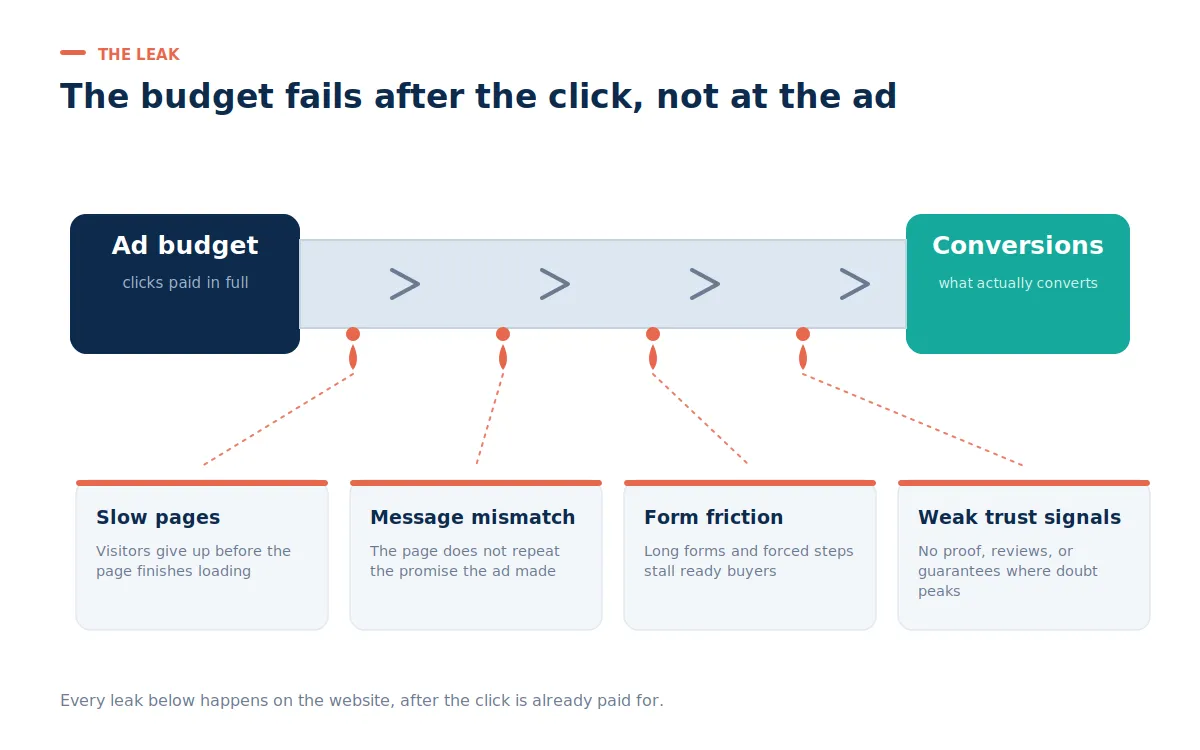
Four leaks show up in almost every audit. Each one happens after the click you already paid for.
Slow pages #
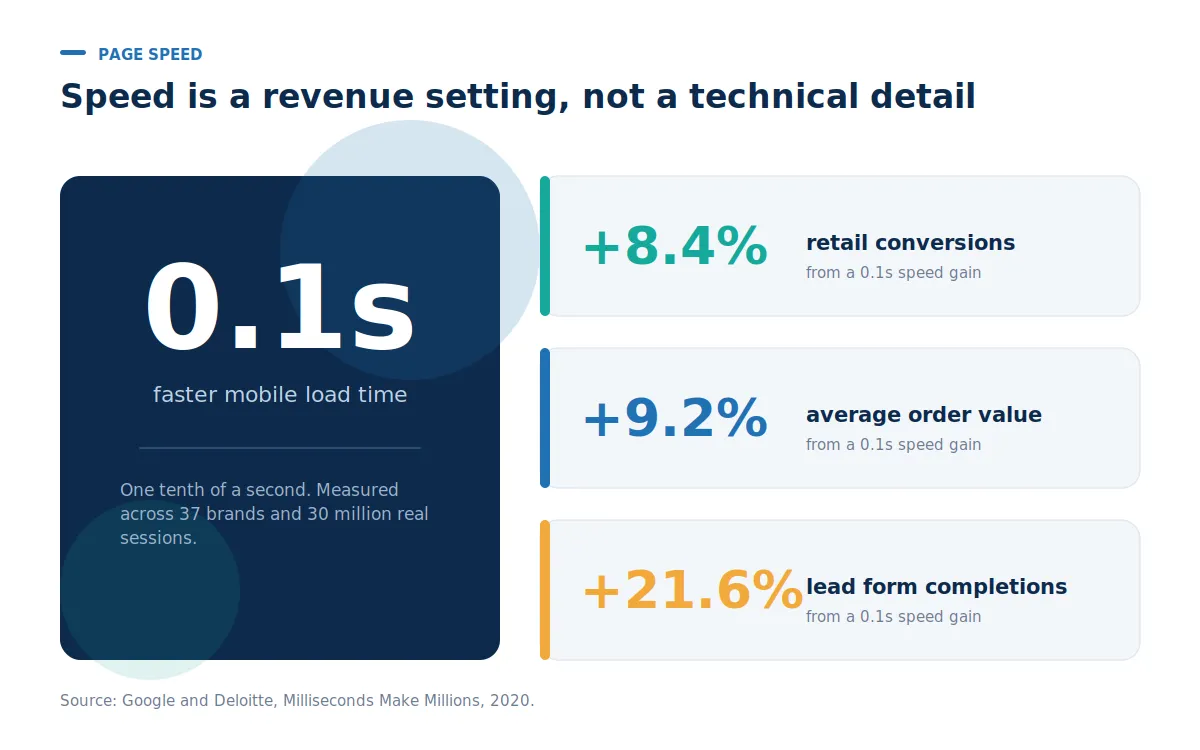
Speed is the least glamorous fix and often the most profitable one. The 2020 Milliseconds Make Millions study by Google and Deloitte tracked 30 million real sessions across 37 brands and found that a 0.1-second improvement in mobile load time increased retail conversions by 8.4%, average order value by 9.2%, and lead form completions by 21.6%—one tenth of a second. Most sites audited for the first time can find a full second or more. If your pages were built years ago, this is usually where modern web design pays for itself fastest.
Message mismatch #
Someone clicks an ad promising a free quote in 24 hours and lands on a generic homepage that mentions no quote. They leave in seconds. Google notices too: landing page experience is a documented factor in Quality Score and Ad Rank, which means a mismatched page doesn't just lose the visitor; it raises what you pay for the next one.
Clarity has a measurable price as well. The same Unbounce dataset found that pages written at a 5th- to 7th-grade reading level converted at a median of 11.1%, roughly double the 5.3% for copy written at a college level. Plain words sell. Skilled content writing keeps the promise consistent across keywords, ads, headlines, and buttons.
Friction at forms and checkout #
Every extra field, forced account, and surprise fee taxes intent. Baymard Institute's research, updated in 2026 across 50 independent studies, puts the average cart abandonment rate at 70.22%. The same research finds that the average large ecommerce site can lift conversions by 35.26% through better checkout design alone, which, across the US and EU, amounts to about $260 billion in recoverable orders every year. For stores, this is where an audit and focused ecommerce marketing overlap most directly. For lead generation sites, the form is the checkout, and the same rules apply.
Weak trust signals #
Doubt peaks at the moment of commitment. Visitors look for reviews, guarantees, security cues, real contact details, and clear pricing right before they act. If those signals are missing, buried, or stale, hesitation wins—an audit checks whether proof appears exactly where doubt does, not just somewhere on the site.
What a CRO Audit Examines #
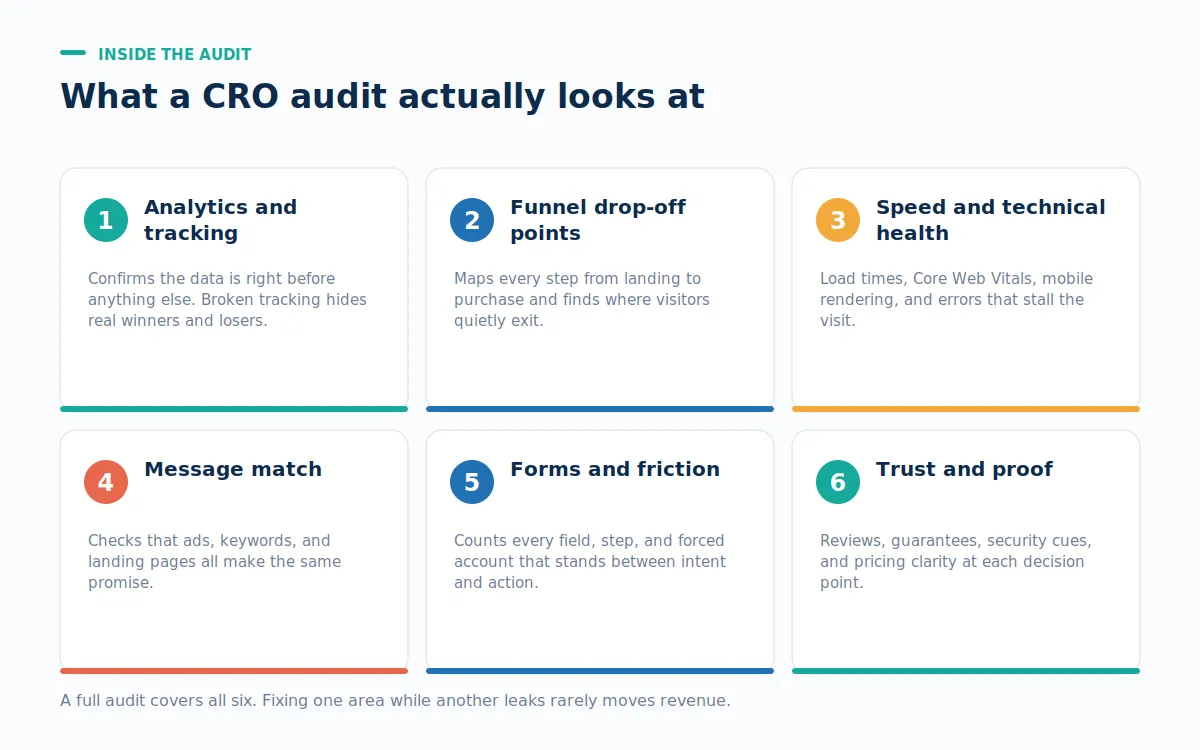
A proper audit covers six areas. Skipping any one of them leaves a blind spot big enough to hide the real problem.
Analytics and tracking. First, confirm the data is true. Broken or double-firing tracking has sunk more optimization programs than bad design ever has.
Funnel drop-off points. Map every step from landing to purchase or submission, and identify where visitors exit in unusually high numbers.
Speed and technical health. Load times, Core Web Vitals, mobile rendering, broken elements, and script errors that stall the visit.
Message match. Do the keyword, the ad, and the page all make the same promise in the same words?
Forms and friction. Count the fields, steps, and forced decisions between intent and action, then justify each one or cut it.
Trust and proof. Reviews, guarantees, and pricing clarity positioned at each decision point, not just the footer.
One thing worth stressing: none of this is paid-only. The same fixes increase the conversion rate for every visitor, including those SEO brings in for free. A leak doesn't check the traffic source before it drains.
How a CRO Audit Works, Step by Step #
The process is the same whether you run it in-house or hire it out. Five steps, in order, no skipping.
1. Set the baseline. Verify tracking, define the conversions that matter, and record current rates by page, device, and traffic source.
2. Find the drop-offs. Use funnel reports to identify the specific pages and steps where visitors leave at unusually high rates.
3. Diagnose the causes. Watch session recordings, read heatmaps, and run quick user tests. The data says where. This step says why.
4. Rank the fixes. Score each finding based on revenue impact and effort. Cheap, high-impact repairs ship first.
5. Test and measure. A/B test the big swings, ship the obvious repairs, and compare everything against the baseline from step one.
Expect two to four weeks for the audit itself, then an ongoing testing cycle. Teams that treat the audit as a one-time report lose most of its value. Teams that treat it as the start of a testing habit compound it. That habit is exactly what good CRO services are built to install.
Fix the Site Before You Scale the Ads #
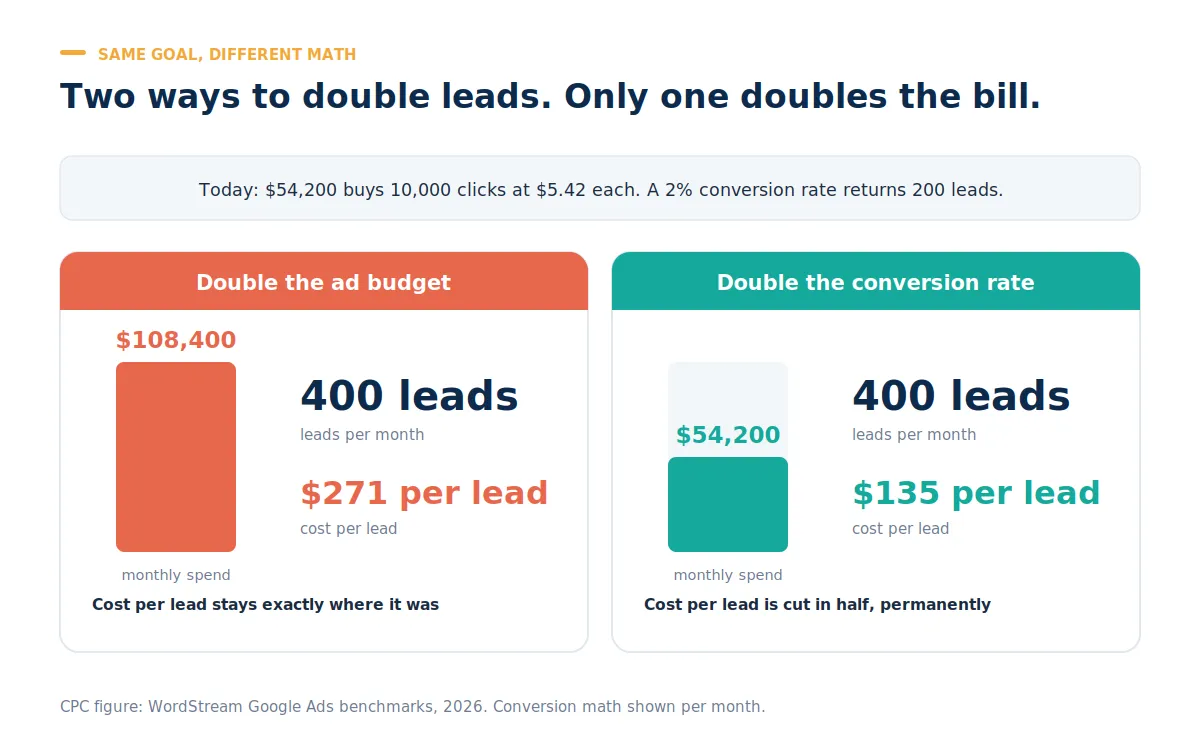
Here's the arithmetic that makes the whole argument. Say you spend $54,200 per month, which buys 10,000 clicks at an average cost of $5.42 per click. At a 2% conversion rate, you get 200 leads, and each one costs $271.
Now you want 400 leads. You have two options. Double the budget to $108,400, and your cost per lead stays at $271 forever. Or lift the conversion rate from 2% to 4% and get the same 400 leads for the original $54,200, at roughly $135 each. The first option doubles your bill. The second one halves the cost of every lead you'll ever generate, on every channel at once, because a page that converts paid search traffic better also converts email, organic, and social media advertising traffic better. Ad improvements help one campaign. Site improvements help all of them, permanently.
Doubling a conversion rate is not a given, and nobody serious promises it on a schedule. But moving from 2% toward the 6.6% median, or from median toward the top quartile, is a documented, repeatable path. Scaling spend into a leaking site just buys leaks at volume.
Six Signs You Need a CRO Audit Now #
You don't need every symptom. Two or more of these at the same time is the signal.
CPCs rise every quarter while sales stay flat.
Traffic grows but leads and orders barely move.
Paid landing pages lose most visitors within seconds.
Carts and forms get started, then abandoned.
Mobile brings most of the traffic and a fraction of the revenue.
The site gets redesigned on opinion, and nothing is ever tested.
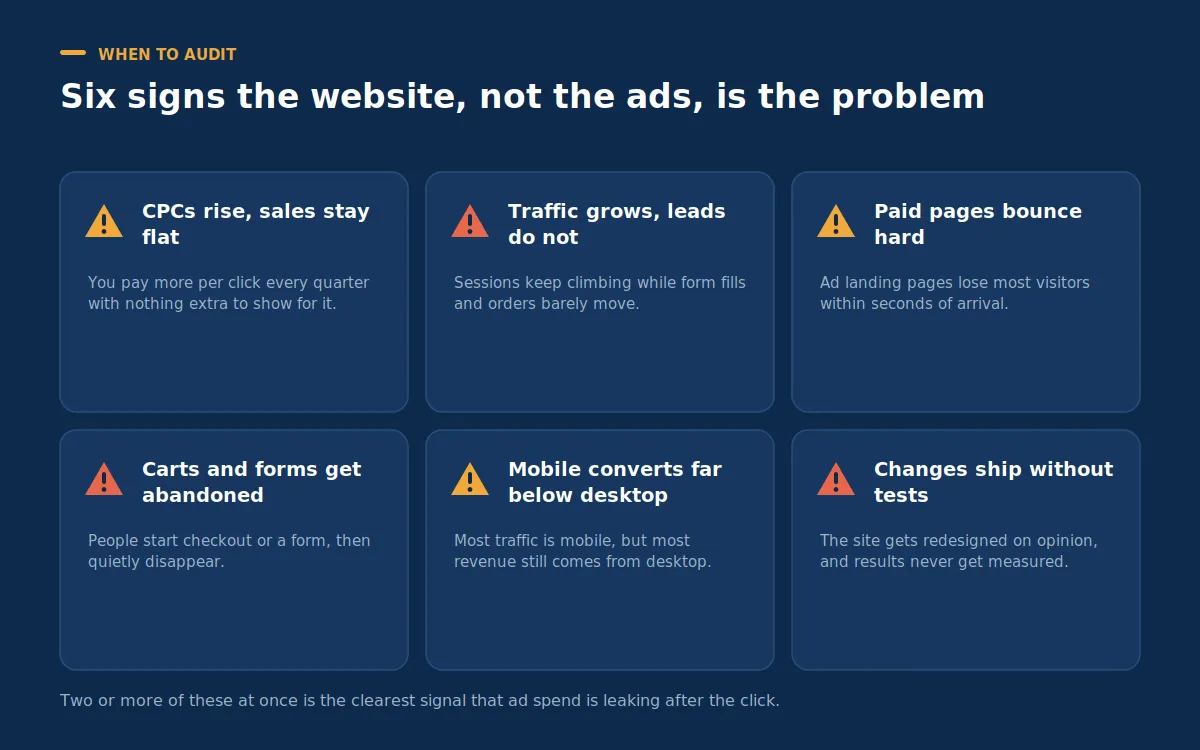
Any one of these can be noise. Two or more at once means the website is taxing every campaign you run.
Frequently Asked Questions #
What is a CRO audit?
A CRO audit is a structured review of a website that finds where visitors drop off, diagnoses why they fail to convert, and ranks fixes by revenue impact.
How is a CRO audit different from an SEO audit?
An SEO audit improves the amount of traffic a site earns. A CRO audit improves the revenue generated by traffic once it arrives.
How long does a CRO audit take?
Most audits take two to four weeks, depending on traffic volume and the number of conversion paths the site has.
How much does a CRO audit cost?
Professional audits typically run from around $2,000 for a focused single-funnel review to $15,000 or more for large ecommerce sites.
What tools are used in a CRO audit?
Analytics platforms, heatmaps, session recordings, funnel reports, speed testing tools, and A/B testing software are the standard kit.
What is a good conversion rate?
The median landing page converts at 6.6% per Unbounce's Q4 2024 data. A good rate beats your industry median; top performers reach roughly three times it.
How often should you run a CRO audit?
Run a full audit once a year, or after any major redesign, replatform, or significant change in traffic mix.
Do CRO audits only help paid traffic?
No. The same fixes raise conversion rates for organic, email, social, and referral visitors, which multiplies the return.
Can I run a CRO audit myself?
Yes, if you can verify your tracking and read funnel data honestly. Specialists mostly add speed, testing discipline, and pattern recognition from other sites.
What happens after a CRO audit?
You get a prioritized fix list. Quick repairs ship immediately; bigger changes go into an A/B testing queue; and results are measured against the baseline.