
How Much Is Dhai Crore? 2.5 Crore Explained

Shahid Ali
October 13, 2026
Table of Contents
- Key Takeaways
- What Does Dhai Crore Mean?
- Dhai Crore in Numbers: Where the Commas Go
- Dhai Crore in Lakh, Million and Billion
- Dhai Lakh, Dhai Crore and Dhai Lakh Crore
- How Much Is Dhai Crore in US Dollars?
- Dhai and Its Family of Fraction Words
- Where Dhai Crore Shows Up in Real Figures
- How to Convert Any Crore Figure in Seconds
- Writing Crore Figures for Indian and US Audiences
- Getting Crore Figures Right Everywhere
- Frequently Asked Questions
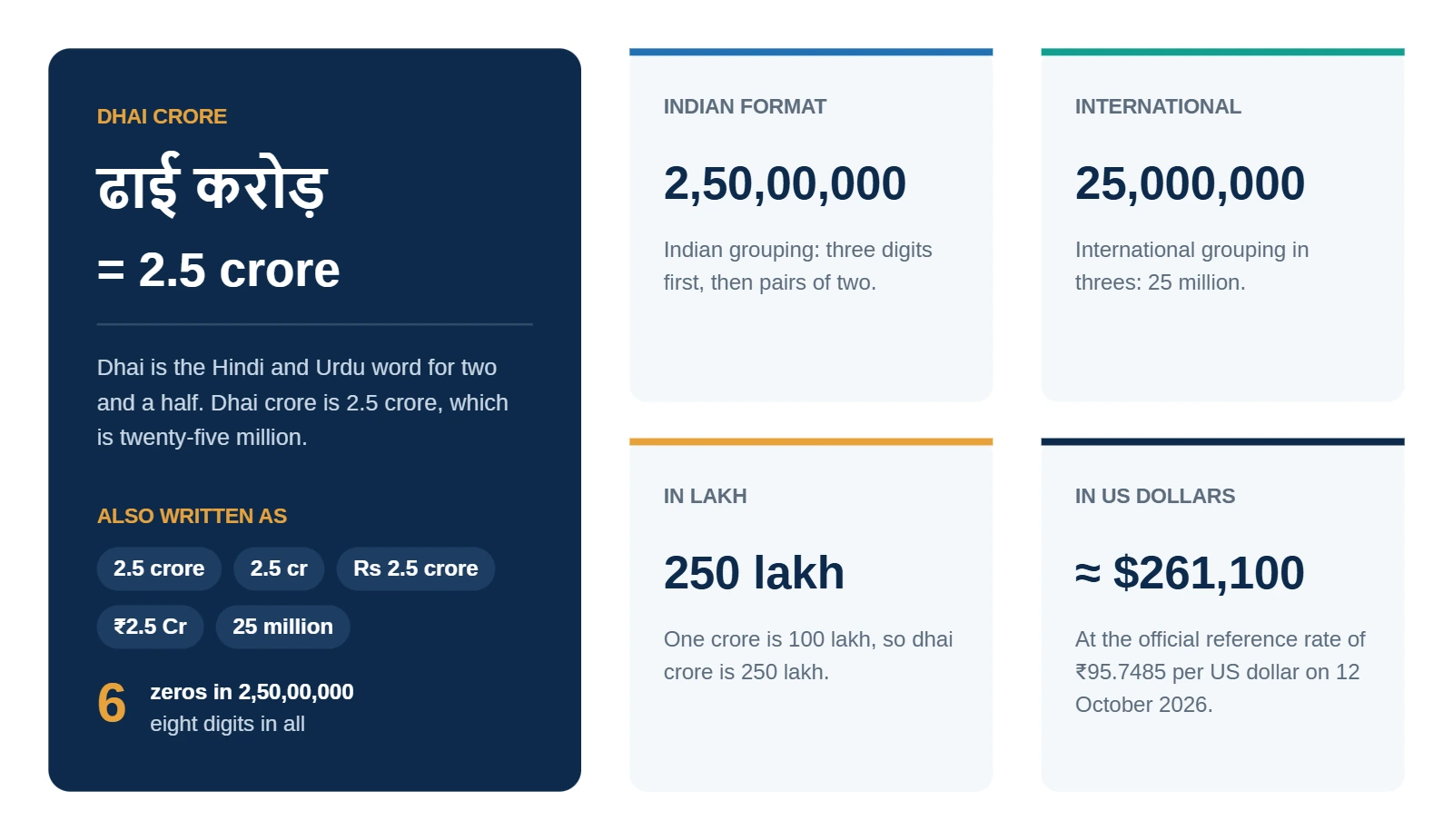
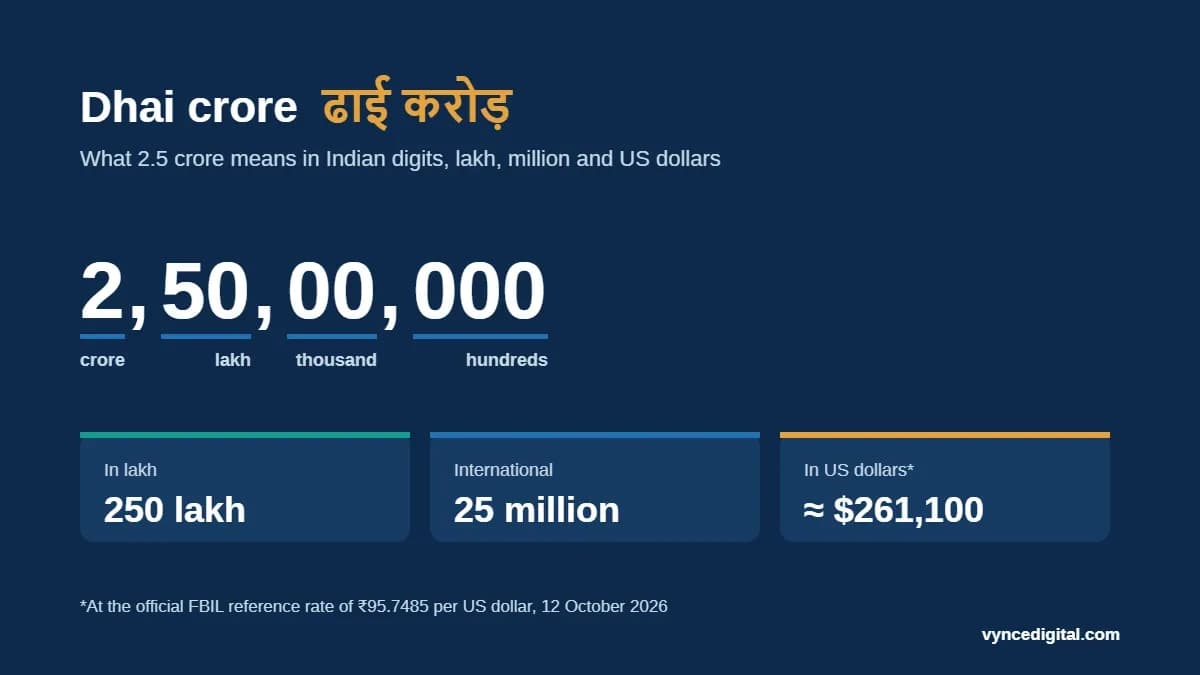
Dhai crore means 2.5 crore. In numbers it is written 2,50,00,000 in the Indian format and 25,000,000 in the international format, which is twenty-five million or 250 lakh. At the official reference rate of ₹95.7485 per US dollar on 12 October 2026, as listed by the Reserve Bank of India, dhai crore rupees is worth about $261,100.
The phrase turns up wherever money is discussed in Hindi and Urdu: a flat listed at dhai crore, a funding round, a player auction, a family deciding what to sell. It also lands in front of people who did not grow up with it, such as a US colleague reading Indian business news or an Indian American making sense of a property figure from home.
The two audiences need different things. An Indian reader wants the figure in lakh and crore with the right commas. A US reader wants millions and dollars, with a date on the exchange rate. This guide covers both: the meaning, the digits, the conversions, the dollar value over time, and how to write crore figures so that neither reader has to stop and count zeros.
Key Takeaways #
Dhai (ढाई) means two and a half, so dhai crore is 2.5 crore: 2,50,00,000 in Indian notation and 25,000,000 internationally.
Dhai crore equals 250 lakh, 25 million and 0.025 billion, and it is written with eight digits, six of them zeros.
At the official reference rate of ₹95.7485 per dollar on 12 October 2026, dhai crore is about $261,100; at the 2010 average rate the same sum was worth about $547,600.
Dhai belongs to a family of Hindi fraction words: sawa adds a quarter, saadhe adds a half, paune takes a quarter away, and dedh and dhai stand for 1.5 and 2.5.
Pages written for both markets should use crore and Indian commas for Indian readers, and dollars or millions with a dated rate for US readers.
What Does Dhai Crore Mean? #
Dhai (ढाई) is the Hindi and Urdu word for two and a half. The Hindi Urdu Flagship at the University of Texas at Austin glosses it simply as two and a half, the same word speakers use for half past two on a clock. Crore (करोड़) is a unit of the Indian numbering system: Merriam-Webster defines a crore as ten million, specifically ten million rupees or 100 lakh, and dates the word's first known use in English to 1609.
Put the two together and dhai crore is two and a half times ten million, or 25,000,000. In Hindi script it is written ढाई करोड़. In English copy you will see it as 2.5 crore, Rs 2.5 crore, ₹2.5 crore or the shorthand ₹2.5 cr. All of them describe the same amount.
The unit is standard in Indian newspapers, government budgets and property listings, and it is also used in Pakistan, Bangladesh and Nepal. For most US readers it is unfamiliar, which is why a crore figure almost always needs a conversion sitting next to it when the audience is international. If you need to say it aloud, crore rhymes with core, and dhai sounds roughly like "dhaa-ee", two syllables run together.
Dhai Crore in Numbers: Where the Commas Go #
Dhai crore has eight digits, and six of them are zeros. What changes between India and the US is where the commas sit.
In the Indian system, the first comma comes after three digits from the right, and every comma after that comes after two more. That produces 2,50,00,000, which an Indian reader takes in at a glance as 2 crore 50 lakh. In the international system used in the US, commas fall every three digits, giving 25,000,000, read as 25 million.
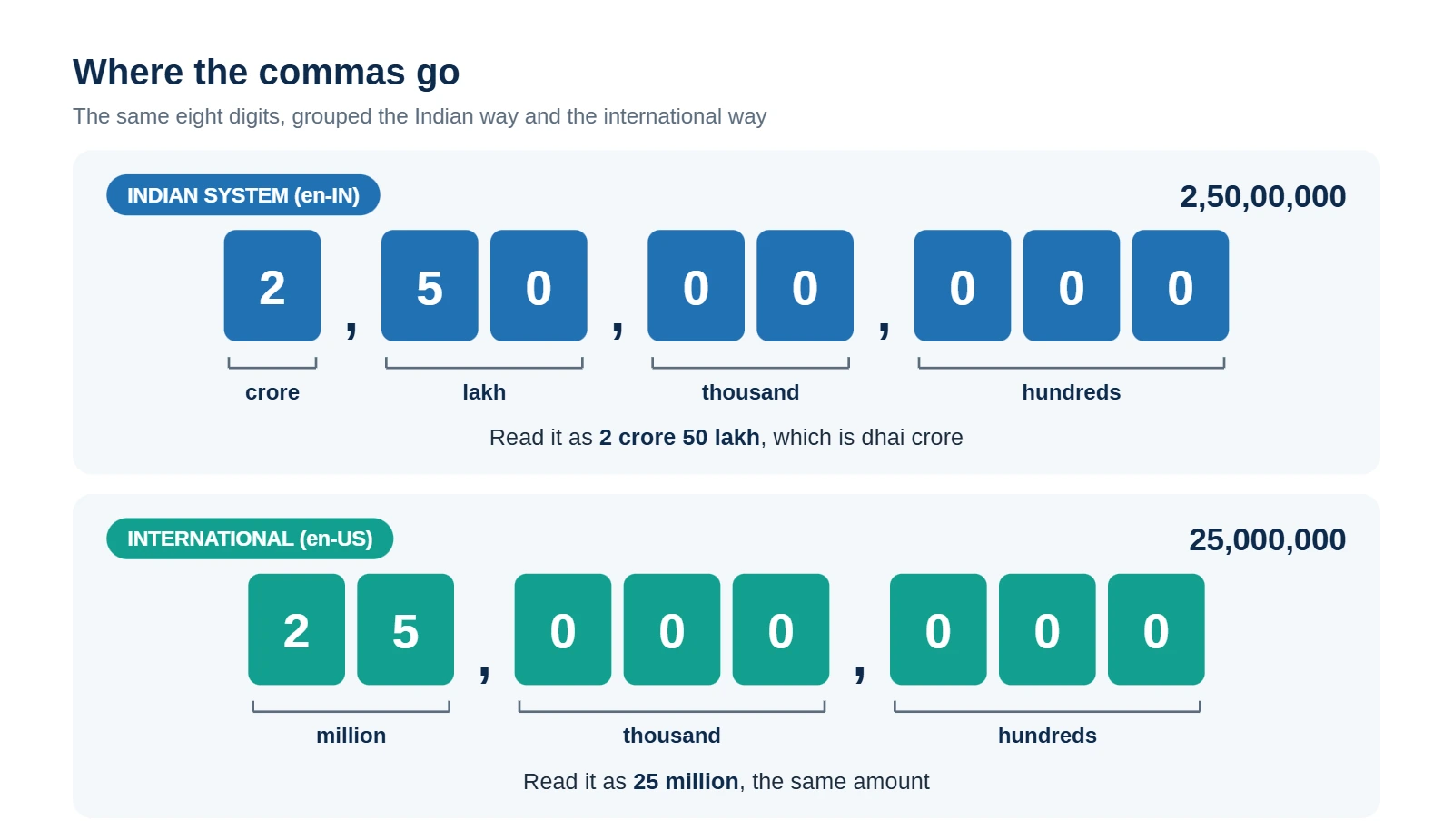
Both strings describe exactly the same number. Only the grouping differs, and the grouping follows the words each system uses for large numbers. English names every third power of ten (thousand, million, billion), while the Indian system names a new unit at every second power once you pass a thousand (lakh, crore, arab).
Written out in words, dhai crore is "two crore fifty lakh" or "two and a half crore" in Indian English, and "twenty-five million" in US English. In scientific notation it is 2.5 × 10⁷.
On an Indian cheque or legal document, the amount is usually written in words as "Rupees Two Crore Fifty Lakh Only", with the figure as ₹2,50,00,000/- in the box. The trailing slash and dash after the figure is a long-standing Indian convention that stops anyone adding digits. A US document would instead read "Twenty-Five Million Indian Rupees" alongside INR 25,000,000.
Dhai Crore in Lakh, Million and Billion #
Three relationships carry almost every conversion: one crore is 100 lakh, one crore is 10 million, and 100 crore is one billion. From those, dhai crore converts as follows.
Unit | Dhai crore equals | How it works |
|---|---|---|
Rupees (Indian format) | ₹2,50,00,000 | 2.5 × 1,00,00,000 |
Rupees (international format) | ₹25,000,000 | Same number, commas every three digits |
Lakh | 250 lakh | 2.5 × 100 lakh |
Million | 25 million | 2.5 × 10 million |
Billion | 0.025 billion | 2.5 ÷ 100 crore |
Scientific notation | 2.5 × 10⁷ | 2.5 × 1 crore, and 1 crore is 10⁷ |
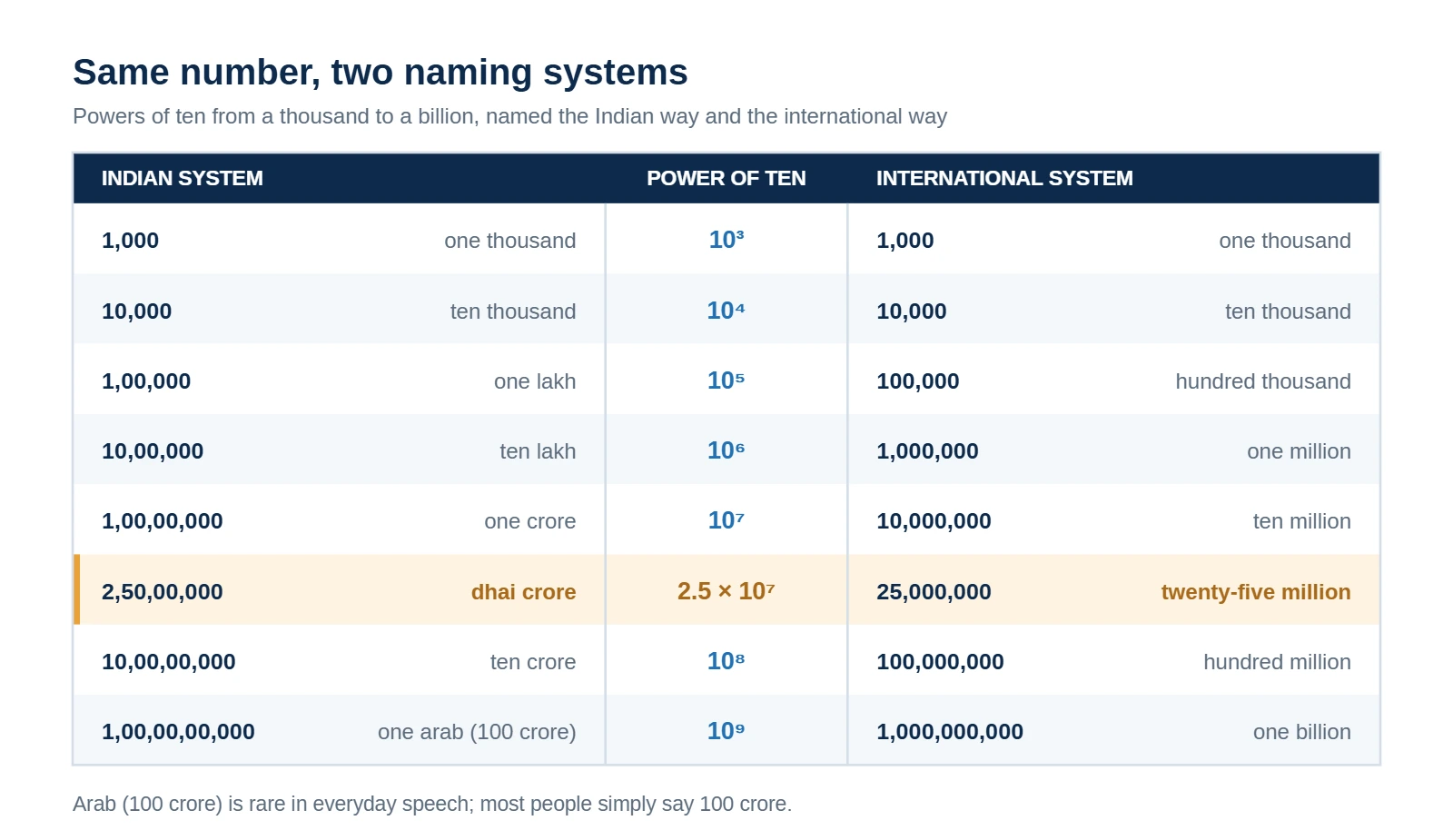
The ladder in Figure 3 shows why these conversions trip people up. Lakh and million sit one power of ten apart, and so do crore and ten million, so a reader moving between systems has to shift two units at once: 25 million becomes 250 lakh, which becomes 2.5 crore. The quick check is to divide millions by ten to get crore, and multiply crore by ten to get millions.
Dhai Lakh, Dhai Crore and Dhai Lakh Crore #
The word dhai scales with whatever unit follows it, and Indian writing uses three of those units constantly. Mixing them up changes the amount by a factor of a hundred or more, so it helps to see them side by side.
Phrase | In numbers | International equivalent |
|---|---|---|
Dhai lakh | 2,50,000 | 250 thousand |
Dhai crore | 2,50,00,000 | 25 million |
Dhai sau crore (250 crore) | 2,50,00,00,000 | 2.5 billion |
Dhai lakh crore | 2,50,000 crore | 2.5 trillion |
Lakh crore is the unit for national-scale numbers such as government budgets, tax collections and market capitalisation. One lakh crore is 10 to the power of 12, a trillion in US terms, so dhai lakh crore rupees is 2.5 trillion rupees. At the 12 October 2026 reference rate that is about $26.1 billion.
In headlines and listings you will also meet the short forms: Cr or cr for crore, L, lac or lakh for lakh, and Rs, INR or ₹ for rupees. ₹2.5 Cr, Rs 2.5 crore and INR 25 million are three spellings of the same dhai crore.
How Much Is Dhai Crore in US Dollars? #
To convert any rupee amount to dollars, divide it by the number of rupees per dollar. For dhai crore the calculation is 25,000,000 ÷ 95.7485, using the official reference rate for 12 October 2026, which gives about $261,100.
That number moves every trading day. India's official rupee reference rates are set each working day by Financial Benchmarks India (FBIL), which took over the task from the RBI in July 2018. A reference rate is a benchmark rather than the rate a customer receives, and a bank or money transfer service applies its own rate and fees, so the dollars that actually arrive in a US account will be somewhat lower than the reference conversion. The table shows how much the answer depends on the rate.
Rupees per US dollar | Dhai crore in US dollars |
|---|---|
₹85 | about $294,100 |
₹90 | about $277,800 |
₹95.7485 (FBIL reference rate, 12 October 2026) | about $261,100 |
₹100 | $250,000 |
Over a longer stretch the change is larger. Using annual average exchange rates from the Federal Reserve Board's G.5A release, published as the FRED series AEXINUS, dhai crore was worth about $547,600 in 2010, $390,000 in 2015 and $286,900 in 2025. Measured against the October 2026 reference rate, the dollar value of the same rupee sum has fallen by 52% since 2010.
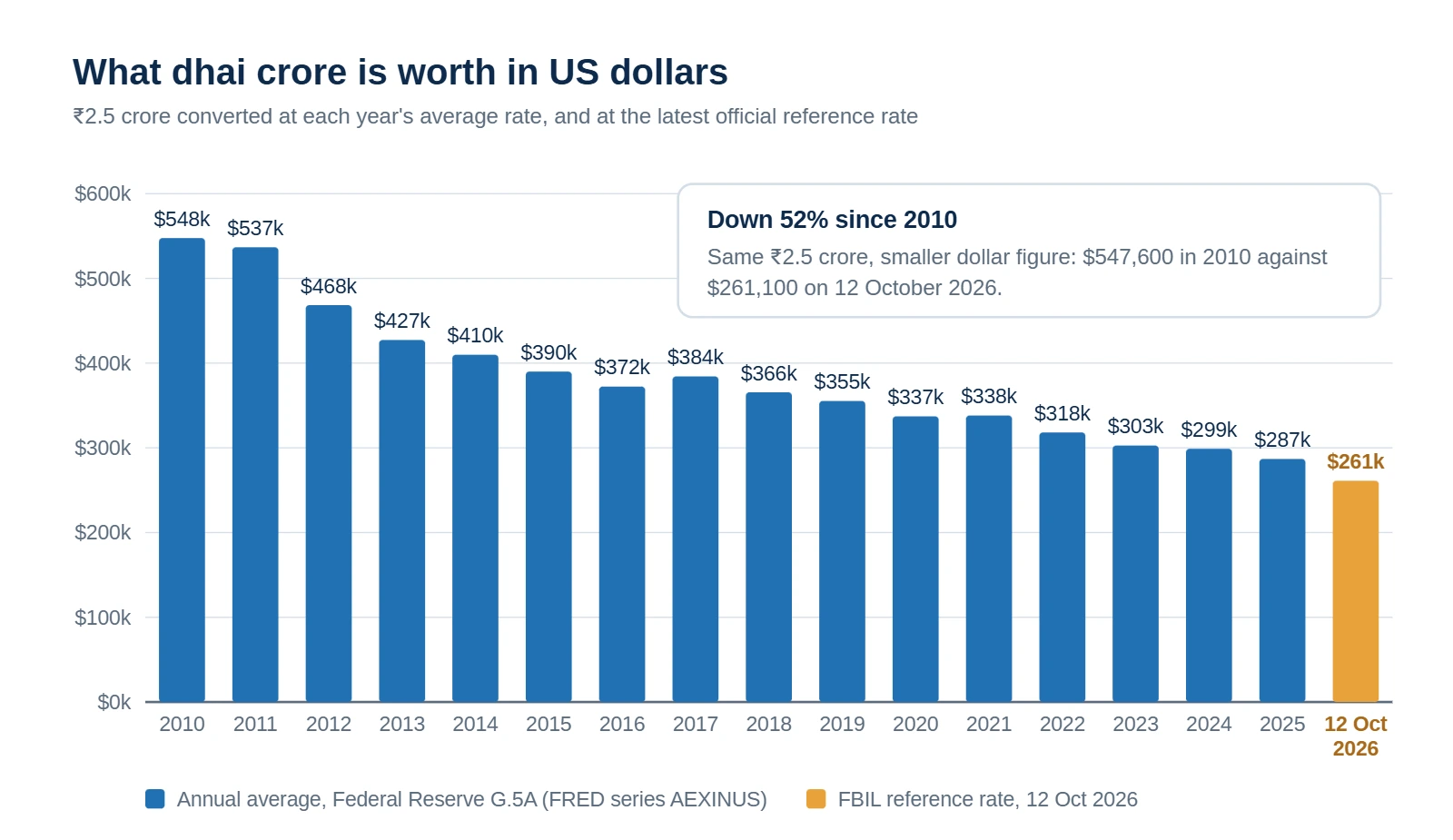
For quick mental math, one crore at about ₹96 per dollar is roughly $104,000, so dhai crore is roughly $260,000. For anything that matters, such as a contract, an invoice or a transfer, use the day's rate and say which rate and date you used.
FBIL also sets reference rates for the euro, the pound and the yen, so the same method gives dhai crore in other currencies. On 12 October 2026 the rates were ₹107.3022 per euro, ₹126.9185 per pound and ₹60.46 per 100 yen.
Currency | FBIL reference rate, 12 Oct 2026 | Dhai crore equals |
|---|---|---|
US dollar | ₹95.7485 | about $261,100 |
Euro | ₹107.3022 | about €233,000 |
Pound sterling | ₹126.9185 | about £197,000 |
Japanese yen | ₹60.46 per 100 yen | about ¥41.3 million |
Dhai and Its Family of Fraction Words #
Dhai is one of a small set of Hindi and Urdu words for quarters and halves. The University of Texas spoken thesaurus lists them together: sawa (सवा) means a number and a quarter, saadhe (साढ़े) means a number and a half, paune (पौने) means a quarter less, and dedh (डेढ़) means one and a half. It also notes that speakers say dedh rather than "saadhe ek" for half past one. Dhai does the same job for two and a half, standing in for "saadhe do".
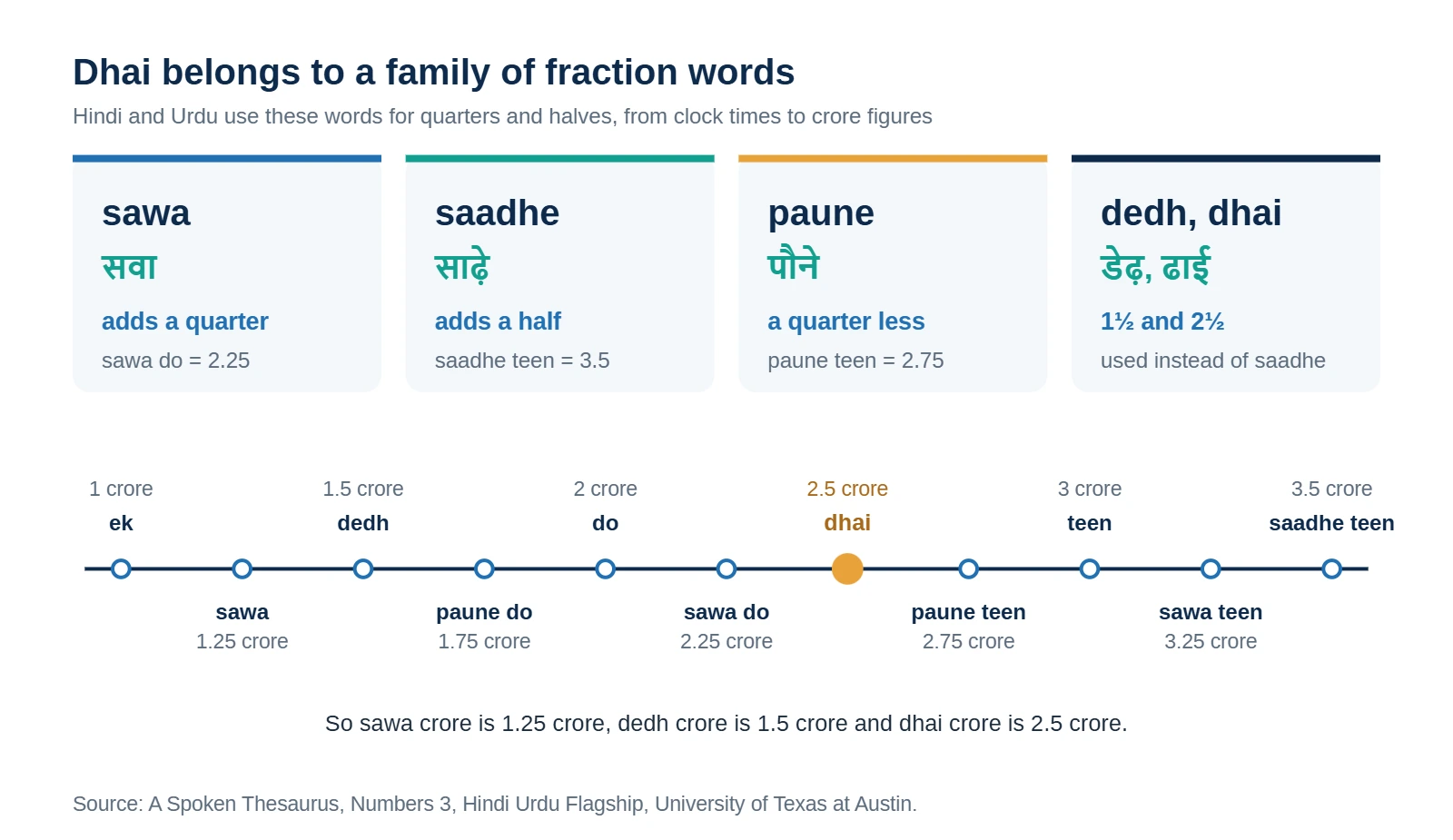
Applied to money, the same words produce the common crore figures. Sawa crore is 1.25 crore (1,25,00,000), dedh crore is 1.5 crore (1,50,00,000), paune do crore is 1.75 crore, dhai crore is 2.5 crore and saadhe teen crore is 3.5 crore. The pattern works with lakh too, so dhai lakh is 2,50,000, or 250,000.
For US readers, the closest English habit is clock time. "Half past two" and "a quarter to three" follow the same logic, applied to hours instead of rupees.
Where Dhai Crore Shows Up in Real Figures #
Dhai crore is more than a round number. It sits on real thresholds that matter to Indian businesses and to families with ties to the US.
Micro enterprise ceiling. Since 1 April 2025, an Indian enterprise with investment in plant, machinery or equipment of up to ₹2.5 crore, and turnover of up to ₹10 crore, is classified as a micro enterprise. The investment limit was raised from ₹1 crore by Notification S.O. 1364(E) dated 21 March 2025, as set out in a Ministry of MSME circular. For a small manufacturer, dhai crore is now the investment figure at which micro status ends and small enterprise status begins.
Overseas remittance limit. Under the RBI's Liberalised Remittance Scheme, a resident individual can send up to USD 250,000 abroad per financial year for permitted transactions. At the 12 October 2026 reference rate, that limit equals about ₹2.39 crore, so moving a full dhai crore out of India in one financial year would exceed it by roughly $11,100. Amounts above the limit generally need prior RBI permission, with some exceptions for purposes such as emigration, medical treatment and education, so confirm the details with your bank.
US housing comparison. The US Census Bureau puts the median sales price of new houses sold in August 2026 at $393,700. Dhai crore, at about $261,100, comes to roughly two thirds of that figure.
Remittance flows. The United States was the largest source of India's inward remittances in 2023-24, at 27.7% of the total, according to the RBI's sixth remittances survey published in March 2025. Every one of those transfers involves a conversion between rupees and dollars.
How to Convert Any Crore Figure in Seconds #
The same handful of rules handles every crore conversion. Keep these five steps nearby:
Crore to digits: multiply by 1,00,00,000, which is a one followed by seven zeros. 2.5 crore becomes 2,50,00,000.
Crore to million: multiply by 10. 2.5 crore becomes 25 million.
Million to crore: divide by 10. 40 million becomes 4 crore.
Lakh to million: divide by 10. 250 lakh becomes 25 million.
Crore to dollars: multiply by 10,000,000, then divide by the rupees per dollar rate for the day you need.
Indian figure | In numbers | International |
|---|---|---|
1 crore | 1,00,00,000 | 10 million |
Sawa crore (1.25 crore) | 1,25,00,000 | 12.5 million |
Dedh crore (1.5 crore) | 1,50,00,000 | 15 million |
Dhai crore (2.5 crore) | 2,50,00,000 | 25 million |
5 crore | 5,00,00,000 | 50 million |
10 crore | 10,00,00,000 | 100 million |
100 crore (1 arab) | 1,00,00,00,000 | 1 billion |
Writing Crore Figures for Indian and US Audiences #
If you publish for both markets, the same figure has to work for two kinds of reader. An Indian reader scanning a price expects crore and lakh; a US reader looking at 2,50,00,000 has to stop and count digits. The answer is not to pick one audience but to give each one its own version of the number.
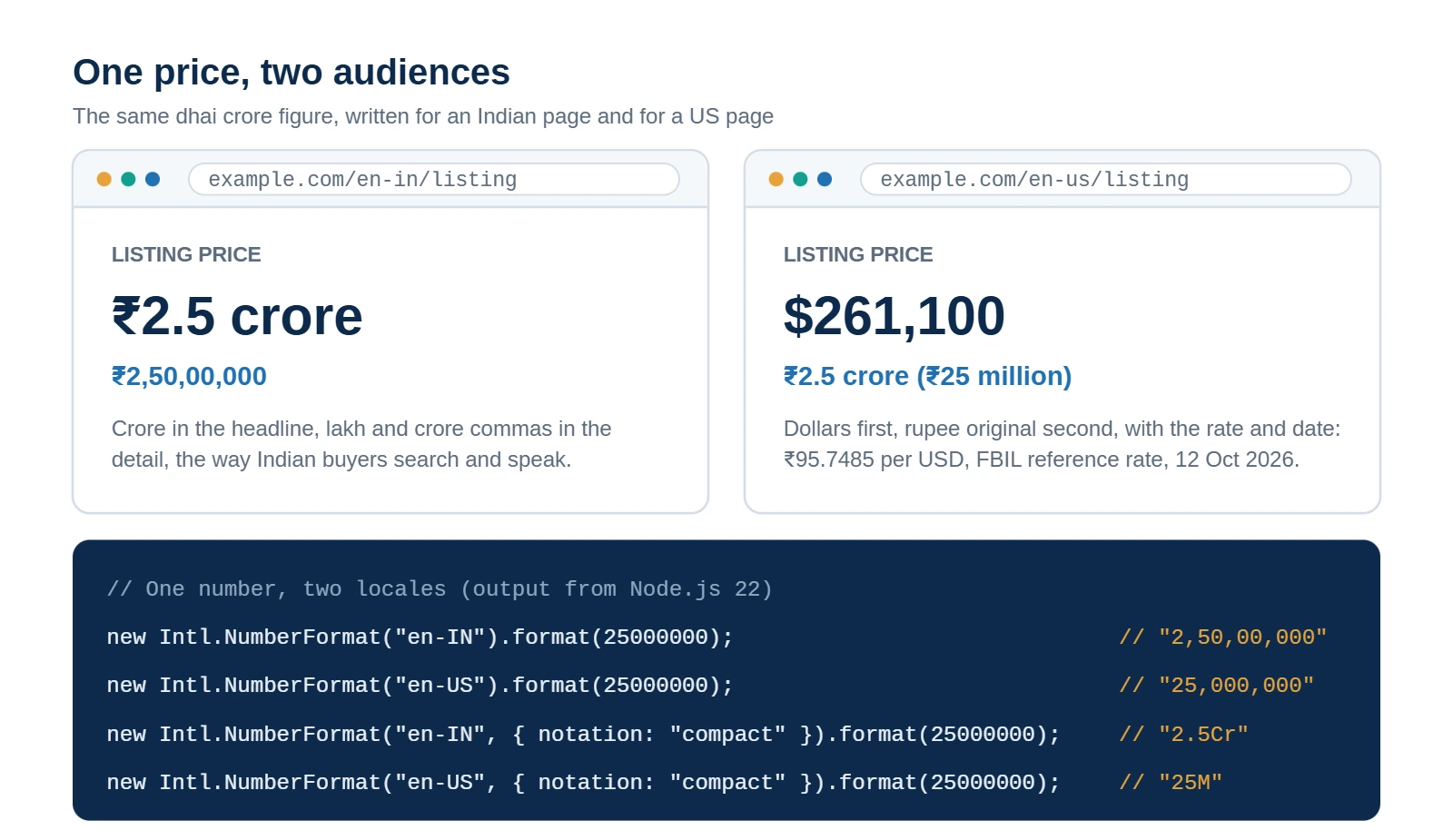
Write in the reader's format. Pages for India should lead with crore and Indian commas. Pages for the US should lead with dollars or millions and keep the rupee figure in brackets with the rate and date. Getting this right page by page is the everyday work of localized content writing.
Give each market its own page signals. Google's guidance on localized versions of a page says each language or regional version should list itself and every alternate with hreflang, and its own example includes a US page that shows prices in US dollars. Setting this up correctly is part of technical SEO for any site serving India and the US.
Format numbers in code, not by hand. JavaScript's Intl.NumberFormat formats numbers by locale. With en-IN it returns 2,50,00,000 for 25 million, and with compact notation it returns 2.5Cr, in our test on Node.js 22. Building this into templates during website design keeps commas consistent across every page.
Keep every price surface in sync. Product pages, feeds and listings should show the same figure in the same format for each market, which is a basic requirement for e-commerce product pages that sell across borders.
Match ad copy to the landing page. If a US ad says $261,100 and the landing page opens on ₹2.5 crore, the mismatch costs trust. Currency and number format should line up across paid search campaigns and the pages they send visitors to.
Write conversions that AI answers can quote. Answer engines tend to lift short, self-contained statements. A sentence that gives the figure, the rate, the date and the source in one line is easy to cite, which supports AI search visibility for questions such as dhai crore in dollars.
Test how the price reads. Whether US visitors respond better to a dollar figure alone or to dollars with the rupee original alongside is worth settling through conversion testing rather than guesswork.
The same applies to news, finance and research content written for a global readership. A common house style is to give the rupee figure in millions and add the dollar conversion in brackets, for example ₹25 million ($261,100), and to keep crore for copy aimed at Indian readers. Whichever style you choose, apply it consistently across a page, because switching between crore and million mid-article is the fastest way to lose a reader.
Getting Crore Figures Right Everywhere #
Dhai crore is a simple number once the pieces are clear: two and a half crore, 2,50,00,000 in Indian notation, 25 million internationally and about $261,100 at the 12 October 2026 reference rate. The part that takes care is presenting it so that a reader in Mumbai and a reader in Chicago both understand it at first glance, with the commas, units and dated rate each one expects.
If your site speaks to readers in both India and the US, a short review of how its prices, figures and regional pages are presented is a sensible place to start.
Frequently Asked Questions #
What is dhai crore in numbers?
Dhai crore is 2,50,00,000 in the Indian numbering system and 25,000,000 in the international system. Both mean twenty-five million. The Indian format places the first comma after three digits and then after every two, while the international format places a comma after every three digits.
Dhai crore mein kitne zero hote hain?
Dhai crore mein chhah (6) zero hote hain: 2,50,00,000. In English, dhai crore has six zeros and eight digits in total, whether you write it in the Indian format, 2,50,00,000, or in the international format, 25,000,000.
How much is 2.5 crore in million?
2.5 crore is 25 million. One crore equals 10 million, so you multiply the crore figure by 10 to get millions. To go the other way, divide millions by 10: 25 million divided by 10 gives 2.5 crore.
How much is dhai crore in US dollars?
At the official reference rate of ₹95.7485 per US dollar on 12 October 2026, set by Financial Benchmarks India and listed by the Reserve Bank of India, dhai crore (₹2,50,00,000) is worth about $261,100. The figure changes with the exchange rate every trading day, and banks apply their own rates and fees to actual transfers.
How many lakh are in dhai crore?
Dhai crore equals 250 lakh. One crore is 100 lakh, so 2.5 crore is 2.5 times 100, or 250 lakh. In digits it is still 2,50,00,000.
How do you write dhai crore in Hindi and in English words?
In Hindi, dhai crore is written ढाई करोड़. In Indian English words it is "two crore fifty lakh" or "two and a half crore", and in US English it is "twenty-five million". As a figure, write ₹2.5 crore or ₹2,50,00,000 for Indian readers and 25 million rupees for US readers.
Is 2.5 crore the same as 2.5 million?
No. 2.5 crore is 25 million, which is ten times larger than 2.5 million. 2.5 million equals 25 lakh. The mix-up happens because lakh and million sit one power of ten apart, as do crore and ten million.
What do sawa crore and dedh crore mean?
Sawa crore means 1.25 crore (1,25,00,000, or 12.5 million) and dedh crore means 1.5 crore (1,50,00,000, or 15 million). Sawa adds a quarter, dedh means one and a half, and dhai means two and a half.
How many crore make one billion?
One hundred crore make one billion: 1,00,00,00,000 in Indian notation, or 1,000,000,000 internationally. Dhai crore is one fortieth of a billion, or 0.025 billion. The rarely used Indian name for 100 crore is arab.
Can I send dhai crore from India to the US in one year?
Under the RBI's Liberalised Remittance Scheme, a resident individual can remit up to USD 250,000 per financial year for permitted transactions. At the 12 October 2026 reference rate, dhai crore is about $261,100, which is above that limit. Amounts beyond it generally need prior RBI permission, so confirm the rules with your bank first.