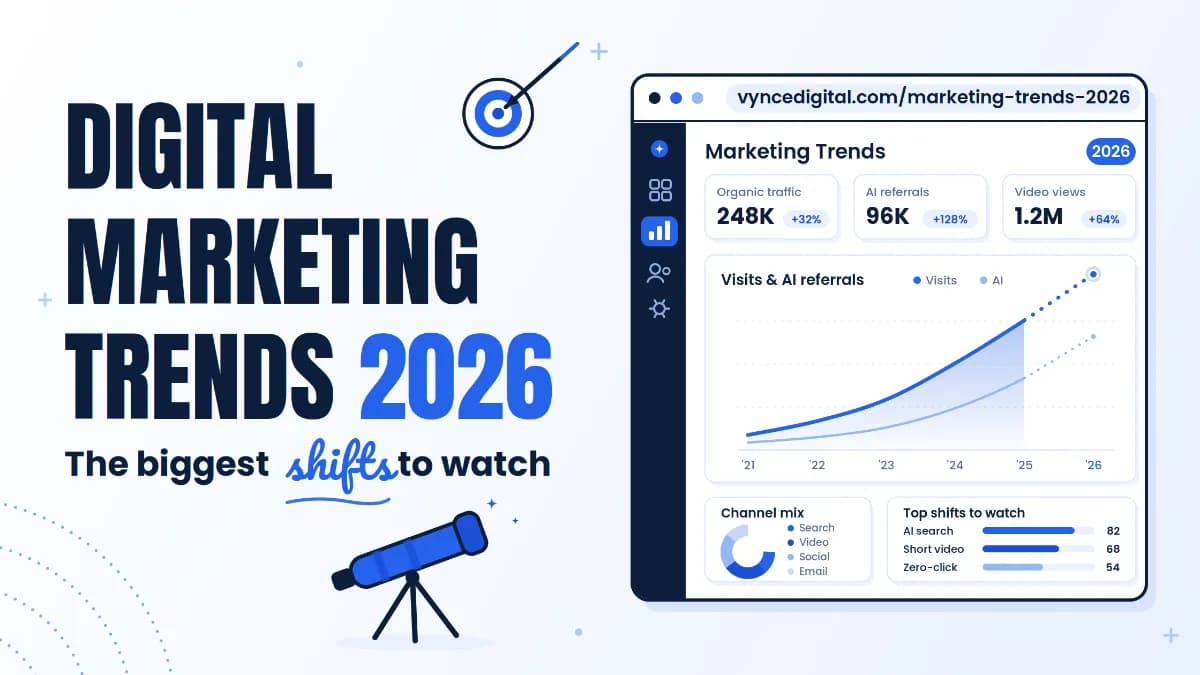
Digital Marketing Trends 2026: The Biggest Shifts to Watch

Tuba
July 23, 2026
Table of Contents
- The Thread That Ties 2026 Together
- Digital Marketing Trends and The Biggest Shifts
- 1. AI Search is Rewriting How Customers Find You
- 2. Generative Engine Optimization Moves From Experiment to Essential
- 3. Agentic AI Turns Shoppers Into Delegators
- 4. Short-Form Video Keeps the ROI Crown
- 5. Social Commerce Crosses the 100 Billion Dollar Line
- 6. Retail Media Grows Up and Spreads Out
- 7. First-Party Data Becomes the Fuel For AI Personalization
- Where to Start If You Cannot Do It All
- Frequently Asked Questions
The Thread That Ties 2026 Together #
Every trend in this article describes the same customer: one who lets AI shorten the path between a question and a purchase. The brands that win 2026 will not be the ones that adopt every tool. They will be the ones AI systems can understand, cite, and transact with, and the ones that still sound human when a real person finally shows up. Pick your sequence, fund it properly, and measure visibility as seriously as you measure clicks.
Digital Marketing Trends and The Biggest Shifts #
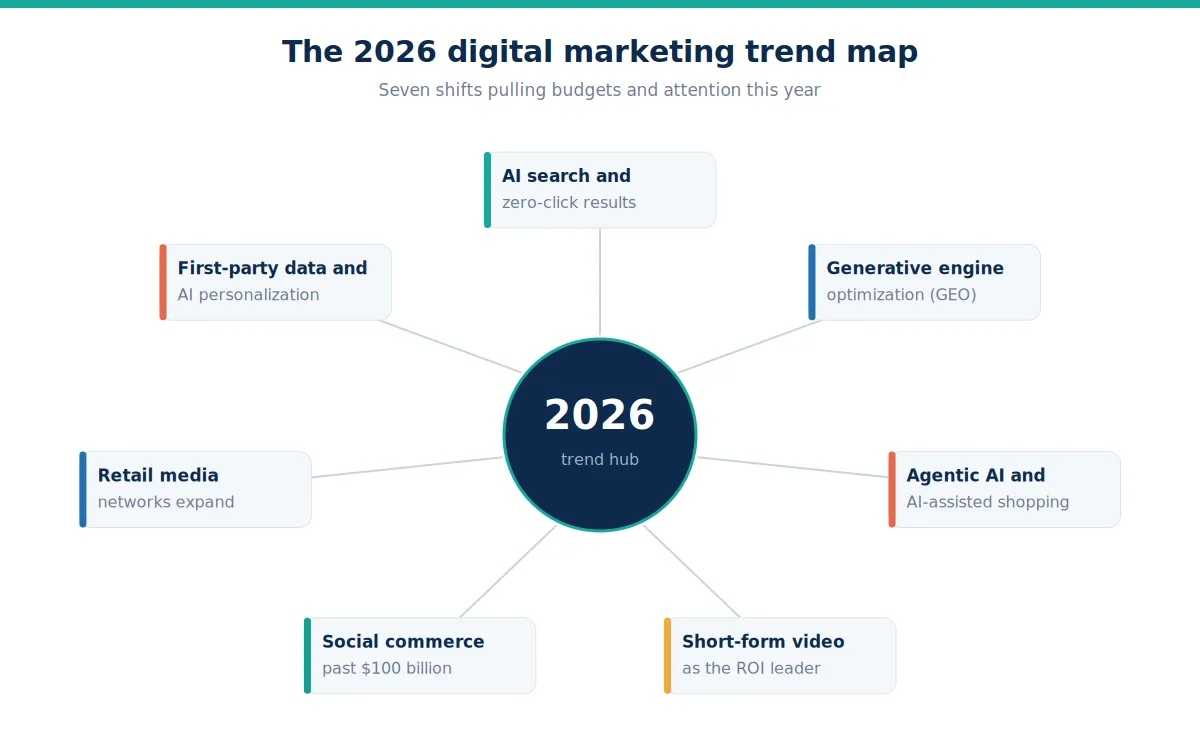
Digital marketing trends 2026 all point in the same direction: artificial intelligence now sits between your brand and your customers. It summarizes your content in search results. It recommends products in chat windows. It even fills carts on a shopper's behalf. Meanwhile, proven winners like short-form video and social commerce keep compounding, and ad budgets keep flowing into retail media networks.
This guide walks through the seven trends that matter most this year, backed by the newest research from Pew, Gartner, Adobe, Salesforce, HubSpot, and EMARKETER. For each one, you will find the numbers behind the shift and a practical way to respond. None of it requires an enterprise budget. It requires picking the right moves early.
1. AI Search is Rewriting How Customers Find You #
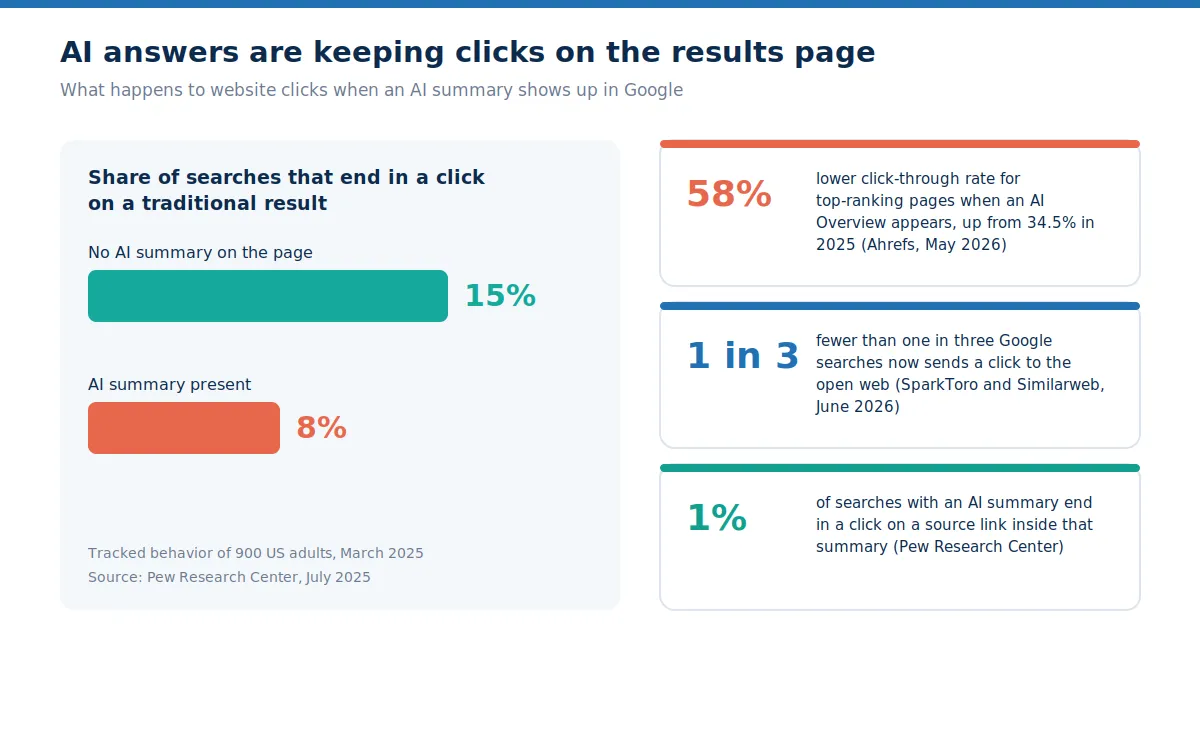
Google still handles billions of searches a day, but fewer of them end with a click on a website. A Pew Research Center study published in July 2025 tracked the real browsing behavior of 900 US adults. When an AI Overview appeared, only 8 percent of searches led to a click on a traditional result, compared with 15 percent when no summary appeared. Just 1 percent of those searches ended in a click on a source link inside the summary itself.
The trend has accelerated since. In May 2026, Ahrefs re-ran its study of 300,000 keywords and found that AI Overviews now account for 58 percent of clicks on top-ranking pages, up from 34.5 percent roughly eight months earlier. A June 2026 SparkToro analysis of Similarweb clickstream data found that fewer than one in three Google searches now leads to a click on the open web. Gartner saw this coming: back in February 2024, it predicted that traditional search volume would fall by 25 percent by 2026 as chatbots absorb queries.
Here is the part many businesses miss: customers have not stopped researching. They have stopped clicking. Your brand can still win the moment of discovery if your content is the source the AI quotes, which changes the job of search engine optimization. Rankings still matter, but being cited, summarized, and remembered matters just as much. If your organic traffic dipped this year while leads held steady, this is probably why, and it is exactly the problem a modern AI SEO strategy is built to solve.
2. Generative Engine Optimization Moves From Experiment to Essential #
Generative engine optimization, or GEO, is the practice of making your brand visible and quotable inside AI answers on ChatGPT, Gemini, Perplexity, and Google's AI features. In 2024, it was a curiosity. In 2026, it has revenue attached.
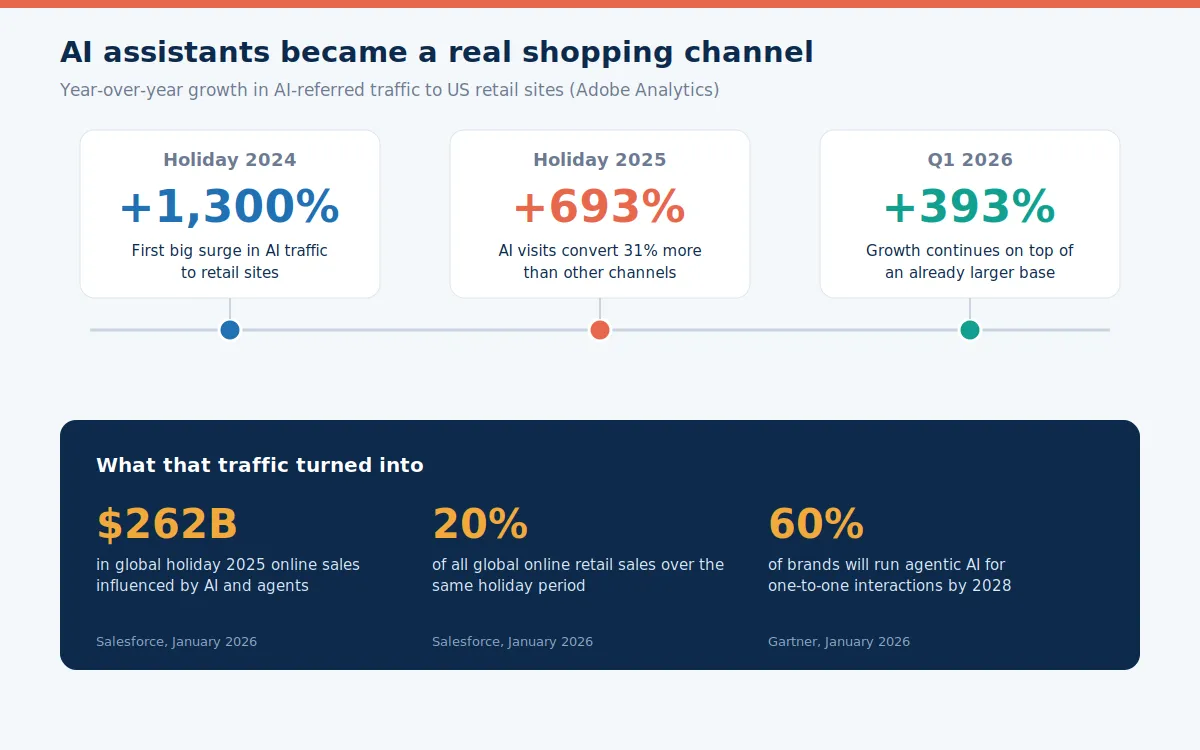
Adobe Analytics reported in April 2026 that traffic from AI sources to US retail sites grew 393 percent year over year in the first quarter of 2026, and that AI-referred visits converted 42 percent better than other channels in March, a record high. In Adobe's survey, 39 percent of consumers said they have used AI while shopping online, and 85 percent of those said it improved the experience.
Earning these citations is not magic. AI engines favor pages with clear structure, direct answers, original data, and consistent brand mentions across the web. That means schema markup and clean HTML, question-led headings, and content writing built to be quoted, not just ranked. It also means checking what each engine currently says about your brand and category, because you cannot fix what you have not seen. A focused generative engine optimization program treats AI answers as a channel with its own funnel, not a footnote to SEO.
3. Agentic AI Turns Shoppers Into Delegators #
The step past AI answers is AI action. Agentic AI refers to assistants that not only recommend products but also compare options, fill carts, and complete tasks with minimal human oversight.
The 2025 holiday season was the proof point. Adobe's January 2026 holiday report showed that traffic to US retail sites from generative AI tools grew 693 percent year over year between November 1 and December 31, and that visits from these tools converted 31 percent more often than other traffic, with revenue per visit up 254 percent. Salesforce's January 2026 recap found AI and agents influenced 20 percent of all global online sales in the same window, worth 262 billion dollars, and retailers running their own shopper agents grew sales 59 percent faster than those without. Looking ahead, Gartner predicted in January 2026 that 60 percent of brands will use agentic AI for one-to-one customer interactions by 2028.
For most businesses, preparing for agents looks less like science fiction and more like housekeeping. Agents need accurate product feeds, transparent pricing, fast page load times, structured data, and checkout flows that do not break. If a bot abandons your cart, so does its human. This is where disciplined conversion rate optimization quietly becomes an AI readiness project.
4. Short-Form Video Keeps the ROI Crown #
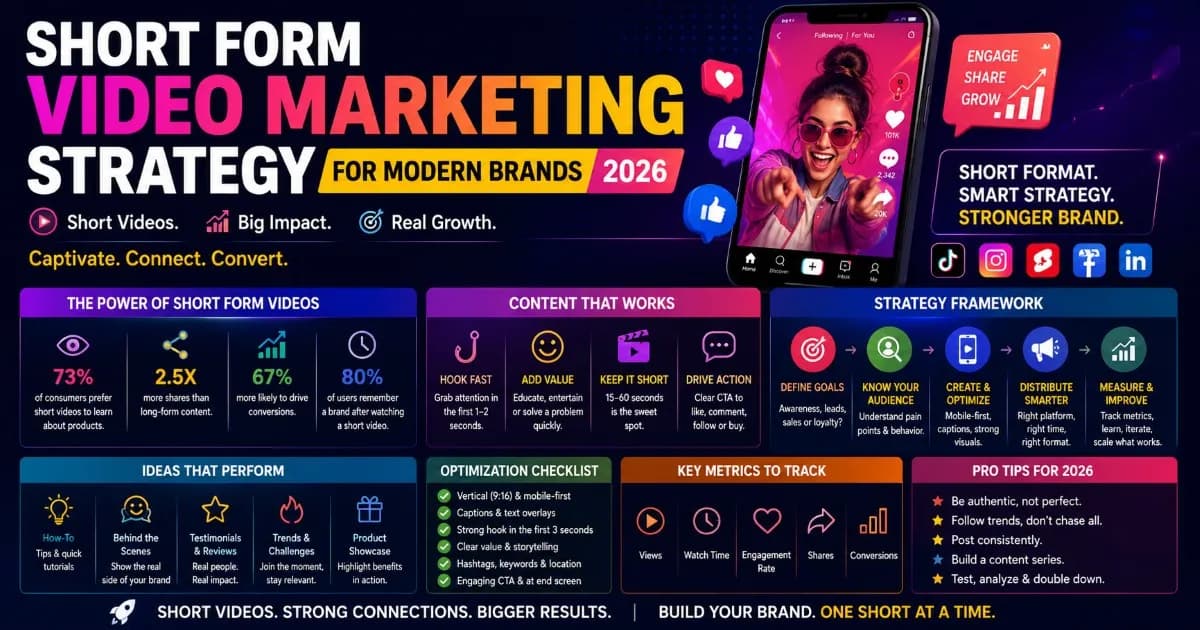
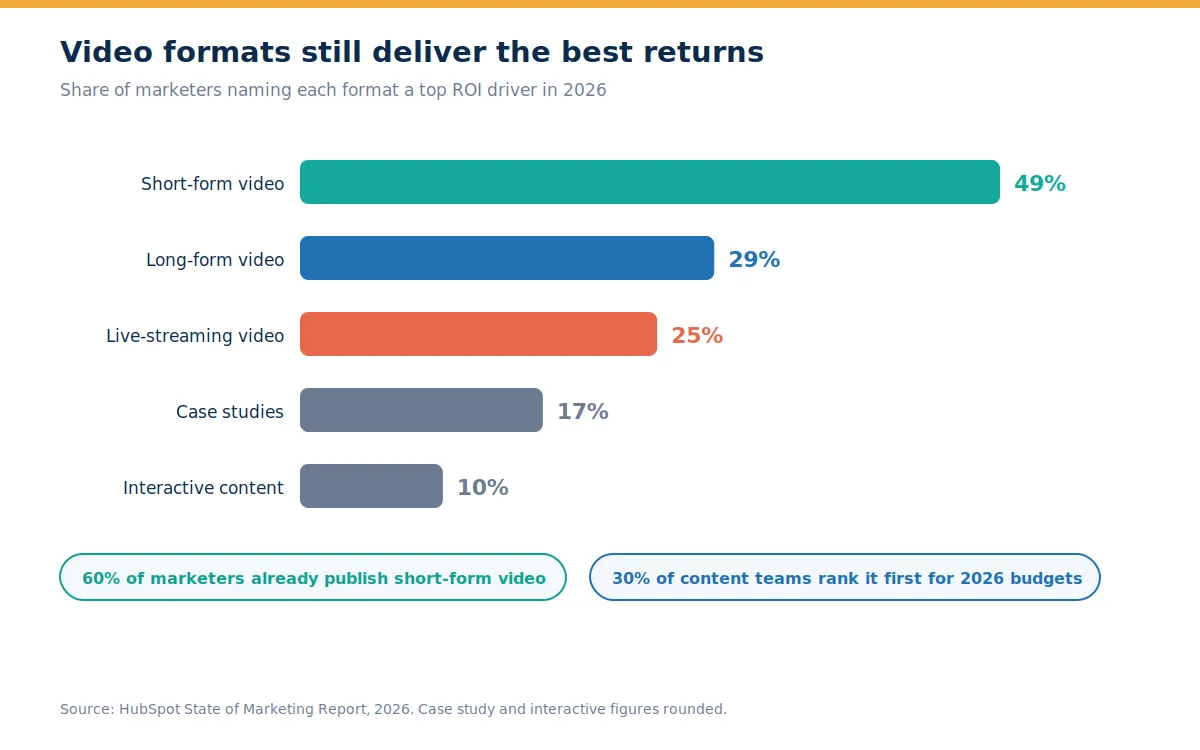
Every year someone predicts video fatigue, and every year the data disagrees. HubSpot's 2026 State of Marketing report, drawn from a survey of more than 1,500 marketers worldwide, found that short-form video is again the top ROI content format, named by 49 percent of marketers, well ahead of long-form video at 29 percent and live streaming at 25 percent. Sixty percent of marketers already publish short-form video, and it tops 2026 investment plans, with 30 percent of content teams prioritizing it.
The 2026 twist is how the videos get made. In the same report, 94 percent of marketers said they plan to use AI in content creation. AI now drafts scripts, captions, cutdowns, and translations, which dramatically lowers the cost per video. What it cannot supply is a point of view: 53 percent of marketers say they struggle to differentiate content in an AI-saturated feed. The brands that win pair AI production speed with human faces, stories, and opinions. Distribution matters as much as production, and a tested social media advertising plan is the fastest way to learn which hooks earn attention before scaling organic output.
5. Social Commerce Crosses the 100 Billion Dollar Line #
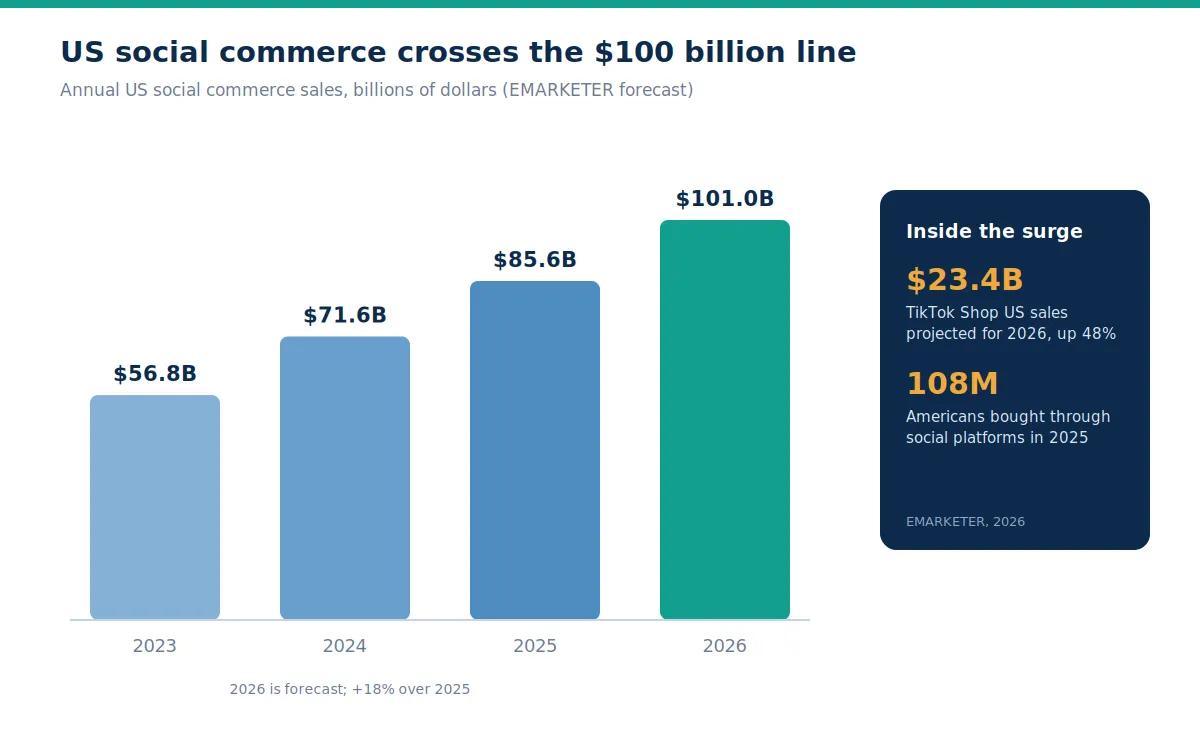
Social platforms are no longer just where products get discovered. They are where products get bought. EMARKETER forecasts that US social commerce sales will surpass $ 100 billion for the first time in 2026, growing 18 percent year over year, after 108.3 million Americans bought through social platforms in 2025. TikTok Shop is the engine: eMarketer projects $ 23.41 billion in US TikTok Shop sales in 2026, up 48 percent from 2025.
The playbook that works blends three ingredients: creators who feel native to the feed, product listings inside the app so checkout takes seconds, and live or short-form video that shows the product solving a real problem. Watch the margins, because platform fees and discounts add up. But for consumer brands, refusing to sell where attention lives is getting expensive. If your products suit discovery and impulse buying, folding social storefronts into your wider ecommerce marketing mix should be a 2026 priority, not a 2027 one.
6. Retail Media Grows Up and Spreads Out #
Retail media, the ads bought on retailer sites and apps using their shopper data, keeps pulling budget from other channels. EMARKETER's November 2025 forecast projects US retail media spending to reach $69.33 billion in 2026, up from $58.79 billion in 2025. The catch: Amazon and Walmart are expected to capture roughly 89 percent of those new dollars, which tells you where scale and proof currently live.
Why the pull? Closed-loop measurement. Retail media ties an ad view to an actual sale inside the same ecosystem, exactly the accountability finance teams demand as privacy rules squeeze third-party tracking. The format is also spreading beyond retail into travel, finance, and delivery apps under the broader label of commerce media.
For brands that sell through Amazon, Walmart, or grocery platforms, retail media is now the price of shelf visibility. For everyone else, the lesson still applies: put budget where the measurement is honest. Pairing retail media tests with a tightly managed paid search program gives you two channels where every dollar can be traced to revenue.
7. First-Party Data Becomes the Fuel For AI Personalization #
Personalization used to mean a first name in an email subject line. In 2026, it means AI systems adjusting offers, timing, and creative for each person, and those systems are only as good as the data you own. With third-party tracking limited by browsers and regulation, first-party data, the information customers share with you directly, is the asset that compounds.
HubSpot's 2026 research ranks personalization among the top drivers of marketing performance this year, while Gartner's January 2026 predictions urge marketers to put strong data governance in place before wiring agentic systems into their stacks. The message from both is the same: collect data cleanly, store it responsibly, and connect it to activation.
Practically, that means giving people reasons to identify themselves: useful email courses, quizzes, calculators, loyalty perks, and gated tools. Then use that data to trigger relevant messages. A well-built email marketing program remains the highest-margin channel you fully own, and it feeds the AI personalization loop everything it needs.
Where to Start If You Cannot Do It All #
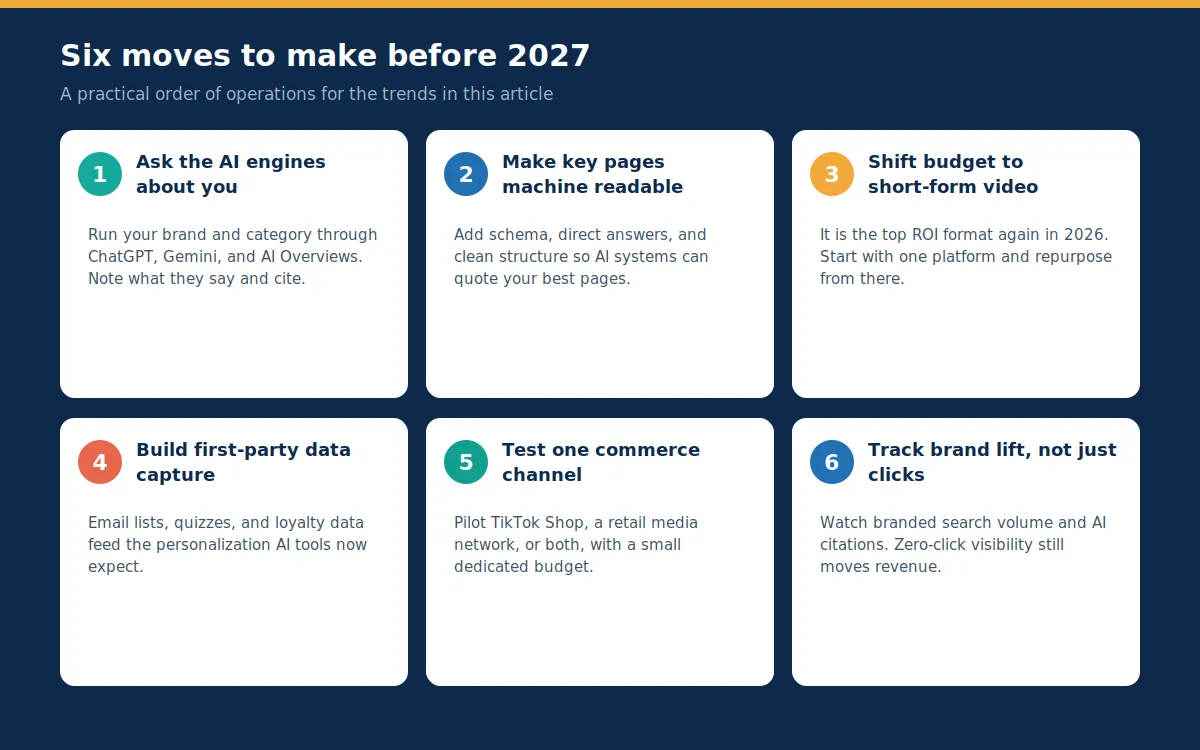
Seven trends can read like seven new jobs. They are not. Most reward the same underlying work: clear positioning, structured content, owned data, and honest measurement. So sequence it. First, audit how AI engines describe your brand today. Second, make your most valuable pages machine-readable. Third, move test budget into short-form video and one commerce channel. Fourth, build the first-party data engine. And throughout, measure branded search volume and AI citations alongside traffic, because zero-click visibility now drives revenue that last-click reports will never show you.
Frequently Asked Questions #
What are the biggest digital marketing trends in 2026?
The seven biggest digital marketing trends in 2026 are AI search and zero-click results, generative engine optimization, agentic AI shopping, short-form video, social commerce, retail media, and first-party data personalization.
How is AI changing search in 2026?
AI summaries now answer many queries directly, so fewer searches end in clicks. Pew found click rates drop from 15 percent to 8 percent when an AI Overview appears, and Ahrefs measured a 58 percent click loss for top-ranking pages by 2026.
What is generative engine optimization (GEO)?
GEO is the practice of structuring your content and brand signals so AI tools like ChatGPT, Gemini, and Google's AI Overviews cite and recommend your business in their answers.
Is SEO still worth doing in 2026?
Yes. Organic rankings feed both human clicks and AI citations. The work has shifted toward structured content, original data, and brand authority rather than chasing keywords alone.
What is agentic AI in marketing?
Agentic AI refers to assistants that act on behalf of the user by comparing products, filling carts, and completing tasks. Salesforce data shows AI and agents influenced 20 percent of global online sales during the 2025 holiday season.
Which content format has the best ROI in 2026?
Short-form video. In HubSpot's 2026 State of Marketing report, 49 percent of marketers named it their top ROI format, ahead of long-form video and live streaming.
How big is social commerce in 2026?
US social commerce sales are forecast to pass 100 billion dollars in 2026, up 18 percent year over year, with TikTok Shop alone projected to reach 23.41 billion dollars, according to EMARKETER.
What is retail media and why does it matter?
Retail media is advertising bought on retailer sites and apps using their shopper data. It matters because it ties ad spend directly to sales, and US ad spend is forecast to reach $ 69.33 billion in 2026.
Why does first-party data matter more in 2026?
Privacy rules and browser changes limit third-party tracking, while AI personalization and agentic systems need reliable customer data. Information collected directly from your audience powers both.
Where should a small business start with these trends?
Start by checking how AI engines describe your brand, then make key pages machine-readable with schema and direct answers. Add short-form video and first-party data capture before testing new paid channels.