Email Deliverability in 2026: Why Emails Miss the Inbox

Tuba
August 14, 2026
Table of Contents
- Key takeaways
- Why Your Marketing Emails Are Not Reaching Customers in 2026
- Delivery Rate and Deliverability Are Different Numbers
- The Sender Requirements That Became Mechanical Gates
- Authentication: Where Most Senders Are Half Finished
- The Complaint Rate Math Nobody Does
- Engagement Filtering and the AI Inbox
- List Hygiene Is a Deliverability Control, Not Housekeeping
- How to Diagnose Where Your Email Is Failing
- Where Deliverability Fits in the Rest of Your Funnel
- Frequently Asked Questions
Key takeaways #
Email deliverability is whether your message reaches a visible inbox, not whether a server accepted it. In 2025, 87.2% of commercial email worldwide made the inbox, which means roughly one message in eight still disappeared into spam folders or vanished outright. The senders losing that traffic almost always fail one of three checks: authentication (SPF, DKIM, and an aligned DMARC record), complaint control (user-reported spam under 0.3%, ideally under 0.1%), or engagement quality. All three are fixable in about 30 days.
Why Your Marketing Emails Are Not Reaching Customers in 2026 #
Your email platform says the campaign was delivered. The dashboard shows a 98% delivery rate, the copy was strong, and the segment made sense. Then the results come in flat, and nobody can say why. The uncomfortable answer is that “delivered” only means a receiving server accepted the message. It says nothing about whether the message landed where a human would ever see it. That gap between accepted and seen is what email deliverability measures, and in 2026 it is governed by mechanical rules that Gmail, Yahoo, and Microsoft now enforce with rejections rather than warnings.
This guide covers what changed between 2024 and 2026, the benchmarks that define good and bad inbox placement, and the specific sequence for getting a struggling program back into the inbox.
Delivery Rate and Deliverability Are Different Numbers #
Delivery rate is the share of messages that did not bounce, and it sits near 98 to 99% for almost every legitimate sender. Inbox placement rate is the share of sent mail that actually reached the primary inbox. The distance between those two numbers is where campaigns quietly die, because mail filed to the spam folder still counts as delivered.
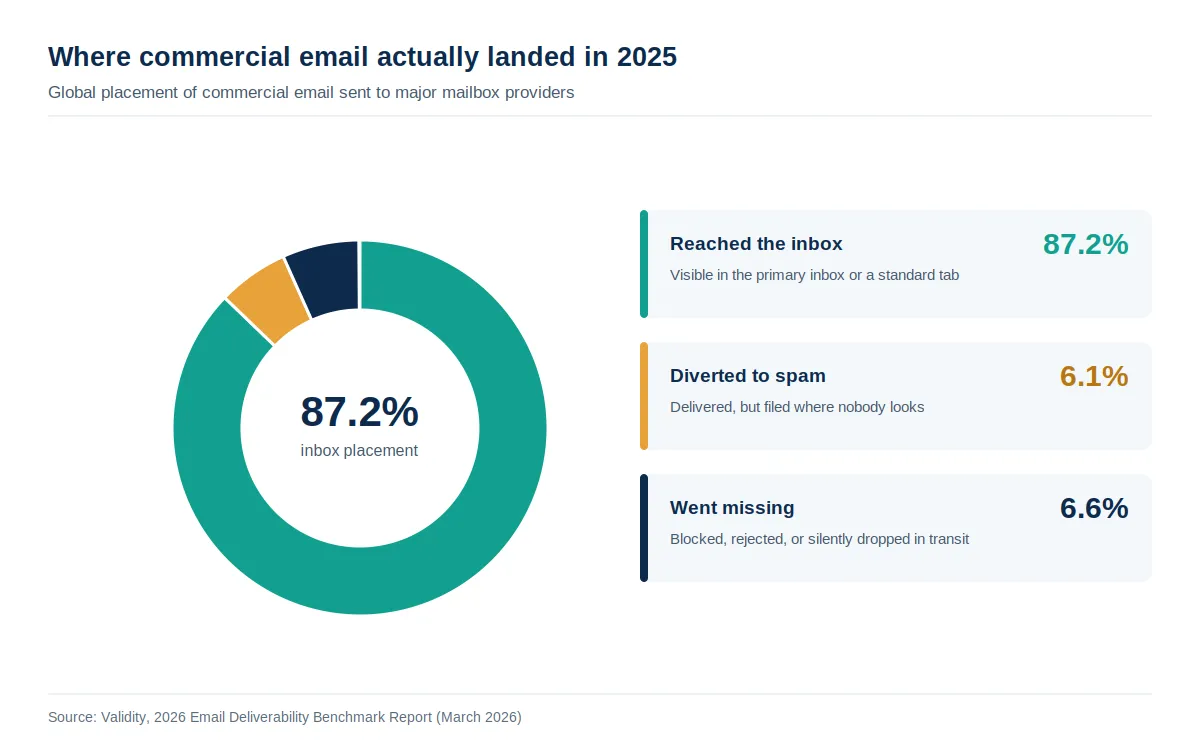
The 2026 Email Deliverability Benchmark Report from Validity, built on trillions of inbox data points, puts the global inbox placement rate at 87.2% for 2025, an improvement of 3.7 points year over year. Of the rest, 6.1% was diverted to spam, and 6.6% went missing entirely through blocks, rejections, and silent drops. Better than 2024, but still a meaningful tax on every send.
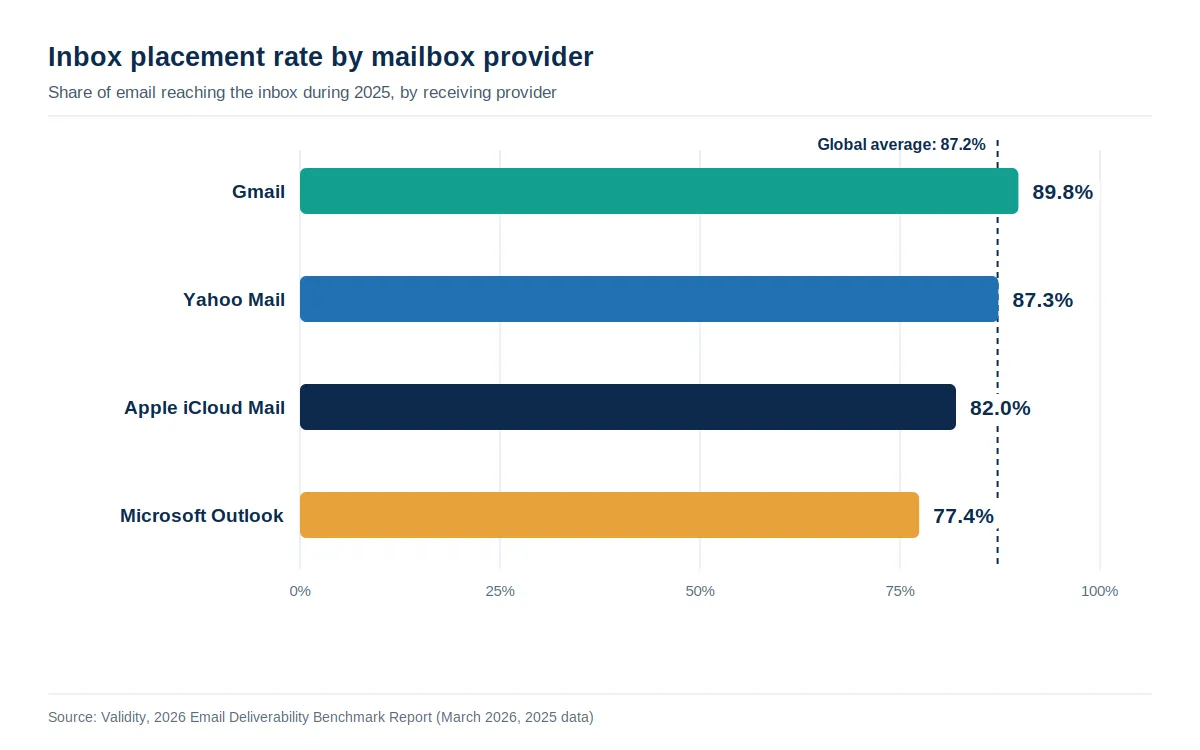
The average also hides sharp differences by provider. Gmail, which holds a 42.9% share of global mailboxes in Validity's data, rewarded compliant senders with an 89.8% inbox placement rate. Yahoo landed at 87.3% and Apple at 82.0%. Microsoft remained the hardest inbox to reach at 77.4%, which matters enormously for B2B programs where corporate Outlook addresses dominate. Region matters too: Europe led the world at 91.1%, a gap widely attributed to consent-based list building under GDPR.
The Sender Requirements That Became Mechanical Gates #
For most of email's history, deliverability guidance was advisory. That era ended in stages. In February 2024, Google and Yahoo began enforcing requirements for anyone sending 5,000 or more messages a day: pass SPF and DKIM, publish a DMARC record, align the visible From: domain with the authenticated domain, support one-click unsubscribe in commercial mail, and keep user-reported spam under 0.3%. Google's email sender guidelines spell out each requirement, down to message formatting under RFC 5322.
Microsoft followed. In April 2025, it announced matching rules for domains sending more than 5,000 messages a day to outlook.com, hotmail.com, and live.com addresses, and began rejecting non-compliant mail on May 5, 2025 with the error code 550 5.7.515. Then, in November 2025, Google moved from graduated filtering to ramped-up enforcement, permanently rejecting a growing share of traffic that fails authentication. There is no appeals desk. Machines check the requirements, and machines apply the penalty.
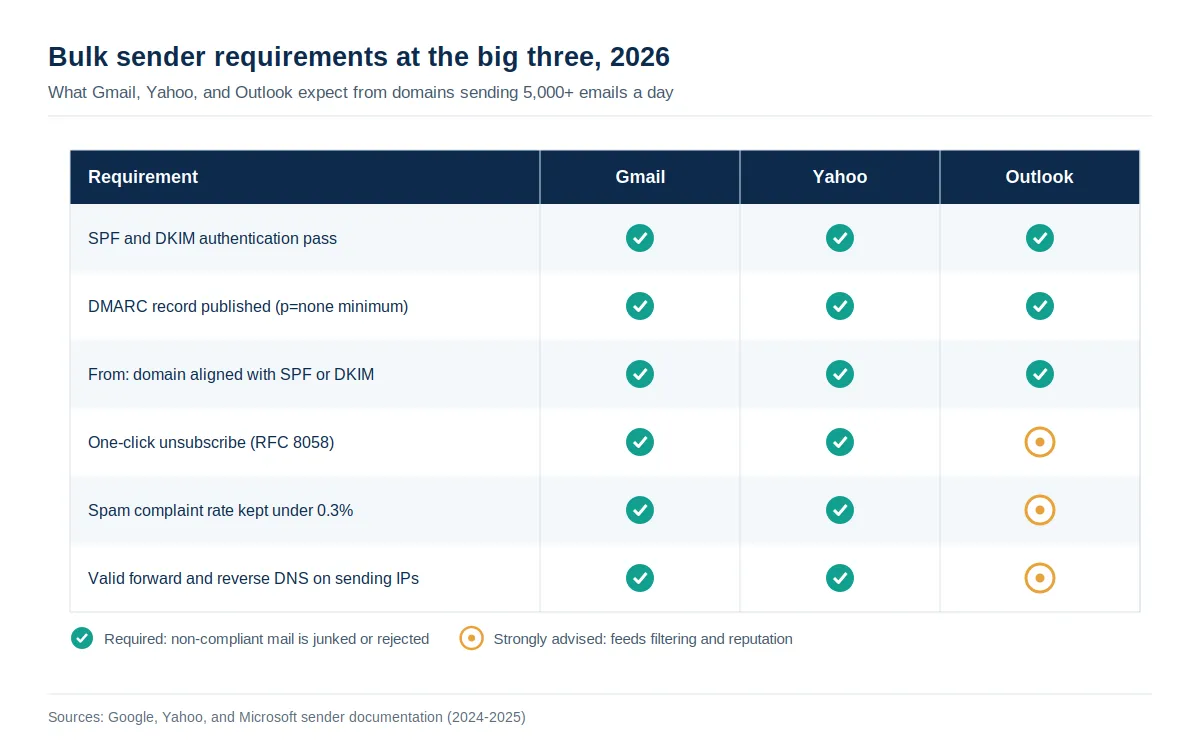
The policy works, which is why it will not be rolled back. Google reported a 65% drop in unauthenticated messages reaching Gmail users within the first year, 265 billion fewer unauthenticated messages in 2024 than the year before. For legitimate senders, the practical takeaway is simple: the floor for even being evaluated by spam filters is now full authentication.
Authentication: Where Most Senders Are Half Finished #
Three protocols carry the load. SPF lists which servers may send for your domain. DKIM adds a cryptographic signature that proves the message was not altered. DMARC ties them together, tells receivers what to do when a message fails, and, critically for the 2026 rules, requires the visible From: domain to align with the domain that passed SPF or DKIM. Misalignment is one of the most common silent failures: everything “passes” individually, yet the message still gets junked.
Adoption data shows how unfinished this work is. The 2026 DMARC Adoption and Enforcement Report from EasyDMARC analyzed the top 1.8 million domains and found 937,931 with a valid DMARC record (52.1%), the first time adoption has crossed half. But 525,996 of those domains sit at p=none, the monitoring-only policy that blocks nothing. Only 411,935 enforce with quarantine or reject, and just 9% or so combine enforcement with the reporting needed to see what their policy is doing. Fortune 500 companies enforce at more than 80%; among the Inc. 5000, only 15.2% reach p=reject.
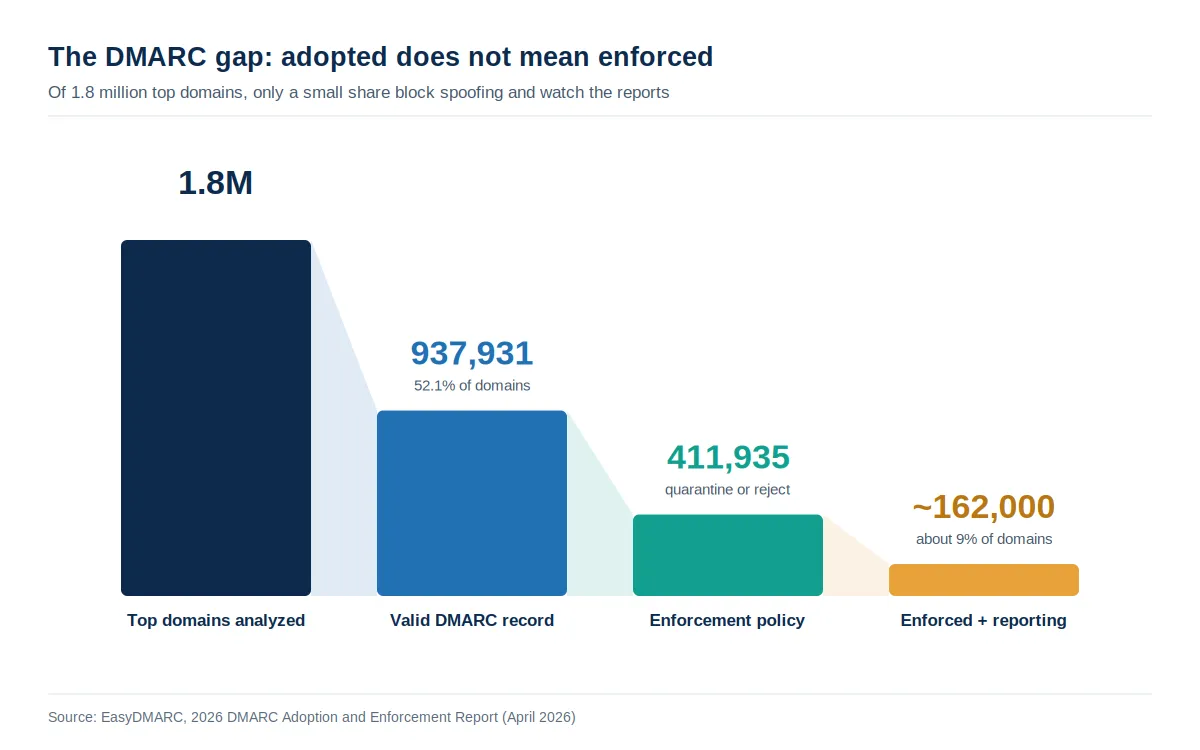
The path forward is staged. Publish p=none with aggregate reporting, spend two to four weeks identifying every legitimate sending service in the reports, fix their authentication, then step to p=quarantine and finally p=reject. Domains that stop at monitoring get the compliance checkbox and none of the spoofing protection, and mailbox providers can see the difference.
The Complaint Rate Math Nobody Does #
Spam complaints are the metric mailbox providers weigh most heavily, and the thresholds are unforgiving. Google's sender guidelines FAQ asks senders to keep user-reported spam below 0.1% and to never reach 0.3%. Put in concrete terms, one complaint per 1,000 delivered messages is the target and three per 1,000 is the ceiling. Cross the ceiling and inbox delivery degrades sharply, and Gmail withholds mitigation support until your rate holds below 0.3% for seven consecutive days.
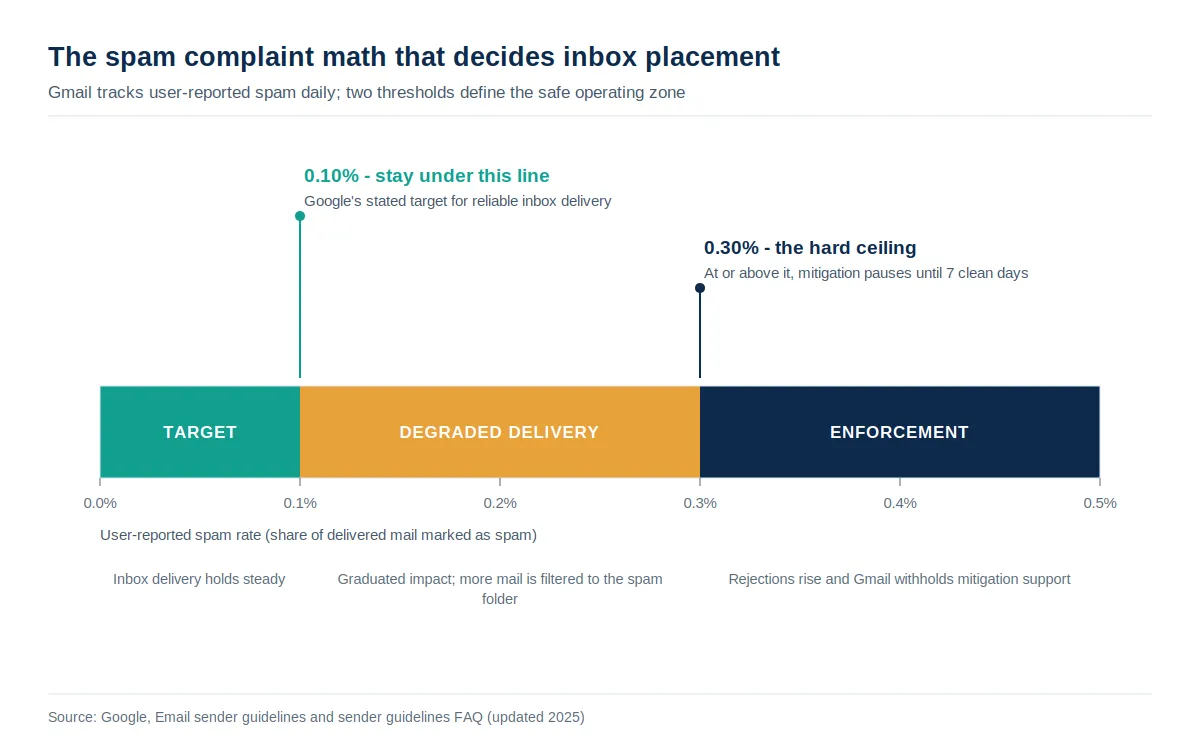
Complaint prevention is mostly friction removal. One-click unsubscribe, required under RFC 8058 for commercial mail, exists because a subscriber who cannot leave easily will press the spam button instead, and Google expects opt-outs to be honored within 48 hours. Frequency discipline matters for the same reason. Every complaint is a subscriber who felt the spam button was the fastest exit, so make the real exit faster.
Engagement Filtering and the AI Inbox #
Passing authentication gets you evaluated; engagement decides where you land. Gmail's filtering now runs on large language models and feeds AI features that summarize, sort, and surface mail, which means relevance is scored message by message. In July 2025, Google shipped a Manage subscriptions view that lists every sender by mail frequency next to a one-click unsubscribe. A subscriber who has ignored 40 straight sends can now see that history, and act on it, in one screen.
Measurement changed underneath marketers at the same time. Apple's Mail Privacy Protection pre-loads tracking pixels whether or not anyone reads the message, and Apple clients accounted for 64.66% of tracked opens in Litmus data from May 2026, with roughly 55 to 60% of all opens privacy-impacted. Open rates now overcount by design. Clicks, replies, and conversions are the signals worth optimizing, and they are also closer to what providers read as genuine interest. That puts a premium on professional content writing that earns a response rather than an impression.
List Hygiene Is a Deliverability Control, Not Housekeeping #
Every stale address on a list is a small engagement penalty, and some are worse: recycled addresses become spam traps, and hard bounces signal careless acquisition. Validity's benchmark also notes that total sending volume fell year over year in 2025 for the first time, a sign that strong programs are choosing tighter, engaged lists over raw reach. The senders winning in 2026 mail fewer people, more relevantly.
Three habits do most of the work. Validate addresses at capture so typos and disposable domains never enter the list. Suppress hard bounces immediately and permanently. And run a sunset policy: after 90 to 180 days without a click, move contacts to a re-permission sequence, then stop mailing the silent ones. This is hardest for promotion-heavy ecommerce marketing calendars, where volume feels like revenue, but disengaged segments can be reached through paid media retargeting instead of burning the sending domain's reputation on them.
How to Diagnose Where Your Email Is Failing #
Sender reputation works like online reputation management for a domain: it is scored continuously, it compounds, and it is easier to protect than to repair. Diagnosis starts with Google Postmaster Tools, whose compliance dashboard shows authentication status, spam rate, and your domain's reputation against each requirement. Microsoft's SNDS gives the equivalent view for Outlook. Read your bounce messages too; modern rejection codes state the reason in plain text, including the 550 5.7.515 authentication rejection.
Then measure placement per provider rather than in aggregate. A program can sit at 90% on Gmail and 60% on Outlook, and the blended number will hide the fire. Seed testing across the major providers, plus DMARC aggregate reports, shows exactly which gate you are failing. From there, the fix follows a sequence: authentication first, hygiene second, engagement third, volume last.
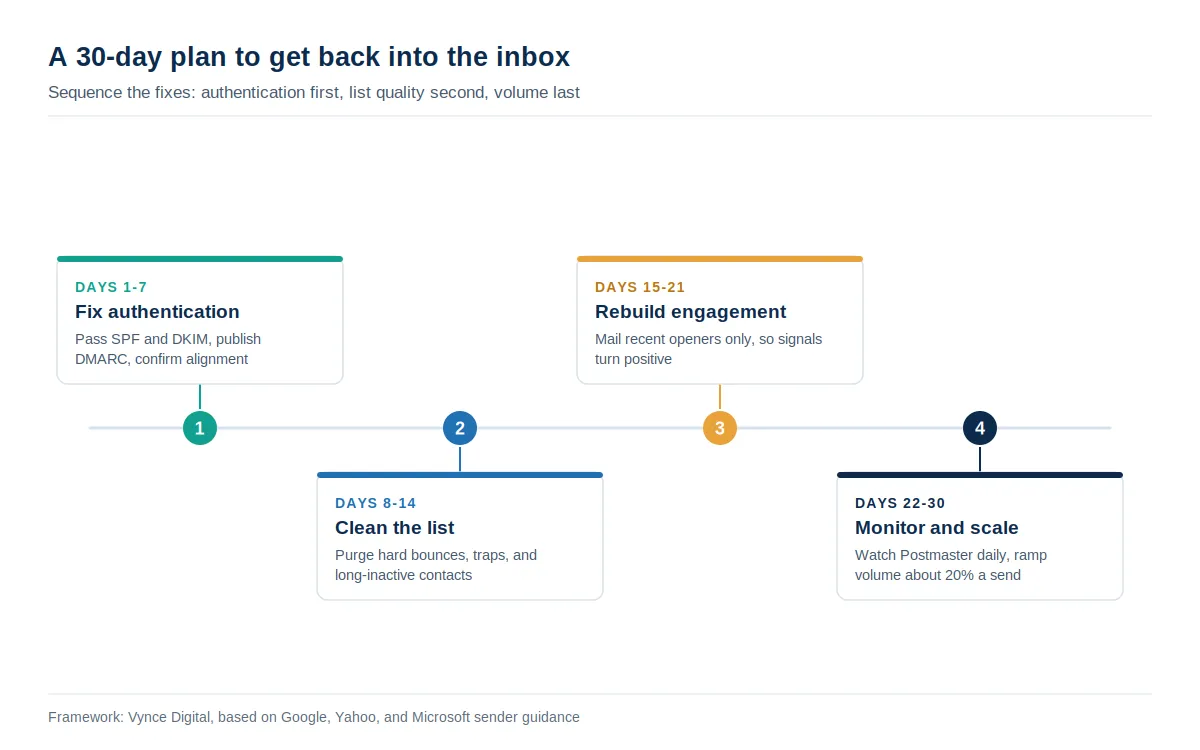
The order matters because each phase feeds the next. Ramping volume before reputation recovers re-triggers the filters, which is the single most common way recoveries fail. Roughly 20% volume growth per send, watched daily against Postmaster metrics, keeps the ramp inside what providers tolerate.
Where Deliverability Fits in the Rest of Your Funnel #
Inbox placement is upstream of every email metric you report. It sets the ceiling on opens, clicks, revenue per send, and the payback of every conversion rate optimization test running on your landing pages, because a variant nobody arrives at cannot win. It also compounds with your other owned channels: the same consent discipline and content quality that reach the inbox tend to strengthen search engine optimization outcomes, since both systems now reward genuine engagement over volume. Treat deliverability as infrastructure, reviewed quarterly like analytics or site speed, rather than a crisis project that starts after revenue dips. If you would rather have specialists watching the thresholds every week, a managed email marketing program is the fastest way to keep placement above 90% while your team stays on strategy.
Frequently Asked Questions #
What is email deliverability? #
Email deliverability is the ability of a message to reach the recipient's primary inbox rather than the spam folder or nothing at all. It is controlled by authentication, sender reputation, complaint rates, and engagement signals, and it sits one layer deeper than the delivery rate your sending platform reports.
What is a good email deliverability rate in 2026? #
The global average inbox placement rate reached 87.2% in 2025, according to Validity's 2026 Email Deliverability Benchmark Report. Programs above roughly 90% are performing well; top senders exceed 93%, and anything below 80% signals a problem that is actively costing revenue.
What is the difference between delivery rate and deliverability? #
Delivery rate measures whether a receiving server accepted your message and typically sits near 98 to 99%. Deliverability, measured as inbox placement, tracks whether the message then landed in a visible inbox. Mail filed to spam still counts as delivered, so a high delivery rate can hide a serious inbox placement problem.
What are the Gmail and Yahoo bulk sender requirements? #
Since February 2024, senders of 5,000 or more messages a day must authenticate with SPF and DKIM, publish a DMARC record with proper alignment, support one-click unsubscribe in commercial mail, and keep user-reported spam below 0.3%. Google began rejecting more non-compliant traffic outright in November 2025.
Do Microsoft Outlook's sender requirements apply to my business? #
If your domain sends more than 5,000 emails a day to outlook.com, hotmail.com, or live.com addresses, yes. Since May 5, 2025, Microsoft requires SPF, DKIM, and at least a monitoring-level DMARC record, and rejects non-compliant mail with a 550 5.7.515 error code.
What spam complaint rate is acceptable? #
Google asks senders to stay below 0.1% user-reported spam and to never reach 0.3%. At 0.3% or higher, inbox delivery degrades sharply, and Gmail withholds mitigation support until the rate stays below the ceiling for seven consecutive days. In practice, three complaints per 1,000 delivered messages is the ceiling.
Do I need DMARC if I send fewer than 5,000 emails a day? #
You are not forced to publish one, but you should. DMARC protects your domain from spoofing, feeds you reports on who is sending as you, and builds the authentication history that mailbox providers reward. Volume thresholds also count spikes, so a single large campaign can pull you into bulk sender territory.
Why did my open rates stop being reliable? #
Apple's Mail Privacy Protection pre-loads tracking pixels whether or not a subscriber reads the message, and Apple clients accounted for 64.66% of tracked opens in Litmus data from May 2026. Machine-generated opens inflate the metric, which is why clicks, replies, and conversions are now the trustworthy engagement signals.
How long does it take to fix email deliverability? #
Authentication faults can be corrected in days, while reputation recovery typically takes two to eight weeks of consistent, clean sending. A practical sequence is one week for SPF, DKIM, and DMARC fixes, one week for list hygiene, then two or more weeks of engagement-focused sending while volume ramps back up.
Does email deliverability affect transactional email too? #
Yes. Password resets, receipts, and shipping notices ride on the same domain and IP reputation as marketing mail, even though they are exempt from one-click unsubscribe rules. A complaint problem on the promotional side can push transactional messages into spam, which is why many teams separate the two streams onto different subdomains.