Generative Engine Optimization: How to Get Your Business Cited by AI Search

Tuba
July 1, 2026
Table of Contents
- Key Takeaways
- Shift From Traditional Search to AI
- What Does Generative Engine Optimization means
- How big is this shift, really
- How Generative Engines Choose What to Cite
- GEO and Traditional SEO: what carries over and what changes
- What actually moves the needle
- How to measure GEO Performance
- Frequently asked questions
Key Takeaways #
Search is moving from a page of links to a written answer, and the question for any business has changed with it. It is no longer only about whether you can rank. It is whether, when an AI answers your customer's question, you are the source it trusts.
The good news is that the work is not mysterious. The data points are consistently in the same direction. Answer questions directly, back up claims with specific, current facts, cite credible sources, write clearly for people, and structure pages so that a clean passage can stand on its own. Do that, and you are building the kind of content AI tools are designed to reward, while keeping the SEO foundations that still matter.
The shift is early, the measurement is still rough, and the tools will keep changing. But the brands setting up for it now, while many are still arguing about whether it is real, are the ones who will own the answer when their customers ask.
Shift From Traditional Search to AI #
Search is no longer a list of blue links. When someone asks a question now, there is a good chance an AI writes the answer for them and names only a few sources. If your business is not one of those sources, you are invisible at the exact moment a buyer is making up their mind.
That shift has a name. Generative engine optimization, or GEO, is the work of getting your content picked up, trusted, and cited by AI search tools like Google AI Overviews, AI Mode, ChatGPT, Gemini, and Perplexity.
This guide explains what GEO is, how those tools choose what to cite, where it overlaps with traditional SEO, and what the latest data says about how fast this is moving. By the end, you will know what to change on your site and how to tell whether it is working.
What Does Generative Engine Optimization means #
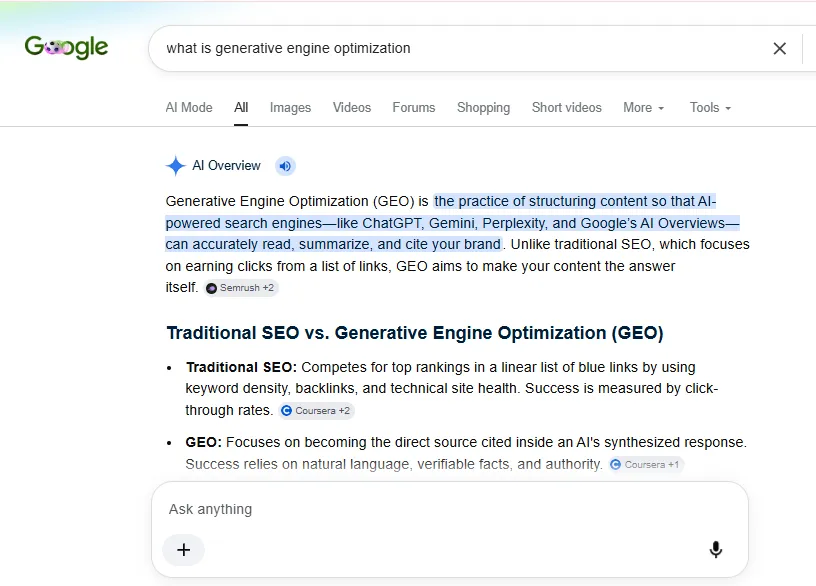
GEO is the practice of shaping your content so AI search tools include it, and ideally cite it, when they answer a question. Traditional SEO aims to secure a position on a search results page. GEO tries to win a place inside the answer itself.
The term comes from a 2024 research paper from teams at Princeton, Georgia Tech, the Allen Institute for AI, and IIT Delhi. The researchers studied how AI answer engines pick sources and tested which changes to a page made it more likely to be cited. It introduced the first real framework for visibility in AI answers, and it remains the most-cited academic work on the topic.
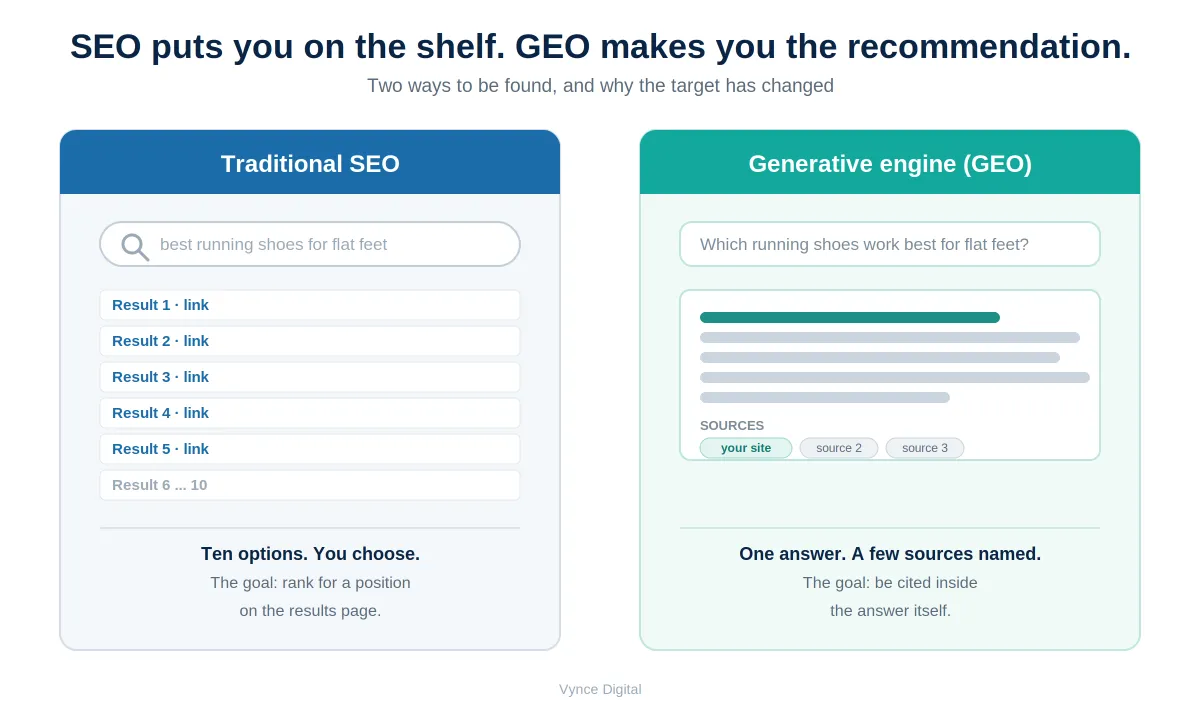
The simplest way to picture the difference is this. Traditional search hands you ten options and asks you to choose. A generative engine reads many sources, writes one answer, and names a handful of them. SEO is about being on the shelf. GEO, the discipline behind generative engine optimization, is about making recommendations.
How big is this shift, really #
The numbers moved faster than most teams expected.
Google AI Overviews, the summaries that sit above normal results, reached 2 billion monthly users by mid 2025 and about 2.5 billion a year later, according to Google. AI Mode, Google's chat-style search, went from its May 2025 launch to more than 1 billion monthly users within a year. ChatGPT surpassed 800 million weekly users in early 2026, double its number a year earlier. A Pew Research survey in late 2025 found that 65 percent of United States adults at least sometimes see AI summaries when they search.
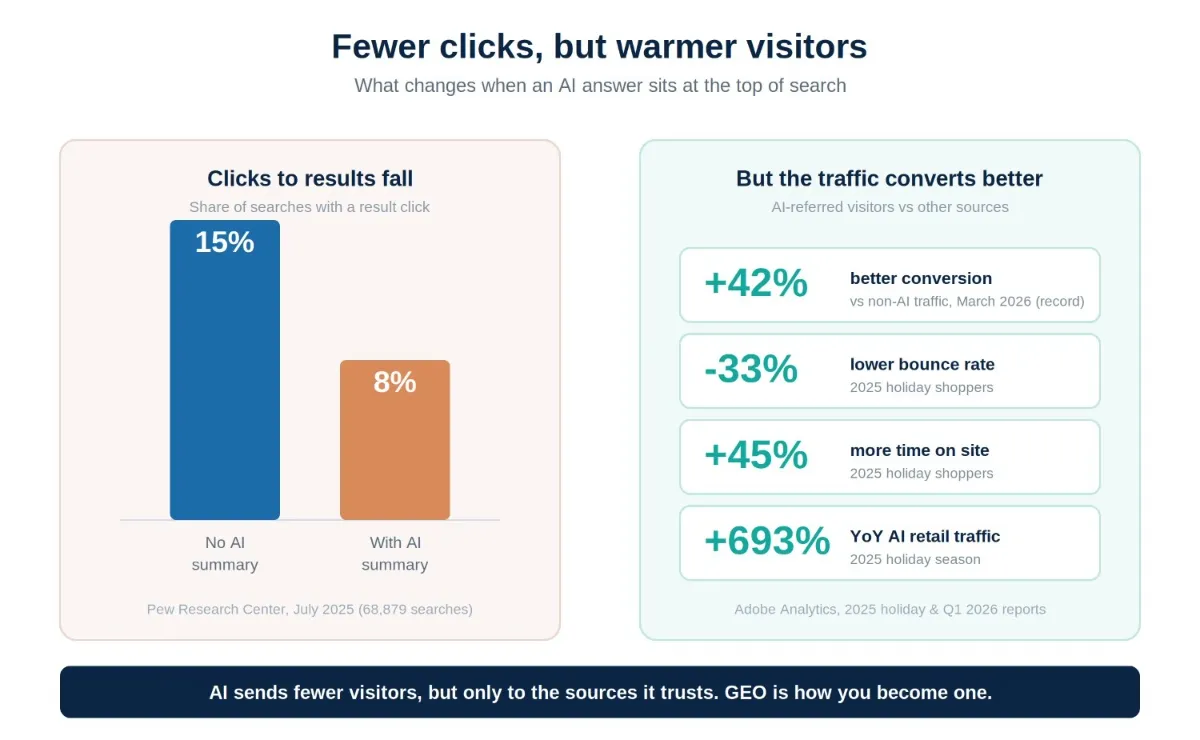
People are not just seeing these answers; they are stopping at them. A Pew Research study of nearly 69,000 real Google searches found that when an AI summary appeared, people clicked a normal search result only 8 percent of the time, compared with 15 percent when there was no summary. Clicks on links within the AI summary were even rarer, at around 1 percent. People were also more likely to end their session right there, on 26 percent of pages with a summary versus 16 percent without. An early 2026 analysis of Wikipedia traffic found a similar effect, estimating that exposure to AI Overviews cut visits to English Wikipedia articles by roughly 15 percent.
That is the hard part of the story for anyone who relies on search traffic. Fewer people click through, even when your page is the source the AI used.
But there is a second half worth attention, because it changes what GEO is worth. The traffic that does come from AI tools is unusually good. Adobe Analytics, which tracks more than a trillion visits to United States retail sites, found that during the 2025 holiday season, visits from AI tools were up about 693 percent year over year, and those shoppers converted 31 percent more often than people arriving from other sources. They also stuck around, with 33 percent lower bounce rates and 45 percent more time on site. By March 2026, AI traffic was converting 42 percent better than non-AI traffic, a record high in Adobe's data.
So the picture is not simply that AI is taking your clicks. It is that AI sends fewer but warmer visitors, and only to the sources it decides to trust. GEO is the work of becoming one of those trusted sources.
How Generative Engines Choose What to Cite #
This is the part most guides skip, and it is the part that tells you what to do.
An AI answer engine does not rank pages one through ten. It reads a set of sources, extracts the pieces it deems most useful, and stitches them into a single reply with a few citations. A few patterns recur in the research and public data.
First, these tools lean on a small set of sources. The Pew study found that 88 percent of AI summaries cited three or more sources, and that Wikipedia, YouTube, and Reddit were the most commonly cited sites. Government sites also appeared more often in AI answers than in normal results. The lesson is not to post on Reddit. It is that AI tools favor sources that read as neutral, well-structured, and widely referenced.
Second, the format of your content matters as much as the topic. The 2024 research tested specific changes to pages and measured the effect on citation rates. Adding relevant statistics raised visibility by about 41 percent. Adding direct quotes from credible sources raised it by about 28 percent. For pages that were not already near the top, citing external sources increased visibility by up to 115 percent. In short, content that shows its work gets picked up more often.
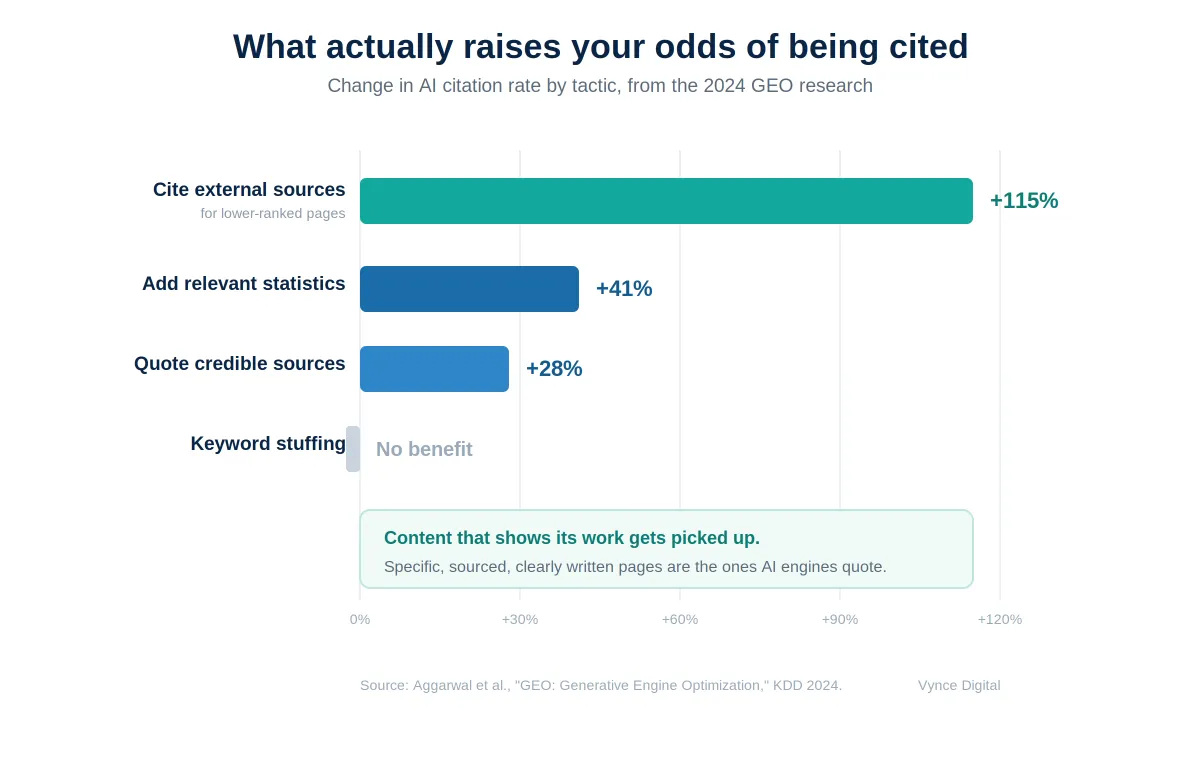
Third, the old tricks do not just fail; they can backfire. The same study found that keyword stuffing produced no benefit and slightly hurt performance. Writing for a crawler instead of a reader is a losing move in AI search.
Put together, the behavior is fairly logical. These tools are trying to write a trustworthy answer quickly, so they reward specific content, sourced, clearly written, and easy to lift a clean sentence from.
GEO and Traditional SEO: what carries over and what changes #
A common worry is that GEO replaces SEO, and everything you built is wasted. That is not what the data shows.
A lot carries over. Technical health still matters because an AI tool cannot use a page it cannot crawl or read. Clear structure, fast load times, and a logical heading order all help, which is why the same fundamentals behind search engine optimization services still apply. Authority still matters too, since the sources AI tools trust tend to be the same ones that earn links and rank well.
What changes is the target. Traditional SEO optimizes for a position. GEO optimizes for a sentence. You are no longer only asking whether you can rank for a keyword. You are asking whether your page is the cleanest, best-sourced answer an AI can quote when someone asks the question out loud. That is largely a content strategy problem, and a few practical shifts follow.
• Answer up front. Put the direct answer near the top in plain language, instead of burying it under a long warm-up.
• Lead with specifics. Include dated facts and figures, because those are exactly what AI tools lift into answers.
• Cite your sources openly. Outbound references signal that your content is researched rather than guessed.
• Make passages stand alone. Use short paragraphs, descriptive headings, and one clear idea per section so a tool can pull a clean, self-contained quote.
None of this means abandoning SEO. It means writing pages that work for readers, ranking algorithms, and answer engines at the same time, and serving them on fast, well-structured, conversion-focused websites that AI tools can crawl without friction.
What actually moves the needle #
Here is a practical checklist drawn from the research and from how these tools behave today.
1. Answer the question first. Lead with a clear, direct answer, then expand. AI tools reward content that resolves the query quickly.
2. Lead with specifics. Use real numbers, dates, and named examples. A line like “AI traffic converted 42 percent better than non-AI traffic in March 2026” is far more quotable than “AI traffic performs well.”
3. Cite credible sources. Link out to primary research, official data, and recognized authorities. This raised citation rates sharply in the research, especially for pages that were not already dominant.
4. Write for a person. Clear, plain sentences beat dense, keyword-heavy copy. Fluent writing was one of the changes that improved AI visibility.
5. Keep one idea per section. Descriptive headings and short paragraphs make it easy for a tool to pull a clean passage.
6. Cover the follow-up questions. AI search is conversational, so a page that answers the obvious next question tends to get used across more of those exchanges.
7. Keep your facts current. Dated data signals freshness. Old statistics make a page easy to skip.
How to measure GEO Performance #
Measurement is the honest weak spot of GEO right now, and pretending otherwise helps no one.
You cannot see AI citations in the same clean way you see rankings. Google has folded the AI Overview and AI Mode activity into its standard Search Console metrics, making it hard to separate. So measurement takes a few moving parts.
• Watch branded search and direct traffic. When more people discover you inside AI answers, some of them come back later by name. A rise in branded queries and direct visits is often the first visible sign that GEO is working.
• Track AI referral traffic as its own segment. Tools like ChatGPT, Perplexity, and Gemini pass referral data. Set up a segment in performance marketing measurement and GEO meet, since Adobe's data suggests AI traffic converts better than most channels.
• Test the questions yourself. Ask the AI tools the questions your customers ask and see whether you are cited. It is manual, but it is the most direct read on visibility, and a growing set of tools, including the kind of tracking you can wire into AI automation workflows, now does this automatically.
• Judge it on quality, not just clicks. Because AI traffic is smaller but warmer, conversion rate and revenue per visit tell you more than raw sessions
Frequently asked questions #
What is generative engine optimization (GEO)?
GEO is the practice of shaping your content so AI search tools include and cite it when they answer a question. Traditional SEO targets a ranking position on a results page. GEO targets a place within the AI-written answer itself, on tools such as Google AI Overviews, ChatGPT, Gemini, and Perplexity.
How is GEO different from traditional SEO?
SEO tries to win a position so that a person clicks your link. GEO tries to get your page quoted inside a single AI answer that names only a few sources. The foundations overlap, since both reward clear structure and real authority, but GEO places greater emphasis on direct answers, specific data, and cited sources.
Does GEO replace SEO?
No. The work overlaps more than it competes. An AI tool cannot use a page it cannot crawl, and the sources it trusts tend to be the same ones that already earn links and rank well. The strongest pages serve readers, search rankings, and answer engines at the same time.
How do I get my content cited by AI search tools?
Answer the question directly near the top, back up your claims with specific, dated facts, and cite credible outside sources. In the 2024 GEO research, adding statistics raised citation rates by about 41 percent, and citing sources increased visibility by up to 115 percent for lower-ranked pages, while keyword stuffing provided no benefit.
What is the difference between GEO and AEO?
AEO, or answer engine optimization, focuses on direct-answer features in traditional search, such as featured snippets and People Also Ask boxes. GEO aims to cite sources within AI-written answers from tools like ChatGPT and AI Overviews. The two overlap so much that many teams use the terms interchangeably.
Which AI platforms should GEO target?
The main ones are Google AI Overviews and AI Mode, ChatGPT, Gemini, and Perplexity. The same habits, a clear answer up front, dated facts, and cited sources, tend to help across all of them rather than needing a separate playbook for each.
Does schema markup help with GEO?
It helps, but it is not a shortcut. FAQ, Article, and Organization schema make your page easier for AI tools to read and trust. The larger gains still come from clear answers, specific data, and credible sources in the content itself.
How long does GEO take to show results?
There is no fixed timeline. It depends on how often your pages are crawled and how authoritative your site already is. Pages on sites that AI tools already trust tend to appear in answers sooner than on brand-new domains.
Can small businesses benefit from GEO?
Yes. GEO rewards clear, well-sourced answers more than big budgets, so a focused, small site that answers real customer questions can be cited next to much larger brands.
Do I need special tools to do GEO?
No. You can start by testing your own customer questions in AI tools and setting up an AI referral segment in your analytics. Paid tracking tools help at scale, but they are not required to begin.
How do you measure GEO?
There is no single clean metric yet. Watch branded search and direct traffic, set up an AI referral segment in your analytics to track visits and revenue from tools like ChatGPT and Perplexity, and test your own customer questions in those tools to see whether you are cited. Because AI traffic is smaller but converts better, judge it on conversion and revenue, not raw sessions.
Is GEO worth it if AI search sends fewer clicks?
Yes, because the traffic that does arrive is unusually strong. Adobe Analytics found that AI-referred shoppers during the 2025 holiday season converted 31 percent more often than other visitors and bounced 33 percent less often. By March 2026, that traffic was converting at a 42 percent higher rate than non-AI traffic. Fewer visitors with much higher intent can be worth more than a larger but colder audience.