llms.txt Explained: Does Your Website Need It in 2026?

Tuba
July 29, 2026
Table of Contents
- Key takeaways
- What llms.txt is, and What it is Not
- Adoption Grew 8.8x in a Single Year
- Then the Server Logs Arrived
- Where Google Stands: Two Answers From One Company
- The One Audience That Actually Reads It
- Does Your Website Need One in 2026?
- How to Publish a Clean File
- Where the File Fits in a Real AI Visibility Strategy
- Frequently Asked Questions
Key takeaways #
llms.txt will not improve your Google rankings or your AI citations in 2026. Server logs across 137,000 domains show 97% of the files are never requested by anyone. The file still earns a place on documentation-heavy sites and ecommerce stores, because AI coding agents and browser agents are the one audience that genuinely reads it, and publishing costs almost nothing. Treat it as cheap infrastructure for the agentic web, not as an AI visibility tactic.
Few web standards have generated this much argument per byte. llms.txt is a small Markdown file that promises to tell AI systems what your website is about, and over the past year it has been called both essential infrastructure for the AI era and a placebo for anxious marketers. In 2026, the argument finally has data: a full year of adoption tracking, server logs from 137,000 domains, machine learning studies on citation impact, and an unusually blunt statement from Google. This guide walks through all of it and ends with a simple rule for deciding whether your site needs the file.
What llms.txt is, and What it is Not #
llms.txt, written llms.txt in the official specification published by Jeremy Howard of Answer.AI in September 2024, is a Markdown file placed at the root of a domain. It opens with the site name as an H1, follows with a short blockquote summary, then lists the site's most important pages under H2 sections, each link paired with a one-line description. A companion file, llms-full.txt, goes further and inlines complete page content as plain Markdown. The pitch: HTML is noisy, context windows are finite, and a curated map helps a language model reach your best material without wading through navigation, scripts, and ads.
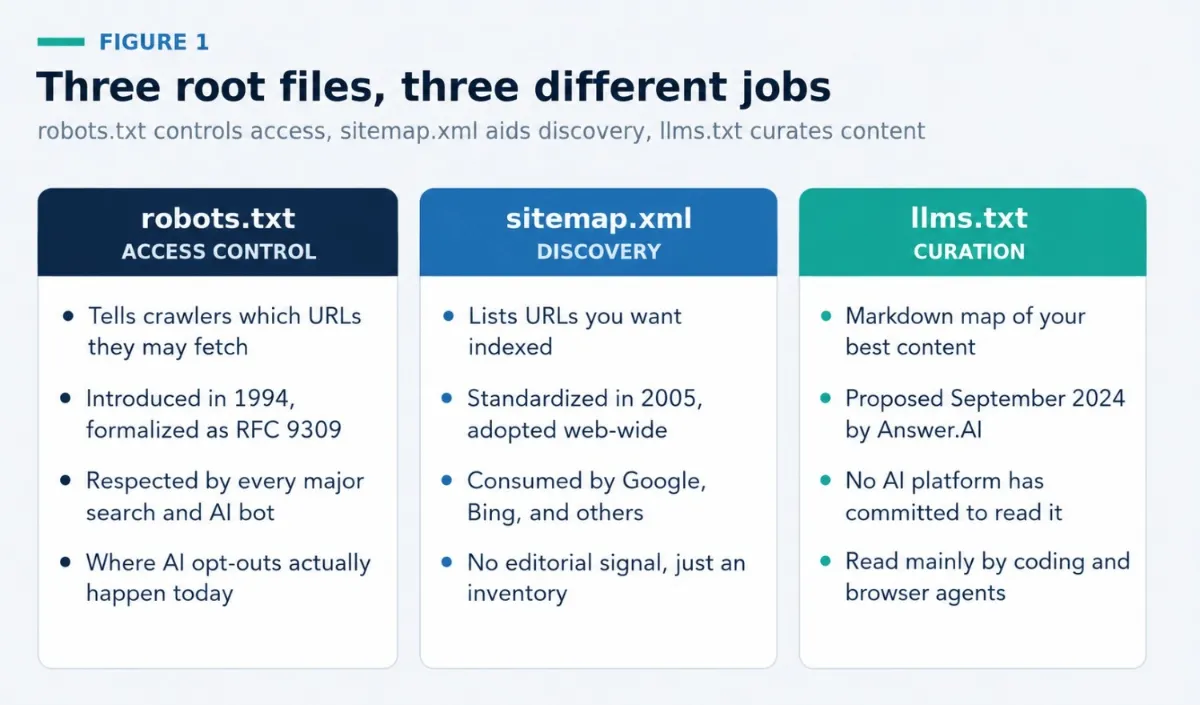
The most common misconception is that llms.txt is a robots.txt for AI. It is not. robots.txt controls access; it tells crawlers what they may fetch, and it remains the only place where AI crawler permissions actually get enforced. sitemap.xml is an inventory; it lists URLs for indexing with no commentary. llms.txt is curation; it makes an editorial claim about which content matters most. Access control, discovery, and curation are three different jobs, and only the first two have universally adopted standards behind them.
Adoption Grew 8.8x in a Single Year #
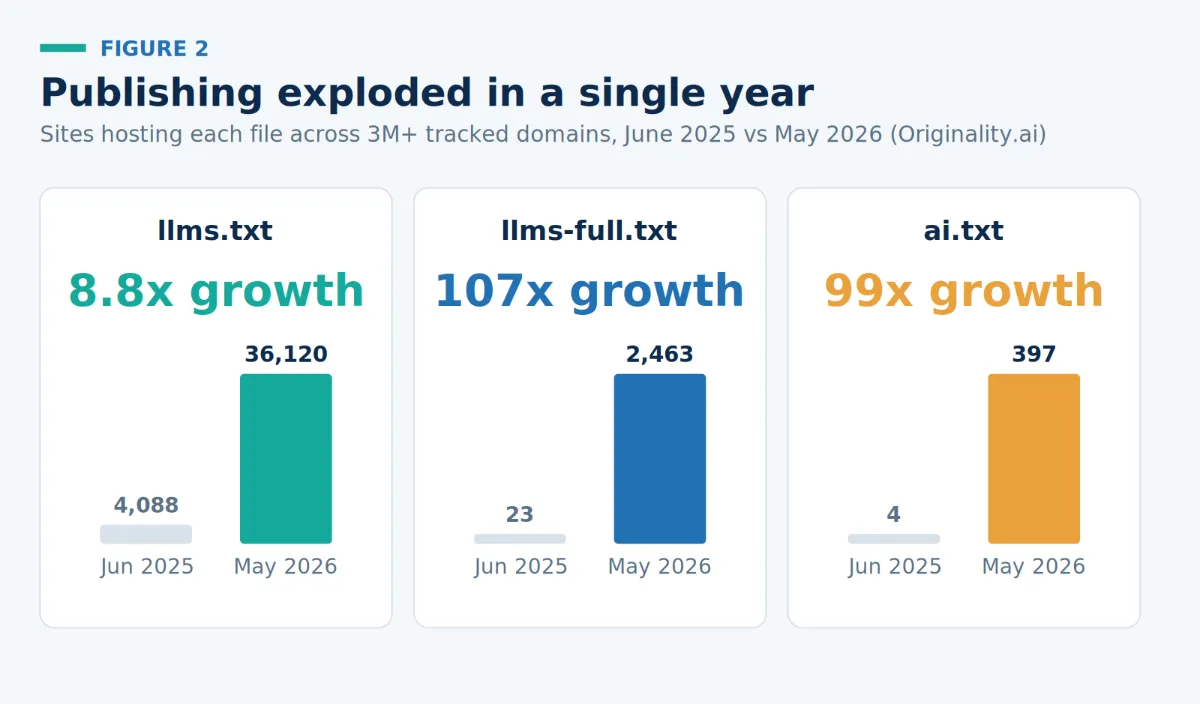
Publishing numbers look like a success story. Originality.ai's tracking study, which monitors more than 3 million websites and published its latest update in July 2026, counted 4,088 sites with an llms.txt file in June 2025 and 36,120 by May 2026, an 8.8x increase. The llms-full.txt variant grew 107x over the same window, from 23 sites to 2,463, and the total across all three emerging AI files reached 38,980 sites.
The pattern holds at the top of the web, at a smaller scale. Rankability's monthly crawl of the Tranco top 1,000 domains found 8.7% publishing the file as of June 2026. Casey Burridge's study of millions of domains puts top-10,000 adoption at 5.61% in June 2026, up from 1.04% a year earlier, and surfaces the year's most interesting adoption event: in late April and early May 2026, Shopify pushed llms.txt to every store on its platform by default, no opt-in and no announcement, which took adoption among Shopify sites in the sample to 78.1% overnight. When a platform that powers millions of storefronts ships the file silently, it is placing a bet on agentic commerce.
Then the Server Logs Arrived #
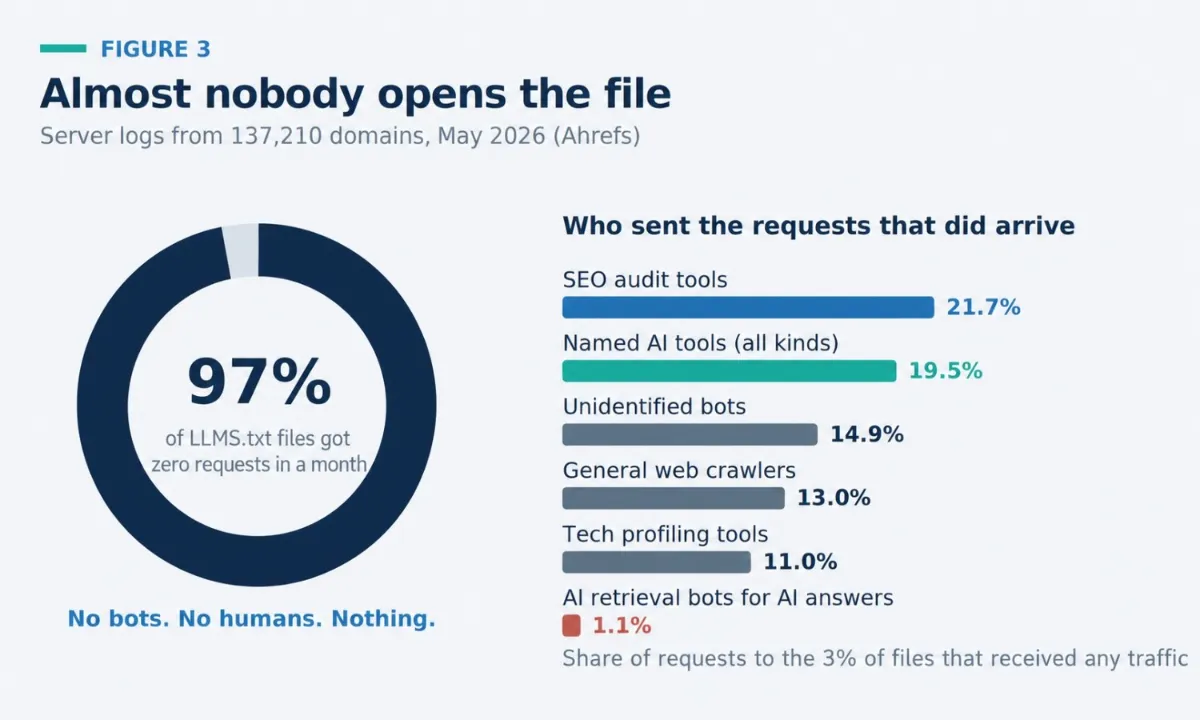
On June 15, 2026, Ahrefs published the largest traffic study of llms.txt to date, examining server logs and bot analytics across all 137,210 domains in its Web Analytics dataset for May 2026. Roughly 28% of those domains had a valid file, a figure inflated by the sample's technical skew and best read as an upper bound. The headline finding was stark: 97% of valid llms.txt files received zero requests for the entire month. Not from AI crawlers, not from humans, not from anything.
The 3% of files that did get traffic tell an even stranger story. Of those requests, 96% came from bots, and the largest single category was SEO audit tools at 21.7%, the industry checking whether the file exists rather than AI reading what it says. Unidentified bots took 14.9%, general web crawlers about 13%, and technology profiling tools around 11%. The AI retrieval bots that actually feed answers in ChatGPT and Perplexity accounted for 1.1% of requests. Ahrefs also confirmed that AI bots never probe for the file on domains where it does not exist, which is exactly what you would not expect if any major platform depended on it.
Independent tests agree. OtterlyAI ran a 90-day controlled experiment, updated February 2026, recording 62,100 AI bot visits to a test domain, of which 84 requests targeted the llms.txt file: 0.1% of AI crawler traffic. In November 2025, SE Ranking analyzed nearly 300,000 domains and found a 10.13% adoption rate, with no statistically significant correlation between having the file and being cited by AI systems. When SE Ranking removed the llms.txt variable from its XGBoost citation-prediction model, the model's accuracy improved, meaning the file was adding noise, not signal.
Where Google Stands: Two Answers From One Company #
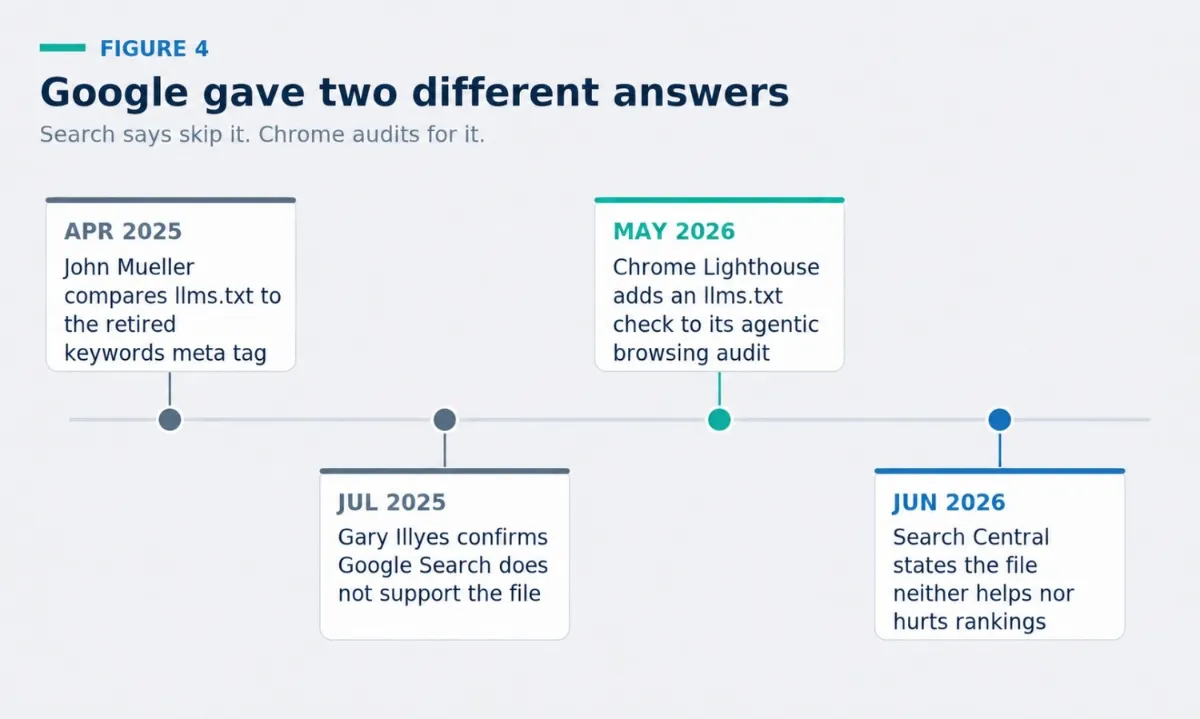
Google has been consistent about Search and surprising about everything else. In April 2025, Search Advocate John Mueller compared the file to the keywords meta tag on Reddit, noting that no AI service had committed to reading it and that a self-declared summary is easy to game. Gary Illyes confirmed in July 2025 that Google Search does not support the file. Then on June 15, 2026, Google settled the question in writing. Its Search Central AI optimization guide now states that site owners do not need machine-readable files, AI text files, or Markdown to appear anywhere in Google Search, including its generative AI features, “as Google Search itself doesn't use them.” The same update adds that maintaining the file for other systems is fine and will neither harm nor help visibility or rankings.
Here is the twist. Less than a week before that update, Google's Chrome team added an llms.txt check to Lighthouse under its new Agentic Browsing audit category, which evaluates how well a site is built for machine interaction. Google's Lighthouse documentation explains that without the file, “agents may spend more time crawling the site” to understand its structure. Both positions are official and correct, because they answer different questions. Search ranking does not use the file. Browser agents completing tasks on your site may.
The One Audience That Actually Reads It #
Buried in the Ahrefs data is the finding that reframes the whole debate. Among named AI tools, which made up 19.5% of requests to the files that got any traffic, the top requester was OpenAI's GPTBot and the second was Claude Code, Anthropic's coding agent, which fetched the file more often than every AI search and assistant bot. That matches how developer tools behave in practice: coding agents and IDE assistants such as Claude Code and Cursor pull external documentation into a working context on demand, and a curated Markdown index is genuinely useful for that job. It is why the companies that maintain the most polished llms.txt files, including Anthropic, Stripe, and Cloudflare, are documentation-heavy developer businesses, and why documentation platforms like Mintlify generate the file automatically.
So the honest description of llms.txt in 2026 is narrow but real: it is not a search visibility play; it is an agent readiness play. The audiences that exist today are coding agents retrieving documentation and, increasingly, browser agents navigating sites to complete tasks. The audience that does not exist is AI search engines deciding who to cite.
Does Your Website Need One in 2026? #
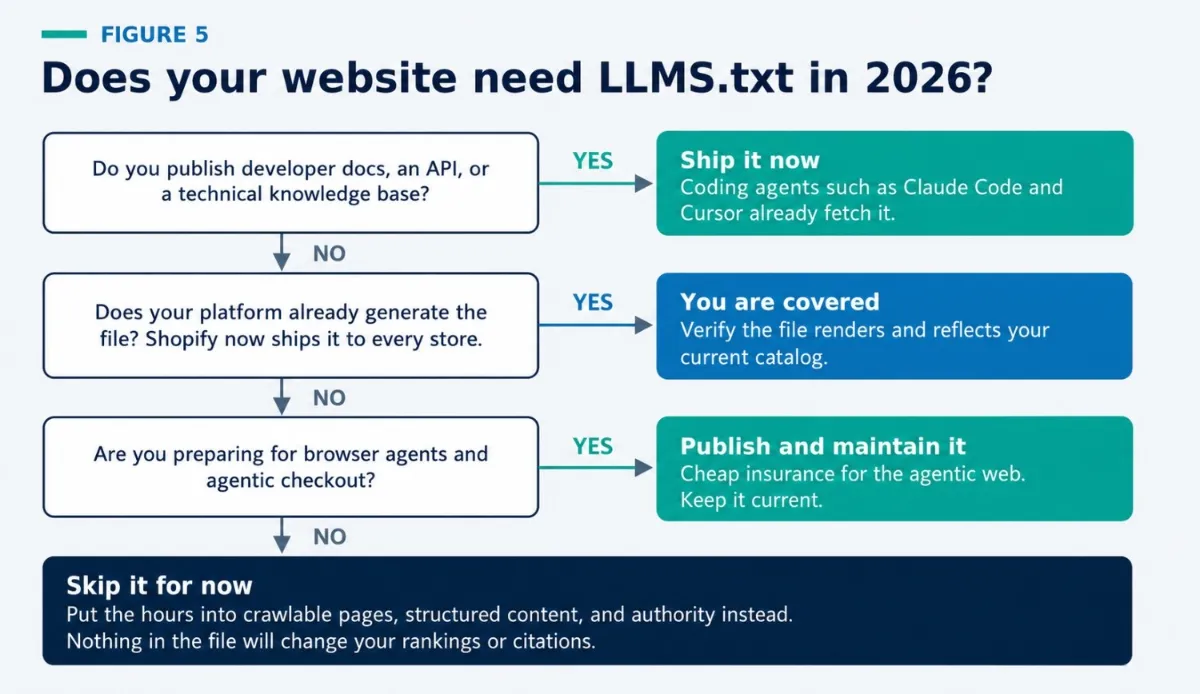
Three questions settle it for almost every site.
Do you publish developer documentation, an API, or a deep technical knowledge base? Ship the file now. The agents your audience already uses will read it, and clean docs retrieval is a real product experience win.
Is your store on a platform that generates the file for you? Shopify merchants already have one. Verify it renders at your domain and reflects your current catalog rather than adding anything new.
Are you preparing for browser agents and agentic checkout? Publish it and keep it current. Chrome's Lighthouse audit signals where browser vendors think this is heading, and the cost of being early is an hour of work.
Everyone else can skip the file without losing anything measurable. A local service business, a lead generation site, or a publisher hoping for more AI citations will see no return, because the systems that grant citations do not read it. The hours are better spent on the fundamentals that citation studies keep confirming: crawlable pages, structured answers, and real authority signals.
How to Publish a Clean File #
If your site passes the framework above, do it properly. The format is deliberately simple.
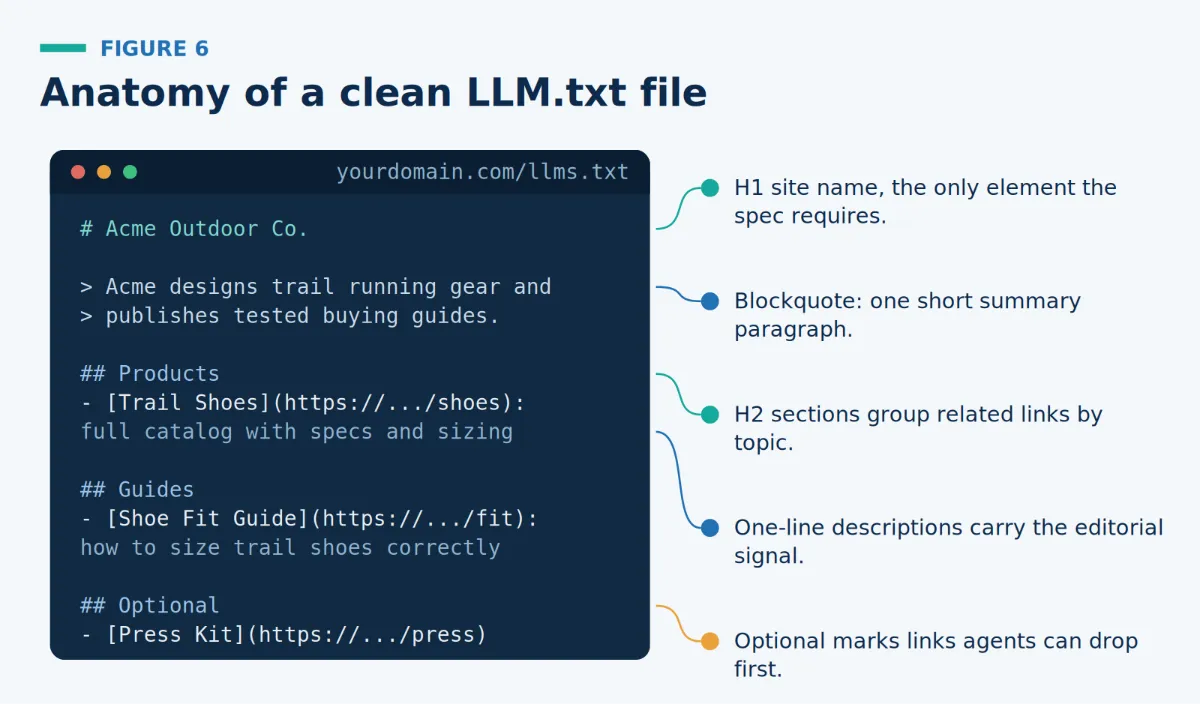
Create a plain UTF-8 Markdown file and host it at yourdomain.com/llms.txt, served with a text content type.
Open with one H1 carrying the site name, the only element the specification requires, then a short blockquote summarizing what the site is and who it serves.
Group links under H2 sections by topic. Every link gets a one-line description; those descriptions are the editorial signal the file exists to provide.
Link canonical, crawlable HTML pages. If a page matters enough to list, it should load fast and read cleanly without JavaScript.
Use an Optional section for links agents can drop when context is tight, and add llms-full.txt only if you maintain documentation worth inlining.
Review the file whenever site structure changes. A stale map misleads the only agents that read it, which is worse than no map at all.
A current, accurate file takes minutes to write. A stale one misleads the only agents that read it.
Where the File Fits in a Real AI Visibility Strategy #
The studies above keep arriving at the same closing point: what earns AI citations is the same substance that earns rankings. Models cite sites they can crawl cleanly, quote precisely, and trust. That starts with technical SEO that keeps every important page accessible to both classic and AI crawlers, and a fast, crawlable site build that serves real content without JavaScript gymnastics. It continues with content written to be quoted: direct answers high on the page, one claim per sentence, sources named and dated.
From there, generative engine optimization is the discipline of earning presence inside AI answers themselves: entity consistency, third-party mentions, and the structured signals models use to decide who is trustworthy, measured through a proper AI SEO program rather than guesswork. Ecommerce brands have the extra step of preparing product data for agent-driven shopping, which sits at the intersection of ecommerce marketing and the agent readiness work this article describes. In that stack, llms.txt is a single, cheap brick near the bottom: worth laying when agents are part of your audience, never a substitute for the wall.
Frequently Asked Questions #
What is llms.txt? #
llms.txt (file name llms.txt) is a Markdown file at a website's root that lists the site's most important pages with short descriptions so AI systems can find its best content quickly.
Is llms.txt the same as robots.txt? #
No. robots.txt controls which URLs crawlers may access, while llms.txt only suggests which content matters most. It grants no permissions and blocks nothing.
Does Google use llms.txt? #
No. Google's Search Central documentation, updated June 15, 2026, states that Google Search ignores the file and that it neither helps nor hurts rankings.
Will llms.txt improve my AI citations? #
Current evidence says no. SE Ranking's 300,000-domain study found no correlation between having the file and being cited by AI systems.
Who actually reads llms.txt files? #
Mostly SEO audit tools, plus AI coding agents. In Ahrefs' May 2026 log data, Claude Code fetched the file more than any AI search or assistant bot.
How many websites have llms.txt in 2026? #
Roughly 36,000 sites across Originality.ai's 3 million tracked domains as of May 2026, and about 8.7% of the top 1,000 websites as of June 2026.
What is llms-full.txt? #
A companion file that inlines complete page content as plain Markdown instead of linking to it. It grew 107x in the year to May 2026 but remains rare.
How do I create an llms.txt file? #
Write a Markdown file with an H1 site name, a blockquote summary, and H2 sections of links with one-line descriptions, then host it at yourdomain.com/llms.txt.
Can llms.txt hurt my SEO? #
No. Google confirms the file has no positive or negative effect on rankings. The only real risk is letting it go stale for the agents that do read it.
Should ecommerce stores use llms.txt? #
Stores preparing for agent-driven shopping benefit most. Shopify now generates the file for every store by default, so many merchants already have one.