Marketing Mix Modeling 2026: Beyond Last-Click Attribution

Tuba
July 27, 2026
Table of Contents
- Key takeaways
- What the Marketing Mix Really Covers
- Where Last-Click Attribution Breaks Down
- The Forces Behind the 2026 Mix Modeling Comeback
- Marketing Mix Modeling vs. Attribution vs. Incrementality
- What the Latest Numbers Show
- How to Build Your First Marketing Mix Model
- What This Means For Your 2026 Budget
- Frequently Asked Questions
Key takeaways #
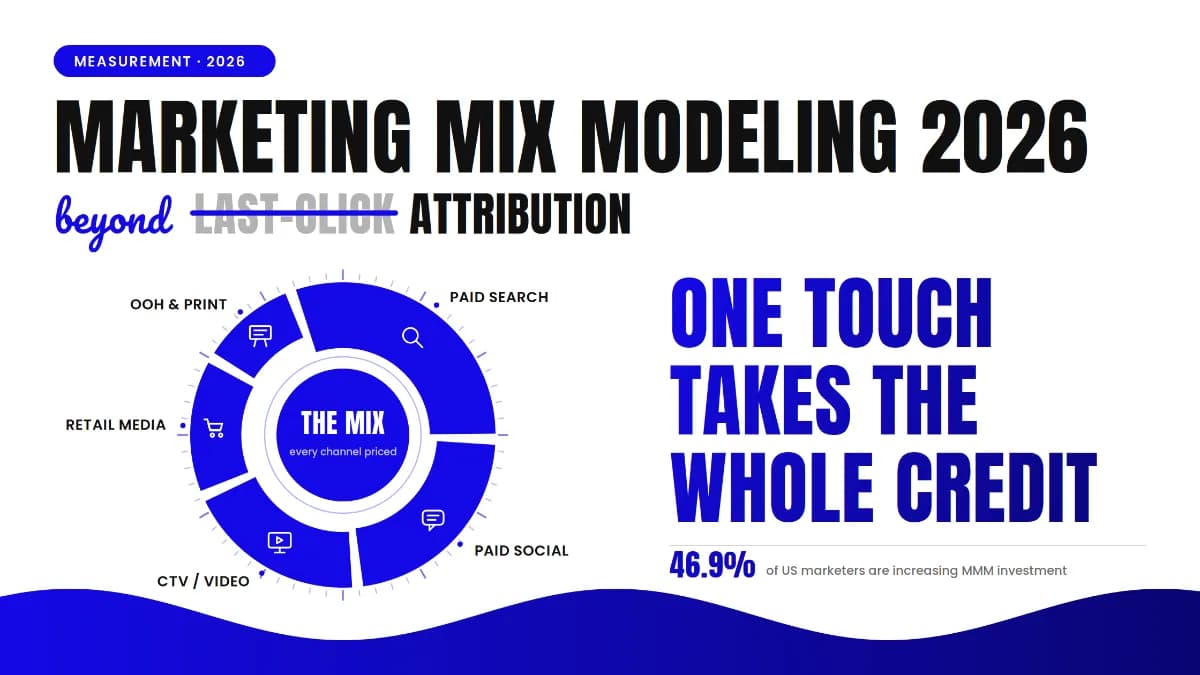
Last-click attribution rewards the final interaction and hides everything that led to it. Marketing mix modeling measures how every channel, price move, and outside force contributes to sales, using aggregate data that privacy rules cannot erode. Free frameworks such as Google Meridian and Meta Robyn have dropped the cost of entry to near zero; 46.9 percent of US marketers plan to increase MMM investment, and research shows short-term reporting captures barely half of marketing's true return.
Somewhere in your analytics account, a report is telling you a confident story. Search ads drove 60 percent of revenue. Email closed another quarter. Podcasts and paid social barely registered. The story feels precise, but it rests on a shaky rule: whoever touched the customer last gets all the credit.
In 2026, that rule is failing quietly and expensively. Privacy controls hide most of the journey, buyers hop across devices and AI assistants, and the final click is often just the receipt for a decision made weeks earlier. Marketing mix modeling, a technique once reserved for consumer goods giants, has surged back to fill the gap. This guide explains what the marketing mix actually covers, why last-click reporting keeps misleading budget decisions, what changed between 2021 and 2025, and how to stand up a first model without a six-figure consulting engagement.
What the Marketing Mix Really Covers #
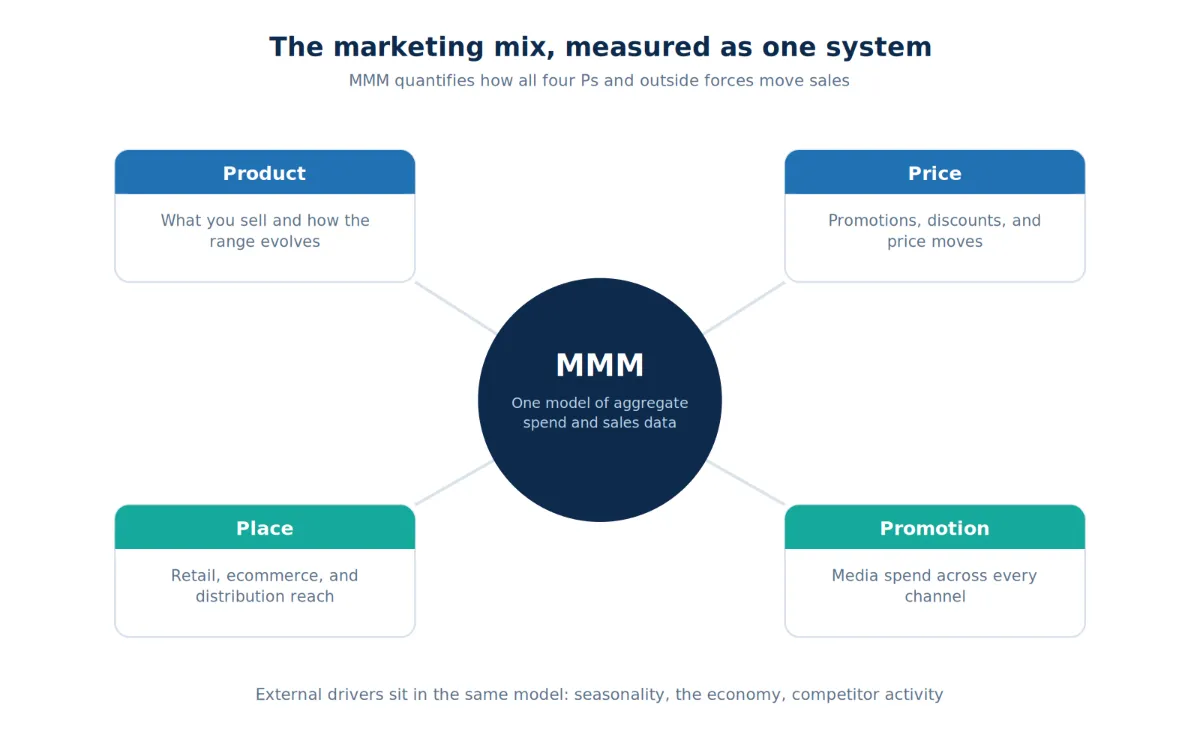
The marketing mix is the set of levers a business controls to generate demand. The classic formulation is the four Ps: product (what you sell and how the range evolves), price (list prices, discounts, and promotions), place (where customers can buy, from retail shelves to your checkout page), and promotion (every channel you pay for or earn attention through).
Most modern analytics only watches a thin slice of the fourth P. It counts clicks on digital promotion and stays blind to the rest. Yet a price cut can move revenue more than any campaign, and a distribution win can dwarf a quarter of ad spend. Customers experience the whole mix at once, so measuring one sliver in isolation guarantees a distorted picture.
Marketing mix modeling, usually shortened to MMM, is the statistical answer to that problem. Gartner defines MMM solutions as software and services that apply advanced statistical techniques to aggregate time-series data and quantify the holistic impact of marketing, optimizing outcomes such as sales or lead generation. In plain terms: the model looks at years of weekly spend, pricing, and sales history, alongside seasonality, the economy, and competitor activity, and estimates how much each lever actually contributed.
Because MMM works on aggregate data, it needs no cookies, device IDs, or personal identifiers. That single property explains most of its comeback.
Where Last-Click Attribution Breaks Down #
Last-click attribution assigns 100 percent of a conversion's value to the final tracked interaction. It survived for two decades because it is simple, free, and built into every analytics tool. It also fails in ways that compound each other.
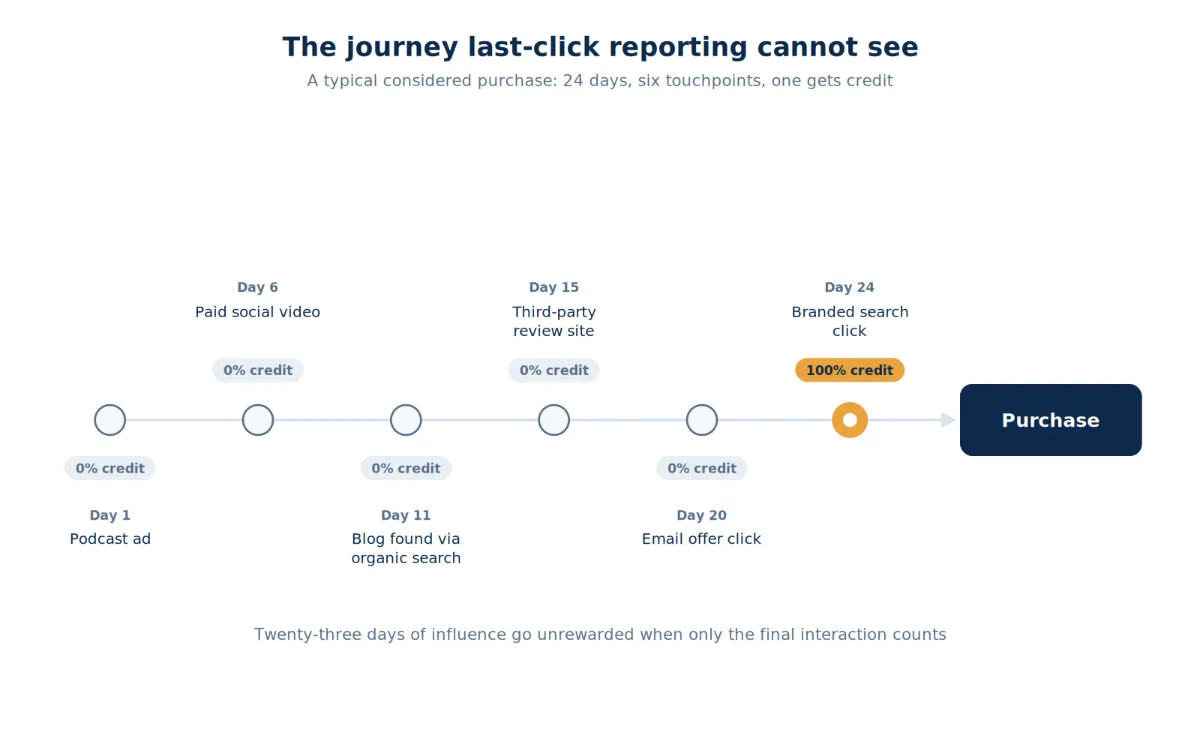
Consider a typical considered purchase. A buyer hears a podcast ad on day one, watches a product video through paid social advertising on day six, reads a comparison post found through organic search on day eleven, checks a third-party review site on day fifteen, clicks an email marketing offer on day twenty, then searches the brand name on day twenty-four and buys. Last-click hands the entire sale to that final branded search, and the report concludes that brand search is your best channel. It is not. It is simply the last stop.
The distortion has practical costs. Teams over-fund bottom-funnel paid search campaigns that harvest demand and starve the channels that create it. Worse, the tracking that last-click depends on keeps degrading. Apple's App Tracking Transparency framework cut off app-level identifiers in 2021. Safari and Firefox block third-party cookies by default. A growing share of research now happens inside AI assistants and answer engines that produce no click at all, which is why AI search optimization has become its own discipline. Every one of these shifts removes touchpoints from the journey your analytics can see, and every removed touchpoint inflates the credit given to whatever click remains.
The result is a measurement system that looks precise, updates in real time, and is confidently wrong about where growth comes from.
The Forces Behind the 2026 Mix Modeling Comeback #
MMM is not new. Consumer goods companies have used it since the 1960s to measure television and trade promotion. What changed is that three forces converged to make it relevant, affordable, and fast for everyone else.
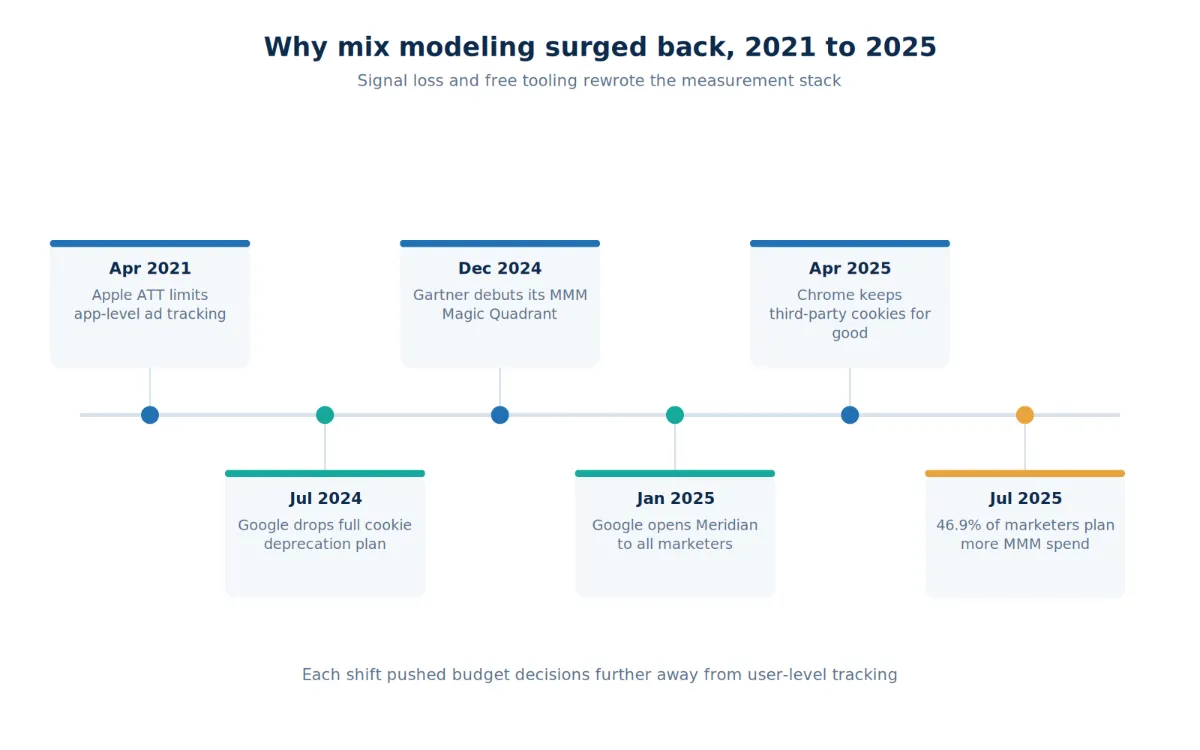
First, the privacy ground stopped shifting and settled somewhere inconvenient. After years of delays, Google announced in July 2024 that it would not fully deprecate third-party cookies, then confirmed on April 22, 2025 that Chrome would keep them under existing user controls and scrapped the planned standalone choice prompt. That sounds like a reprieve for tracking, but the practical message was the opposite: the industry spent five years preparing for signal loss, users kept opting out anyway, and no deterministic replacement arrived. Aggregate measurement became the only stable foundation to build on.
Second, the cost of entry collapsed. Google released Meridian, its open-source Bayesian MMM framework, to all marketers and data scientists on January 29, 2025, alongside a program of more than 20 trained and certified measurement partners. Meta's Robyn offers an open-source alternative with automated hyperparameter tuning. Work that once required a six-figure annual consulting engagement is now a project a capable in-house analytics team can run.
Third, the discipline gained institutional legitimacy. Gartner launched its first Magic Quadrant for Marketing Mix Modeling Solutions in December 2024 and published the second edition on November 10, 2025, the clearest possible signal that MMM has moved from specialist technique to mainstream enterprise requirement.
Marketing Mix Modeling vs. Attribution vs. Incrementality #
Moving beyond last-click does not mean deleting your attribution reports. It means demoting them to the job they can actually do, and adding the two methods that answer the questions they cannot.
Attribution, whether last-click or multi-touch, is a tactical steering tool. It tells you which ad, keyword, or subject line to adjust this week. MMM is the strategic allocation tool. It tells you how the next quarter's budget should split across channels, including offline and untrackable ones. Incrementality testing is the verification layer: geo holdouts and audience splits that prove whether a channel causes lift or merely collects credit for sales that would have happened anyway.
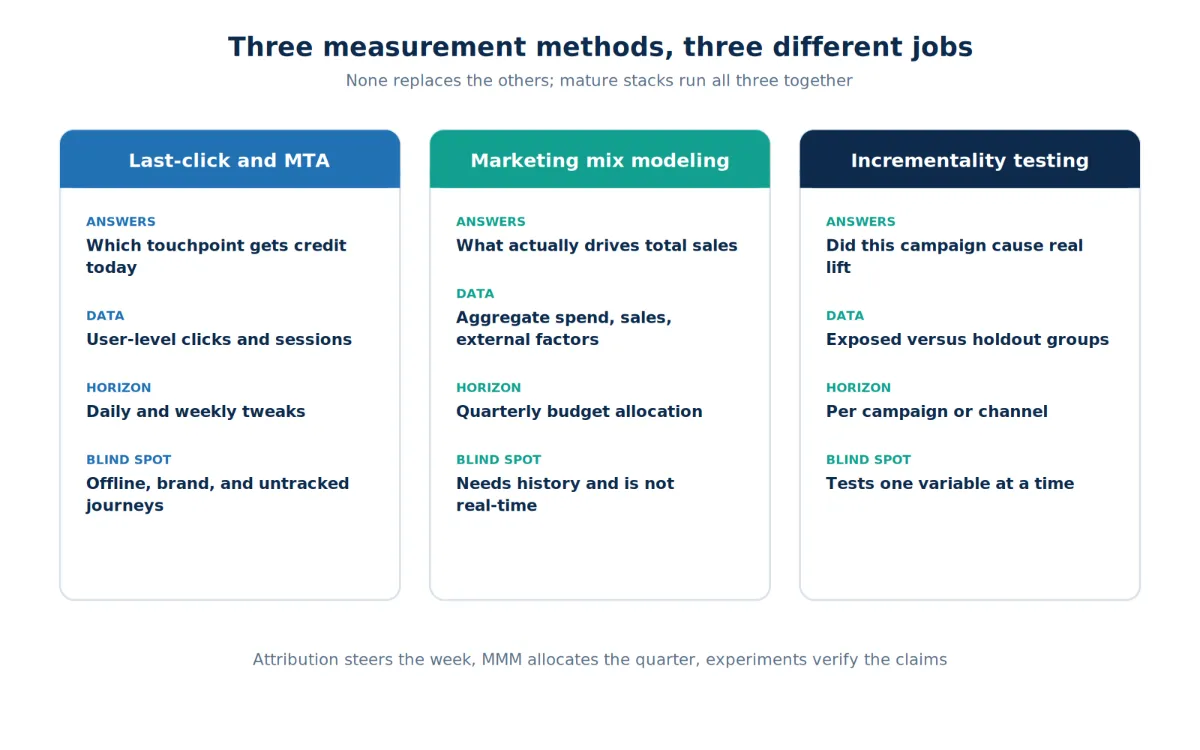
The three reinforce each other. Experiment results calibrate the model so its estimates stay honest, and the model tells you which channels are worth the cost of a formal test. EMARKETER's 2026 incrementality guidance reports that 36.2 percent of marketers plan to increase incrementality spending over the next 12 months, and that seven in eight US marketers will invest more in at least one measurement methodology. Triangulation, not any single model, is the emerging standard.
It is worth being honest about MMM's limits, because credibility with finance depends on it. A mix model is an estimate with confidence intervals, not a ledger. It needs meaningful variation in spend to detect effects; it struggles to separate channels that always move together, and a model fed thin or messy data will produce wide, unhelpful ranges. Those limits are exactly why the calibration layer exists: experiments narrow the uncertainty where it matters most.
What the Latest Numbers Show #
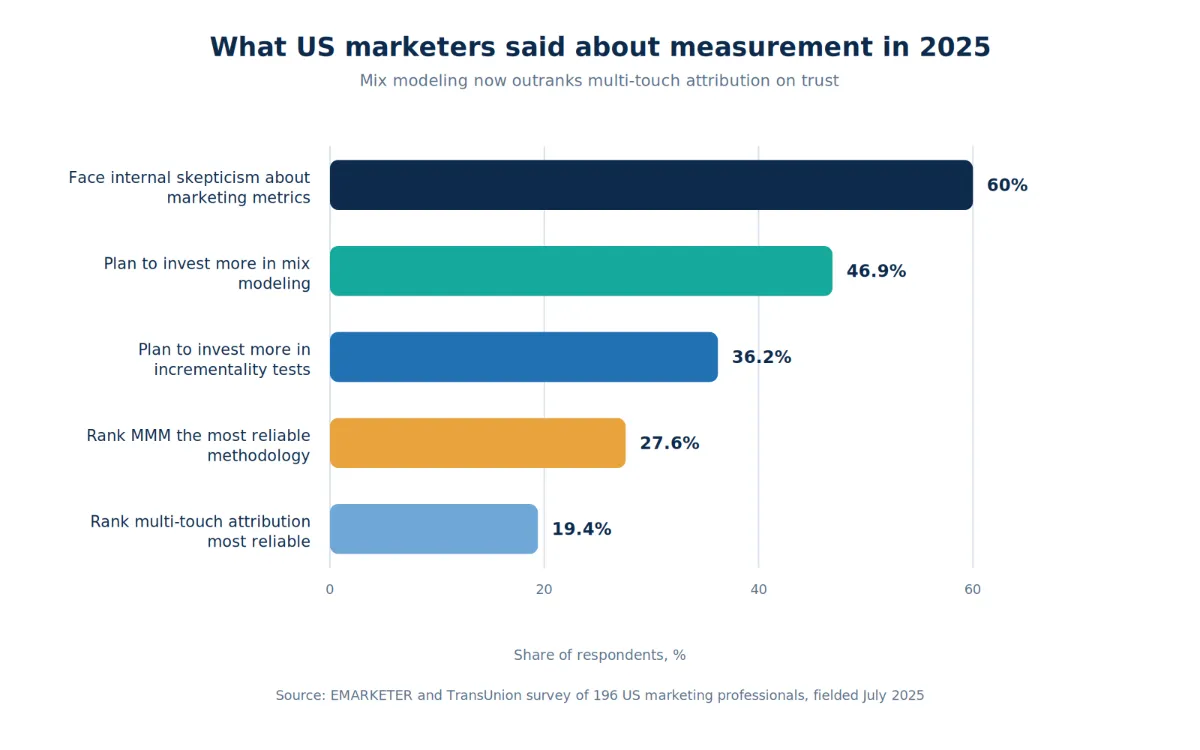
The adoption data tells a consistent story. A July 2024 EMARKETER and Snap survey found that 53.5 percent of US marketers already use MMM. A year later, momentum accelerated: in a July 2025 survey of 196 US marketing professionals by EMARKETER and TransUnion, 46.9 percent said they plan to invest more in MMM over the next 12 months, and 27.6 percent named MMM the single most reliable measurement methodology, ahead of multi-touch attribution at 19.4 percent.
The same research explains the urgency. TransUnion's October 2025 report, The True Cost of Trust in Marketing Measurement, found that 60 percent of marketers face internal stakeholder skepticism about their metrics, and roughly 29 percent have seen up to a fifth of their budget reallocated because leadership doubted the measurement behind it. Weak measurement is no longer an analytics problem. It is a budget-defense problem.
The financial stakes are larger than most dashboards suggest. Google and WARC's Beyond the Horizon research (October 2024) found advertisers see an average short-term profit return of 1.87 pounds per pound spent, rising to 4.11 pounds once sustained effects over the following months are measured. A related Ekimetrics meta-analysis reported by WARC concluded that advertisers who prioritize short-term ROI may overlook half of the media returns generated by brand building. Last-click does not just misallocate credit between channels. It hides more than half of marketing's total value from view.
How to Build Your First Marketing Mix Model #
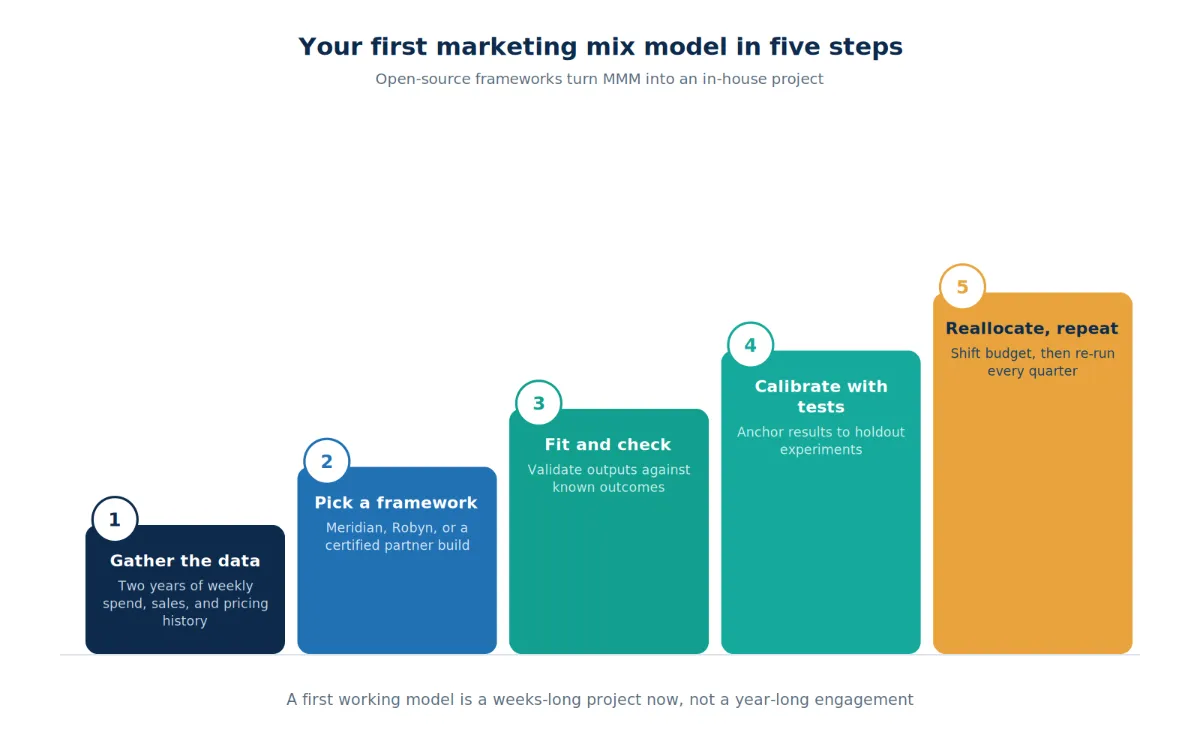
A first model is a focused project, not a transformation program. The sequence below reflects how teams are shipping working models in 2026.
1. Gather the data. Assemble roughly two years of weekly history: spend and impressions by channel, revenue or conversions, pricing and promotion calendars, and known external events. Data assembly is consistently the longest phase, so start it before anything else.
2. Pick a framework. Google Meridian suits teams that want Bayesian methodology, geo-level modeling, and native access to Google query volume data. Meta Robyn favors speed and automation. Certified partners are the right path if in-house data science capacity is thin.
3. Fit and check. Validate the model against periods with known outcomes and sanity-check the response curves. A model that claims a channel has no saturation point is telling you about its own flaws, not your media.
4. Calibrate with experiments. Anchor at least the largest channel estimates to a geo holdout or audience split test. Calibrated models are what finance teams sign off on. Pair tests with an ongoing conversion rate optimization program so site-side changes are controlled for rather than mistaken for media effects.
5. Reallocate and repeat. Use the model's budget optimizer to shift spend, then re-run quarterly. This cadence matters most for ecommerce marketing teams, where promotion calendars and marketplace dynamics change fast enough to stale an annual model.
What This Means For Your 2026 Budget #
Teams that adopt mix modeling tend to make the same three moves within two planning cycles.
They rebalance toward demand creation. Once brand video, audio, and content stop reporting as zeros, their budgets stop being the first cut in a downturn. They give compounding channels fair credit: organic search programs and content investments routinely show up in models as major contributors that last-click had been quietly assigning to branded search. And they change the conversation with finance, replacing platform-reported ROAS with a single model of incremental revenue that survives scrutiny.
None of this requires abandoning performance channels. It requires funding them for the incremental revenue they actually produce, which is sometimes more than last-click showed, and often less.
The practical way to manage the transition is to run both systems in parallel for one or two quarters. Keep the attribution reports for daily optimization, publish the model's channel contributions next to them, and let the gaps between the two views drive the conversation. Where the model says a channel is under-credited, fund a small test before a big shift. Teams that treat the first model as a hypothesis generator rather than an oracle build trust faster and make fewer expensive corrections.
Frequently Asked Questions #
What is the marketing mix? #
The marketing mix is the set of controllable levers a business uses to drive demand, classically the four Ps: product, price, place, and promotion.
What is marketing mix modeling (MMM)? #
MMM is a statistical technique that uses aggregate historical data to measure how each marketing channel, price change, and external factor contributes to sales.
How is MMM different from last-click attribution? #
Last-click credits the final tracked interaction before a conversion, while MMM measures the contribution of every channel, including offline and untrackable ones, from aggregate data.
Why is last-click attribution less reliable in 2026? #
Privacy controls, blocked cookies, cross-device journeys, and AI search answers hide most touchpoints from user-level tracking, so the final click overstates its own importance.
Is marketing mix modeling only for large enterprises? #
No. Free open-source frameworks such as Google Meridian and Meta Robyn let mid-sized teams build credible models in-house.
How much data does a marketing mix model need? #
Most models need about two years of weekly data covering spend, sales, pricing, and promotions across all major channels.
How often should a marketing mix model be refreshed? #
Quarterly refreshes are now the standard operating rhythm, and some teams re-run models monthly as their data pipelines mature.
What is Google Meridian? #
Meridian is Google's open-source Bayesian marketing mix modeling framework, released to all marketers and data scientists in January 2025.
Does MMM replace attribution and incrementality testing? #
No. Attribution guides daily optimization, incrementality tests validate causality, and MMM sets the budget across channels. Mature teams run all three.
Does marketing mix modeling comply with privacy regulations? #
Yes. MMM works on aggregate data rather than personal identifiers, so it needs no cookies, device IDs, or consent-gated tracking.