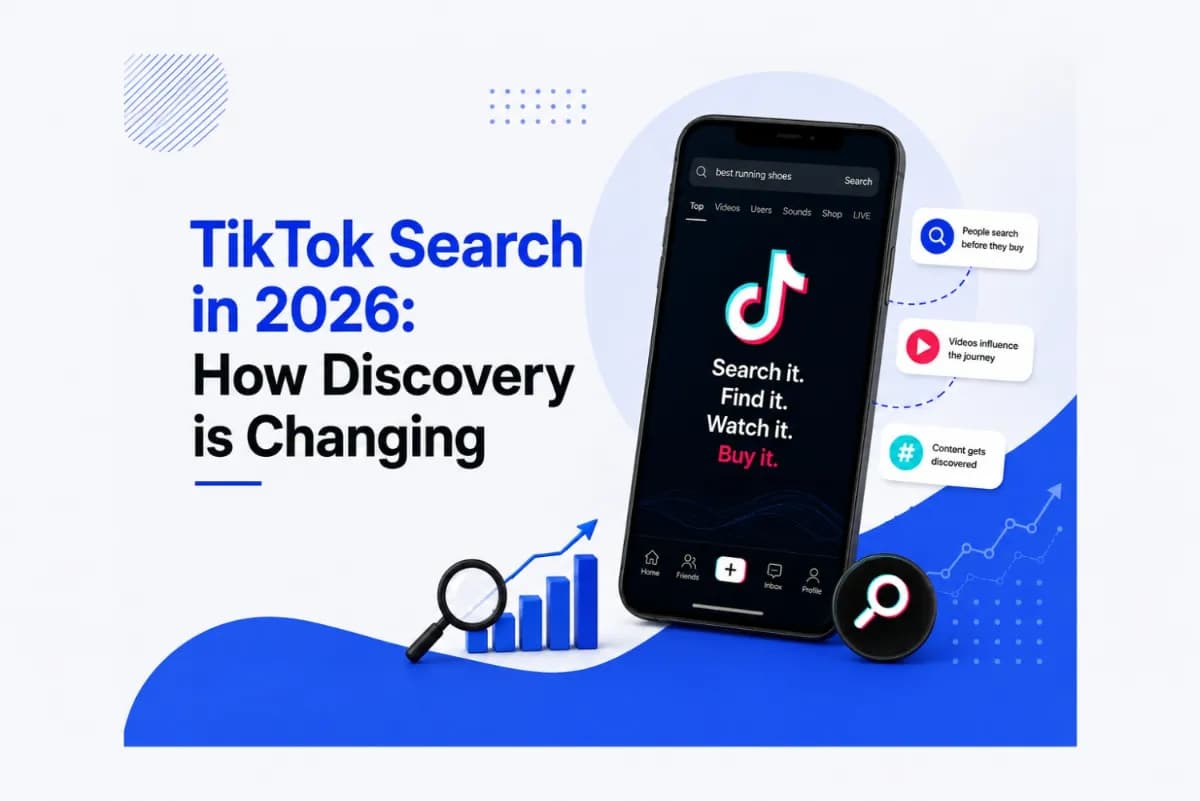
TikTok Search in 2026: How Discovery is Changing

Tuba
September 16, 2026
Table of Contents
- Key takeaways
- TikTok Search Is Becoming a Discovery Engine. Here Is What to Change in 2026
- What TikTok Search is Now, and Why "Discovery Engine" is the Right Term
- The 2026 Numbers Marketers Should Know
- Where TikTok Search Sits in the Buying Journey
- How TikTok Ranks Search Results
- Change 1: Do Keyword Research Inside TikTok, not Only in Google Tools
- Change 2: Build Videos to Answer a Query, then Hold Attention
- Change 3: Add TikTok Search Ads to the Paid Mix, with Realistic Expectations
- Change 4: Fix the Path From Search to Purchase
- Change 5: Measure TikTok Search as its Own Channel
- A TikTok Search Audit You Can Run This Month
- Frequently Asked Questions
Key takeaways #
TikTok Search is now a discovery engine used by 49% of US consumers and by 86% of Gen Z internet users every week. It ranks videos on query match, watch behavior, and personal context, not on links or follower counts. Marketers who win in 2026 will research keywords inside TikTok, build videos that answer specific questions, add Search Ads to the paid mix, fix the path from search to purchase, and measure search as its own channel.
TikTok Search Is Becoming a Discovery Engine. Here Is What to Change in 2026 #
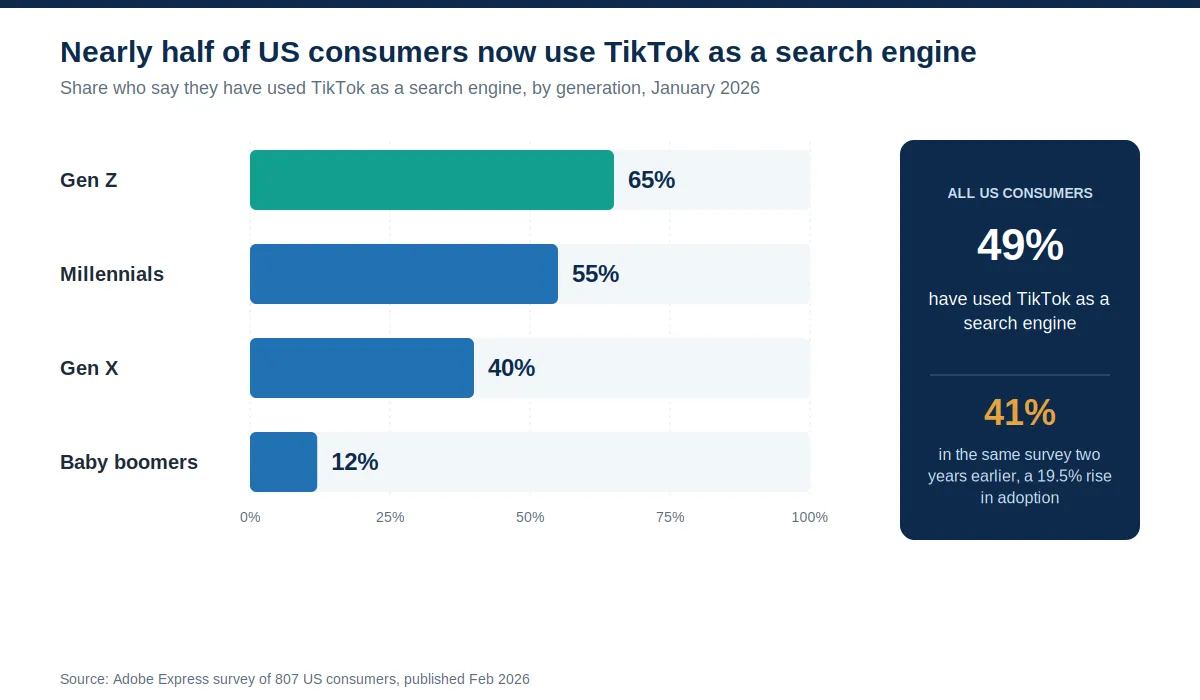
Type "best sunscreen for oily skin" into TikTok and you get something a web search cannot show you: twenty people applying it on camera, arguing about it in the comments, and linking to it in a shop tab. That is why TikTok Search has stopped being a side feature. In Adobe Express's February 2026 survey of 807 US consumers, 49% said they had used TikTok as a search engine, up from 41% two years earlier. Among Gen Z, the figure was 65%.
The shift is not that TikTok is replacing Google. The same survey found only 4% of Gen Z would rather rely on TikTok than Google. The shift is that search behavior now starts, continues, or ends inside TikTok for a large share of your audience, and most marketing plans still treat the app as a feed. This post covers what changed, how TikTok ranks search results, and five things to change in your 2026 plan.
What TikTok Search is Now, and Why "Discovery Engine" is the Right Term #
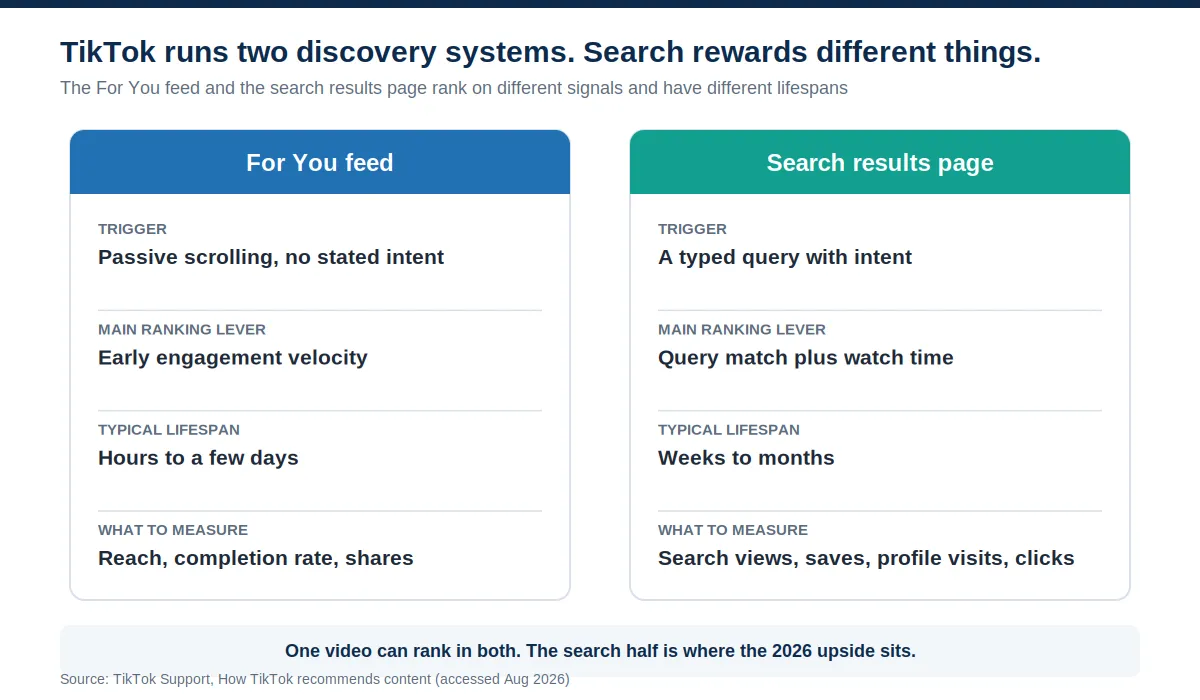
TikTok has two discovery systems. The For You feed pushes videos to people based on predicted interest. Speed matters there: a video that earns fast likes, shares, and rewatches in its first hours gets more distribution, then fades. The search results page works differently. It fires when someone types a query, and TikTok says the strongest signal is how well the content matches that query.
That has a practical consequence. A video that ranks for a query can keep collecting views for months, long after its feed distribution stopped. Search visibility compounds in a way feed visibility does not. Since March 2024, TikTok has also paid creators for it. Creator Search Insights shows which topics people search for, flags content gap topics with high demand and few videos, and feeds search value into the Creator Rewards Program.
"Discovery engine" fits because most TikTok searches are not looking for a single fact. WARC and TikTok's July 2025 study, based on a US survey fielded in March 2025, found people arrive with layered intent: inspiration, learning, research, comparison, and purchase, often in one session. That is closer to how people use Pinterest or YouTube than to how they use a web search box.
The 2026 Numbers Marketers Should Know #
Three data sets describe how big TikTok Search has become.
The audience. Pew Research Center's November 2025 report found 37% of US adults use TikTok, up from 21% in 2021, and roughly half of 18- to 29-year-olds open it at least once a day. A separate Pew analysis from September 2025 found 20% of US adults regularly get news on TikTok, up from 3% in 2020, the fastest growth of any platform Pew tracks. TikTok's own count, as of the US joint venture's signing in December 2025, is more than 170 million Americans.
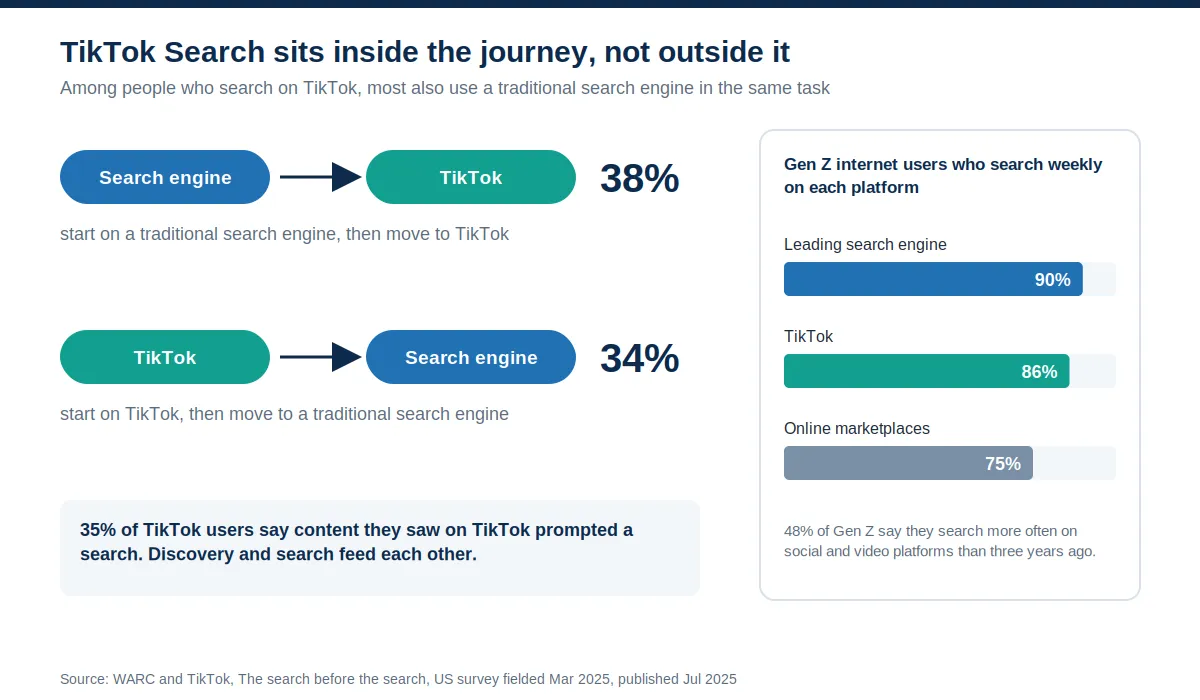
The search habit. TikTok's numbers, published when it launched Search Ads Campaign in September 2024, put 57% of users using search and 23% searching within 30 seconds of opening the app. By September 2025, TikTok said the community runs billions of searches a day, up 40% year over year. WARC and TikTok's 2025 research found 86% of Gen Z internet users search on TikTok weekly, close to the 90% who search weekly on the leading search engine and ahead of the 75% who search on online marketplaces.
The intent. Adobe's 2026 survey found 65% of Gen Z, 55% of millennials, 40% of Gen X, and 12% of baby boomers have used TikTok as a search engine. In the same survey, small business owners already spent an average of 16% of their marketing budget on TikTok content and 15% of their SEO budget on TikTok search optimization.
Where TikTok Search Sits in the Buying Journey #
Marketers spend time on the wrong question. "Is TikTok replacing Google?" has a clear answer: no. Adobe's 2026 data shows 89% of Gen Z still preferring Google over any other platform, and only 4% saying they would rather rely on TikTok, down from 8% in 2024. Google itself is a growing surface for TikTok content, since short videos now appear inside standard results.
The useful question is where TikTok sits in the sequence. TikTok's September 2025 summary of the WARC work found that among people who search on TikTok, 38% start on a traditional search engine and then move to TikTok, while 34% start on TikTok and then move to a search engine. And 35% of TikTok users say something they saw on TikTok prompted them to search. In other words, TikTok is a middle step for many purchases and a first step for others.
That is why the search results page behaves like a comparison surface. People come to see how something looks in use, what other buyers say, and whose take they trust. One in five TikTok search users told WARC they had bought directly from a brand site or TikTok Shop after searching. HubSpot's 2025 State of Consumer Trends report points the same way: social media is the top product discovery channel for Gen Z, millennials, and Gen X, and 43% of Gen Z bought something inside a social app in the previous three months.
How TikTok Ranks Search Results #
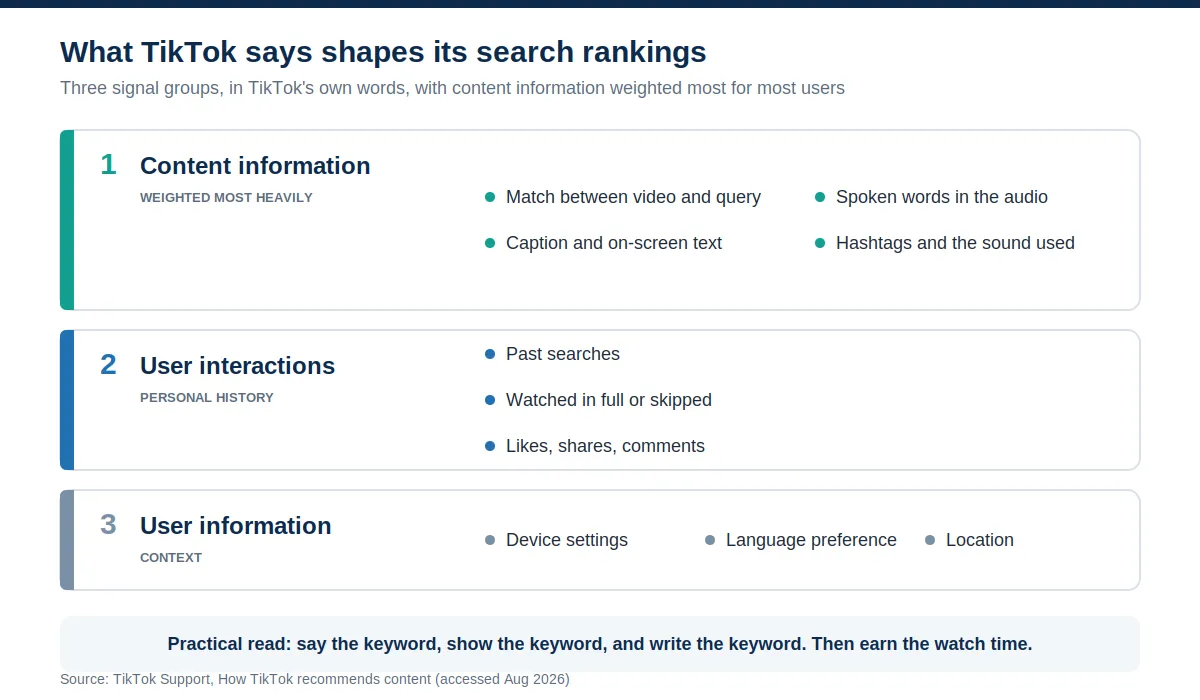
Nobody outside TikTok has the ranking formula, but TikTok's help documentation plus what shows up when you test queries gives a workable model. Three groups of signals matter, in this order.
Content information. Does the video match the query? TikTok reads captions, on-screen text, spoken words through automatic transcription, hashtags, and the sound. A video that says the keyword out loud, shows it on screen in the first seconds, and repeats it in the caption is easier to classify than one that relies on a hashtag.
Watch behavior. Search results are personalized, and TikTok says past search behavior and whether people watched a video in full or skipped it both influence rankings. So a well-matched video that people abandon at second three will lose to a slightly less matched video that holds attention.
User information. Device settings, language, and location shape results, which is why local queries such as "brunch in Austin" pull location-tagged videos.
Follower count is not on the list. That is the biggest difference from most people's mental model. Small accounts can, and do, hold top spots for competitive queries because their video answers the question better. TikTok says three signal groups
Change 1: Do Keyword Research Inside TikTok, not Only in Google Tools #
Google keyword tools tell you how people phrase questions to a search box. TikTok's own search surfaces show how people phrase them in a video app, which is often shorter, more spoken, and more specific.
Start with the search bar. Type your seed term and record the auto-complete suggestions and the "others searched for" prompts under top videos. Then open Creator Search Insights in the app, filter by your category, and note the content-gap topics. Those are queries with demand and thin supply, which is exactly the list an SEO team would want on Google.
If you run paid campaigns, TikTok Ads Manager gives a third source. When you set up a search campaign, it recommends keywords from your seed terms and, once live, shows the actual search terms that triggered your ads. Feed those terms back into organic planning. The keyword logic mirrors what a PPC team already does, so it fits well beside an existing paid search program.
Group what you find into intent buckets: how-to, review, comparison, "is it worth it", and local. Each bucket calls for a different video, and each maps to a different point in the journey from Figure 3.
Change 2: Build Videos to Answer a Query, then Hold Attention #
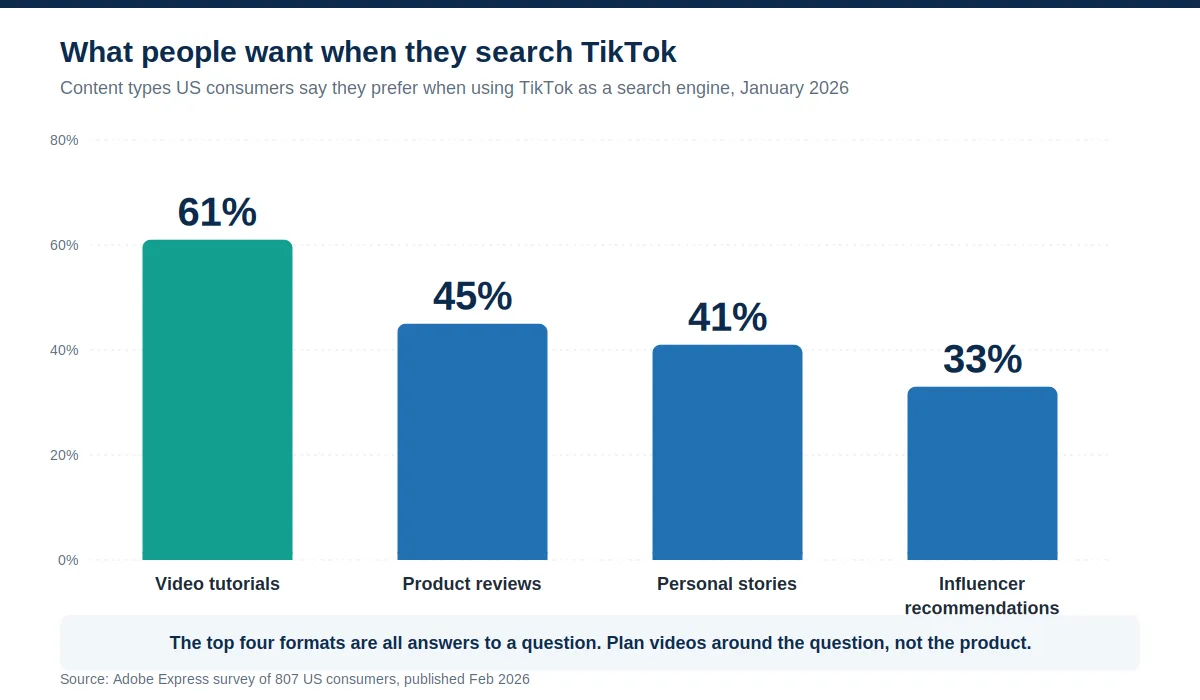
The Adobe survey is blunt about what people want when they search TikTok: video tutorials (61%), product reviews (45%), personal stories (41%), and influencer recommendations (33%). All four answer a question. So plan the question first.
A working format for a search-first video:
Open with the query in the first two seconds, spoken and on screen. "Best budget espresso machine under $200" beats "Let me show you my morning routine."
Answer early, then explain. Search viewers skip fast, and TikTok says skips count against you.
Repeat the keyword in the caption in plain language. Write captions like a person answering the query, not a hashtag wall. Two or three hashtags for context is enough.
Add on-screen text for key claims. TikTok reads it, and viewers watching without sound need it.
Close with a reason to save or comment. Saves and comments signal usefulness.
Longer explainers have a place too. WARC's seven intent types include learning and research, and those queries reward a two- to three-minute answer over a fifteen-second hook. Test both lengths per keyword.
This is as much content work as social work. Scripts, captions, and web cuts come from the same brief, so many teams fold TikTok search planning into their content writing process. And because Google surfaces short videos too, one script can serve TikTok, YouTube Shorts, and a supporting page on your site, which is the same principle behind good SEO: one clear answer, structured so machines can read it.
Change 3: Add TikTok Search Ads to the Paid Mix, with Realistic Expectations #
TikTok launched a keyword-based Search Ads Campaign in September 2024. Advertisers pick keywords, choose broad, phrase, or exact match, add negatives, and bid; the ads appear in search results next to organic videos. It works with Traffic, Web Conversion, and Lead Generation objectives.
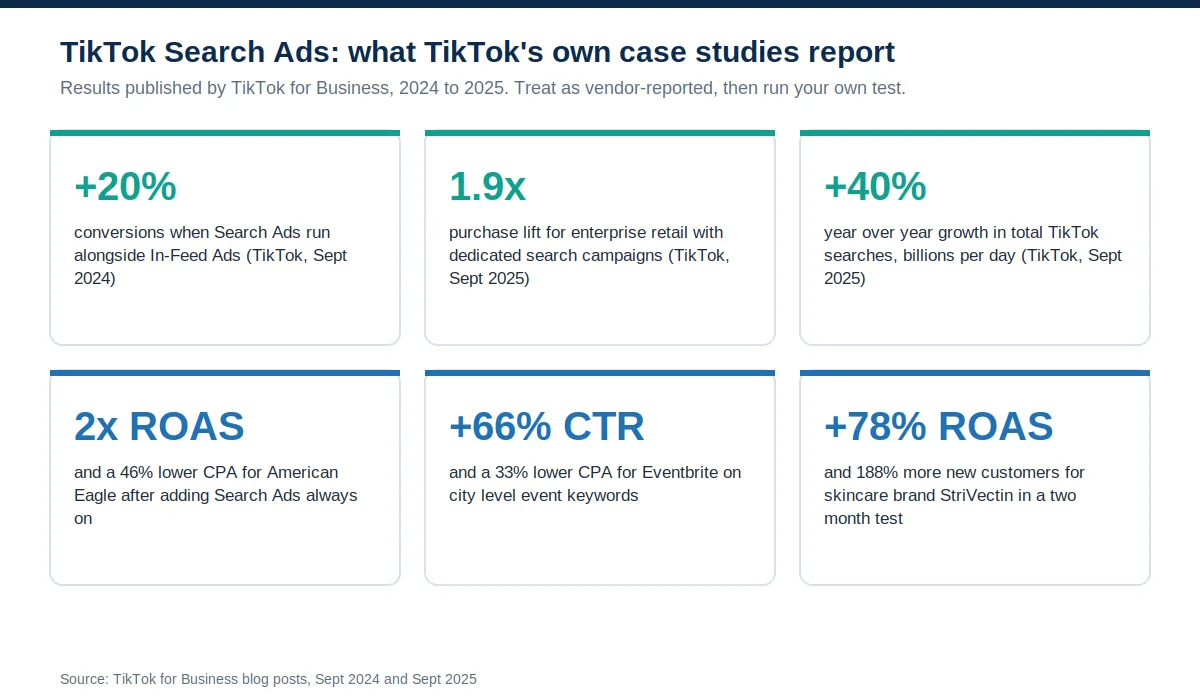
TikTok's published results are strong but come from TikTok. In its launch post, it said brands running Search Ads with In-Feed Ads saw 20% more conversions on average. In September 2025, it added that for enterprise retail, dedicated search campaigns delivered a 1.9x purchase lift versus campaigns without. Case studies TikTok published include American Eagle doubling ROAS with a 46% lower CPA, Eventbrite lifting click-through 66% with a 33% lower CPA on city-level event keywords, and StriVectin, a skincare brand, reporting a 78% ROAS lift and 188% more new customers in a two-month test.
Read those like any platform's case studies. The direction is credible because the mechanism is: you reach people as they type intent instead of interrupting a scroll. The lift depends on keyword demand in your category and how well your creative matches the query.
Practical guidance:
Start with broad match on your top intent terms, then tighten to phrase and exact once search-term reports show what converts.
Give search campaigns their own ad groups and creative, and match the first two seconds of the ad to the keyword. Reusing feed creative in search is the most common reason results disappoint.
Put 20% to 30% of TikTok spend into search while you learn, and judge it on incremental purchases, not last click.
If your team already runs social advertising on TikTok, this is an extension of that account, not a new platform.
Change 4: Fix the Path From Search to Purchase #
Adobe's survey asked small business owners what was hardest about TikTok. The top answer, at 38%, was converting engagement into sales. That is the gap between winning a search and winning a customer. Three fixes close most of it.
Give every search-first video a next step. A shop tab, a link in bio that matches the query, or a pinned comment with the exact page. If someone searched "best carry-on for Europe", the link should land on the carry-on page, not the homepage.
Build landing pages that continue the video. Same product, same claim, same price, and ideally the same creator's face. Landing pages that reset the story lose the intent you just earned. This is standard conversion rate optimization work applied to a new source.
Decide where checkout happens. For lower-priced products, TikTok Shop keeps buyers in the app and removes friction. For considered purchases, a fast mobile page with reviews works better. Either way, treat TikTok Shop, your store, and any marketplace listing as one ecommerce system, so pricing and stock match everywhere the video sends people.
Change 5: Measure TikTok Search as its Own Channel #
Most reporting mixes search views into total views, which hides the whole point.
Inside TikTok analytics, video-level traffic sources split into For You, Following, Search, Profile, and Sound. Track the Search share per video and per topic. A video with a low view count and a high search share is a keeper, and a topic where search share keeps rising is telling you where to invest.
Track your rankings by hand for your ten to twenty priority queries, once a week, from a logged-out account and from a customer-like account. Because results are personalized, log both views and note who else holds the top spots.
Tag outbound links by video and by keyword so your web analytics can separate search-driven visits from feed-driven visits. Add branded search on TikTok to your brand health dashboard next to Google branded search. If people are typing your name into TikTok, they are checking you before they buy.
Finally, run an incrementality test on Search Ads rather than trusting platform attribution. Hold out by region or by keyword group and compare purchases, not clicks.
A TikTok Search Audit You Can Run This Month #
Here is a one-week audit that tells you where you stand.
Day 1. List 20 queries your customers would type: five how-to, five review, five comparison, five local or brand. Pull auto-complete and content gap topics for each.
Day 2. Search each query on TikTok, logged out. Record whether you appear in the top ten, who does, and what format wins.
Day 3. Audit your last 30 videos. For each, note whether the query appears spoken, on screen, and in the caption within the first three seconds. Most brands score under 20%.
Day 4. Pull traffic source data. Rank your library by search share and see which topics TikTok already sends searchers to.
Day 5. Check the path. Click your own links from three search-winning videos on a phone. Time the journey to the product page and note every mismatch.
Day 6. If you run TikTok ads, check whether Automatic Search Placement is on and whether you have a dedicated search campaign. Pull search-term reports.
Day 7. Write the gap list: queries with demand and no answer from you, videos that answer but do not rank, and links that lose intent.
That list becomes your Q4 content calendar and your first search campaign. If you want a second pair of eyes, our social media team runs this audit as part of channel planning and can turn the gap list into a production schedule.
Frequently Asked Questions #
What is TikTok Search? #
TikTok Search is the query-based discovery system inside TikTok. When someone types a phrase, TikTok ranks videos, creators, sounds, and hashtags on how well they match the query, how people have interacted with them, and personal context such as language and location. It runs separately from the For You feed, and results can stay in place for weeks or months.
Is TikTok replacing Google as a search engine?
No. Adobe Express's February 2026 survey found that 49% of US consumers have used TikTok as a search engine, but 89% of Gen Z still prefer Google over any other platform, and only 4% would rely on TikTok over Google. Realistically, TikTok is a stage in the search journey for many people, especially for reviews, tutorials, and comparisons.
How many people use TikTok as a search engine in 2026?
Adobe's 2026 survey of 807 US consumers found 49% had used TikTok as a search engine, including 65% of Gen Z, 55% of millennials, 40% of Gen X, and 12% of baby boomers. WARC and TikTok's 2025 research found 86% of Gen Z internet users search on TikTok weekly. TikTok said in September 2025 that total searches on the platform were up 40% year over year.
How does TikTok rank search results?
TikTok says search results and suggested searches are shaped by three groups of signals: content information such as how well the video matches the query, its hashtags, and its sound; user interactions such as past searches and whether videos were watched in full or skipped; and user information such as device, language, and location. For most people, content information carries the most weight. TikTok does not include follower count.
What is TikTok SEO?
TikTok SEO is the practice of making videos rank for queries typed into TikTok's search bar. It combines keyword research inside TikTok, placing the query in spoken words, on-screen text, and the caption, and holding attention so viewers watch the video instead of skipping it. It overlaps with web SEO because Google also surfaces TikTok videos in its own results.
What is Creator Search Insights and how do marketers use it?
Creator Search Insights is a free tool TikTok launched in March 2024. It shows topics people search for, sorted by category or matched to your content, and flags content gap topics that are searched often but have few videos. Marketers use it for keyword research and to build a content calendar around existing demand. Open it by searching "Creator Search Insights" in the app.
How do TikTok Search Ads work?
TikTok Search Ads Campaign, launched in September 2024, is a keyword-based campaign type. You choose keywords with broad, phrase, or exact match, add negative keywords, set bids and budgets, and your video or carousel ads appear inside TikTok search results next to organic videos. It supports Traffic, Web Conversion, and Lead Generation objectives. TikTok reports that brands running Search Ads with In-Feed Ads see about 20% more conversions on average.
Do hashtags still matter for TikTok Search?
Yes, but as context rather than the main lever. TikTok lists hashtags among the content information it reads alongside query match and the sound used. Two or three specific hashtags plus a descriptive caption is enough. The keyword spoken out loud and shown on screen in the first seconds carries more weight than a long hashtag list.
How long does a video rank in TikTok search?
Unlike feed distribution, which usually fades within days, a video that ranks for a query can hold its position for weeks or months as long as it keeps matching the query and holding attention. When the answer changes, such as a new product version or price, post an updated video rather than relying on the old one.
How should I measure TikTok Search performance?
Track the Search share of views per video in TikTok analytics, check your rankings for priority queries weekly from a logged-out account, tag outbound links by video and keyword so web analytics can separate search-driven visits, watch branded search volume on TikTok next to Google, and run holdout tests on Search Ads to measure incremental purchases rather than platform-attributed clicks.