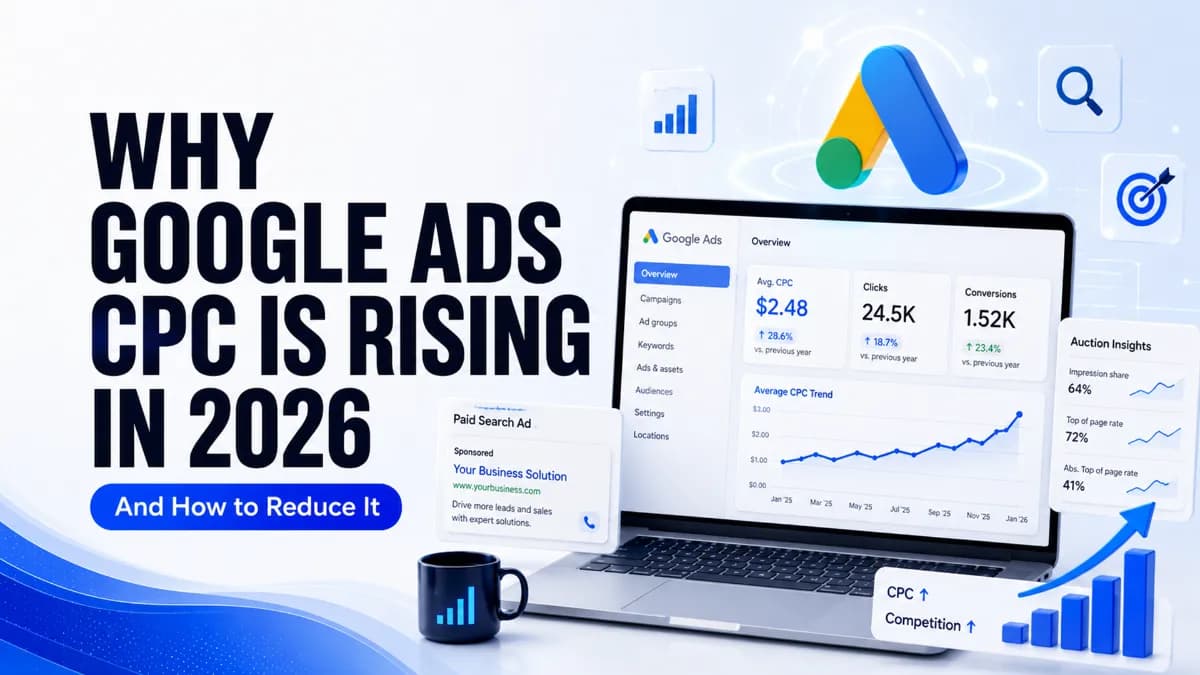
Why Google Ads CPC Is Rising in 2026 (And How to Reduce It)

Tuba
July 17, 2026
Table of Contents
- Key Takeaways
- Why Your Google Ads Clicks Keep Getting More Expensive (and How to Pay Less)
- How Expensive Have Google Ads Clicks Actually Become?
- Why Google Ads CPC is rising in 2026
- 1. Google's own hand is on the pricing dial
- 2. AI Overviews shrank the pool of free clicks
- 3. Automation widens your targeting by default
- 4. Brand terms became a battleground
- 5. Record budgets are chasing the same slots
- How to Reduce Google Ads CPC: The Six-Step Playbook
- Step 1: Rebuild the inputs behind Quality Score
- Step 2: Contain the match type creep
- Step 3: Split brand from non-brand
- Step 4: Feed real profit data to Smart Bidding
- Step 5: Make every click worth more
- Step 6: Diversify beyond a single auction
- Where To Start
- Frequently Asked Questions
Key Takeaways #
Google Ads CPC is rising in 2026 for reasons that are structural, documented, and, in one case, court-ordered to be made public. The auction will not get cheaper on its own. But the spread between what disciplined and undisciplined accounts pay has never been wider, and every input in that spread- relevance, containment, campaign structure, conversion data, and channel mix- sits on your side of the dashboard. Treat CPC as an output of how well the account is built rather than a market condition to endure, and the 2026 cost curve becomes something you manage instead of something that happens to you.
If costs have climbed for two straight quarters and nobody has audited the search terms report in months, a structured PPC audit is usually the fastest way to find where the money is leaking.
Why Your Google Ads Clicks Keep Getting More Expensive (and How to Pay Less) #
Every advertiser feels it. Same keywords, same targeting, same landing pages, and somehow the invoice keeps growing. The average cost per click in search advertising reached $5.42 in 2026, according to LocaliQ's benchmark study of campaigns running from April 2025 through March 2026, published in May 2026. That is more than double the $2.32 average recorded in the same report series in 2016.
The uncomfortable part is that rising Google Ads CPC is not a spike or a seasonal blip. It is the product of five structural forces, at least one of which was engineered inside Google itself, and they compound one another. The encouraging part is that most accounts are paying a premium they do not have to pay. This guide covers what is actually driving up click costs in 2026, the evidence behind each cause, and the six levers that reliably pull them back down.
How Expensive Have Google Ads Clicks Actually Become? #
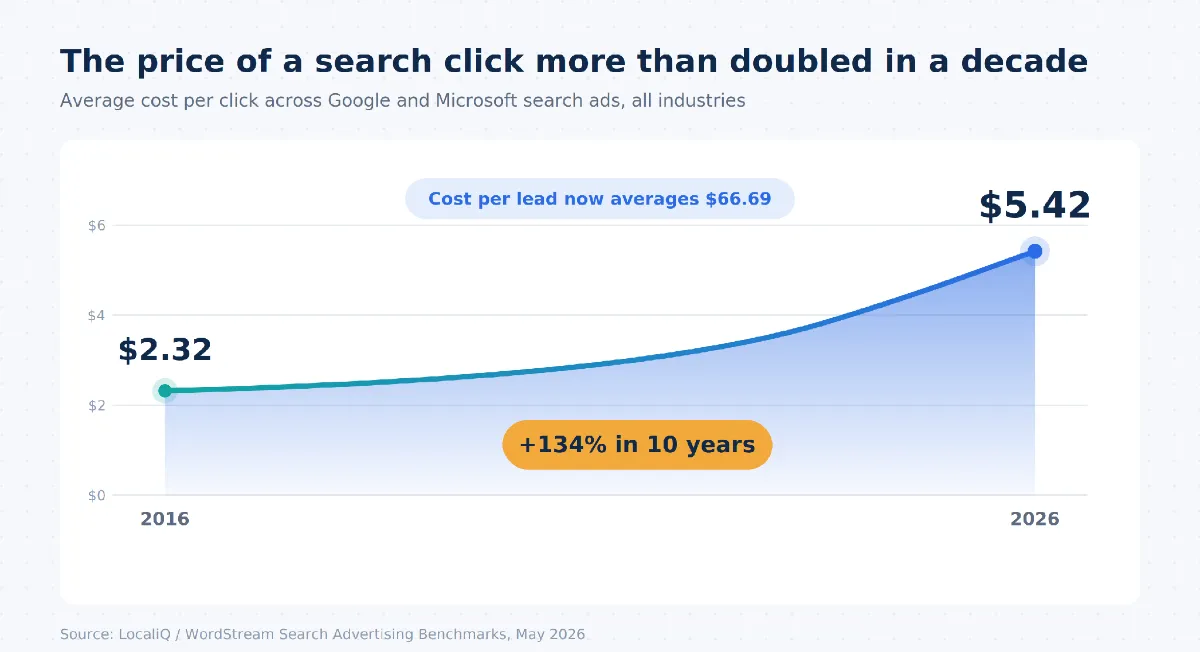
The 2026 LocaliQ report puts the cross-industry average at $5.42 per click across Google and Microsoft search ads, with attorneys and legal services at the top of the table at $9.87 and arts and entertainment at the bottom at $1.63. Average cost per lead is now $66.69. Costs rose year over year in the large majority of the twenty industries tracked, even in a year the report itself describes as unusually stable.
Zoom out and the direction is unmistakable. Alphabet closed 2025 with annual revenue above $400 billion for the first time, and search advertising revenue accelerated in every quarter, finishing at 17 percent growth in Q4 2025. Meanwhile, Tinuiti's Q1 2026 benchmark report reveals something: among its large, closely managed enterprise accounts, spend rose 14 percent while average CPC stayed roughly flat, as growth came from clicks. Sophisticated advertisers are holding their click prices down. The increases concentrate on everyone else. That gap between managed and unmanaged accounts is the real story of 2026, and it is also the opportunity.
Why Google Ads CPC is rising in 2026 #
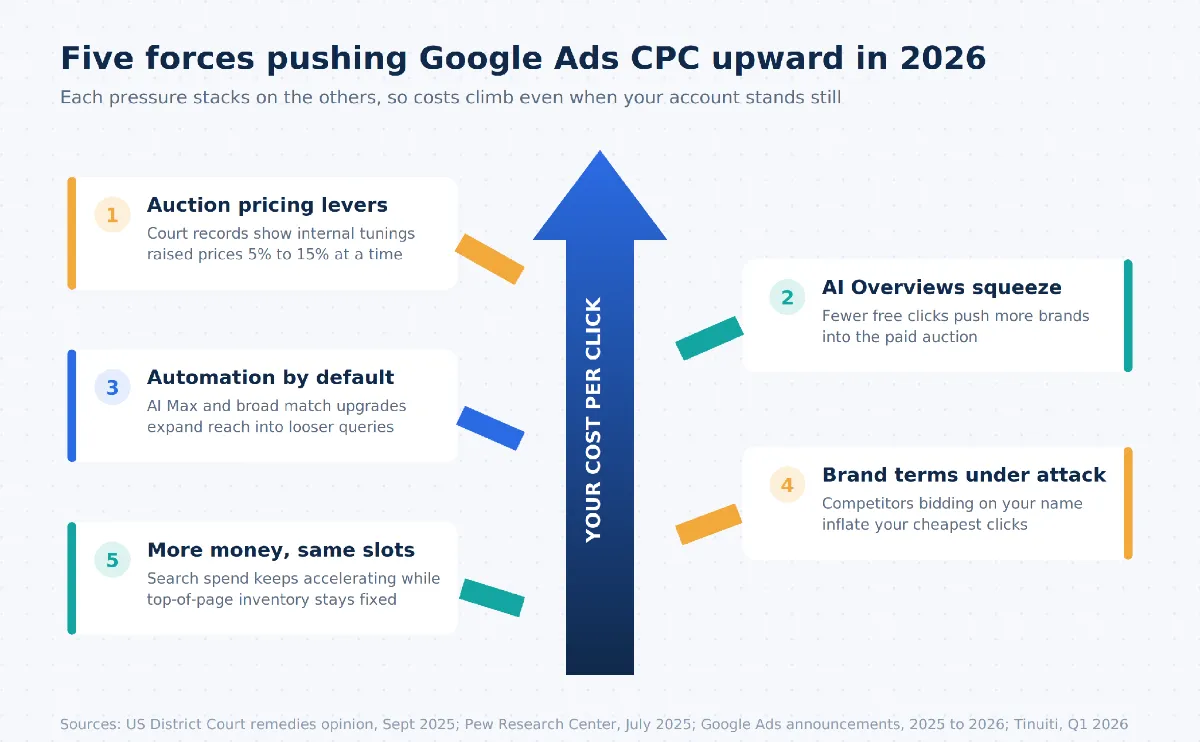
Five forces are pushing in the same direction at once. None of them is going away on its own, which is why accounts that changed nothing still saw costs climb.
1. Google's own hand is on the pricing dial #
For years, advertisers assumed auction prices reflected pure competition. Court records say otherwise. During the US v. Google antitrust case, Google executives testified that the company routinely adjusts its ad auctions through internal mechanisms it calls tunings, that these changes can raise prices, and that advertisers are typically not told when they happen. Testimony compiled by the Department of Justice in 2024 describes auction changes made specifically to meet revenue targets.
The September 2025 remedies opinion went further. Judge Amit Mehta's ruling describes internal pricing knobs that raised ad prices by 5 to 15 percent at a time, calibrated so the increases appeared to be ordinary auction fluctuations. Google's own internal surveys showed advertisers noticed the higher costs but blamed the market. The court now requires Google to report material auction changes monthly, which means advertisers will finally see price-affecting changes that were previously invisible.
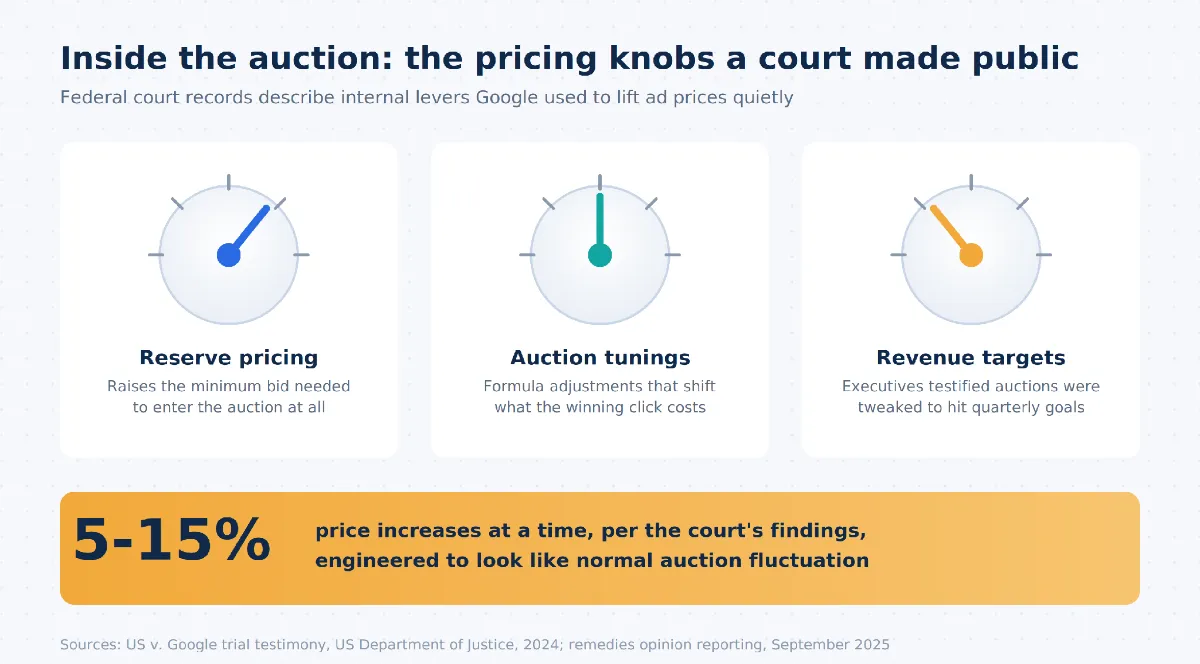
The practical takeaway: a slice of your CPC increase was a decision, not demand. Watch the new disclosure reports as they roll out, and treat unexplained account-wide price jumps as events to investigate rather than costs to absorb.
2. AI Overviews shrank the pool of free clicks #
Pew Research Center's July 2025 browsing study of 900 US adults measured how AI summaries affect click behavior. When a results page included an AI summary, users clicked a traditional result in just 8 percent of visits, compared with 15 percent when no summary appeared. Links within the summaries were clicked in only 1 percent of visits. And 18 percent of the tracked searches already triggered a summary.
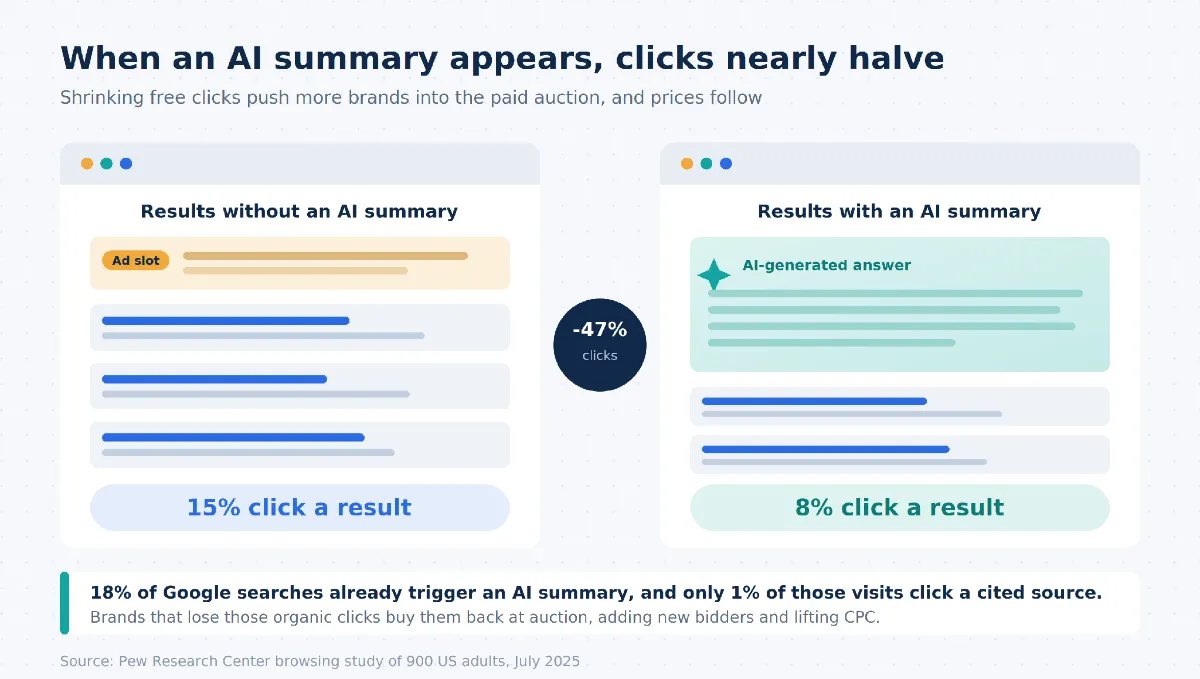
Here is the connection to your CPC: when organic clicks evaporate, the brands that depended on them do not simply accept the loss. They buy the traffic back at auction. Every displaced organic click adds a bidder, and more bidders mean higher clearing prices for everyone. That is why defending your organic search visibility and earning citations inside AI answers through generative engine optimization now function as CPC control strategies, not just traffic plays. The cheapest click is still the one you never had to bid on.
3. Automation widens your targeting by default #
Google introduced AI Max for Search in May 2025 as a one-click suite that expands campaigns beyond your chosen keywords using broad match and keyword-less technology. Then, in April 2026, Google confirmed that campaigns using Dynamic Search Ads, automatically created assets, or campaign-level broad match will be automatically upgraded to AI Max, with upgrades beginning in September 2026. Expansion is no longer something you opt into. It is the default you must actively manage.
To be fair, the expansion often works on Google's chosen metric: the company reports around 7 percent more conversions or conversion value at similar efficiency when the full feature suite is enabled. But averages hide the mechanism. Keyword-less matching buys queries you never chose, at prices you never inspected, and looser intent costs more per useful click. Left unmonitored, automated expansion inflates average CPC while topline conversion numbers look healthy enough that nobody checks.
4. Brand terms became a battleground #
The clicks that used to anchor your account average at pennies are being repriced. Tinuiti's benchmark data recorded a 19 percent year-over-year jump in brand keyword CPCs for text ads in Q1 2025 before growth eased later in the year. The driver is conquesting: competitors bidding on your name force you to defend traffic you previously collected almost free. Because brand clicks are usually the cheapest in the account, even modest inflation there drags the blended average up and quietly distorts every efficiency metric built on it.
5. Record budgets are chasing the same slots #
The simplest force is also the largest. Search ad spending among Tinuiti's advertisers grew 14 percent year over year in Q1 2026, the fastest rate in nearly two years, and Alphabet's search revenue growth accelerated through every quarter of 2025. The supply side did not expand to match: there are still only a handful of paid positions above the fold on a results page. When more money chases fixed inventory in an auction, prices rise without anyone misbehaving. Combine that with the four forces above and the 2026 cost curve stops looking mysterious.
How to Reduce Google Ads CPC: The Six-Step Playbook #
The order matters. The early steps are cheap and fast, and they fund the later ones. Work them in sequence, and each step compounds the savings from the previous one.
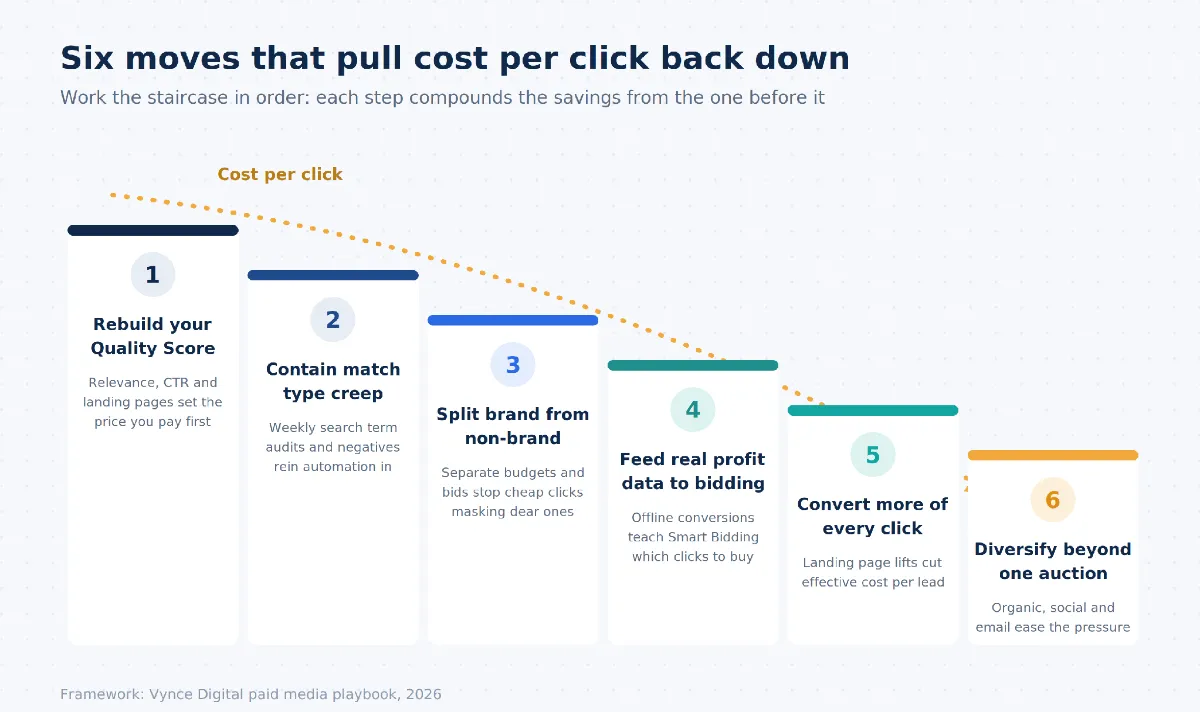
Step 1: Rebuild the inputs behind Quality Score #
Quality Score is the closest thing the auction has to a pricing dial you control. Expected click-through rate, ad relevance, and landing page experience together determine whether you pay a discount or a penalty relative to competitors in the same auction. Tighten each ad group to a single intent theme, mirror the query language in your headlines, and make sure the landing page answers the query in its first screen. This is unglamorous work, and it is the only CPC reduction that is structural rather than tactical: the discount applies to every future click.
Step 2: Contain the match type creep #
With AI Max and broad match becoming defaults, the search terms report is now the most important report in the account. Review it weekly. Add negatives at the campaign and account level for irrelevant themes, competitor products you do not sell, and informational queries that never convert. Use the brand and location controls Google shipped with AI Max rather than accepting expansion wholesale, and keep exact match on your proven converters so automation earns its keep on the margins instead of spending the core.
Step 3: Split brand from non-brand #
Blended metrics hide inflation. Put brand terms in their own campaign with a separate budget and bid strategy, then judge each side honestly: non-brand by incremental cost per acquisition; brand by whether the spend is a defensive necessity or habit. If nobody is conquesting your name, test reduced brand bids and measure what organic recaptures. If competitors are bidding on you, defend deliberately at the lowest position that still wins the click.
Step 4: Feed real profit data to Smart Bidding #
Smart Bidding buys whatever you tell it to value. If your account optimizes for raw form fills, the algorithm will happily pay rising prices for leads that never convert to revenue. Import offline conversions from your CRM, pass conversion values that reflect margin rather than volume, and set target CPA or target ROAS from unit economics instead of last quarter's average. Better inputs make the algorithm selective, and a selective bidder is a cheaper bidder.
Step 5: Make every click worth more #
You cannot fully control what a click costs, but you control what it is worth. A landing page that converts at 6 percent instead of 3 percent halves your effective cost per lead without touching a bid. Systematic conversion rate optimization work, from message match and form friction to page speed and proof placement, is how accounts stay profitable inside an auction they cannot cool down.
Step 6: Diversify beyond a single auction #
Dependence is expensive. Advertisers with one traffic source must win every auction; advertisers with several can walk away from bad prices. Build paid social campaigns for demand creation, invest in AI-focused SEO so your visibility survives the shift to AI-driven answers, and grow email marketing as the owned channel that reconverts past clicks at near-zero marginal cost. Every conversion sourced elsewhere strengthens your bargaining position inside Google's auction.
Where To Start #
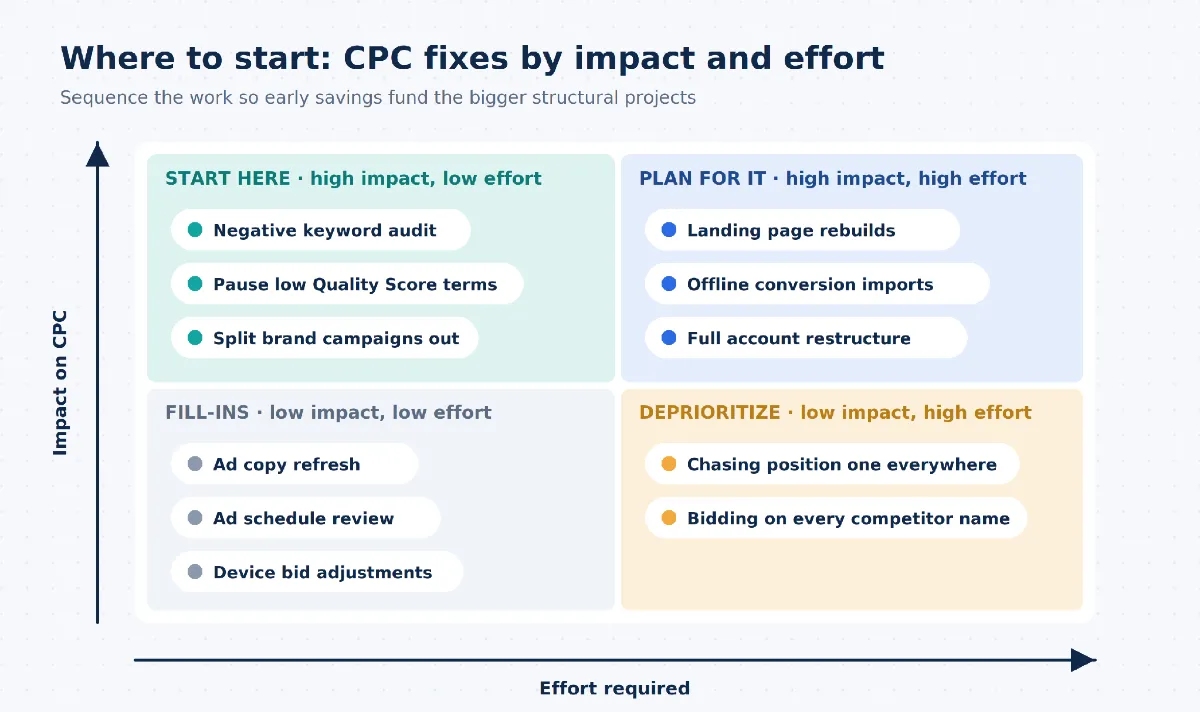
Run the quick wins first: a negative keyword audit, pausing chronically low-Quality-Score terms, and splitting brand campaigns can usually be completed within a week and often recover 10 to 20 percent of wasted spend, based on what typical account audits surface. Reinvest those savings into the structural projects: landing page rebuilds, offline conversion imports, and, where the account has grown organically messy, a full restructure. Teams without the bandwidth to run this sequence internally typically get there faster with a professionally managed PPC program that treats the audit, rebuild, and ongoing containment work as a single, continuous system rather than a one-off cleanup.
Frequently Asked Questions #
What is a good Google Ads CPC in 2026?
The cross-industry average is $5.42 per click, per LocaliQ's 2026 benchmarks. A good CPC is one below your industry average that still supports a profitable cost per acquisition.
Why is my Google Ads CPC so high?
The usual causes are low Quality Score, loose match types, competitive keywords, and automated expansion buying low-intent queries. Audit your search terms report and ad relevance first.
How much has Google Ads CPC increased?
Average search CPC has more than doubled in a decade, rising from $2.32 in 2016 to $5.42 in 2026, according to LocaliQ benchmark data.
Did Google deliberately raise ad prices?
Federal court records describe internal pricing knobs that raised ad prices 5 to 15 percent at a time. A September 2025 ruling now requires Google to disclose material changes to its auctions monthly.
Do AI Overviews make Google Ads more expensive?
Indirectly, yes. Pew Research found result clicks nearly halve when an AI summary appears, which pushes displaced brands into the paid auction and adds bidding pressure.
Does a better Quality Score lower CPC?
Yes. Quality Score discounts your cost relative to competitors in the same auction, so improving expected CTR, ad relevance, and landing page experience directly reduces your CPC.
Should I still bid on my own brand name?
Usually yes, but in a separate campaign with its own budget and bids. If no competitor is bidding on your name, test reduced spend and measure what organic search recaptures.
Does Performance Max reduce CPC?
Often on paper, because it blends cheaper display and video inventory with search. Judge it on conversion value rather than click price, since blended CPC can fall while search CPC rises.
What is the fastest way to lower CPC?
A negative keyword audit. Cutting irrelevant and low-intent queries removes the most expensive waste within days and requires no structural changes.
Is a higher CPC ever worth paying?
Yes. A $10 click converting at 10 percent beats a $2 click converting at 1 percent. Judge clicks by cost per acquisition and margin, never by price alone.