Generic Content Is Dying: Why Brand POV Wins in the AI Era

Tuba
September 18, 2026
Table of Contents
- Key takeaways
- The Death of Generic Content: Why AI Is Making an Original Brand POV More Valuable
- What Generic Content Actually Means
- The Supply Shock: Half of New Articles are Machine-Written
- Published is not the Same as seen
- Why AI Output Converges on the Average
- Google Wrote the Standard Down
- Readers Penalize What Feels Machine-Made
- Buyers Reward a Point of View
- What an Original Brand POV is Made of
- Where AI Belongs in a POV-led Workflow
- How to Tell Whether It Is Working
- Start With Ten Pages
- Frequently Asked Questions
Key takeaways #
Generic content is losing its value because AI has made it free to produce. About half of all newly published web articles are now primarily AI-generated, yet 86% of the articles ranking in Google and 82% of those cited by ChatGPT and Perplexity are human-written. Readers rate content 48% less trustworthy when they merely suspect AI wrote it, and 86% of hidden B2B buyers say they want ideas that challenge their assumptions. The brands that stay visible will be the ones publishing what a model cannot supply on its own: evidence they own, experience they have lived, and a clear stance. AI still has a place in the workflow, handling research, outlines, and drafts, while people own the perspective and the final edit.
The Death of Generic Content: Why AI Is Making an Original Brand POV More Valuable #
Two years ago, a competent 1,500-word explainer took a writer most of a day. Today it takes a prompt and about a minute. That collapse in production cost is the biggest change content marketing has seen this decade, and many brands have read it backward. They see cheap articles and conclude they should publish more. The market is drawing the opposite conclusion: when anyone can produce a passable article on any topic, the passable article stops being worth much.
That is what the death of generic content means. Nothing was banned. The price changed, and the evidence is arriving from four directions at once: what gets published, what gets ranked and cited, what readers trust, and what buyers act on. This piece walks through each, then shows what replaces the generic page: an original brand point of view, built from material a language model cannot supply on its own.
What Generic Content Actually Means #
Generic content is any page that could carry a competitor's logo without changing a single sentence. It answers the question correctly, covers the expected subtopics, and says nothing the reader could not get from the other nine results.
Two clarifications matter. First, generic does not mean AI-written. Agencies and in-house teams produced generic content by hand for a decade: read the top five results, merge them, make the result slightly longer. AI did not invent that workflow. It automated it and cut its cost to almost nothing. Second, generic does not mean wrong. Most of it is accurate, and that is exactly why it is replaceable. Correct information that exists in fifty places has no scarcity value.
The swap test. Remove the brand name from a page and ask whether a rival could publish it tomorrow with no edits. If the answer is yes, the page is generic, whoever or whatever typed it.
The Supply Shock: Half of New Articles are Machine-Written #
The scale of the shift is measurable. A May 2026 analysis of 55,400 English-language articles sampled from Common Crawl ran every page through three separate AI detectors and averaged the results. Twelve months after ChatGPT launched in November 2022, 35.9% of newly published articles were primarily AI-generated. At the 24-month mark, the figure was 48%. It reached 49.6% in the first quarter of 2025, edged past human output at 50.9% in the fourth quarter, and sat at 49.9% in the first quarter of 2026.
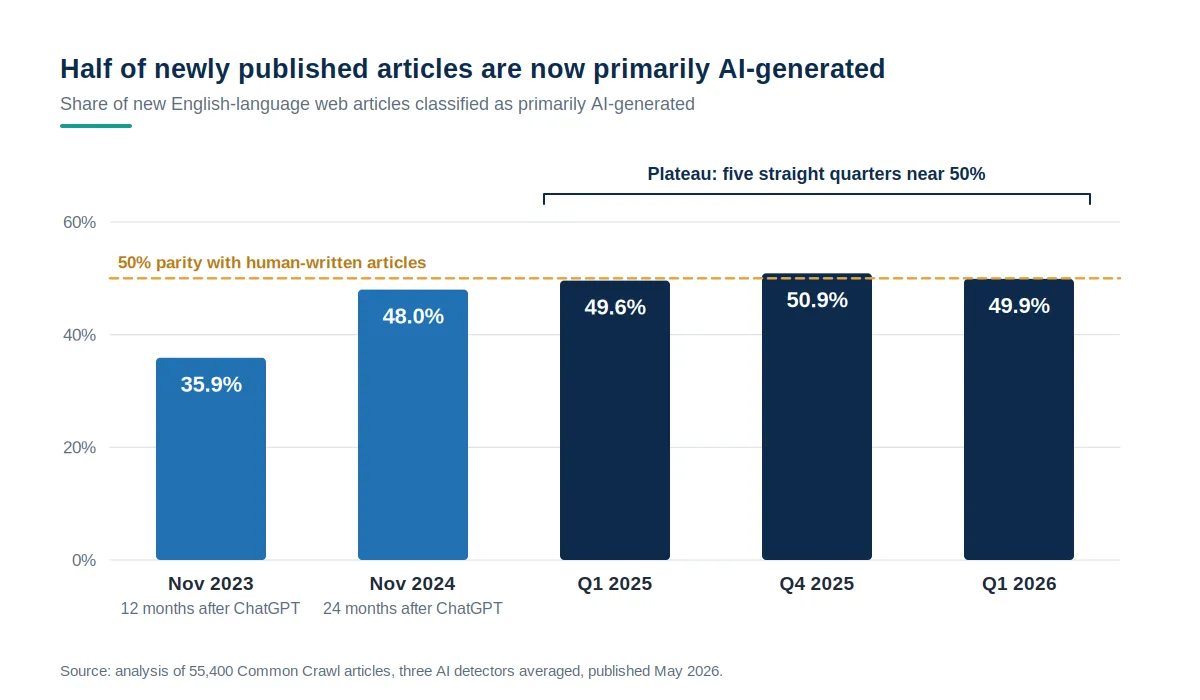
Two details deserve attention. The researchers tested their detectors against 15,700 articles published before ChatGPT existed and found false positive rates under 2%, so the headline number is not the product of jumpy software. And the curve has been flat for five straight quarters. The authors' own hypothesis for the plateau is telling: practitioners found that primarily AI-generated articles do not perform well in search, and stopped scaling them.
For marketers, the practical takeaway is simple. On any topic you plan to cover, assume the basic explainer already exists in dozens of near-identical versions, and that half of them cost their publishers nothing to make.
Published is not the Same as seen #
Volume is one measure. Visibility is another, and here the picture flips. The same research group's companion study of search and answer engines examined 31,493 keywords across ten categories, collecting the first two pages of Google results in June 2025. Of the articles that ranked, 86% were human-written, and 14% were AI-generated. The team then asked sampled questions of ChatGPT and Perplexity and classified the articles each cited: 82% human-written and 18% AI-generated on both platforms.
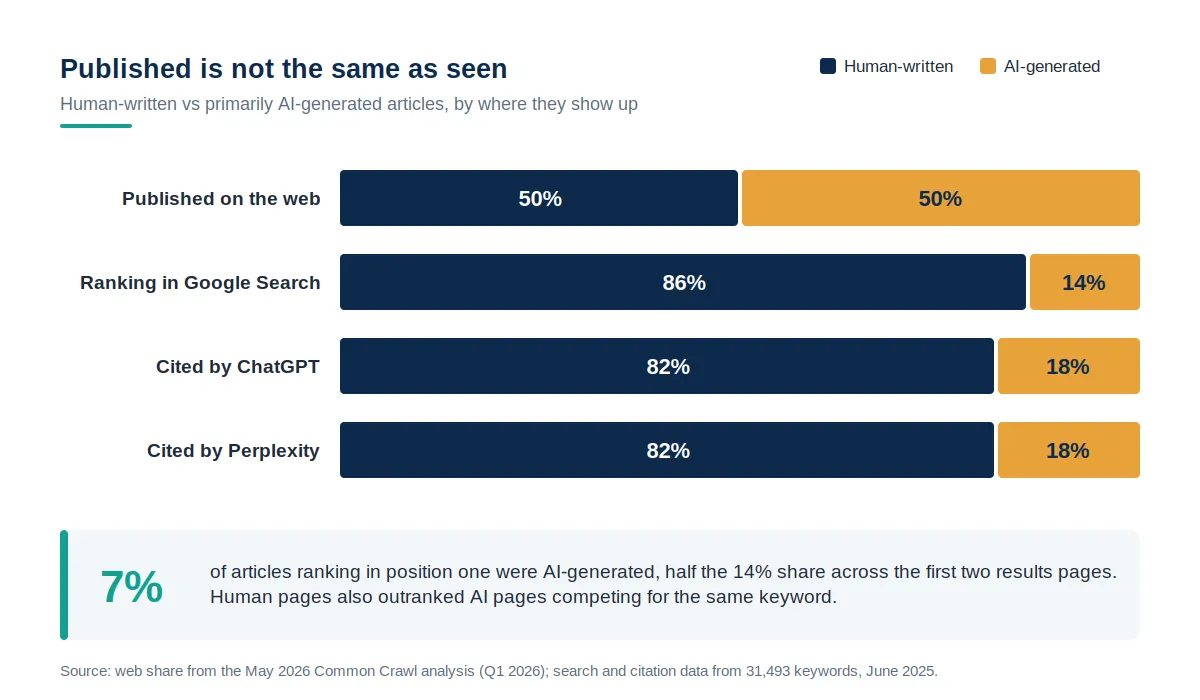
The gap widens at the top of the page. Only 7% of articles ranking in position one were AI-generated, half the rate across the results overall. When the team compared AI and human pages competing for the same keyword, the human pages ranked higher by a statistically significant margin.
One caveat keeps this honest. The study did not evaluate AI-assisted content with heavy human editing, and its authors suspect that approach can work. So the finding is narrower than "AI involvement sinks a page." Primarily machine-written pages make up half of what is published and a small fraction of what is found. Any serious search engine optimization program in 2026 has to start from that asymmetry.
Why AI Output Converges on the Average #
A better model release will not fix this, because it follows from how the tools work. A language model produces the most probable continuation of a prompt, given everything it has absorbed. Ask ten tools for an article on email segmentation, and you get ten versions of the consensus view, because the consensus view is by construction the most probable one. What a model cannot produce unprompted is whatever sits outside its training data: your client results, your failed experiments, your unpopular opinion about what the industry gets wrong.
Experimental evidence supports the convergence. A 2024 study published in Science Advances gave some writers access to AI-generated story ideas and left others to work alone. The AI-assisted stories were rated as better written and more enjoyable, especially those from less creative writers. They were also more similar to each other than the stories written without help. Each writer improved while the collective output narrowed. The authors call it a social dilemma, and content marketing is living through its commercial version.
Marketers' own numbers show the same split. In the Content Marketing Institute and MarketingProfs survey of 1,015 B2B marketers, fielded from June to August 2025, 95% said their organization uses AI tools, and 89% of those use them to write or optimize copy. Among teams using AI for content creation, 87% reported better productivity and 80% better operational efficiency. Only 58% said content quality improved, only 39% said content performance improved, and 12% said quality got worse.
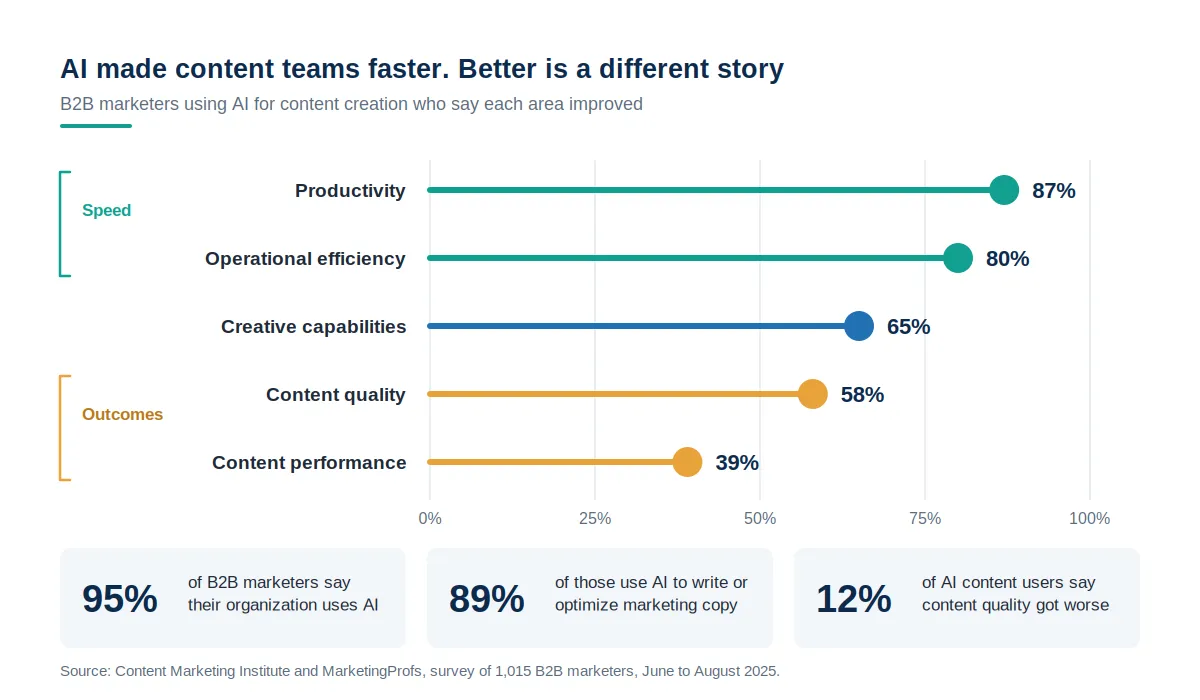
Producing the same article as everyone else, faster, is not an advantage. It is the cost of standing still.
Google Wrote the Standard Down #
Search policy has pointed the same way since March 2024, when Google added scaled content abuse to its spam policies. The policy targets pages generated in volume mainly to manipulate rankings, and it applies regardless of how those pages were produced. Google's guidance on generative AI content calls the tools useful for research and for adding structure to original content, then warns that generating many pages without adding value may violate that policy.
More useful than the prohibition is the self-assessment list in Google's helpful content documentation. It asks whether a page provides original information, reporting, research, or analysis, whether it offers insight beyond the obvious, and whether content that draws on other sources avoids simply rewriting them. Read that list with the swap test in mind. It describes non-generic content, and the company that decides what ranks wrote it.
AI summaries raise the stakes. Pew Research Center tracked the browsing of 900 US adults in March 2025 and found that people clicked a traditional result on 8% of Google visits that showed an AI summary, against 15% of visits without one. Links inside the summary itself were clicked on 1% of visits. The commodity answer now gets delivered on the results page, and a page whose entire value fits in three sentences will be reduced to three sentences. What survives is what a summary cannot fully carry: proprietary numbers, worked examples, a position worth arguing with. That is also the raw material of generative engine optimization, because an answer engine needs a reason to cite you in particular.
Readers Penalize What Feels Machine-Made #
Audiences are running their own filter. Raptive commissioned a study of 3,000 nationally representative US adults in which participants reviewed similar articles, some written by people and some generated by AI, each shown beside a brand ad. When participants believed an article was AI-generated, they rated it 48% less trustworthy and 57% less authentic, and reported 60% less emotional connection to it. The ad next to it suffered as well: purchase consideration and willingness to pay a premium each fell 14%.
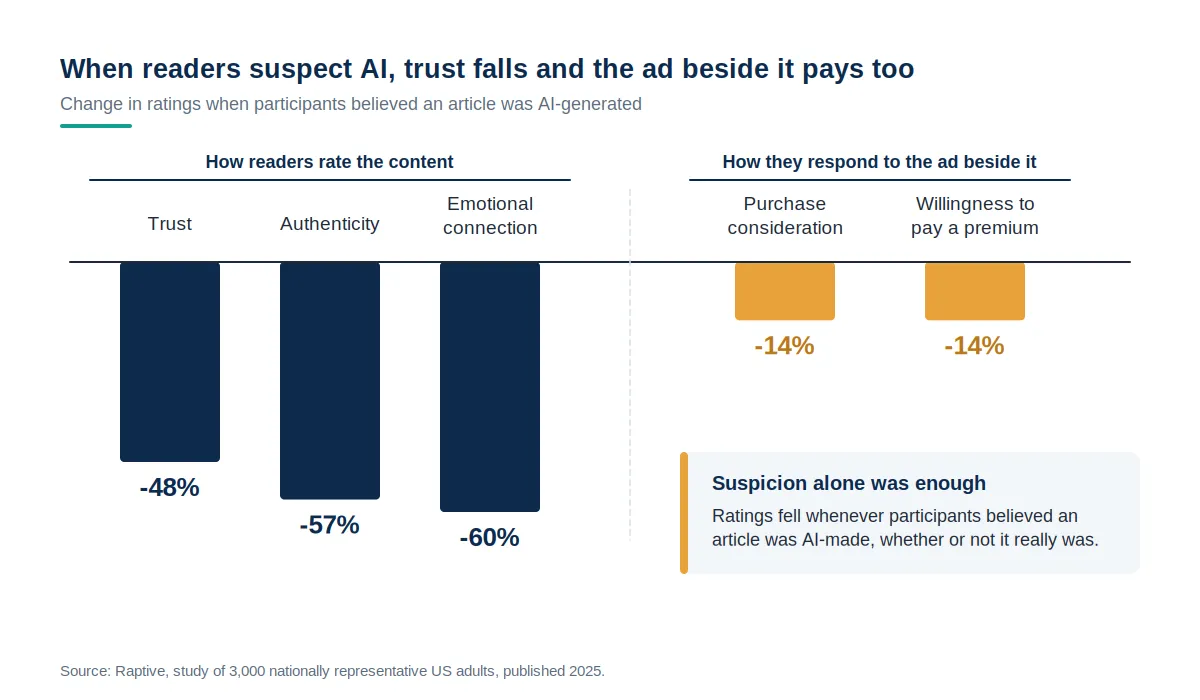
The key takeaway is that the penalty applied whether or not the article was really machine-made. Suspicion alone triggered it. Our reading of that result: generic content is exposed to the same penalty even when a person wrote it, because its defining feature, the absence of anything specific, is what readers have learned to associate with AI. Flat, evenly hedged prose with no examples now carries a trust cost regardless of where it came from.
Buyers Reward a Point of View #
The demand side completes the picture. LinkedIn's 2025 B2B Thought Leadership Impact Report, a survey of 1,934 business executives fielded in March and April 2025, focused on hidden buyers: the finance, legal, procurement, and operations stakeholders who shape a deal without ever meeting sales. Among these hidden decision-makers:
86% prefer ideas that challenge their assumptions over ideas that confirm what they already think.
91% say a hallmark of quality is that it helps them uncover a need or challenge they had not recognized.
79% are more likely to champion a vendor in the RFP process if that vendor consistently publishes high-quality thought leadership.
65% prefer a human, less formal tone over an even, intellectual one.
53% of both hidden and target buyers agree that when thought leadership is strong, how well-known the brand is matters much less.
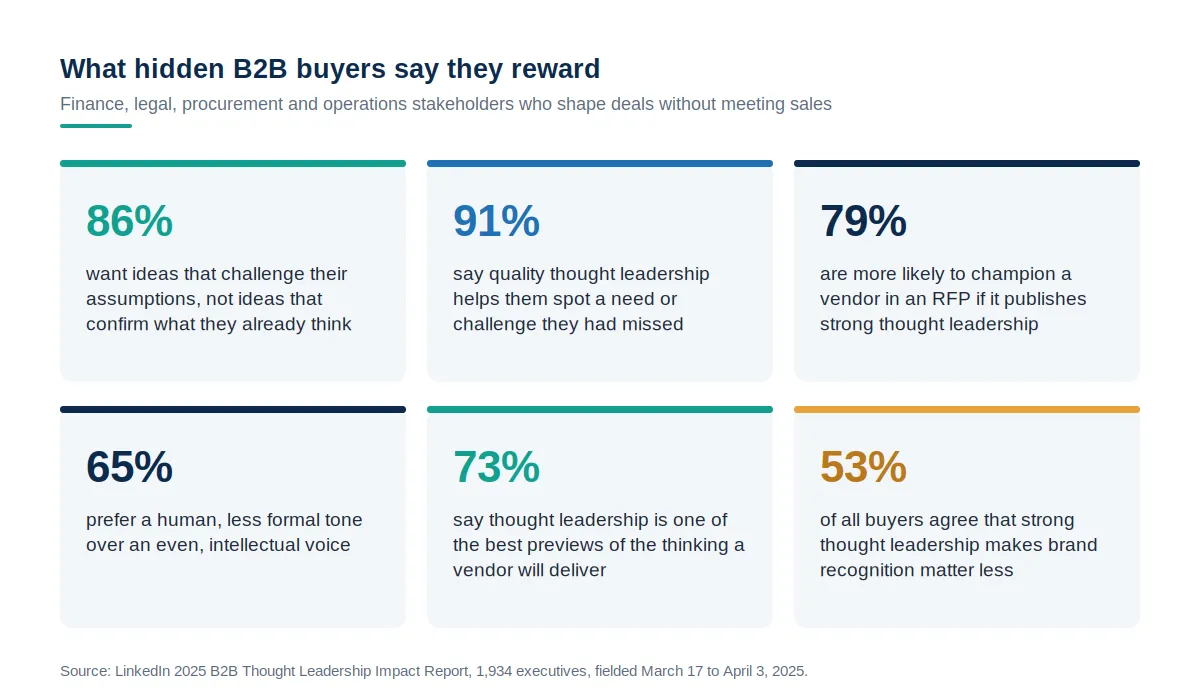
That last figure is the opening for smaller brands. A challenger cannot outspend a category leader on volume, and the data says it does not need to. Meanwhile, the supply of real perspective is thin. In the CMI survey, 96% of B2B marketers said their organization creates thought leadership, yet 37% said fewer than 5% of their in-house experts contribute. Much of what is labeled thought leadership is a content team summarizing the consensus, which is generic content with a better title.
What an Original Brand POV is Made of #
A point of view is not a tone of voice, and it is not an opinion held for its own sake. It is a repeatable way of seeing your market that shows up in everything you publish. In practice, it is built from four materials.
Evidence you own. Campaign results, customer data, survey responses, support tickets, pricing experiments. A dental group that publishes its own no-show rates by reminder type has something no model can generate.
Experience you have lived. What went wrong, what you stopped doing, what surprised you. First-hand detail is the hardest thing to fake and the first thing an expert reader looks for.
A stance with a trade-off. A real position rules something out. "Content quality matters" is not a stance, because nobody argues the opposite. "We would rather publish four researched pieces a month than twenty summaries, and we accept slower keyword coverage as the price" is one.
A consistent lens. A named framework or a recurring test, applied across topics, so a reader can recognize your thinking before they see your logo.
A hypothetical ecommerce brand selling running shoes shows the difference. The generic article is "How to choose running shoes," identical in substance to several hundred others. The POV version is "We analyzed 4,000 of our own returns: the three fit mistakes that send shoes back." It carries owned evidence, lived experience, and an implied stance about what buyers get wrong. Only one of those two articles can be replaced by a summary, and that distinction is the brief any serious content writing effort should begin with.
Where AI Belongs in a POV-led Workflow #
None of this argues against using AI. The ranking research above left room for AI-assisted work with heavy human editing, and the productivity gains in the CMI data are real. The useful question is which steps the model owns.
POV brief (human). Before any drafting: the stance, the evidence, the trade-off, the reader. One short paragraph each.
Expert interview (human). Twenty minutes with the person who does the work. This fixes the participation problem above. Experts rarely write, but they will talk.
Research and outline (AI). Summarize sources, map subtopics, and structure questions the way AI search surfaces them.
Draft expansion (AI). Turning the brief and the transcript into full prose.
Expert edit (human). Add the numbers, cut every paragraph that only restates consensus, restore the voice.
Swap test (human). If a competitor could publish it unchanged, it goes back to step five.
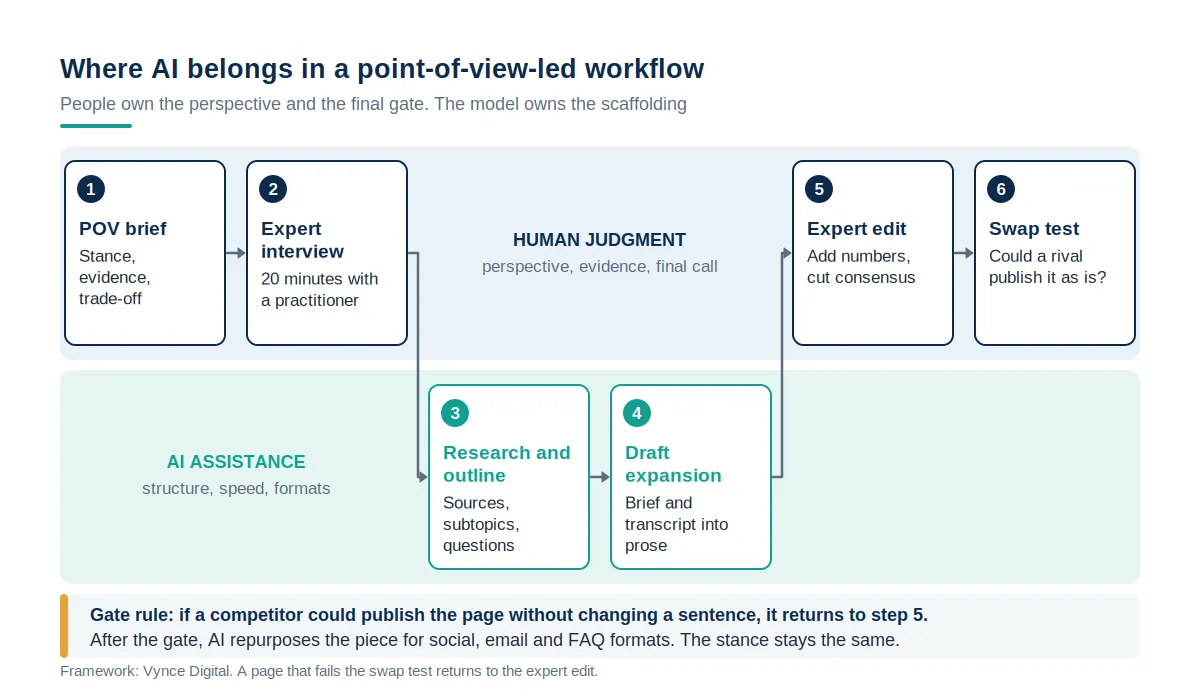
A six-step workflow that keeps perspective with people and scaffolding with AI.
After the gate, AI earns its place in repurposing again. The article becomes a LinkedIn and social media series and a segment of the email newsletter, each carrying the same stance. The model handles the format while the perspective stays constant across channels.
How to Tell Whether It Is Working #
We measured generic content by volume and rankings. POV content shows up in different places first.
Branded search and direct traffic, because people remember who said the memorable thing.
Mentions and citations inside AI answers for your core topics, checked monthly by hand or with a tracking tool.
Replies, forwards, and sales conversations that reference a specific piece.
Conversion rate on POV pages compared with standard explainers, which is where conversion rate optimization and editorial finally share a scoreboard.
Expect fewer published pages and a slower first quarter. In the CMI data, among teams whose content strategy improved, 74% credited refining the strategy itself and 16% credited budget changes. The gains came from choosing better, and volume had little to do with it.
Start With Ten Pages #
Pick the ten pages that matter most to revenue and run the swap test on each. For every page that fails, write down the one thing your company knows about that topic that a competitor does not: a number, a case, a position. If you cannot name one, that is the real finding, and the next step is an expert interview before any rewrite. If you can, rebuild the page around it and let AI handle the scaffolding. If that audit is more than your team can absorb this quarter, an outside content strategist can run it alongside you.
Generic content worked when information was scarce and production was expensive. Neither condition holds anymore. The brands that keep their audience will be the ones with something of their own to say.
Frequently Asked Questions #
What is generic content? #
Generic content is any page that could carry a competitor's logo without changing a single sentence. It is usually accurate and well organized, but it contains no evidence, experience, or position that belongs to the brand publishing it, so readers, search engines, and AI answer engines have no reason to prefer it over the dozens of similar pages.
Is AI-generated content the same as generic content? #
No. Generic content existed long before language models, produced by writers who merged the top search results into a slightly longer article. AI automated that workflow and cut its cost to almost nothing. A page drafted with AI can be original if a person supplies the evidence, the stance, and the final edit, and a page typed entirely by hand can still be generic.
Does Google penalize AI content? #
Google does not penalize content for being made with AI. Its spam policy on scaled content abuse targets pages generated in volume mainly to manipulate rankings, regardless of how they were produced, and its generative AI guidance warns that publishing many pages without adding value may violate that policy. Google tests whether a page adds original information and value for users.
How much of the web is AI-generated in 2026? #
A May 2026 analysis of 55,400 English-language articles from Common Crawl, averaged across three AI detectors, found that 49.9% of articles published in the first quarter of 2026 were primarily AI-generated. The share rose to 35.9% within twelve months of ChatGPT's launch and has held near 50% for five straight quarters.
Does AI-generated content rank in Google or get cited by ChatGPT? #
Far less than its volume suggests. A study of 31,493 keywords using June 2025 search results found that 86% of ranking articles were human-written and 14% AI-generated, and only 7% of articles in position one were AI-generated. Among articles cited by ChatGPT and Perplexity, 82% were human-written. The study did not evaluate AI-assisted content with heavy human editing.
What is a brand POV in content marketing? #
A brand point of view is a repeatable way of seeing your market that shows up in everything you publish. It is built from four materials: evidence you own, experience you have lived, a stance that accepts a trade-off, and a consistent lens such as a named framework or test. It is different from tone of voice, which governs how you sound and says nothing about what you believe.
How can a small brand develop an original point of view? #
Start with what only you can see: your own customer data, the questions your sales and support teams hear every week, and the projects that went wrong. Interview the person who does the work for twenty minutes, and look for advice that contradicts the standard advice in your industry. LinkedIn's 2025 research found 53% of B2B buyers say strong thought leadership makes brand recognition matter less, which favors smaller brands.
Can I still use AI to write content? #
Yes. In the Content Marketing Institute and MarketingProfs survey of 1,015 B2B marketers, 87% of teams using AI for content reported better productivity. The same survey found only 39% saw better content performance, so the gains depend on where the model is used. Let AI handle research synthesis, outlines, draft expansion, and repurposing, and keep the brief, the expert input, the final edit, and the swap test with people.
How do readers react to content they think is AI-written? #
Poorly, and the reaction does not depend on whether they are right. In a Raptive study of 3,000 US adults, participants who believed an article was AI-generated rated it 48% less trustworthy and 57% less authentic, and reported 60% less emotional connection. Purchase consideration for the brand advertised beside that article fell 14%.
How do I measure whether POV-led content is working? #
Look past page counts and rankings. Track branded search and direct traffic; mentions and citations of your brand inside AI answers for your core topics; replies and sales conversations that reference a specific piece; and conversion rate on POV pages compared with standard explainers. Expect fewer published pages and a slower first quarter, followed by stronger per-page results.