Google Ranking Factors vs Real SEO Success: 2026 Guide
SEO Specialist · October 22, 2026
Table of Contents
- Key Takeaways
- Rankings Are Not Everything in SEO: What Really Drives Organic Growth
- What Google Ranking Factors Actually Decide
- Why Rankings Don't Tell the Whole Story
- Semantic SEO: Rank for Meaning, Not Matching Words
- Can Frequent Website Changes Affect SEO?
- The Technical and Authority Foundation
- How to Measure SEO Beyond Rankings
- Quick Action Checklist
- Watch the Whole Scoreboard, Not One Number
- Frequently Asked Questions
Key Takeaways #
A ranking measures visibility, not SEO success. Impressions, qualified clicks, and conversions each tell a different part of the story.
Google's own documentation groups its signals into five areas: meaning, relevance, quality, usability, and context. None of them promises traffic.
Zero-click results and AI Overviews mean the same position delivers far fewer visits than it did two years ago.
Search intent decides whether a ranking produces revenue. The wrong intent brings the wrong audience at any position.
Measure three layers: visibility in Search Console, engagement in GA4, and business outcomes such as leads and sales.
Rankings Are Not Everything in SEO: What Really Drives Organic Growth #
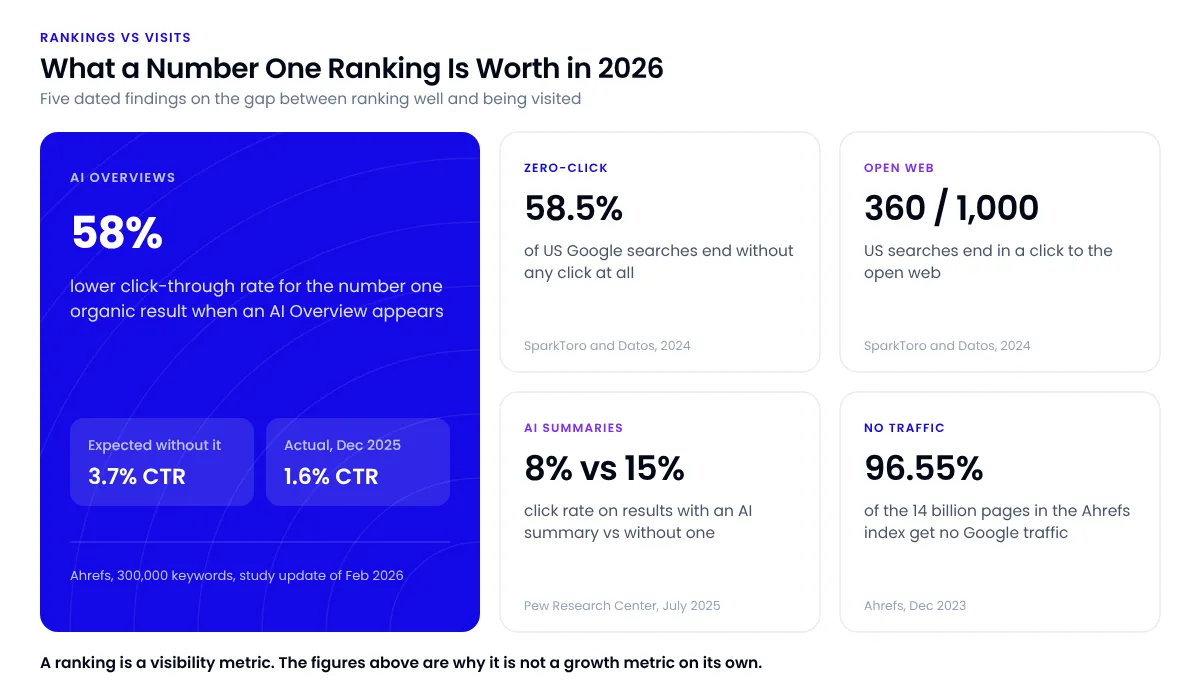
On searches that show an AI Overview, the number one spot on Google now earns well under half the clicks it otherwise would. Ahrefs re-ran its study in February 2026: across 300,000 keywords, an AI Overview correlated with a 58% lower click-through rate for the top organic result, 1.6% in December 2025 against about 3.7% expected without one. And most searches now end before any result is clicked. SparkToro's 2024 clickstream study put zero-click searches at 58.5% in the US, with only 360 of every 1,000 searches sending a visit to the open web.
None of this means rankings stopped mattering. It means a ranking is what it always quietly was: a visibility metric. It confirms that Google considers your page eligible for a query, not whether the right people clicked or whether anything converted. Those outcomes are decided by the factors this guide covers.
What Google Ranking Factors Actually Decide #
Google's own description of how results are generated names five groups of signals: the meaning of your query, the relevance of content, the quality of content, the usability of pages, and your context and settings. Nothing in that list promises visits. These factors describe how Google ranks a given search, and that order is a moving target. Google reports that in 2023 it ran 719,326 search quality tests and shipped 4,781 improvements to Search.
So a position comes from a system that changes thousands of times a year, and it only makes your page eligible. Whether that turns into growth depends on what the searcher wanted and what happens after the click.
Why Rankings Don't Tell the Whole Story #
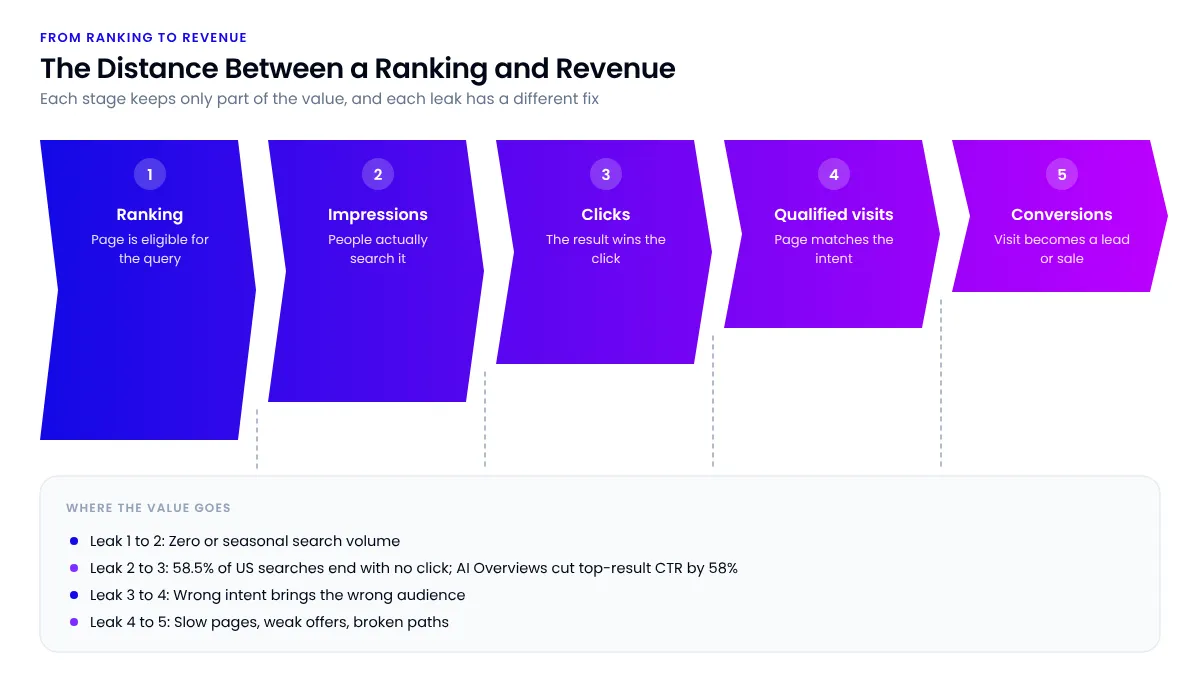
Between a ranking and revenue sit four filters, and each one leaks. A position only produces impressions if people actually search the query. Impressions only produce clicks if the result wins attention against ads, map packs, and AI answers: Pew Research Center's July 2025 analysis of 68,879 real searches found users who saw an AI summary clicked a standard result in 8% of visits, against 15% of visits without one. Clicks only produce qualified visits if the page matches what the visitor expected. And visits only produce revenue if the page can convert.
The base rate is humbling: Ahrefs' December 2023 study of 14 billion pages found 96.55% get no Google traffic at all. Ranking is an achievement, but only the first filter, which is why visibility inside AI answers now needs its own generative engine optimization program alongside the classic results page.
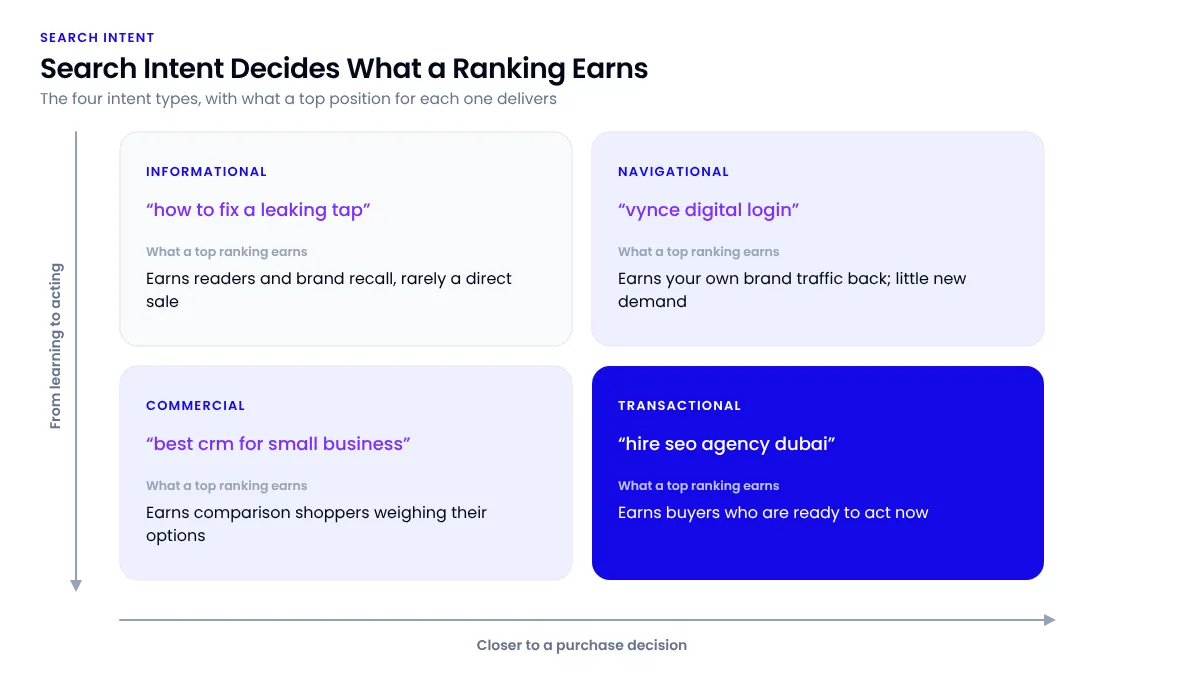
Google's first ranking factor is the meaning of the query, which is another way of saying intent. Rank number one for a query whose intent you cannot satisfy, and the position is worth little: a plumber ranking for "how to fix a leaking tap" has won readers who intend to do the job themselves.
Intent falls into four broad types. Informational searches want to learn, navigational searches want a specific site, commercial searches compare options, and transactional searches are ready to act. A page built for one intent rarely converts another, so the question to ask of every target keyword is not "can we rank" but "what does the searcher plan to do next?" When traffic arrives and stalls, the gap usually sits in the page itself, which is the territory of conversion rate optimization rather than more rankings.
Semantic SEO: Rank for Meaning, Not Matching Words #
Around 15% of the searches Google sees each day are brand new, a figure Google restated as recently as March 2025. Nobody can target queries that have never been typed, so Google ranks pages by meaning: the entities a page covers, the related concepts around them, and how completely it answers the questions behind a topic.
That is semantic SEO, and Google's guidance on helpful, reliable, people-first content describes the standard in plain self-assessment questions: does the content provide a substantial, complete description of the topic, and does it leave readers feeling they need to search again? In practice, that means one clear topic per page, clusters of supporting pages around it, and consistent facts about your brand everywhere they appear- the everyday discipline of a strong content writing team.
Can Frequent Website Changes Affect SEO? #
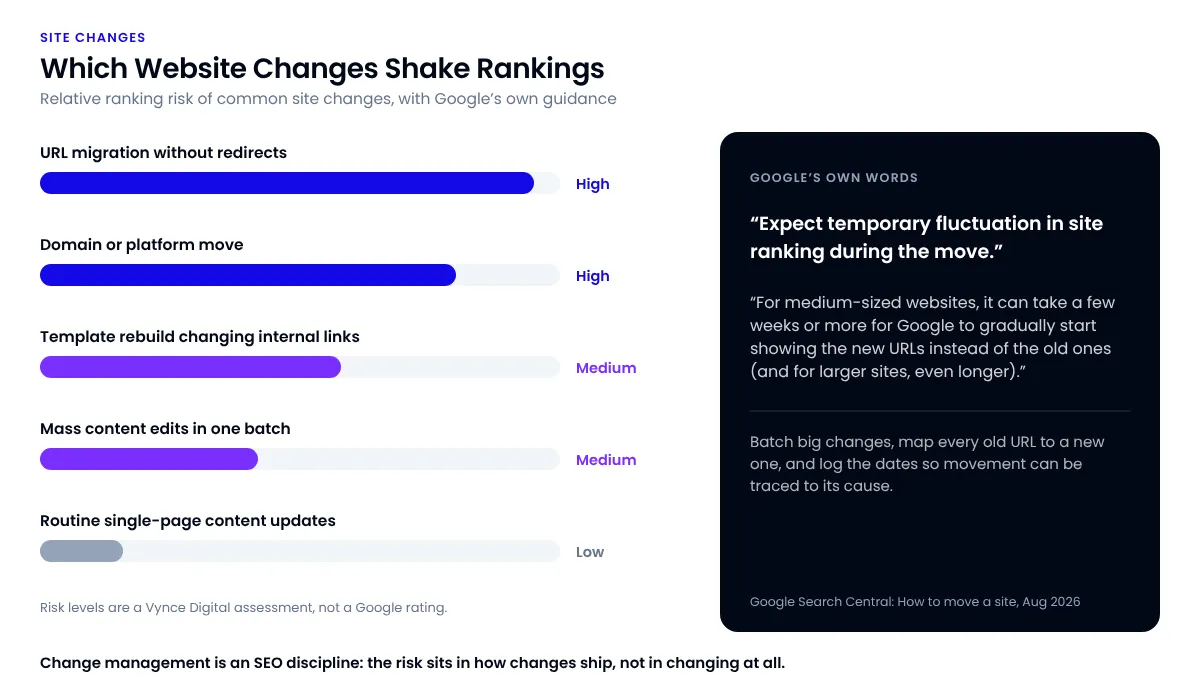
Yes, and Google says so directly. Its site move documentation tells owners to expect temporary ranking fluctuations while pages are recrawled, and that for medium-sized sites it can take a few weeks or more before Google shows the new URLs instead of the old ones, longer for large sites.
URL changes without clean redirects are the highest-risk edit, followed by template rebuilds that alter internal links and page structure. Mass content edits sit in the middle. Routine updates to individual pages carry little risk and usually help. The answer isn't to freeze the site; it's to batch significant changes, map every old URL to a new one, and record dates so you can trace movement, planning that belongs in the site build itself.
The Technical and Authority Foundation #
Two quieter factor groups decide whether everything above gets a chance. The first is technical: a page Google cannot crawl, render, or index cannot compete at all, and Google's page experience documentation says its core ranking systems look to reward content that provides a good page experience, with Core Web Vitals the measurable piece. The same page cautions that good scores alone do not guarantee top rankings. Clean crawling, canonical tags, and fast pages are technical SEO groundwork, not a growth strategy on their own.
The second is authority. Google's quality factor includes whether other prominent sites link to or reference your content, which makes reviews, citations, and press part of the ranking conversation- the slow compounding work of reputation management.
How to Measure SEO Beyond Rankings #
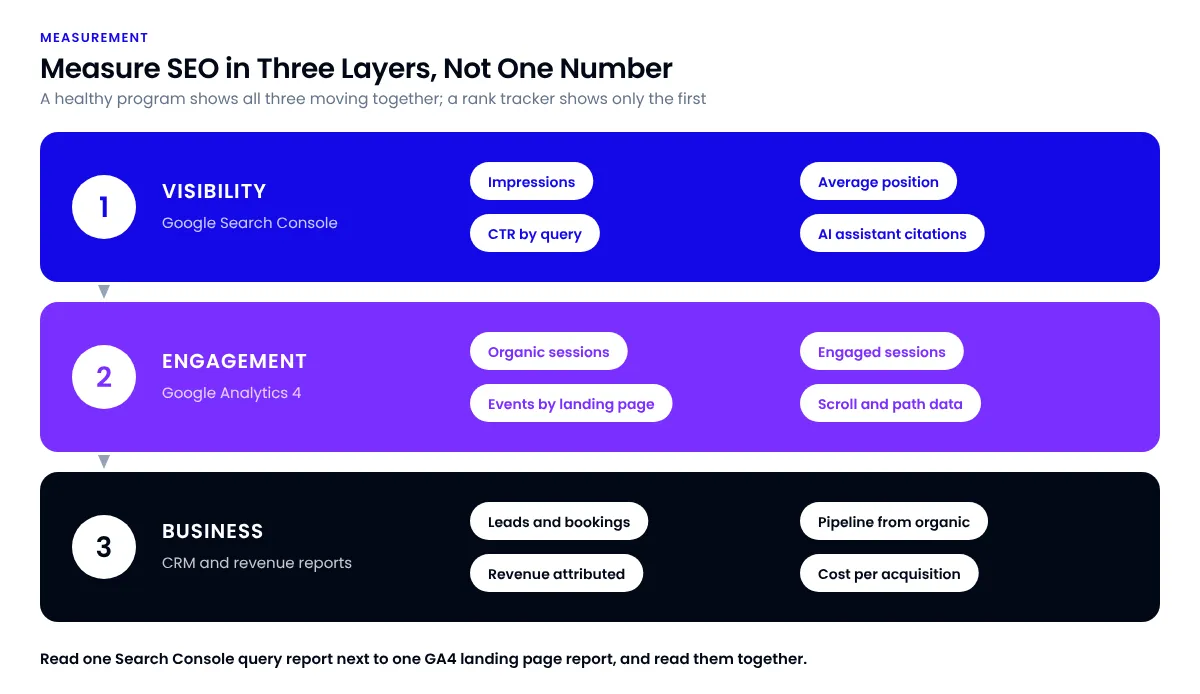
Replace the rank tracker as your headline report with three layers. Visibility: impressions, average position, and query coverage in Search Console, plus whether AI assistants cite you, the new surface that AI search visibility work tracks. Engagement: sessions, engaged sessions and conversion events by landing page in GA4. Business: leads, bookings and revenue attributed to organic. A healthy program shows all three moving together; a rankings-only program can look healthy while leads stand still.
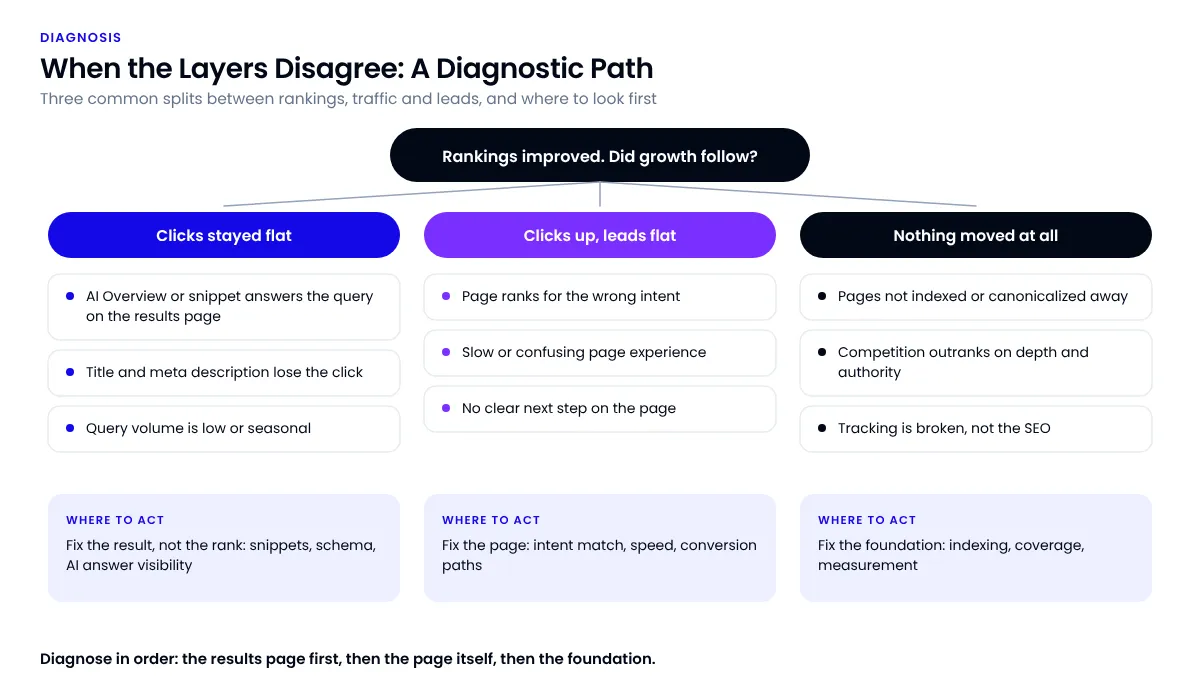
When the layers disagree, diagnose in order. Rankings up but clicks flat points to the results page: an AI Overview, a weak title and snippet, or a query that never converts to visits. Clicks up but leads flat points to intent mismatch or page experience. Nothing moving at all points to indexing and competition, the territory covered in our guide to businesses that don't show on Google.
Quick Action Checklist #
What to track | Where | Why it matters |
|---|---|---|
Impressions and average position | Search Console | Visibility, the job rankings actually do |
Click-through rate by query | Search Console | Shows AI Overview and snippet losses |
Engaged sessions by landing page | GA4 | Separates qualified visits from bounces |
Organic conversions and revenue | GA4 plus CRM | The outcome rankings are supposed to serve |
AI assistant citations | Monthly manual checks | Visibility where no ranking exists |
Change log of site edits | Internal record | Ties ranking movement to its cause |
Watch the Whole Scoreboard, Not One Number #
Rankings deserve a place on the dashboard, like a speedometer. Growth comes from the full chain: queries chosen for intent, pages that cover their topic completely, a site that is fast and crawlable, authority that compounds, and measurement that connects positions to revenue. If you would rather have the whole chain mapped in one pass, a structured SEO audit will show exactly where rankings, traffic, and revenue disagree.
Frequently Asked Questions #
Are Google rankings still important for SEO?
Yes, as a visibility signal. A ranking makes your page eligible for clicks and keeps you in the sources AI answers draw from. It's no longer a useful end goal because zero-click results and AI Overviews mean the same position now delivers fewer visits than before.
What are the main Google ranking factors?
Google's documentation groups them into five areas: query meaning, content relevance, content quality, page usability, and the searcher's context and settings. Quality includes whether prominent sites reference your content, and usability includes page experience signals such as Core Web Vitals.
Why is my site ranking but not getting traffic?
Usually one of three reasons: the query has low or seasonal search volume, an AI Overview or featured snippet answers the query without a click-through, or your title and snippet lose the click to competitors. Compare impressions against clicks in Search Console to see which applies.
Why is my organic traffic increasing but not conversions?
The traffic is probably arriving with the wrong intent. Informational visitors research rather than buy, so rising blog traffic can coexist with flat leads. Check conversions by landing page in GA4, then either target more commercial queries or improve the paths from informational pages to your service pages.
What is semantic SEO?
Semantic SEO is optimizing for the meaning behind searches rather than exact keyword matches: covering a topic completely, using related entities and concepts, and structuring pages so Google understands what they are about. It matters because about 15% of daily searches are brand new, so Google matches meaning, not strings.
How does search intent affect SEO?
Intent decides what kind of page can rank and whether the ranking pays. Informational, navigational, commercial, and transactional searches each expect a different page type, and Google ranks the type that matches. A page ranking against the wrong intent attracts visitors who were never going to become customers.
Can frequent website changes affect SEO?
Yes. Google's documentation says to expect temporary ranking fluctuations after significant changes while pages are recrawled, with medium-sized sites taking a few weeks or more before Google shows the new URLs. URL changes without redirects carry the highest risk, template rebuilds and mass edits follow, and routine content updates are low risk.
What SEO performance metrics should I track instead of rankings?
Track three layers together: impressions, average position, and click-through rate in Search Console; engaged sessions and conversion events by landing page in GA4; and leads or revenue attributed to organic in your CRM. Add a monthly check of whether AI assistants cite your brand for key questions.
How do AI Overviews affect click-through rates?
Sharply. Ahrefs' February 2026 update, covering 300,000 keywords, found an AI Overview correlates with a 58% lower click-through rate for the top result, and Pew Research found users clicked a standard result in only 8% of visits with an AI summary, against 15% without. Impressions can hold steady while clicks fall.
How do I measure SEO success in Search Console and GA4?
In Search Console, read the performance report for impressions, clicks, click-through rate, and average position by query and page. In GA4, read organic sessions, engaged sessions, and conversion events by landing page. Success is the two reports agreeing: visibility that turns into qualified visits that turn into recorded conversions.
Written by