How to Choose a Digital Marketing Agency: 10 Checks for 2026

SEO Specialist · October 30, 2026
Table of Contents
- Key Takeaways
- Start With Your Brief, Not a Shortlist
- What to Look for in a Digital Marketing Agency: The 10 Checks
- Fit: Can the Agency Solve Your Problem?
- Proof: Can You Verify What They Claim?
- Control: Will You Stay in Charge?
- Terms: Will the Relationship Hold Up as Search Changes?
- Digital Marketing Agency Pricing: What to Expect in 2026
- Questions to Ask a Digital Marketing Agency Before You Sign
- How to Compare Digital Marketing Agencies Side by Side
- Choose on Evidence, Not the Pitch
- Frequently Asked Questions
- How do I choose a digital marketing agency?
- What should I look for in a digital marketing agency?
- What factors should I consider when choosing a digital marketing agency?
- What questions should I ask a digital marketing agency?
- How do I evaluate a digital marketing agency?
- How much does a digital marketing agency cost?
- How do I compare digital marketing agencies?
- How do I choose a B2B digital marketing agency?
- Who should own the ad and analytics accounts when I hire an agency?
- Can a digital marketing agency guarantee results?
Key Takeaways #
Write the brief first: one business goal, one success metric, a monthly budget and what progress should look like after 90 days.
Judge proof you can check yourself: case studies with baselines and dates, references you call, and reviews on platforms the agency does not control.
Keep every account in your name, from Google Ads and GA4 to the domain, and give the agency user access rather than ownership.
Treat guaranteed rankings as a red flag. Google's own hiring guidance says nobody can promise the top spot.
Score every shortlisted agency on the same weighted criteria instead of comparing pitches from memory.
Most agency relationships that fail, fail fast. In vcita's April 2025 survey of 500 US small and medium-sized businesses, 40% of those that outsource marketing had discontinued or switched their agency. More than half of that churn came within six to twelve months of starting, and 60% of the businesses that left pointed to a lack of return on investment.
The relationships that work tend to last. The ANA and the 4As put the average client-agency tenure at about seven years in April 2025, more than double the 3.2 years reported in 2016. The decision you make before signing largely decides which of those two stories you end up in.
The trouble is that most agencies are chosen on the pitch: a confident strategist, a polished deck, and a slide of logos. You can check very little of that, and almost none of it predicts how your account will be run in month seven. This checklist turns choosing a digital marketing agency into things you can verify before you sign.
Start With Your Brief, Not a Shortlist #
Before you contact anyone, write one page that answers four questions: what business result you need, how you will measure it, what you can spend each month including ad budget, and what your own team will keep doing. Add what progress should look like after 90 days. Most channels cannot show their full effect that quickly, but they can show the right early signals.
The brief does two jobs. It stops agencies from selling you the service they are best at instead of the one you need, and it makes every proposal answer the same question, which is the only fair way to compare them. If you sell B2B, add your average deal size and sales cycle. A B2B agency that never asks how leads become pipeline is optimizing for form fills, not revenue.
What to Look for in a Digital Marketing Agency: The 10 Checks #
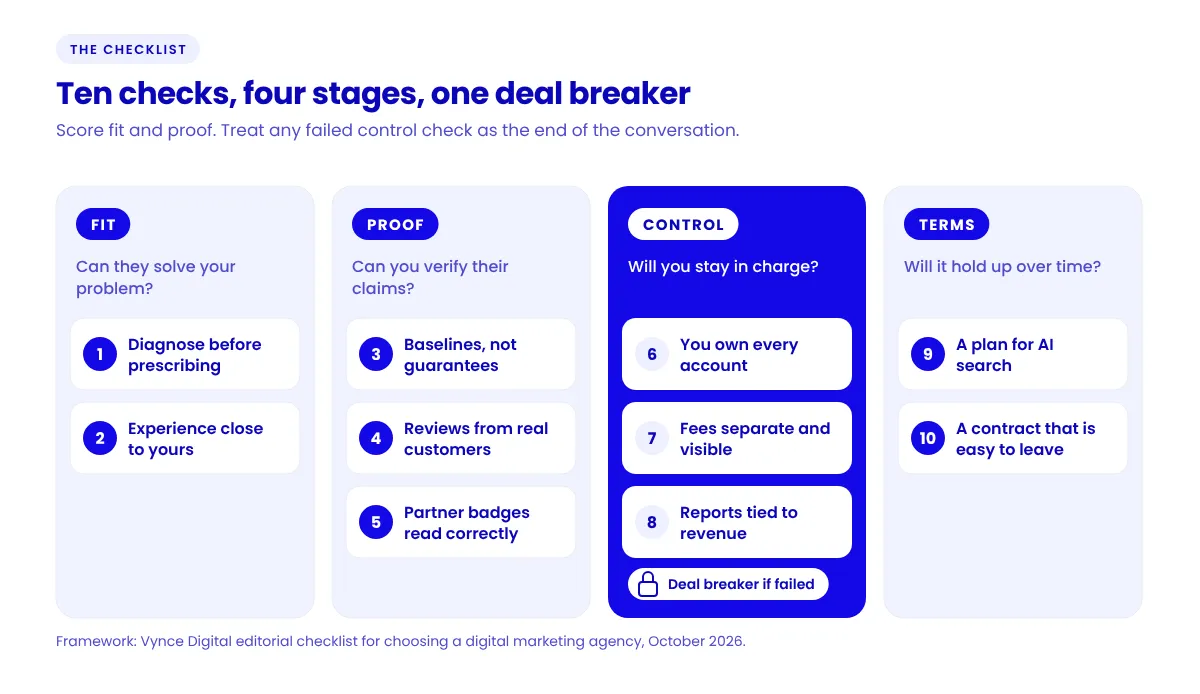
The ten checks fall into four stages: fit, proof, control, and terms. No agency needs a perfect score, but a fail on any control check is a deal breaker, because it decides whether you can ever leave.
Fit: Can the Agency Solve Your Problem? #
1. They diagnose before they prescribe. A good first call is mostly questions about your customers, margins, data, and past campaigns. If a fixed package arrives before anyone has looked at your analytics, the recommendation reflects their capacity, not your goal. The right mix might be SEO for compounding visibility, paid search campaigns for demand that already exists, or both.
2. They have experience close to yours. Google's own guide to hiring an SEO, last updated in June 2026, tells site owners to ask about experience in their industry, in their country or city, and with international sites. The same test works for every channel. Regulated categories such as healthcare and legal services, long B2B sales cycles and multi-country targeting all need experience you can see in past work.
Proof: Can You Verify What They Claim? #
3. Results come with baselines, not guarantees. "Traffic up 300%" means nothing without the starting number, the time frame and what the agency actually did. Ask for two case studies close to your situation, then call the clients behind them. Treat promises as a warning sign: Google's hiring guide states that "No one can guarantee a #1 ranking on Google," and it tells owners to be wary of firms that claim a special relationship with Google, send unsolicited pitches or will not explain their methods.
4. Reviews read as real customers wrote them. The FTC's rule on consumer reviews and testimonials bans fake and AI-generated reviews, undisclosed insider reviews, and fake followers or views bought to inflate influence, and it took effect on 21 October 2024 with civil penalties for knowing violations. That raises the cost of faking without ending it, so read for specifics: named services, time frames, and problems solved, on platforms the agency does not control. How an agency handles its own online reputation is a fair preview of how it will handle yours.
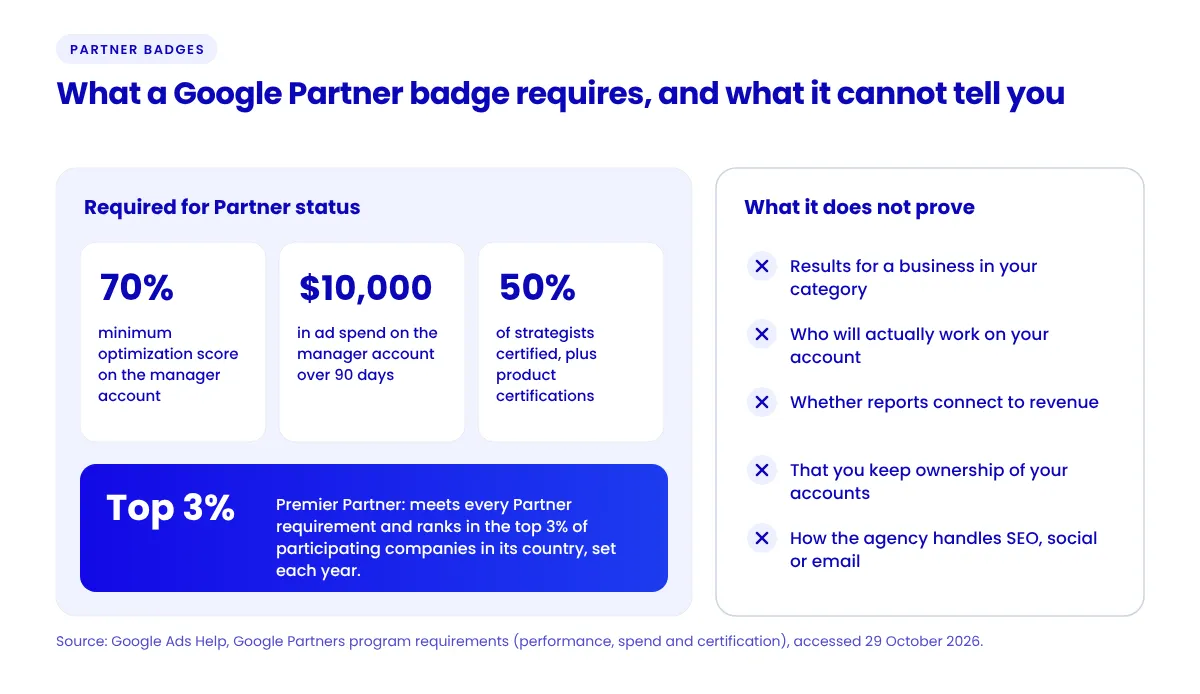
5. Partner badges mean what you think. A Google Partner badge means the agency's manager account holds a minimum 70% optimization score, $10,000 in ad spend over 90 days and certified staff. Premier Partners also rank in the top 3% of participating companies in their country each year. That proves activity and training. It does not prove results in your category, so treat a badge as an entry ticket rather than evidence.
Control: Will You Stay in Charge? #
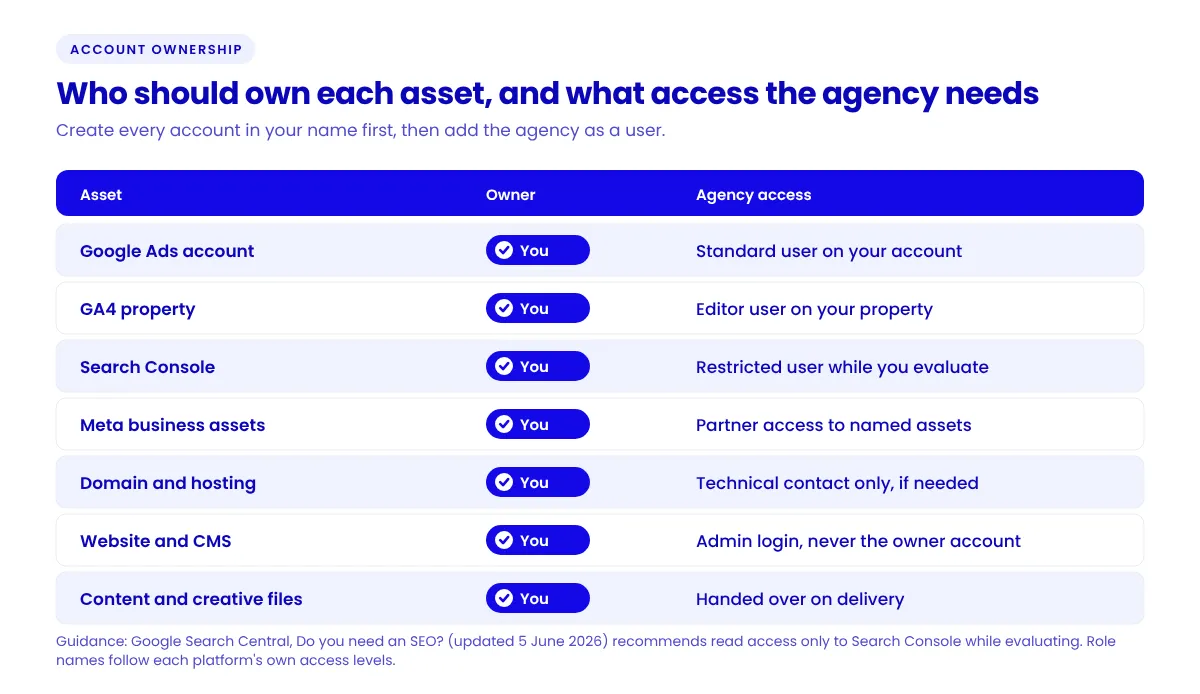
6. You own every account. Your Google Ads account, GA4 property, Search Console property, Meta business assets, domain, hosting and website logins should sit in your name, with the agency added as a user. Google's hiring guide goes further for SEO hires: while you are still evaluating, grant read access to Search Console only. An agency that insists on owning the ad account, or the website it builds for you, is building a lock-in, not a partnership.
The ownership test. Ask every shortlisted agency to list the logins you would lose if you parted ways tomorrow. The only good answer is none.
7. Fees are separate and visible. Google's transparency requirements for third parties say an agency charging a management fee on top of Google Ads costs must tell new customers in writing before the first purchase and show the fee on every invoice. Where an agency's terms promise monthly reports, those reports must include costs, clicks and impressions at the account level, with cost shown as the exact amount Google charged. Ask for the same clarity on every channel, not just Google.
8. Reports tie activity to revenue. Ask to see a real, anonymized monthly report. Impressions and rankings belong in it, but the headline should be leads, booked calls, sales, and cost per acquisition. Rankings measure visibility rather than success, a gap we unpack in our guide to Google ranking factors. If a report never mentions what happens after the click, the agency isn't watching your conversion rates either.
Terms: Will the Relationship Hold Up as Search Changes? #
9. They have a plan for AI search. Ahrefs' February 2026 study of 300,000 keywords found that an AI Overview correlated with a 58% lower click-through rate for the top-ranked page. An agency selling SEO in 2026 should explain how it tracks citations in AI answers and where generative engine optimization fits, not only how it chases positions. Budgets are moving the same way: Gartner's 2026 CMO Spend Survey of 401 marketing leaders found they put 15.3% of marketing budgets toward AI initiatives.
10. The contract is easy to leave. Look for a defined scope, a short notice period after any initial term, and a written handover clause that returns accounts, files and data when you go. The articles, ads and creative you pay for should belong to you. A long lock-in with no review point usually means the agency expects you to want out.
Digital Marketing Agency Pricing: What to Expect in 2026 #
Prices vary by channel, market, and scope, and recent independent data covering every service is thin. The most detailed public survey covers SEO. In Ahrefs' survey of 439 SEO providers, published in December 2023 and updated in August 2024, the most common monthly retainer was $501 to $1,000, charged by 20.4% of respondents. Agencies averaged about $3,209 a month against $1,349 for freelancers, based on the top of each price band, and the most common one-off project fee was $2,501 to $5,000. Geography moves the number too: 76% of India-based providers charged $1,000 or less a month.
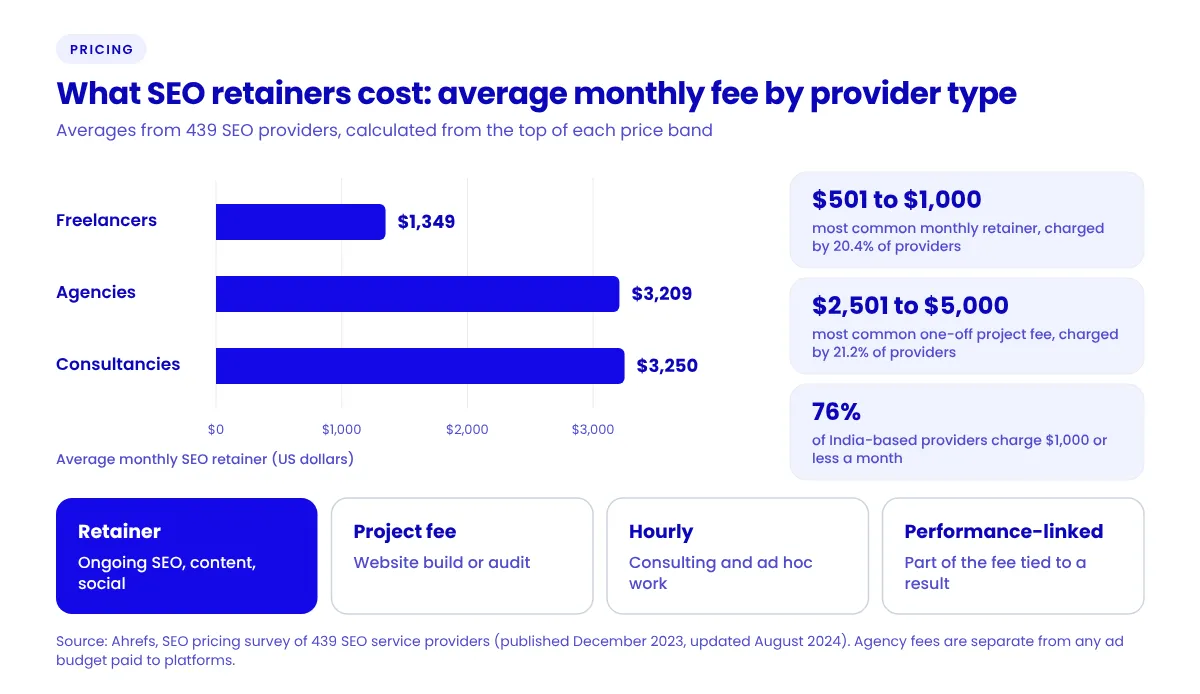
Four pricing models cover most proposals. A monthly retainer suits ongoing work such as SEO, content, and social. A project fee suits a defined deliverable such as a website build or an audit. Hourly billing suits consulting. A performance-linked fee ties part of the price to an agreed result and only works when both sides trust the tracking.
For paid media, keep the agency fee and the ad budget on separate lines. The budget goes to the platform and the fee pays for the work, and you should always be able to see both. Compare proposals on what each fee buys, including how much senior time is included, rather than on the headline monthly figure.
Questions to Ask a Digital Marketing Agency Before You Sign #
Bring the same questions to every final-round call and write the answers down, so you compare agencies on substance rather than on the most memorable presenter:
1. What would you change first in our marketing, and why?
2. Which results have you achieved for a business like ours, from what baseline and over what time frame?
3. Which two current clients can we speak to?
4. Who will work on our account each week, and how much of their time is included?
5. Whose name will our ad accounts, analytics, domain and website be in?
6. What does your fee include, and what costs sit outside it?
7. What will the monthly report show, and how does it connect to revenue?
8. How will you measure our visibility in AI answers?
9. How will you tell us about changes you make to our site and campaigns?
10. What happens to our accounts, content, and data if we leave?
How to Compare Digital Marketing Agencies Side by Side #
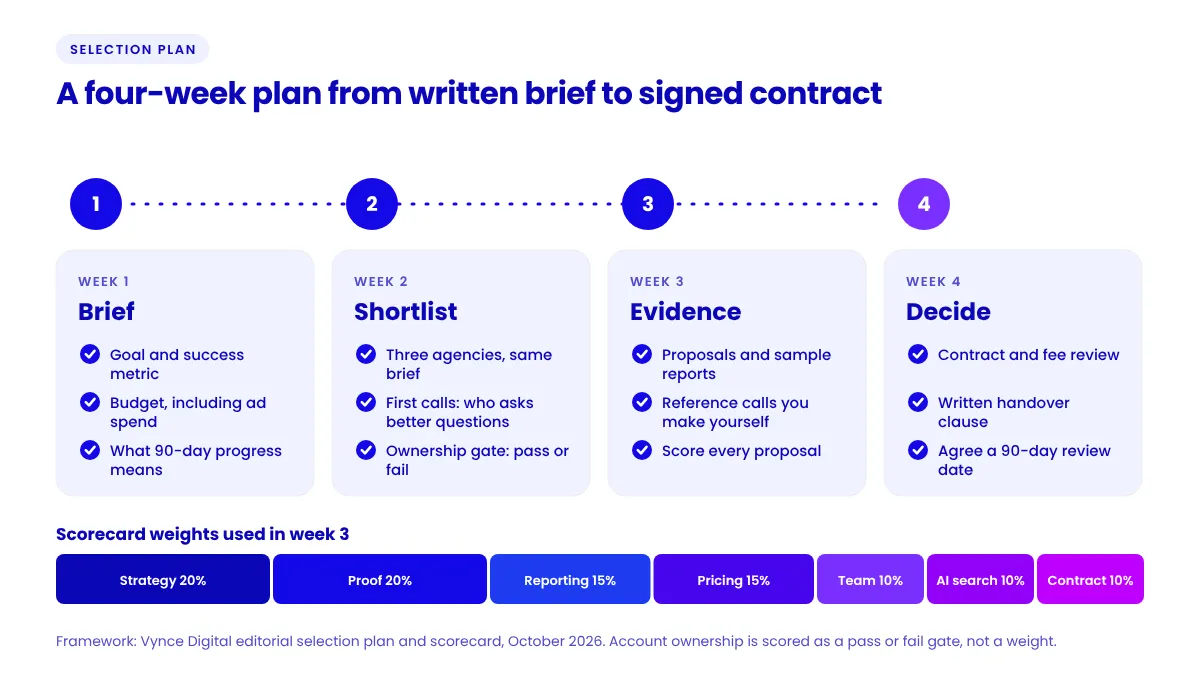
Shortlist three agencies, send them the same brief, and treat account ownership as a pass-or-fail gate. Then score every proposal 0 to 5 on each criterion below, multiply by the weight and add the totals, before anyone on your team says which pitch they liked best.
Criterion | Weight | Full marks when |
Diagnosis and strategy | 20% | The plan answers your brief with clear priorities |
Relevant proof | 20% | Two comparable case studies and references you have called |
Reporting | 15% | The sample report leads with leads, sales or cost per acquisition |
Pricing clarity | 15% | Fee, ad budget and extras are listed separately |
Team | 10% | Named people, with senior time stated |
AI search plan | 10% | Citations in AI answers are tracked, not only rankings |
Contract terms | 10% | Short notice period and a written handover clause |
Choose on Evidence, Not the Pitch #
The agency you hire will sit inside your ad accounts, your analytics and your customer data for years if it goes well. Give the decision the discipline you would give any senior hire: a written brief, evidence you have checked yourself, accounts that stay in your name and a scorecard that settles the debate. If you would like a neutral baseline before you speak to anyone, a short SEO and visibility audit gives every agency the same facts to respond to.
Frequently Asked Questions #
How do I choose a digital marketing agency? #
Write a one-page brief with your goal, success metric, budget and 90-day expectations, then shortlist three agencies with relevant experience. Check their proof yourself, confirm every account stays in your name, compare fees line by line and score each proposal on the same weighted criteria before deciding.
What should I look for in a digital marketing agency? #
Look for an agency that asks diagnostic questions before proposing services, shows case studies with baselines and dates, offers references you can call, keeps your accounts in your name, separates its fee from ad spend and reports on leads, sales and cost per acquisition rather than only impressions or rankings.
What factors should I consider when choosing a digital marketing agency? #
Start with your own factors: the business goal, the budget including ad spend, what your team can handle in-house and your market and industry. Then weigh the agency's fit, verifiable proof, account control, pricing clarity, reporting quality, plan for AI search and contract terms against those needs.
What questions should I ask a digital marketing agency? #
Ask what they would change first and why, which results they achieved for similar businesses and from what baseline, which clients you can call, who works on your account, whose name your accounts will be in, what the fee covers, what reports show, how they track AI visibility and what happens if you leave.
How do I evaluate a digital marketing agency? #
Evaluate evidence rather than the pitch. Ask for case studies with starting figures and time frames, call the clients behind them, read reviews on platforms the agency does not control and check what a Google Partner badge requires. Then score each agency on strategy, proof, reporting, pricing, team, AI search and contract terms.
How much does a digital marketing agency cost? #
It depends on channel, scope and market. In Ahrefs' survey of 439 SEO providers, the most common monthly retainer was $501 to $1,000, agencies averaged about $3,209 a month and the most common project fee was $2,501 to $5,000. Ad budgets for paid media are paid to the platform on top of the agency fee.
How do I compare digital marketing agencies? #
Send three shortlisted agencies the same brief, treat account ownership as a pass or fail gate, and score each proposal 0 to 5 on weighted criteria: strategy, proof, reporting, pricing clarity, team, AI search plan and contract terms. Multiply by the weights and compare totals before anyone shares which pitch they preferred.
How do I choose a B2B digital marketing agency? #
Use the same checks, and add your average deal size and sales cycle to the brief. A strong B2B agency asks how leads become pipeline, reports on qualified opportunities and revenue rather than form fills, and can show work for businesses with similar buying committees and sales cycle lengths.
Who should own the ad and analytics accounts when I hire an agency? #
You should. Create Google Ads, GA4, Search Console, Meta business assets, the domain and hosting in your own name, then add the agency as a user. Google's hiring guide recommends read-only Search Console access while you evaluate an SEO, and its transparency rules require agencies to disclose management fees in writing.
Can a digital marketing agency guarantee results? #
No agency can guarantee rankings. Google's guide to hiring an SEO states that no one can guarantee a number one position, and it warns against firms claiming a special relationship with Google. A credible agency sets measurable targets, explains its assumptions and agrees review points where the plan is adjusted if results fall short.
Written by