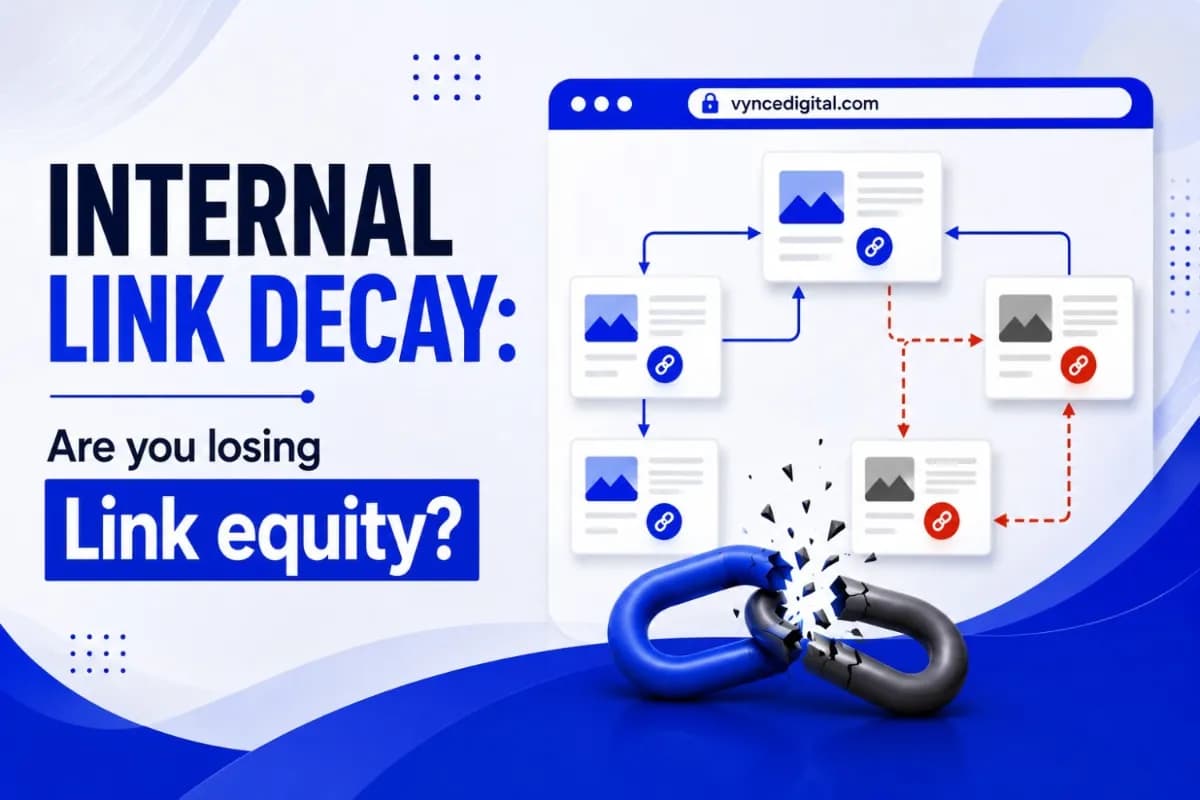
Internal Link Decay: Are You Losing Link Equity?

Tuba
August 5, 2026
Table of Contents
- Key takeaways
- How Internal Link Decay Drains Rankings
- What Internal Link Decay Actually Is
- The Web Decays Faster Than You Think
- Why Decay Costs Rankings
- The Five Ways Equity Leaks
- How to Run an Internal Link Decay Audit
- Preventing Decay at the Point of Publishing
- Frequently Asked Questions
- The Equity You Already Earned Is Waiting
Key takeaways #
Internal link decay is the gradual loss of link equity inside your own site as pages get deleted, moved, redirected, or disconnected by redesigns and new content. It never triggers an alert, yet the data says it is universal: an Ahrefs crawl of over one million domains found internal linking problems on roughly two-thirds of sites. A quarterly five-step audit recovers the lost equity without building a single new backlink.
How Internal Link Decay Drains Rankings #
Every marketing team watches its backlinks. Hardly anyone watches what happens to internal links after publish day. Yet every retired product page, every URL change, every redesign, and every new post quietly rewires how authority moves through your site. Multiply those small edits across a few years of normal operation, and the pages you most need to rank end up starved of the equity your backlinks worked so hard to earn.
That slow rewiring has a name: internal link decay. This guide covers what it is, the latest research on how fast it happens, why it costs rankings in both classic search and AI answers, and a repeatable audit that claws the equity back.
What Internal Link Decay Actually Is #
Internal link decay is the progressive weakening of your internal link structure over time. External link rot describes other sites' links to you dying. Internal decay is the version you fully control, which is exactly why it gets ignored: nothing about it looks like an emergency, and no tool emails you when it happens.
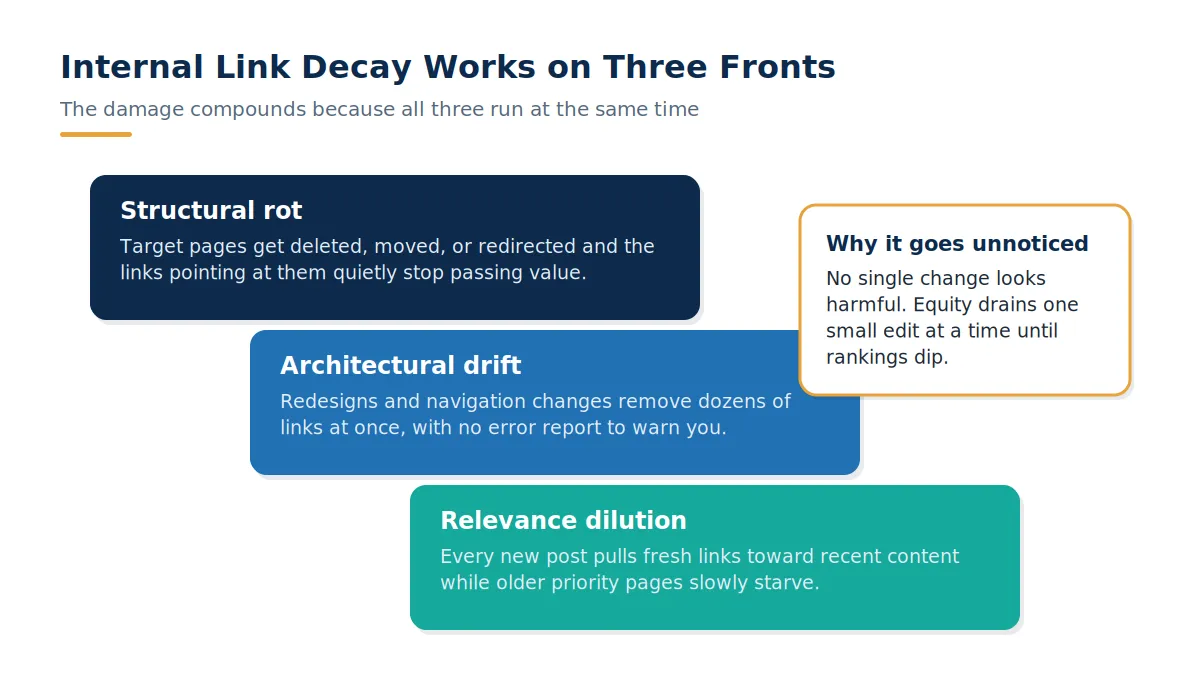
It advances on three fronts at once. Structural rot sets in when the pages your links point to get deleted, moved, or redirected. Architectural drift happens when a website redesign or navigation change removes dozens of links in a single deploy, with no error report to warn anyone. Relevance dilution is the quietest of the three: every new article naturally attracts links from recent content, so equity migrates toward whatever you published last quarter while older strategic pages slowly lose share.
The Web Decays Faster Than You Think #
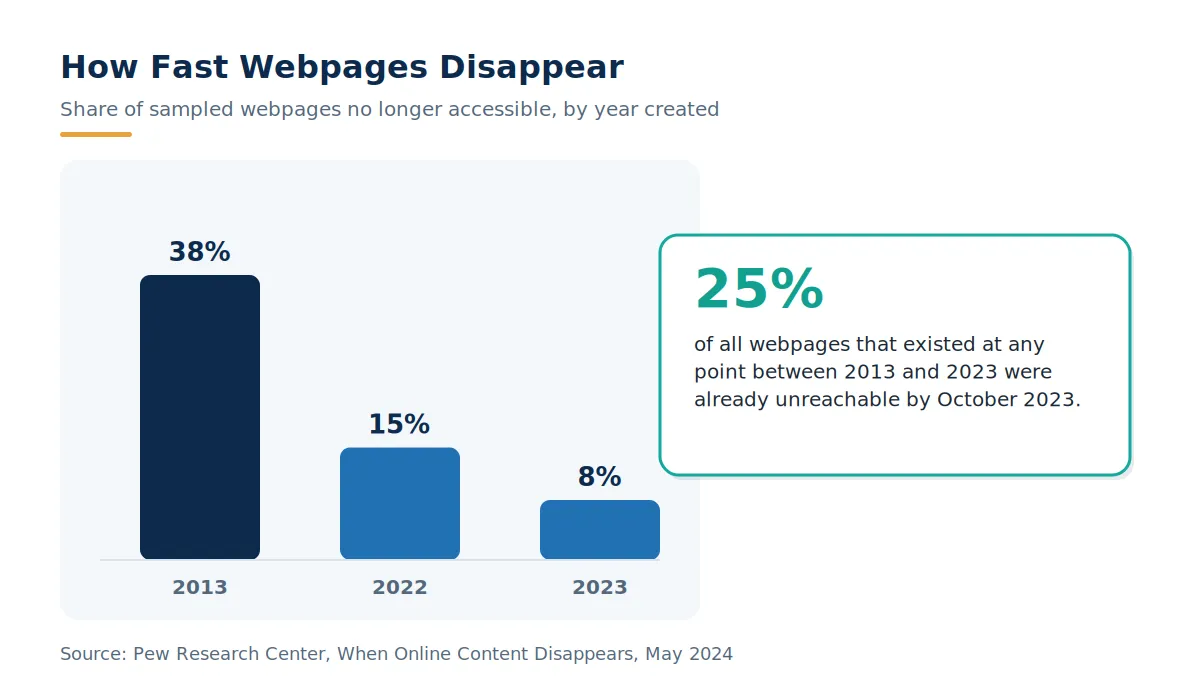
The clearest measurement of how quickly pages vanish comes from the Pew Research Center's May 2024 study of digital decay, which sampled roughly a million webpages from the Common Crawl archive. A quarter of all pages that existed at any point between 2013 and 2023 were already unreachable by October 2023. For pages created in 2013, the loss rate was 38 percent, and even pages published in 2023 had an 8 percent failure rate within about a year. The same study found at least one broken link on 23 percent of news pages and 21 percent of government pages.
Links die even faster than pages. Ahrefs' 2022 link rot study of 2,062,173 domains found that 66.5 percent of the links pointing at those sites since January 2013 had rotted, and once temporary errors and uncounted links were included, 74.5 percent no longer passed value for ranking purposes.
Your site obeys the same physics. Every discontinued product, expired campaign page, merged article, and renamed category adds another dead or detoured endpoint that some internal link somewhere still points at.
Why Decay Costs Rankings #
PageRank never went away. Ahrefs' 2025 analysis of one million SERPs measured 20 metrics against rankings and found links remained among the strongest correlated signals, especially for competitive and informational queries. Internal links are the only part of that signal you control at zero cost, because they redistribute the authority your existing backlinks already bring in.
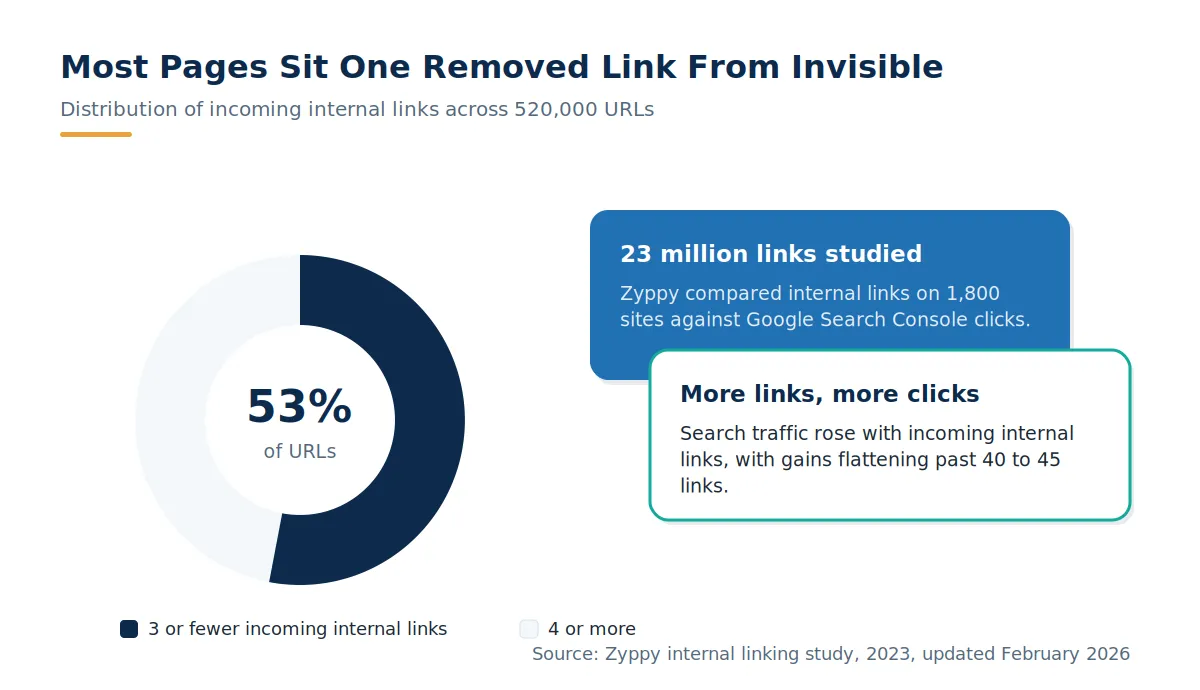
The distribution on most sites is badly skewed. Zyppy's study of 23 million internal links across 1,800 websites (2023, updated February 2026) matched links against Google Search Console clicks and found that 53 percent of URLs received three or fewer incoming internal links, while search traffic rose steadily with link count before flattening past 40 to 45 incoming links. Anchor text variety showed a similar positive relationship.
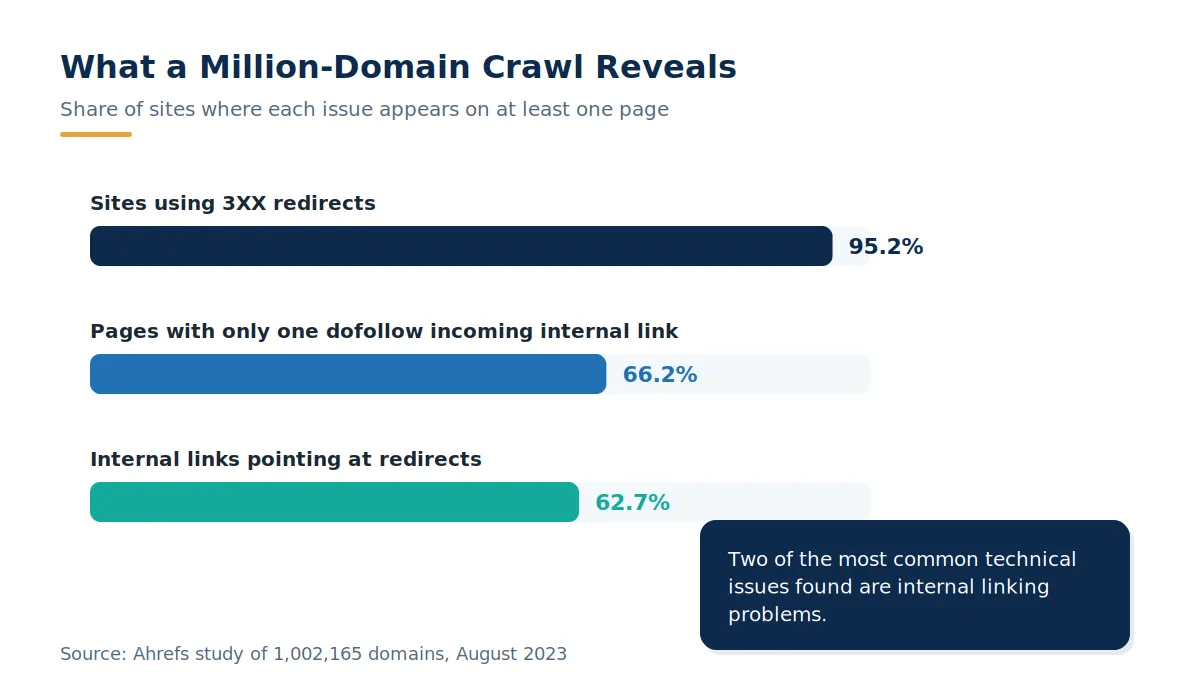
Decay pushes that skew further every quarter. Ahrefs' August 2023 crawl of 1,002,165 domains found 66.2 percent of sites had pages hanging on by a single dofollow internal link, meaning one deleted paragraph or template change away from orphan status. The stakes now extend past Google: AI crawlers use internal links to map which pages your site treats as authoritative, so a decayed architecture weakens the topical signals that AI SEO and generative engine optimization work depends on when assistants decide what to cite.
The Five Ways Equity Leaks #
1. Redirect chains #
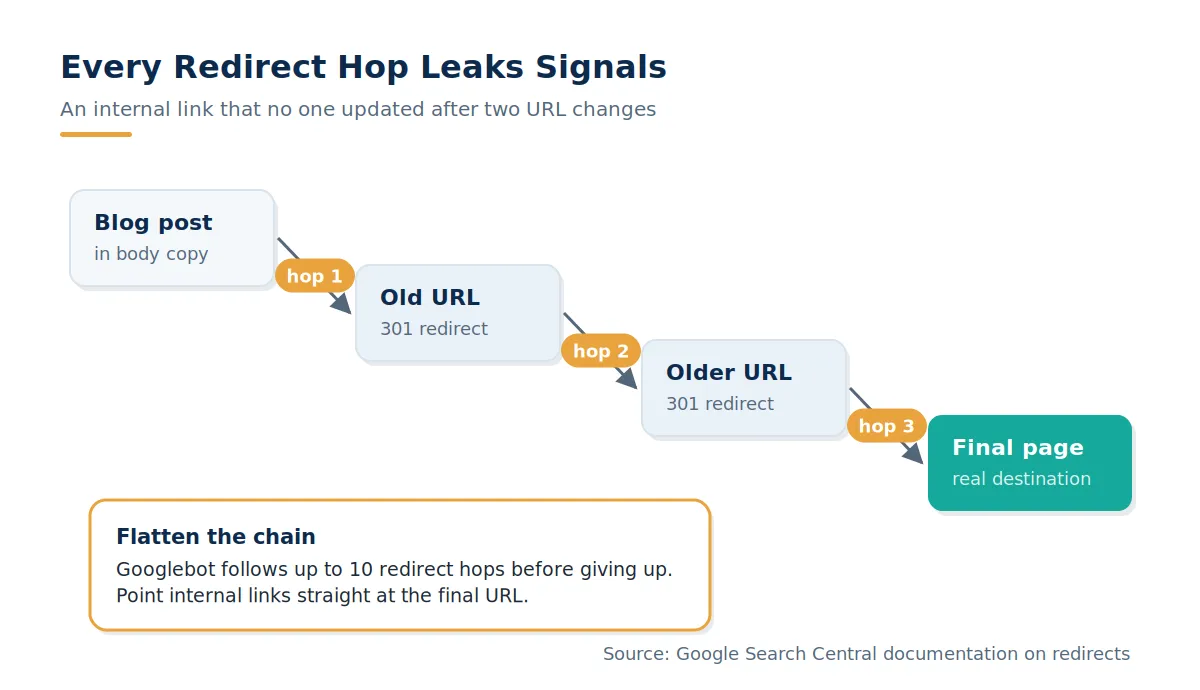
The same million-domain crawl found 95.2 percent of sites use 3XX redirects and 62.7 percent have internal links pointing at them. A redirect resolves for users, so nobody fixes the link behind it. Then the destination moves again, the chain grows, and consolidation gets riskier: Google's redirect documentation states Googlebot follows up to 10 redirect hops before treating the chain as an error. Links that pass through hops also slow crawling and waste crawl budget on URLs that no longer matter.
2. Broken internal links #
Links resolving to 404s pass nothing at all. They accumulate through deletions, typos, and migrations that missed a redirect, and they hurt twice: lost equity for search engines and a dead end for the reader.
3. Orphaned and near-orphaned pages #
A page with zero incoming internal links receives no internal equity and may never be discovered outside your sitemap. The near-orphans matter just as much: the 66.2 percent figure above shows most sites carry a large class of pages one removed link from invisibility.
4. Navigation changes and redesigns #
Header, footer, and category links are sitewide, so editing them changes hundreds or thousands of links at once. A cosmetic refresh that drops a footer section can cut off entire branches of the site without touching a word of content.
5. Anchor text drift #
Content evolves past the anchors that point at it. A guide expanded from a checklist into a full playbook still gets referenced as “the checklist,” so both readers and crawlers receive a weaker relevance signal than the page deserves.
How to Run an Internal Link Decay Audit #
The whole audit fits inside a normal technical SEO audit cycle and takes hours, not days, once the crawl finishes:
Crawl and export. Run a full crawl and export every internal link with its target status code, plus incoming link counts per URL.
Fix broken targets. Filter for links resolving to 404 and other non-200 codes, then update each one to a live, relevant destination or remove it. On large sites, this is a find-and-replace job for developers at the database level.
Flatten redirect chains. Repoint every link that hits a 301 or 302 straight at the final URL. This is the fastest equity recovery available, because it needs no new content and no outreach.
Reconnect orphaned pages. Cross-reference the crawl against your sitemap, analytics, and Search Console to surface pages with no incoming links. Link the valuable ones from relevant hubs, consolidate the redundant ones, and retire the rest.
Rebalance toward priority pages. Compare incoming link counts against the pages that actually drive revenue. If legal boilerplate collects thousands of sitewide links while the pages behind your conversion rate optimization program collect a handful, rewrite templates and add contextual body links until the equity map matches the business map.
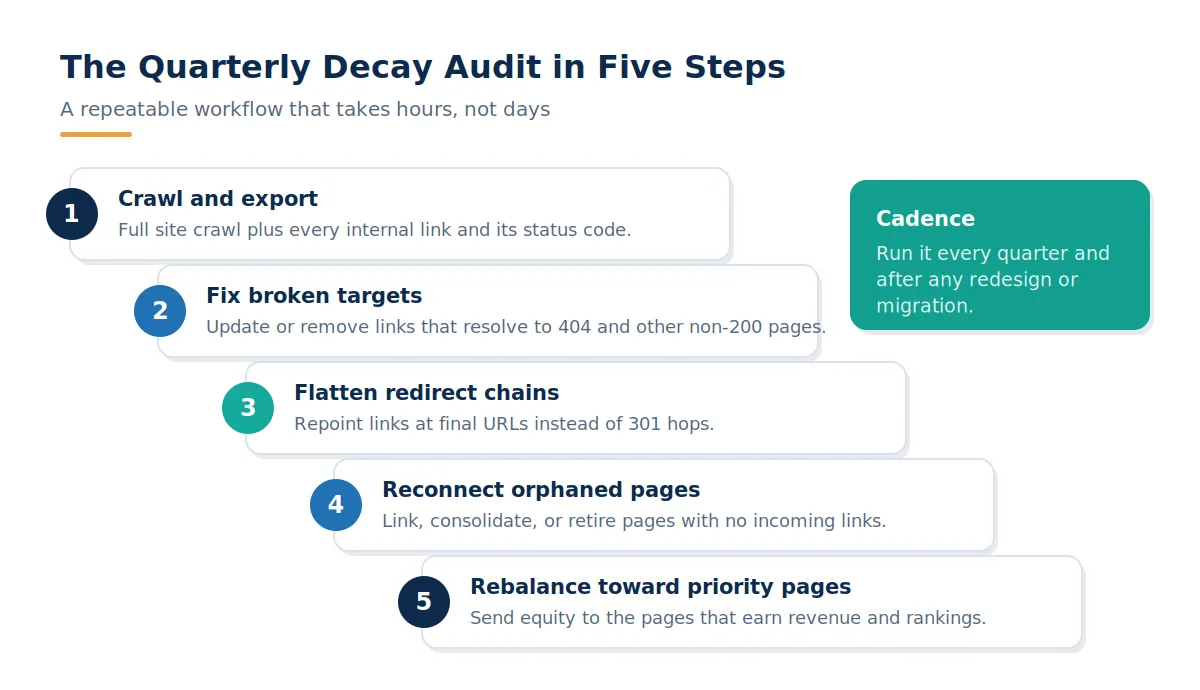
The five-step audit, repeated quarterly, keeps equity flowing to the pages that earn it.
Preventing Decay at the Point of Publishing #
Prevention is a process change, not a tooling change. Add two questions to every brief in your content writing process: which strategic pages should this new article link to, and which existing articles should now link back to it? The second question is the one most teams skip, and it is where relevance dilution gets reversed, because every new post becomes a chance to route fresh equity to priority pages.
Three supporting habits keep the structure healthy between audits. Route clusters through hub pages so equity concentrates somewhere you can direct it. Treat every redesign and migration as a linking event with its own link map and redirect plan. And put the five-step audit on a quarterly calendar so decay never gets more than a 90-day head start.
Frequently Asked Questions #
What is internal link decay? #
It is the gradual loss of internal link equity as pages get deleted, moved, redirected, or disconnected over time. It develops through routine site maintenance rather than any single error.
How is internal link decay different from link rot? #
Link rot describes links dying across the wider web, while internal link decay happens inside your own site. You control internal decay completely, which makes it the cheapest equity to recover.
Does internal link decay affect rankings? #
Yes. Internal links distribute PageRank; links remain among the strongest ranking-correlated signals in Ahrefs' 2025 SERP data, and starved pages lose visibility.
How fast do internal links decay? #
Pew Research Center found 8 percent of pages published in 2023 were unreachable within about a year, so decay begins immediately. Most sites accumulate measurable internal decay within 12 months.
How many internal links should a page have? #
Zyppy's 23-million-link study saw traffic rise with incoming links before flattening past 40 to 45. Priority pages should carry at least five to ten contextual incoming links.
Do redirect chains lose link equity? #
Google says 301s consolidate signals, but Googlebot follows a maximum of 10 hops, and every hop adds risk and crawl waste. Linking straight to final URLs removes the risk entirely.
What are orphaned pages? #
Pages with zero incoming internal links. They receive no internal equity and are hard for search engines to discover, so they rarely rank.
How often should you audit internal links? #
Quarterly for most sites, plus an immediate audit after any migration, redesign, or navigation change.
Can internal link decay hurt AI search visibility? #
Yes. AI crawlers read internal links to map site structure and topical authority, so a decayed architecture weakens your odds of being cited in AI answers.
What tools detect internal link decay? #
Any crawler that reports link status codes and incoming link counts, such as Screaming Frog, Ahrefs Site Audit, or SEMrush Site Audit, combined with Google Search Console.
The Equity You Already Earned Is Waiting #
Internal link decay never announces itself, which is why it compounds. The research is consistent: pages vanish from year one, two-thirds of links rot within a decade, and most sites leave the majority of their URLs underlinked while redirect chains and orphaned pages siphon off the authority their backlinks bring in. The fix is unusually good value, because flattening chains, repairing broken targets, and rebalancing links recovers equity you already paid for.
Put the five-step audit on the calendar this quarter, add the two linking questions to every content brief, and re-crawl after every redesign. If you would rather have a team run the audit and the rebalancing for you, our SEO specialists do exactly this work.