SEO Audit vs Website Audit: Key Differences Explained
SEO Specialist · July 18, 2026
Table of Contents
- SEO Audit or Website Audit: Which One Does Your Business Actually Need?
- What a Website Audit Actually Checks
- What an SEO Audit Actually Checks
- Where the Two Audits Overlap
- The Technical Middle Ground: Core Web Vitals
- Which Audit Does Your Business Need First?
- How Often Should You Run Each Audit?
- Warning Signs that Point to Each Audit
- Why Getting this Distinction Right Pays Off
- Frequently Asked Questions
SEO Audit or Website Audit: Which One Does Your Business Actually Need? #
Two people can look at the same website and walk away with completely different verdicts. A developer notices a checkout that fails on mobile and a contact form that quietly drops submissions. An SEO specialist notices thin pages, a sitemap Google ignores, and titles that target the wrong search terms. Both are auditing the same website. They are simply asking different questions, and that difference is the reason the phrase "SEO audit" vs. "website audit" confuses so many business owners.
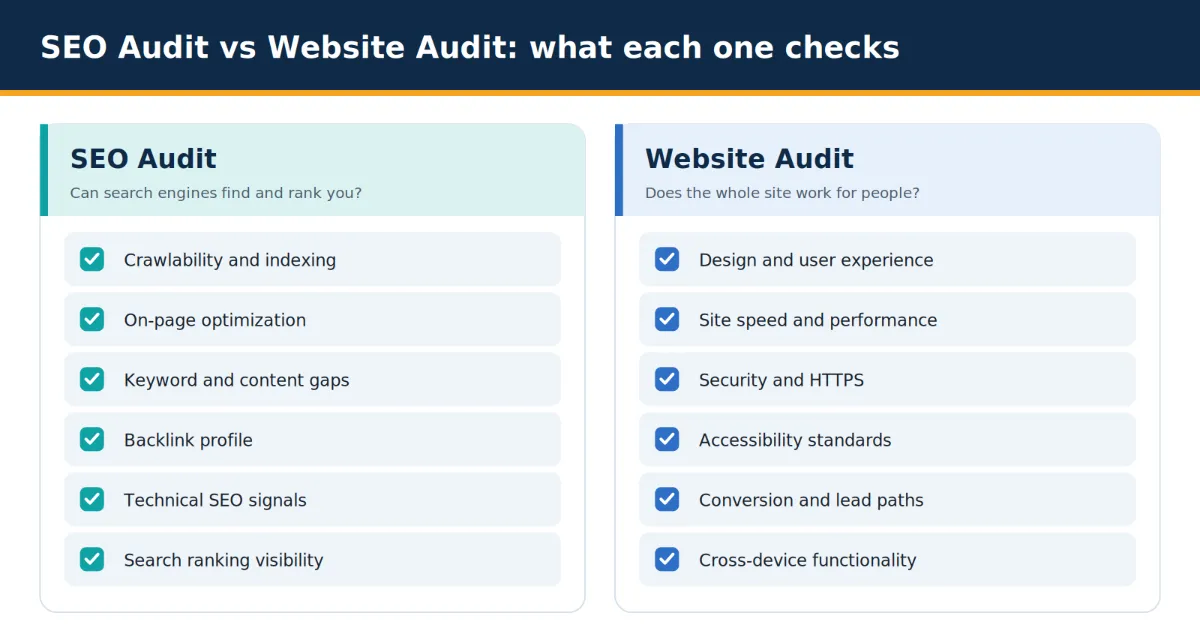
The two are not the same job, and treating them as interchangeable is how budgets get spent in the wrong place. A website audit asks whether your site works for the people who arrive on it. An SEO audit asks whether search engines can find, understand, and rank it. They share a border, and that shared ground is where most of the confusion lives. This guide draws a clear line between the two, shows exactly where they overlap, and gives you a simple way to decide which one to run first.
What a Website Audit Actually Checks #
A website audit is a full health check of your site as a product. It examines everything a visitor experiences and everything that keeps the site running, whether or not those things influence your search rankings. The guiding question is straightforward: does this site work?
A thorough website audit reviews design and user experience, page speed and performance, security and HTTPS status, accessibility for people using assistive technology, the conversion paths that turn visitors into leads or sales, and how the site behaves across phones, tablets, and desktops. It surfaces broken buttons, forms that fail without warning, checkout steps that lose customers, and layouts that collapse on a small screen. None of these problems necessarily hurt your rankings, but each one costs you customers.
The payoff is easy to measure. When a page loads slowly, visitors leave before they see anything at all. Research from Google/SOASTA (2017) found that as mobile page load time increases from 1 second to 10 seconds, the probability of a visitor bouncing rises by 123 percent. A website audit is how you find the pages dragging down that number. If you are planning a rebuild, it is also the right moment to bring in a web design partner and a conversion rate optimization review, so the new site is built to convert rather than simply to look modern.
Consider a common example. A retailer's product pages look fine on a laptop, but on a phone the add-to-cart button sits below a banner that takes a beat too long to load. Nothing is technically broken, so no error ever shows up in a report. Yet a share of mobile shoppers lose patience and leave before the button appears. A website audit is built to catch exactly this kind of silent leak, the friction that never triggers an alert but steadily drains revenue in the background.
What an SEO Audit Actually Checks #
An SEO audit is narrower and more specialized. It measures one thing with precision: how well positioned your site is to earn visibility in search results. A site can be attractive, fast, and easy to use and still be nearly invisible to Google, which is exactly the problem an SEO audit exists to catch.
The work splits into four layers. Technical SEO covers crawlability, indexability, site architecture, and mobile-friendliness, the plumbing that lets search engines reach your pages in the first place. On-page SEO reviews titles, headings, internal links, and how closely each page matches what people actually search for. Off-page SEO examines your backlink profile and the external signals that shape your authority. Content analysis finds keyword gaps, thin or duplicate pages, and topics your competitors rank for that you have not covered yet.
Take indexing, the quietest failure of all. A page can be well written and linked straight from your main menu, yet a single stray instruction in the code, a noindex tag left behind from a staging site, or a blocked path in the robots .txt file can keep it out of Google entirely. Nobody notices until someone asks why an important page never appears in search. An SEO audit exists to surface that kind of invisible gap before it costs you months of traffic.
The reason this matters is reach. BrightEdge Research (2019) found that organic search drives 53 percent of all trackable website traffic, more than any other single channel. If search engines cannot crawl or index your pages, that entire channel stays closed no matter how polished the site looks. An SEO audit keeps it open, and it feeds directly into ongoing SEO services and the content writing that fills the gaps it uncovers.
Audits are also expanding past Google's classic ten blue links. As AI answer engines and search summaries handle a growing share of queries, AI SEO and generative engine optimization have become part of what a forward-looking audit examines, since being cited by an AI answer now matters alongside ranking in a traditional result.
Where the Two Audits Overlap #
Here is where the line blurs and the confusion takes root. Several checks appear in both audits, which is precisely why people treat the two as one.
Site speed, mobile usability, HTTPS security, broken links, and overall crawl health appear in both SEO and website audits. What changes is the reason for flagging them. A website audit flags a slow product page because it frustrates the person trying to make a purchase. An SEO audit flags the same page because slow performance can hold back its ranking. Identical finding, two motivations, two teams who both claim it as their territory.
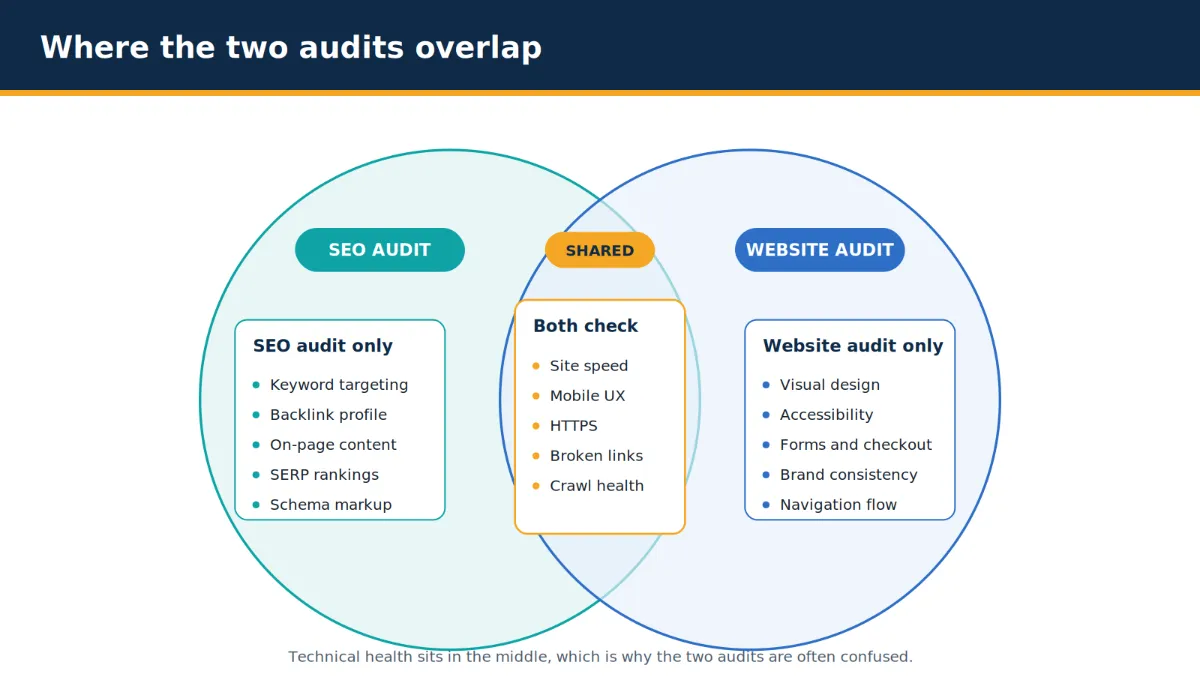
That shared middle is no accident. Google has spent years folding user experience and search performance into the same set of signals, so the technical health of your site now works toward both goals at once. Improve the overlap, and you improve your standing with visitors and search engines together, which is the most efficient place to focus first.
The Technical Middle Ground: Core Web Vitals #
The clearest example of that overlap is Core Web Vitals, a set of three metrics Google uses to measure real-world page experience. They sit squarely in the space both audits care about.
Largest Contentful Paint measures loading speed and should happen within 2.5 seconds. Interaction to Next Paint measures responsiveness and should stay under 200 milliseconds. Cumulative Layout Shift measures visual stability, or how much the page jumps around while it loads, and should stay below 0.1. Google Search Central confirms these metrics are used by its ranking systems and notes that Interaction to Next Paint replaced First Input Delay as a Core Web Vitals metric in March 2024.
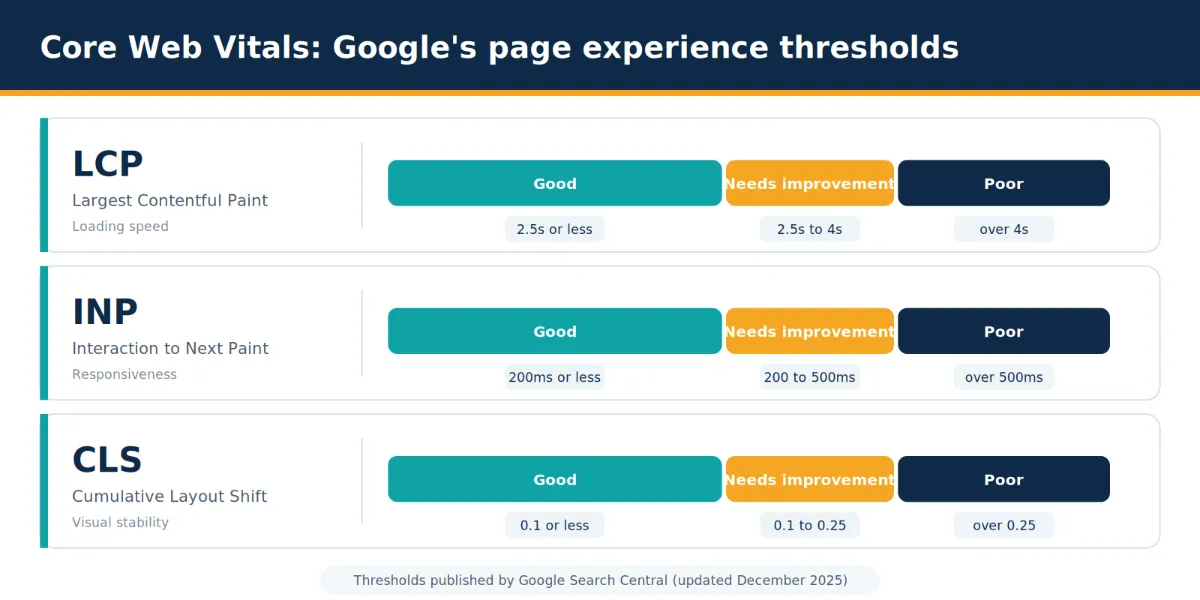
A website audit cares about these numbers because they describe how the site feels in someone's hands. SEO audits matter because Google's page experience guidance treats them as a real ranking input, most valuable as a tie-breaker between pages of similar quality. Fixing them helps on both fronts at the same time, which is the entire reason understanding the overlap pays off.
Which Audit Does Your Business Need First? #
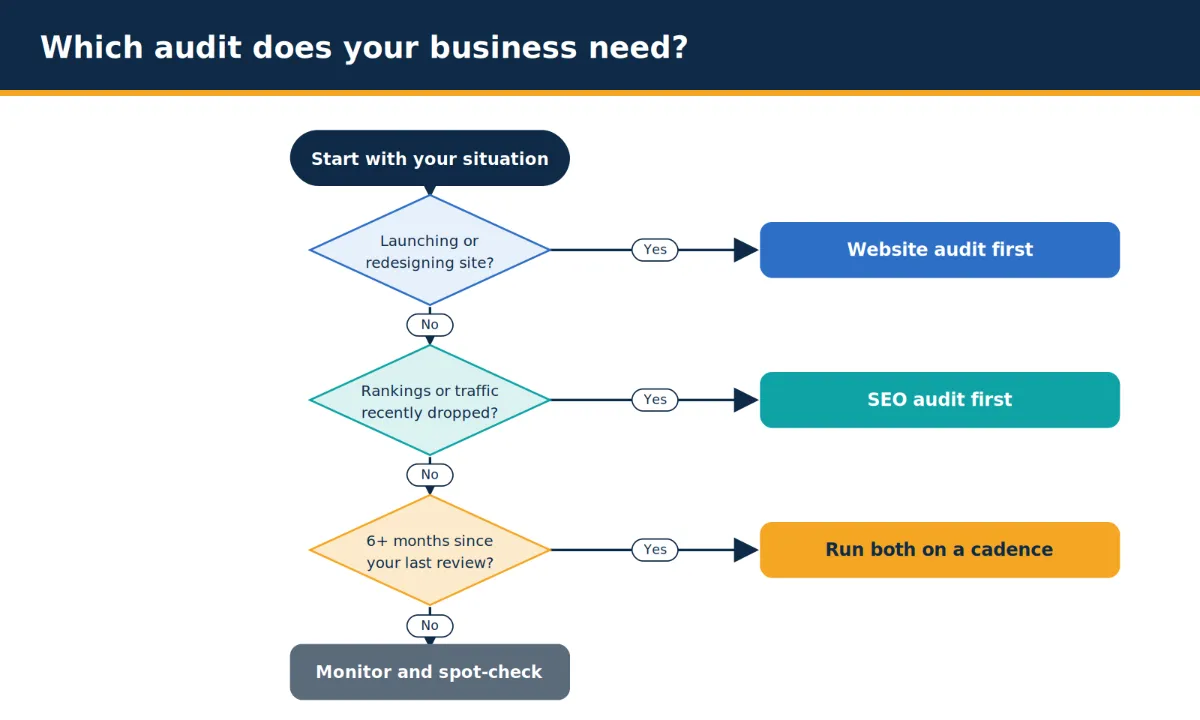
Most businesses do not have to choose between the two forever. They only need to choose what comes first, and the right starting point depends on your situation right now.
If you are launching a new site or planning a redesign, start with a website audit. There is little sense in optimizing rankings for a structure you are about to rebuild. If your rankings have slipped or organic traffic has dropped without an obvious cause, start with an SEO audit to find what changed. If nothing looks broken but it has been six months or more since your last review, run both on a schedule before problems accumulate. And if you are about to invest in a campaign, audit both first, because sending paid or organic traffic to pages that leak conversions wastes the spend twice over.
It is worth saying plainly that these are not rival purchases where one has to win. Over the life of a site, you will almost certainly want both, because a site that ranks well but frustrates visitors wastes the traffic it earns, and a site that delights visitors but never ranks starves for people to serve. The real question is sequence and timing, not loyalty to one audit over the other.
The worst choice is doing neither. An Ahrefs study of more than one million domains (2024) found that meta descriptions were missing on 72.9 percent of sites, while a genuinely damaging issue, a canonical tag pointing to a broken page, appeared on only 2.6 percent. The point is not that audits uncover an endless list of faults to fear. It is that they help you separate the harmless issues from the few that actually cost you traffic and revenue, so you spend your time on the fixes that move the needle.
How Often Should You Run Each Audit? #
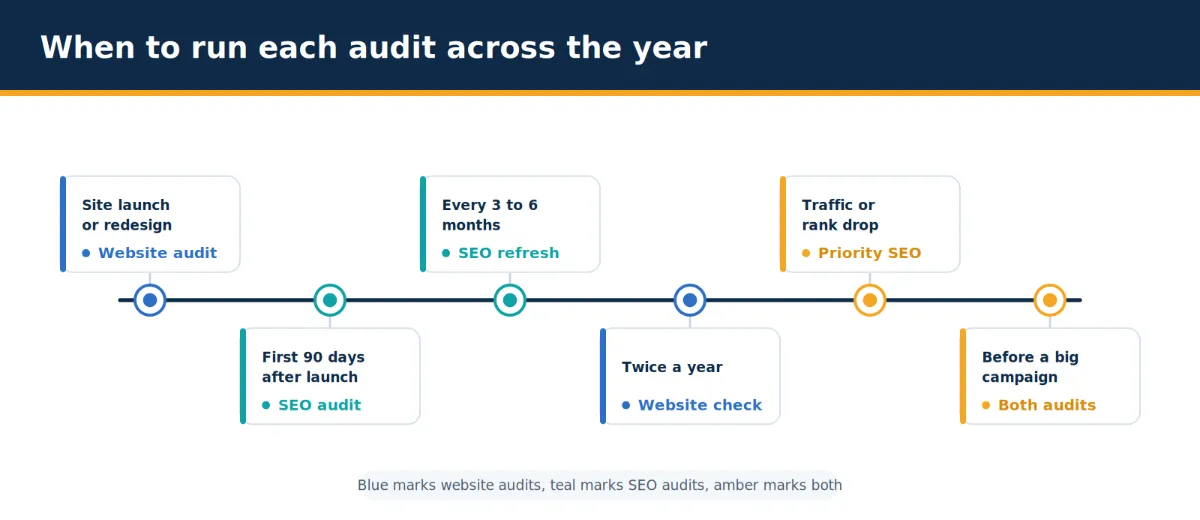
Audits are not one-time events. Sites change, content ages, links break, and search engines constantly update their systems, so a clean report in January can look very different by midsummer. The value comes from repetition, not from a single snapshot.
A practical cadence looks like this. Run a full website audit whenever you launch or redesign, then roughly twice a year as a routine health check. Run an SEO audit within the first 90 days after launch, then every 3 to 6 months to catch slow drift before it becomes a decline. Trigger an immediate SEO audit any time traffic or rankings fall without a clear explanation, and audit both before a major marketing push so you are not paying to send people to pages that are not ready for them.
Warning Signs that Point to Each Audit #
Sometimes the choice makes itself. Certain symptoms point clearly toward one audit or the other, and learning to read them saves you a guess and a wasted invoice.
Lean toward a website audit when visitors bounce within seconds, when your contact form or checkout records far fewer completions than its traffic would suggest, when the site feels sluggish or awkward on a phone, or when a recent design change lined up with a dip in sales rather than in rankings. These are experience problems, and they live in the parts of the site a person actually touches.
Lean toward an SEO audit when rankings slide for terms you comfortably held before, when Google Search Console starts reporting crawl or indexing errors, when new pages take weeks to show up in search, or when a competitor with thinner content keeps landing above you. These are visibility problems, and they live in the signals search engines read rather than the ones people see. When symptoms from both lists appear together, treat that as your cue to run both audits and sequence the fixes so the technical foundation is solid before you chase rankings on top of it.
Why Getting this Distinction Right Pays Off #
Confusing the two audits is expensive in a quiet, easy-to-miss way. You commission an SEO audit and expect it to fix a clunky checkout, or you order a website audit and wonder why your rankings never move. Each instrument is excellent at its own job and nearly useless at the other's, so choosing the wrong one feels like effort without results.
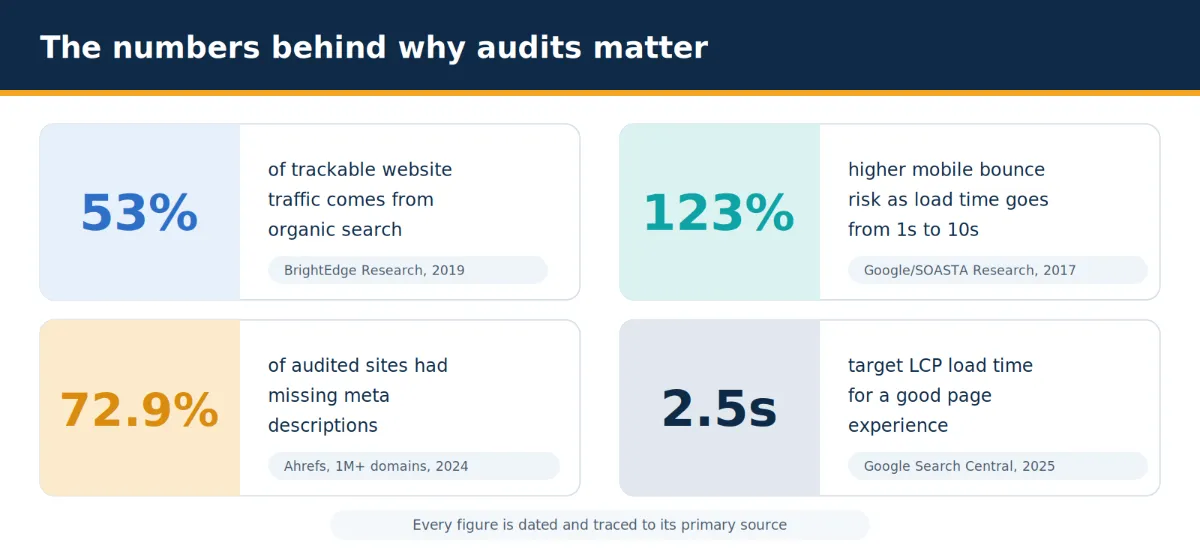
The figures make the stakes concrete. Organic search is the largest single traffic source for most sites; slow pages push visitors away at a measurable rate; and even well-run sites carry technical debt that only a structured review brings to light. Treat SEO audits and website audits as two distinct instruments, each run on its own schedule, and you keep your site both findable by search engines and genuinely usable for the people who arrive. That combination, not either one alone, is what turns a website into a dependable source of growth.
If you are not certain which audit your site needs first, a short conversation usually settles it quickly. Vynce Digital can help you scope the right starting point and turn the findings into a plan you can act on.
Frequently Asked Questions #
What is the difference between an SEO audit and a website audit?
A website audit checks whether your whole site works well for visitors. An SEO audit checks whether search engines can find, understand, and rank it.
Do I need both an SEO audit and a website audit?
Most businesses benefit from both, because they answer different questions. Which one you run first depends on whether your priority is user experience or search visibility.
Which audit should I run first?
Start with a website audit if you are launching or redesigning, and an SEO audit if your rankings or traffic have dropped.
How often should I do an SEO audit?
Every three to six months for most sites, plus an immediate audit whenever traffic or rankings fall unexpectedly.
What does a website audit include?
It reviews design, page speed, security, accessibility, mobile behavior, and the conversion paths that turn visitors into customers.
What does an SEO audit include?
It reviews technical SEO, on-page optimization, backlinks, and content gaps that affect your search rankings.
Are Core Web Vitals part of an SEO audit or a website audit?
Both. They measure page experience, which affects user satisfaction and is also used by Google's ranking systems.
Can one audit replace the other?
No. Each is specialized. An SEO audit will not fix a broken checkout, and a website audit will not diagnose why you are not ranking.
How long does an audit take?
A focused audit usually takes a few days to a couple of weeks, depending on the site's size and the depth of the review.
Will an audit guarantee higher rankings?
No audit guarantees rankings. It identifies the issues holding you back so you can fix the ones that matter most.
Written by