AI Search Visibility: Do Google Rankings Drive Citations?
SEO Specialist · November 5, 2026
Table of Contents
- Does Google Ranking Influence AI Search Visibility? What the Citation Data Shows
- Key Takeaways
- Does Google Ranking Affect AI Search Citations?
- How Google Rankings Differ From AI Search Visibility
- How Google AI Overviews Select Sources
- Does a Google Page One Ranking Affect AI Search Results?
- Query Fan-Out and AI Retrieval: Why Lower-Ranking Pages Still Get Cited
- How to Identify Gaps in AI Search Visibility: A Simple SEO Audit
- How to Improve Visibility in AI Search Results
- What This Means for Your AI Search Visibility
- Frequently Asked Questions
- Can a page get cited without ranking in the top 10?
- Does traditional SEO still matter for AI search visibility?
- Are there AI search rankings?
- What tools track AI search visibility effectively?
- How do you optimize links for AI search visibility?
- Do AI Overviews and AI Mode cite the same sources?
- Do AI search citations send much traffic?
- How often should you check AI search visibility?
Does Google Ranking Influence AI Search Visibility? What the Citation Data Shows #
Key Takeaways #
Higher-ranking pages are cited more often, but a ranking does not guarantee AI search visibility.
Position one earned an AI Overview citation only about 25% of the time in Conductor's 2026 data.
Overlap with Google's top 10 is highest in Perplexity and AI Overviews and lowest in AI Mode and ChatGPT.
Query fan-out may explain part of the gap, because AI retrieval goes beyond the typed phrase.
Track rankings and citations separately, then fix queries where you rank but are not cited.
Your page holds position one, yet the AI answer above it cites someone else. Does ranking on Google still help your AI search visibility, or have the two come apart?
The data supports a middle answer. Pages in higher positions are cited more often, but a strong ranking doesn't determine the outcome, and the pattern changes by AI surface. Here is what the studies show, why rankings and AI citations do not always align, and how to spot your own gaps.
Does Google Ranking Affect AI Search Citations? #
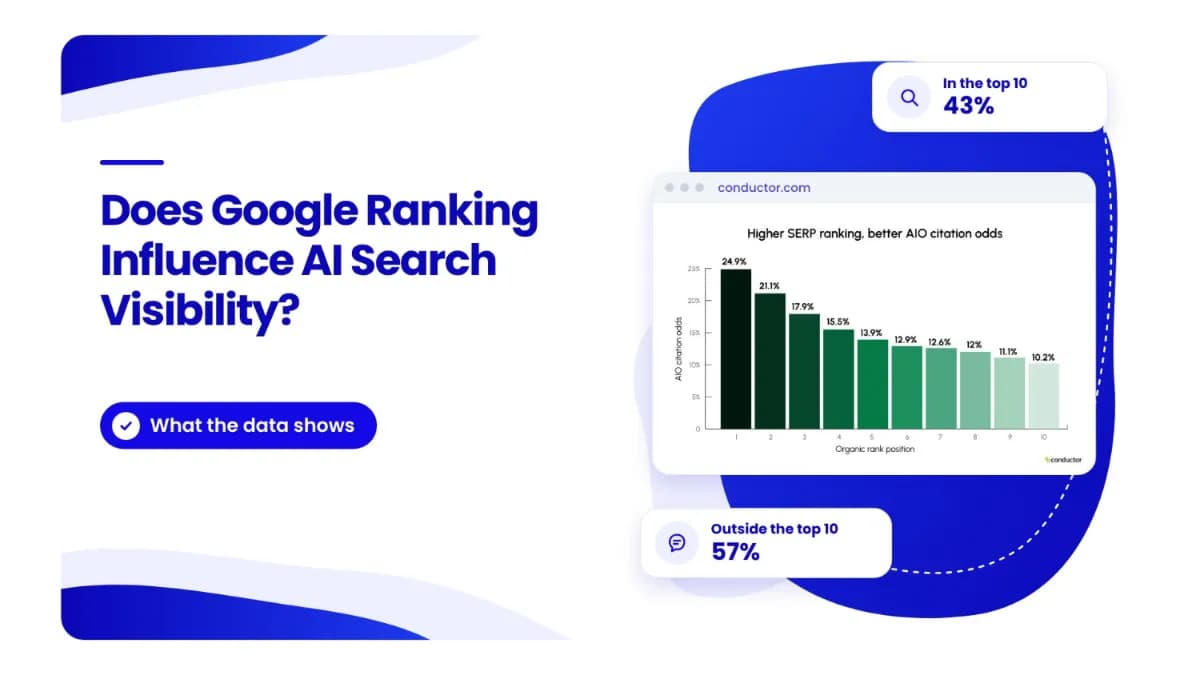
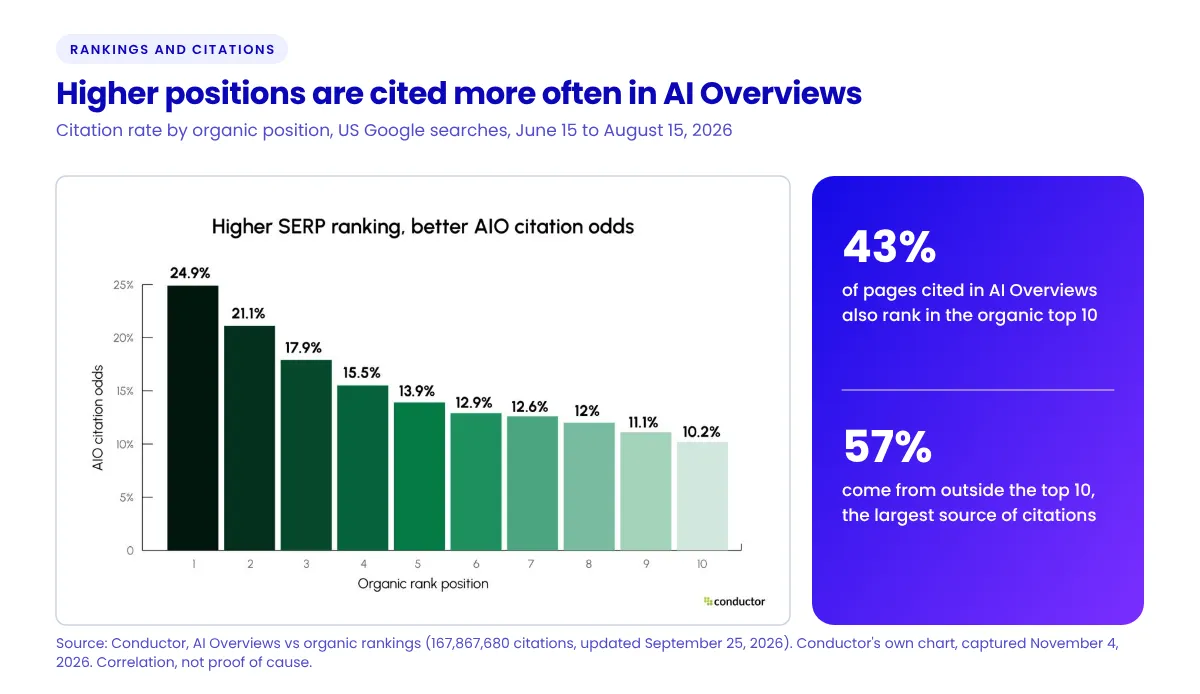
There is a link, but it's moderate. The clearest recent evidence comes from Conductor's study of 167.9 million AI Overview citations from US searches between June 15 and August 15, 2026. Citation rates fell steadily by position: 24.9% at position one, 21.1% at two, 17.9% at three, and 10.2% at position 10. The rate fell at every step, and a page in the top spot was cited nearly 2.5 times as often as one at position 10.
Earlier research agrees. In July 2025, Ahrefs found a 0.347 correlation between top 10 rankings and top three AI Overview citations, with position one pages reaching those links about 50% of the time. The methods differ from Conductor's, but neither figure guarantees results.
A January 2025 study of 10,000 finance and SaaS questions also tied first-page Google rankings to GPT-4o brand mentions, at about 0.65. These are correlations, not proof of cause: strong pages may do well in both places for the same reasons.
How Google Rankings Differ From AI Search Visibility #
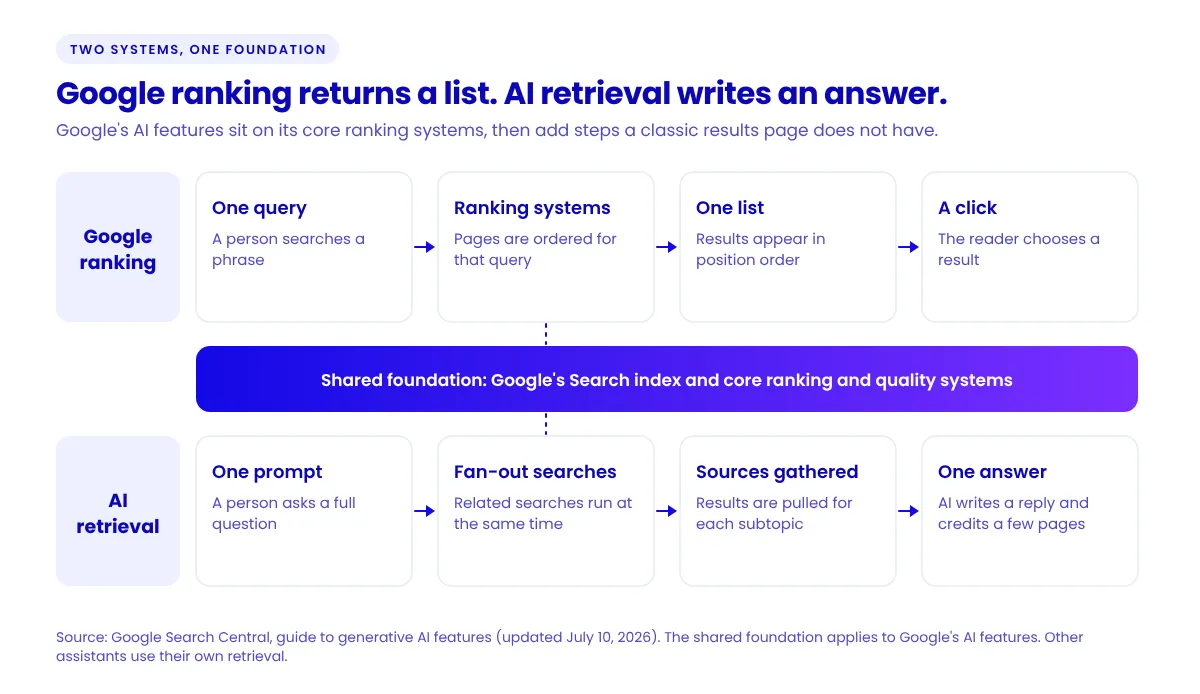
A ranking orders pages for one query and returns one list. AI retrieval gathers sources across several searches, then writes a response that credits a few of them.
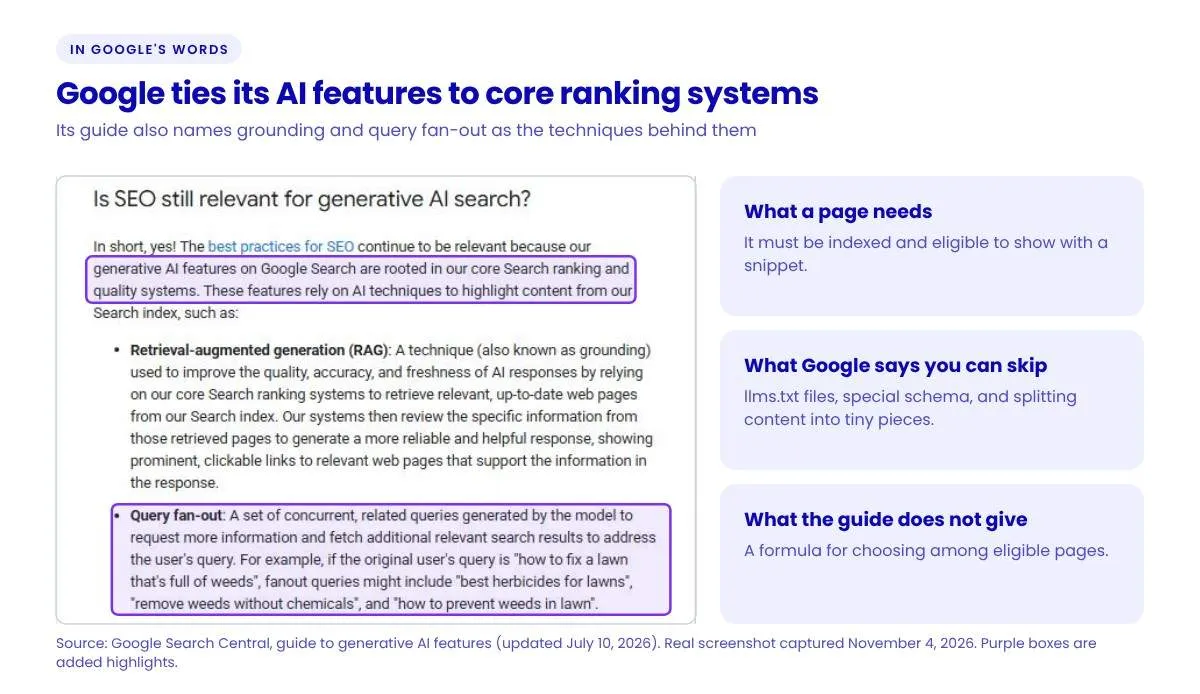
The two systems are connected. Google says its generative AI features are "rooted in our core Search ranking and quality systems," and that they use grounding and query fan-out to fetch extra results. AI answers start from the same foundations as Search, but they do not copy the list a searcher sees.
AI search visibility is also wider than rank. It covers whether your page is retrieved, credited, or named across many prompts, the layers known as grounding, citation, and mention. A page can reach one without reaching the next.
How Google AI Overviews Select Sources #
Google keeps eligibility simple. A page must be indexed and eligible to show with a snippet. You don't need llms.txt files, special schema, or content split into tiny pieces, so strong technical and on-page SEO remains the foundation.
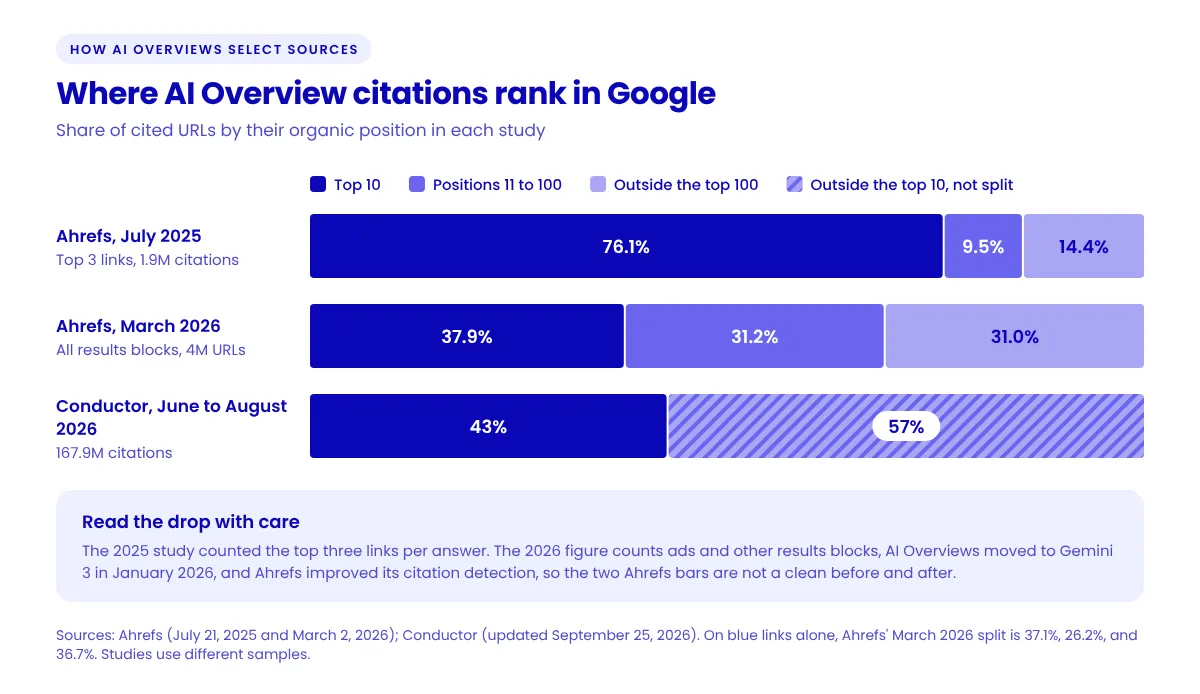
Which eligible pages get chosen is less clear. Ahrefs reported that 76% of AI Overview citations ranked in the top 10 in July 2025. Its March 2026 study of 863,000 keyword results put that share near 38%, with about a third outside the top 100. Conductor's 2026 data puts it at 43%.
Treat that drop with care. The 2025 study counted only the top three links per answer; the 2026 figure counts ads and other results blocks; AI Overviews moved to Gemini 3 in January 2026, and Ahrefs improved its citation detection. Ahrefs suggests fan-out may play a part, but that remains a theory. Still, both newer datasets show most citations in Google AI Overviews coming from beyond the top 10.
Does a Google Page One Ranking Affect AI Search Results? #
That depends on where you look. Semrush's July 2025 study of 5,000 keywords found 82% URL overlap with Google's top 10 for Perplexity, 67% for AI Overviews, and about 35% for AI Mode.
Other measures run lower. Moz's February 2026 analysis of nearly 40,000 queries matched only 12% of AI Mode citations to a top 10 URL for the same query. On long-tail prompts in August 2025, Ahrefs found overlap of 28.6% for Perplexity and about 8% for other assistants, and more than 80% of those assistants' citations did not rank for the prompt at all.
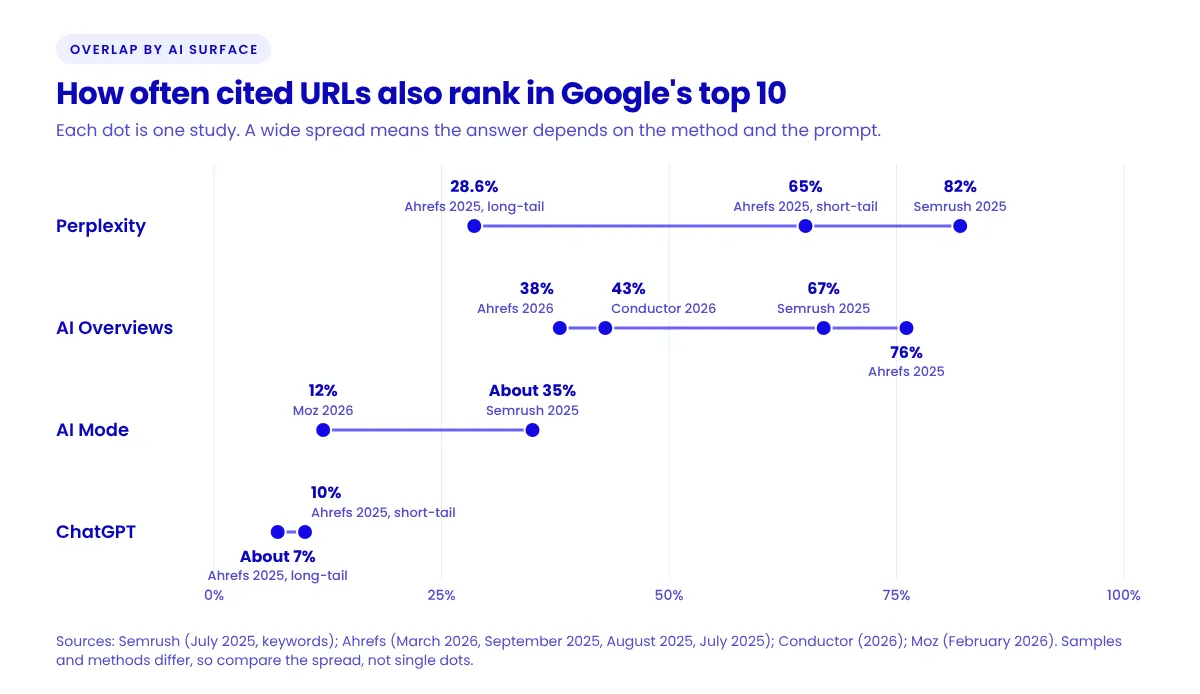
So a page one ranking counts for more on some surfaces than others, and one rank report cannot describe your AI visibility.
Query Fan-Out and AI Retrieval: Why Lower-Ranking Pages Still Get Cited #
Query fan-out may help explain why rank and citation drift apart. Google describes it as "breaking down your question into subtopics and issuing a multitude of queries simultaneously." A prompt like "best CRM for a small agency" can become separate searches on pricing, integrations, reviews, and setup. A page that ranks first for the main phrase may be absent from the others.
Surfer's fan-out study, updated in October 2026, covers 173,902 URLs and 10,000 keywords. The number of fan-out queries a page ranked for had a 0.77 correlation with AI Overview citations. Pages ranking only for fan-outs were cited 29.2% of the time, against 19.6% for pages ranking only for the main query.
Fan-out is not the whole story. In the same data, 67.82% of cited pages ranked in the top 10 for neither the query nor any tracked fan-out (45.86% among the top three citations), so rankings do not explain every citation.
Ahrefs' May 2025 study of 75,000 brands tied branded web mentions to AI Overview visibility at 0.664, well ahead of backlinks at 0.218. A July 2026 recency study of 7,683 pages cited by ChatGPT, Gemini, and Perplexity found 75% had been updated within the past year. Google warns that inauthentic mentions are less helpful than they seem, so treat these as signs of real reputation, not shortcuts.
How to Identify Gaps in AI Search Visibility: A Simple SEO Audit #
Pick 20 queries that matter to revenue. Run each through AI Overviews, AI Mode, ChatGPT, and Perplexity, and log every cited URL beside your organic position. Each query then lands in one of four groups:
Ranking and cited: protect the page and keep it current.
Ranking, not cited: your clearest gap, so diagnose these first.
Cited, not ranking: find out what earned the citation, then build on it.
Neither: decide whether the query is worth a new page.
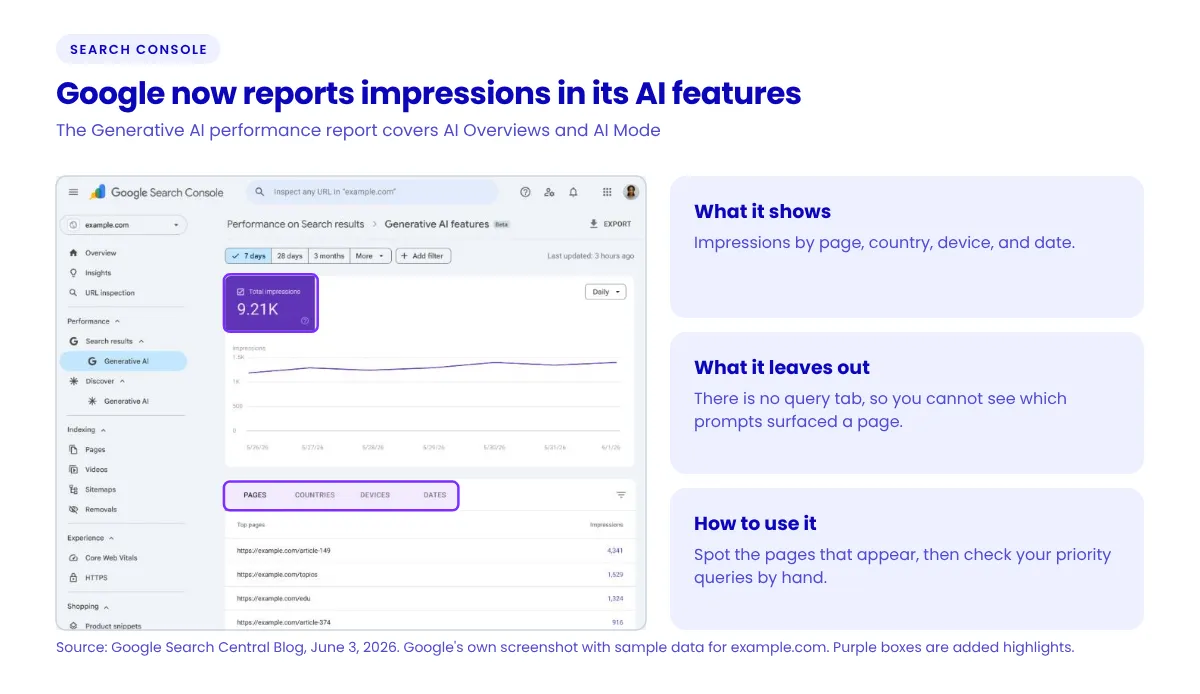
Google's Generative AI performance report, rolled out worldwide by August 31, 2026, shows impressions in AI Overviews and AI Mode by page, country, device, and date. It lists no query view, so your own log still matters.
How to Improve Visibility in AI Search Results #
For queries where you rank but are not cited, name the cause first:
Coverage: competitors answer sub-questions you skip. Add them to the page or a linked one.
Clarity: your answer is buried. Move it under a plain heading.
Reputation: rivals are discussed more across the web. Earn real coverage and reviews.
Freshness: the facts are dated. Update them.
Our guide to growing AI citations covers these fixes in depth. To measure progress, track monthly citation share per surface: your URLs as a percentage of all cited URLs in your query set. That is the core report in any generative engine optimization program.
What This Means for Your AI Search Visibility #
Keep investing in rankings, because they feed the pool Google's AI features draw from. Just stop treating them as proof of AI search visibility. Measure citations separately and work on the queries where the two disagree. For help with the first pass, an AI SEO review can turn the audit into a clear backlog.
Frequently Asked Questions #
Can a page get cited without ranking in the top 10? #
Yes. In Conductor's 2026 data, 57% of AI Overview citations came from outside the organic top 10. Those pages may rank for related searches, or Google may choose them for other reasons.
Does traditional SEO still matter for AI search visibility? #
Yes. Google says a page must be indexed and eligible to show with a snippet, and it ties its AI features to core ranking systems. SEO is the foundation, though it doesn't guarantee a citation.
Are there AI search rankings? #
Not in the classic sense. AI answers have no fixed positions, and citations can change between runs. Tools that report AI search rankings usually show mention or citation share, so read them as trends.
What tools track AI search visibility effectively? #
Start with Search Console for Google surfaces. For wider coverage, Ahrefs Brand Radar and Semrush's AI Visibility tools track AI Overviews, AI Mode, ChatGPT, Gemini, and Perplexity. Pair them with AI referral reporting in GA4. Google notes that no third-party tool can see its internal systems.
How do you optimize links for AI search visibility? #
Favor quality over volume. Among the 50 sites most mentioned in AI Overviews, Ahrefs found a 0.70 correlation between mentions on highly linked pages and visibility, though it was weaker for Perplexity and ChatGPT. In its May 2025 brand study, branded anchors (0.527) also outperformed raw backlinks (0.218).
Do AI Overviews and AI Mode cite the same sources? #
Rarely. In Ahrefs' December 2025 study, responses averaged 86% semantic similarity across 730,000 pairs, yet cited the same URLs only 13.7% of the time across 540,000 pairs.
Do AI search citations send much traffic? #
Often not. Pew Research Center tracked 900 US adults in March 2025. Links inside AI summaries were clicked on 1% of visits with a summary and 8% of traditional results, versus 15% without a summary.
How often should you check AI search visibility? #
Monthly suits a core query set, with a fuller audit each quarter. Citations vary between runs, so repeat each prompt and judge the trend.
Written by