Round Robin Linking in SEO: Does It Actually Work?

Digital Marketing SpecialistPublished November 20, 2026
Table of Contents
- Key Takeaways
- Round Robin Linking in SEO: Does It Work, or Just Pass Link Equity Around?
- What Is Round Robin Linking?
- Example: Websites A, B and C
- Round Robin vs Reciprocal vs Three-Way Linking
- Does Round Robin Linking Pass Link Equity?
- How link equity and PageRank work
- What happens inside a closed ring
- What Google's Link Spam Policy Says
- How to Spot a Manipulative Link Exchange
- The Risks of Joining a Link Ring
- Safer Link-Building Alternatives
- Frequently Asked Questions
- Is round robin linking safe?
- Can Google detect three-way or round robin link exchanges?
- How many link exchanges are too many?
- Are reciprocal links bad for SEO?
- Is it still a link exchange if one link is nofollow?
- Is circular internal linking the same thing?
- What should I do if I'm already in a link ring?
Key Takeaways #
Round robin linking is a link exchange arranged in a circle, so no two sites link to each other directly.
Google's spam policy judges why a link exists, not the shape of the exchange.
A closed ring adds no new authority, and Google works to cancel unnatural links.
Every member gives and receives an arranged link, so each site carries risk both ways.
Round Robin Linking in SEO: Does It Work, or Just Pass Link Equity Around? #
You've probably had this email: "Join our network. You link to one member, another member links to you, and since nobody swaps directly, Google can't tell." It sounds like free backlinks.
That offer is round robin linking. The idea isn't new, but it's now sold through private groups and credit-based exchange platforms. Here's how it works and what Google says about it.
What Is Round Robin Linking? #
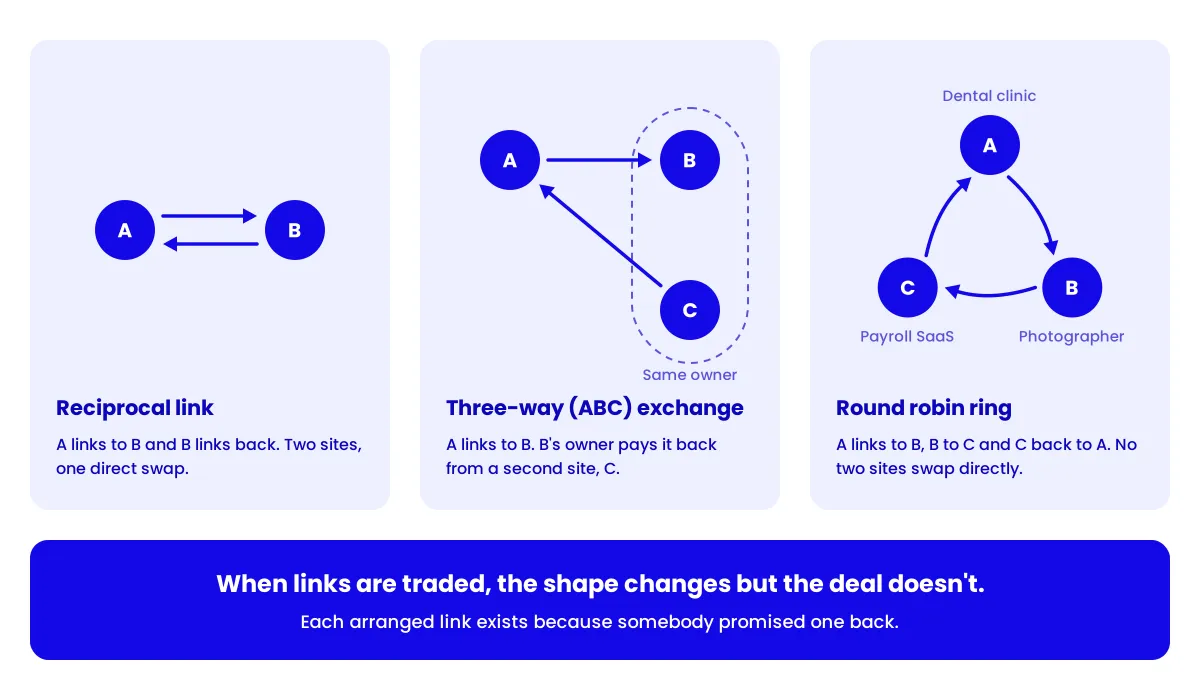
It's when a group of websites link to each other in a circle. Each site links to the next one and gets a link from the one before, so no two sites swap links directly. You'll also see it called a link ring or a multi-way link exchange.
Example: Websites A, B and C #
1. Website A, a dental clinic blog, links to Website B.
2. Website B, a wedding photographer, links to Website C.
3. Website C, a payroll software company, links back to Website A.
Each site gets one new backlink, and none links to the site that links to it.
Look at the dentist's new link: it sits in a payroll article, where no reader wants a dentist. It exists only because of the deal, which is what Google's spam policies target.
Round Robin vs Reciprocal vs Three-Way Linking #
| Reciprocal link | Three-way (ABC) exchange | Round robin ring |
Sites | 2 | 3, often with 2 owners | 3 or more owners |
Link pattern | A to B, B to A | A to B; B's owner links to A from site C | A to B, B to C, C to A |
Happens naturally? | Often | Rarely | Rarely |
Under Google's policy | Fine if natural; excessive exchanges are link spam | Same rules as any exchange | Same rules as any exchange |
Google's policy doesn't name three-way or round robin setups. It judges why links exist, so the same rules apply to all three.
Reciprocal links on their own are common: a 2020 Ahrefs study of 140,592 domains found 73.6% had some. Google's John Mueller calls natural ones fine, as long as you're not "making weird deals, behind the scenes." Rings are that kind of deal.
Does Round Robin Linking Pass Link Equity? #
How link equity and PageRank work #
"Link equity" is SEO shorthand for the ranking value a link passes. Google doesn't use the term, but it confirms the system behind it: PageRank "continues to be part of our core ranking systems."
In the original PageRank paper, each link worked like a vote. A page's score came from the pages linking to it, and each page split its score across its outgoing links. So a link from a strong page counted for more. Google says PageRank has "evolved a lot" since then, and links are just one of many Google ranking factors.
What happens inside a closed ring #
A ring can't create authority. Every link comes from another member, so no new value enters the group, and each site's gain depends on one assigned partner. So yes, round robin linking mostly passes link equity around.
Google also works to cancel that. In its December 2022 link spam update, Google said SpamBrain can detect "sites used for the purpose of passing outgoing links," and that credit from unnatural links is lost. Its spam updates page says that benefit can't be regained.
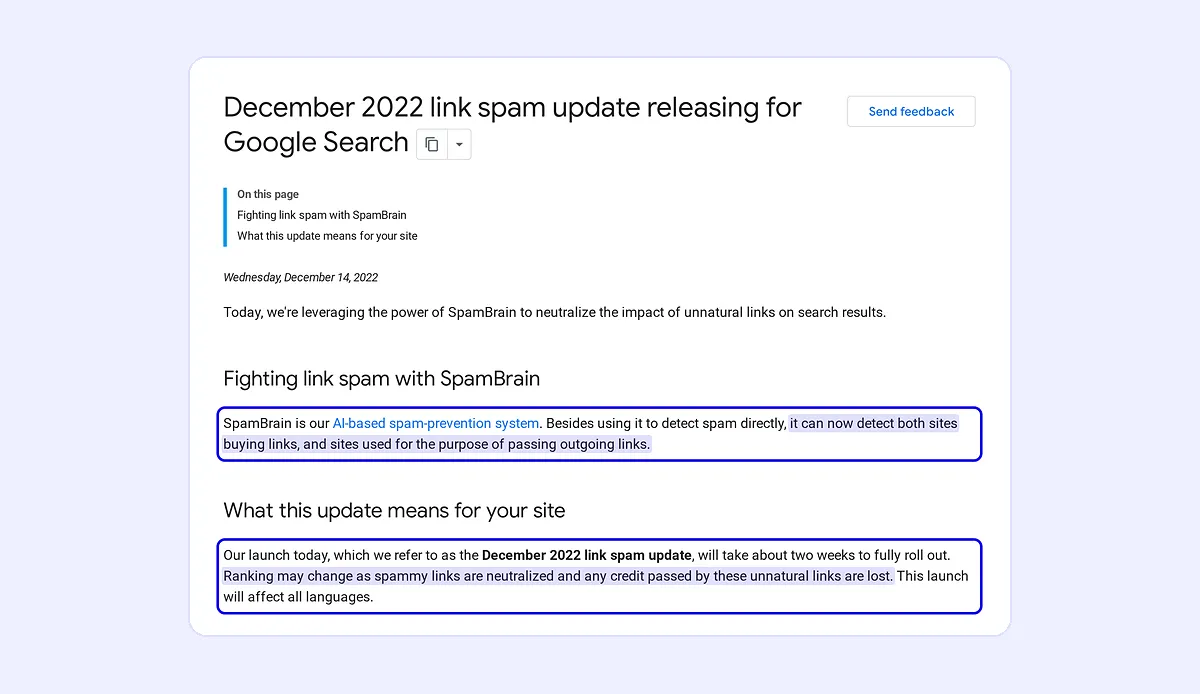
Google says its algorithms catch most spam automatically, while manual actions need human review. So "nobody got caught" may just mean the links quietly stopped counting.
What Google's Link Spam Policy Says #
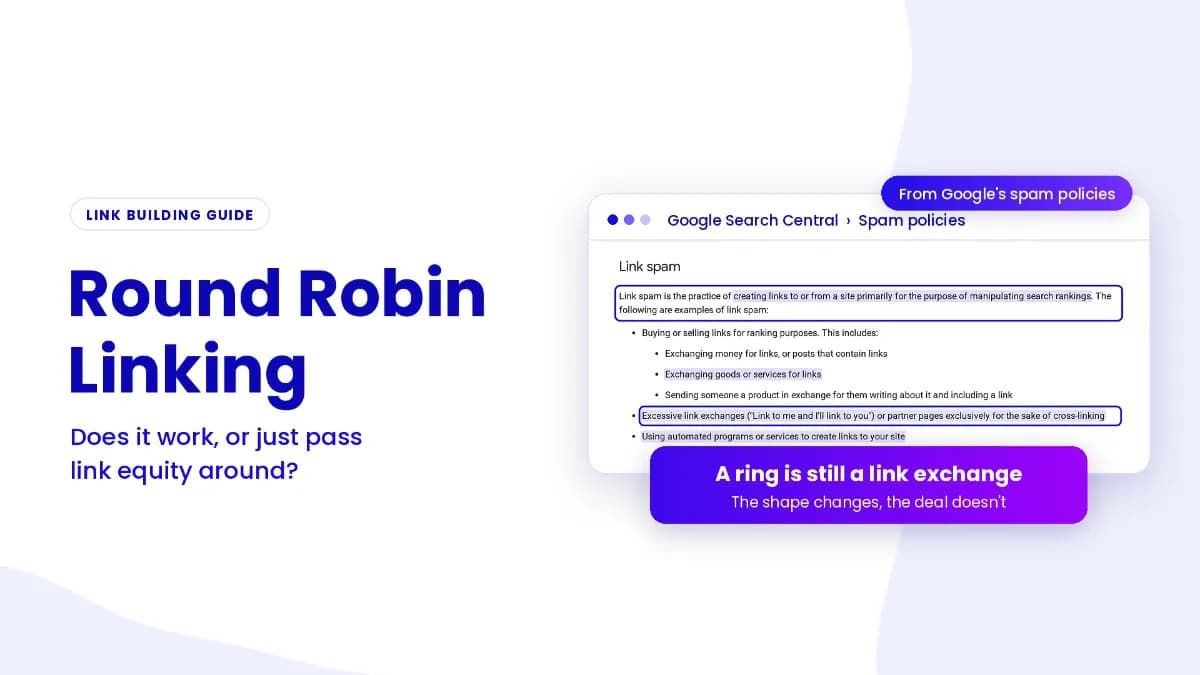
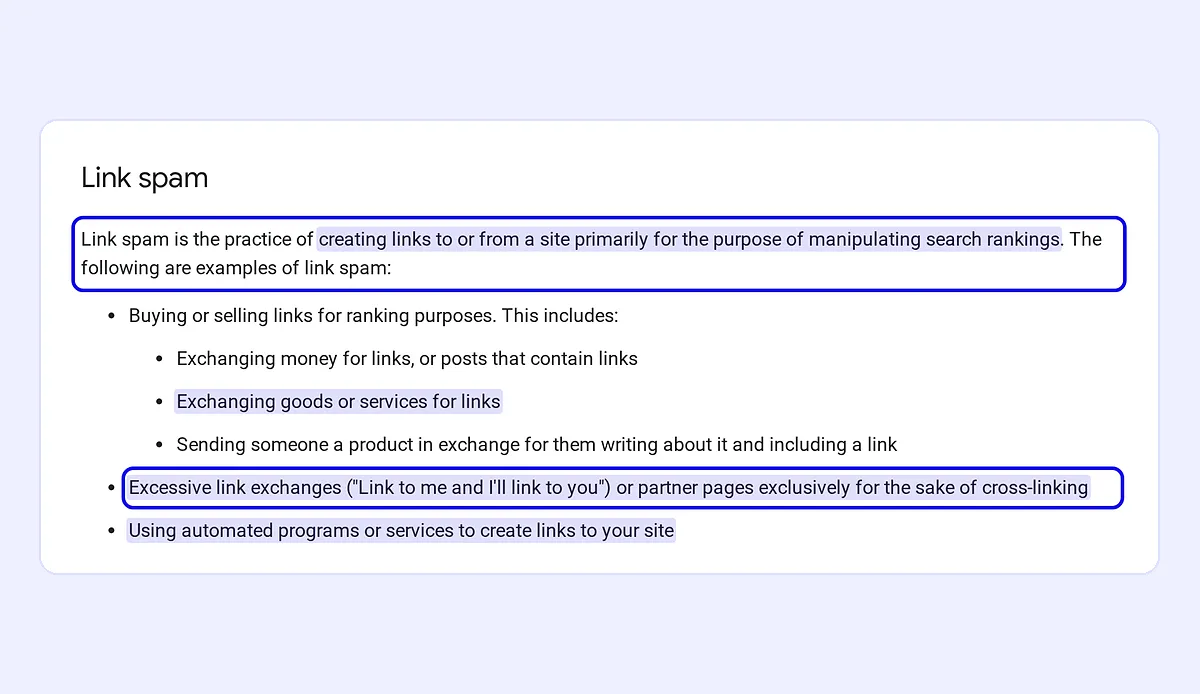
Google's spam policies define link spam as "creating links to or from a site primarily for the purpose of manipulating search rankings." Three listed examples fit link rings:
• "Excessive link exchanges"
• "Exchanging goods or services for links", which in our reading covers credit-based exchange platforms
• "Using automated programs or services to create links to your site"
In July 2021 office hours, Mueller added that topic relevance "doesn't matter" for systematic exchanges, and that Google's webspam team might apply a manual action if such links make up most of a site's links.
How to Spot a Manipulative Link Exchange #
Offers rarely say "link scheme." Watch for these signs:
• The link is conditional. You only get one if you give one.
• You earn or spend credits. That's still trading links.
• Nofollow isn't allowed. Google accepts paid links marked rel="nofollow" or rel="sponsored". A deal that forbids them is about rankings, not readers.
• You choose keyword anchor text. Google lists optimized anchors in guest posts as link spam.
• The page exists for the link. Google lists low-value content created to manipulate linking signals as spam.
The quickest check is the receipt test: would this link exist if nobody had promised anything back?
To review your own links, export them from Search Console's Links report and look for unrelated sites you also link to.
The Risks of Joining a Link Ring #
Rings deliver fast links, and scores like Domain Rating may rise, but those tools can't see what Google discounts. The real risks:
• Wasted links. If Google neutralizes the ring, you've given away outbound links for nothing.
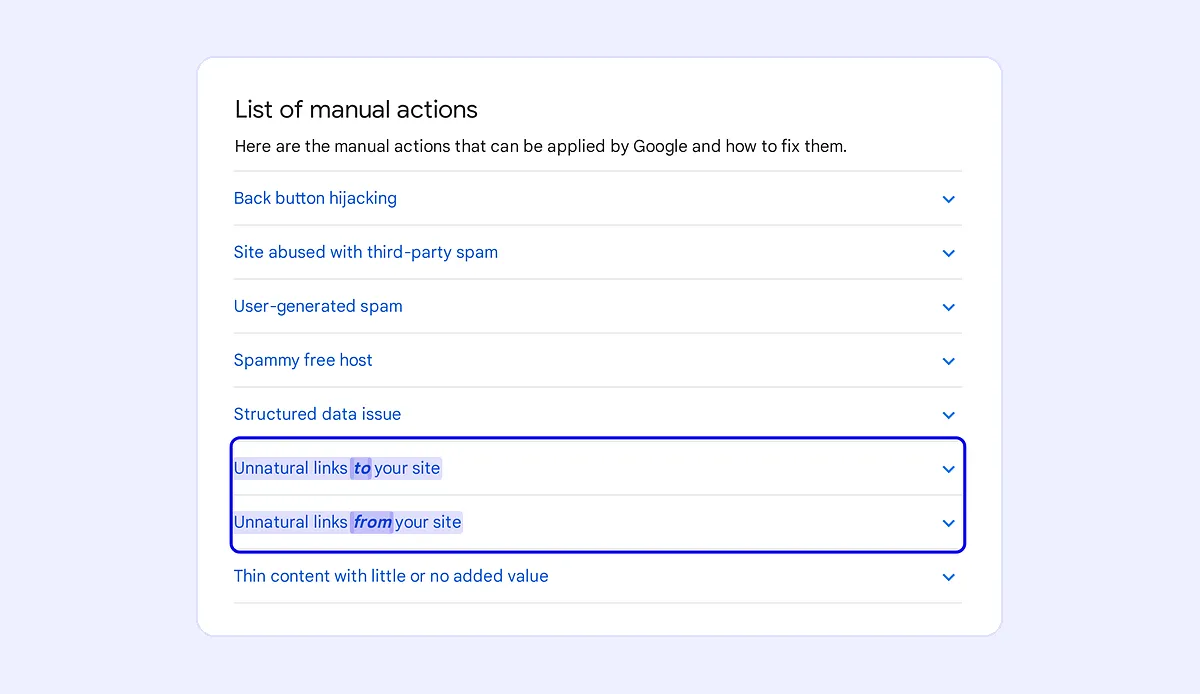
• Two-sided exposure. Google's Manual actions report covers unnatural links both to and from a site. Ring members do both.
• No control. You can't vet who joins later or what they do.
• Slow cleanup. Fixing a manual action means removing links and waiting for a reconsideration review, which Google says can take days or weeks.
Safer Link-Building Alternatives #
These take longer, but they earn links people choose to give:
• Reclaim brand mentions. Ask sites that mention you to add a link, as part of online reputation management.
• Publish original data. Surveys and benchmarks from your content program give writers something to cite.
• Build a free tool. Calculators earn links because people use them, a web design job as much as a marketing one.
• Use real relationships. Suppliers, partners and local neighbors often link to each other naturally.
• Pitch without a trade. Mueller says telling people about good content is fine. Offering a link in return is what makes it unnatural.
Our guide to free link building tactics that still work covers each one in detail.
Not sure what's in your backlink profile? We'll flag arranged links and show you what to fix first. Book an SEO audit with Vynce Digital.
Frequently Asked Questions #
Is round robin linking safe? #
No. A ring doesn't change why the links exist, so Google's spam policies still apply. Expect the links to be ignored at best.
Can Google detect three-way or round robin link exchanges? #
Google doesn't share its methods, but says SpamBrain can spot sites used to pass outgoing links. Search Console flags manual actions, but there's no report for links that quietly stop counting.
How many link exchanges are too many? #
Google has never set a number. Mueller tied manual action risk to exchanges making up most of a site's links, but any systematic exchange breaks the policy.
Are reciprocal links bad for SEO? #
Not by themselves. Mueller calls natural ones, like local businesses linking to neighbors, normal. Links traded as part of a deal are the problem.
Is it still a link exchange if one link is nofollow? #
If both links use rel="nofollow" or rel="sponsored", no ranking credit should pass, so the risk disappears. If only one does, the other was still traded.
Is circular internal linking the same thing? #
No. Linking your own pages in a loop is normal site structure that helps Google find and understand pages. See our guide to internal linking for SEO.
What should I do if I'm already in a link ring? #
Remove or nofollow the links you placed, ask partners to remove theirs and check the Manual actions report. Disavow only links you can't get removed, and only if they've caused, or likely will cause, a manual action.
Written by
Digital Marketing Specialist at Vynce Digital
Tuba Mushtaq is a Digital Marketing Specialist at Vynce Digital who writes about AI search, technical SEO, paid search and conversion rate optimization.
More from Tuba