
SEO Content Pruning: Remove Pages, Grow Organic Traffic

Tuba
August 10, 2026
Table of Contents
- Key takeaways
- Content Pruning: Why Deleting Your Weakest Pages Grows Organic Traffic
- What SEO Content Pruning Actually Is
- Why Fewer Pages Can Mean More Organic Traffic
- What the Documented Results Look Like
- How to Run a Content Pruning Audit
- Executing the Prune Without Losing Equity
- The Judgment Calls That Decide the Outcome
- Content Pruning in the AI Search Era
- Frequently Asked Questions
Key takeaways #
SEO content pruning removes or consolidates pages that earn no traffic, conversions, or links so that sitewide quality signals, crawl budget, and link equity concentrate on the pages that can rank. Documented pruning projects have lifted organic sessions by as much as 104 percent within months, but only when decisions were driven by performance data rather than page age.
Content Pruning: Why Deleting Your Weakest Pages Grows Organic Traffic #
Every established website accumulates pages nobody visits. Announcements for events that ended years ago, thin tag archives, posts written for keywords that never had demand, product pages for discontinued lines. Individually they look harmless. Collectively they shape how Google judges the whole domain, how often it crawls the pages that matter, and how thinly your internal authority is spread.
SEO content pruning is the discipline of finding that dead weight and dealing with it deliberately. Done with data, it is one of the few tactics that can grow organic traffic without publishing a single new page. Done on gut feel, it can vaporize rankings you spent years earning. This guide covers why the tactic works, what the documented results look like, and how to run a pruning audit that ends in growth.
What SEO Content Pruning Actually Is #
Content pruning is the process of auditing every URL in a section of your site and assigning each one an outcome: keep it, update it, consolidate it into a stronger page, redirect it, or remove it from the index entirely. The name suggests deletion, but deletion is only one of five possible endings, reserved for pages that offer nothing to visitors, search engines, or the business.
What pruning is not, and this matters, is deleting content because it is old. When CNET removed thousands of archived articles in the summer of 2023, Google's Danny Sullivan publicly pushed back in August 2023, writing that the idea that Google dislikes old content is "not a thing" in the company's guidance. Age was never the criterion. Performance and quality are. A ten-year-old guide that still answers its query perfectly should stay untouched, while a six-month-old post with zero clicks, zero conversions, and zero links is a legitimate candidate. Keeping that distinction straight is what separates pruning from vandalism.
Why Fewer Pages Can Mean More Organic Traffic #
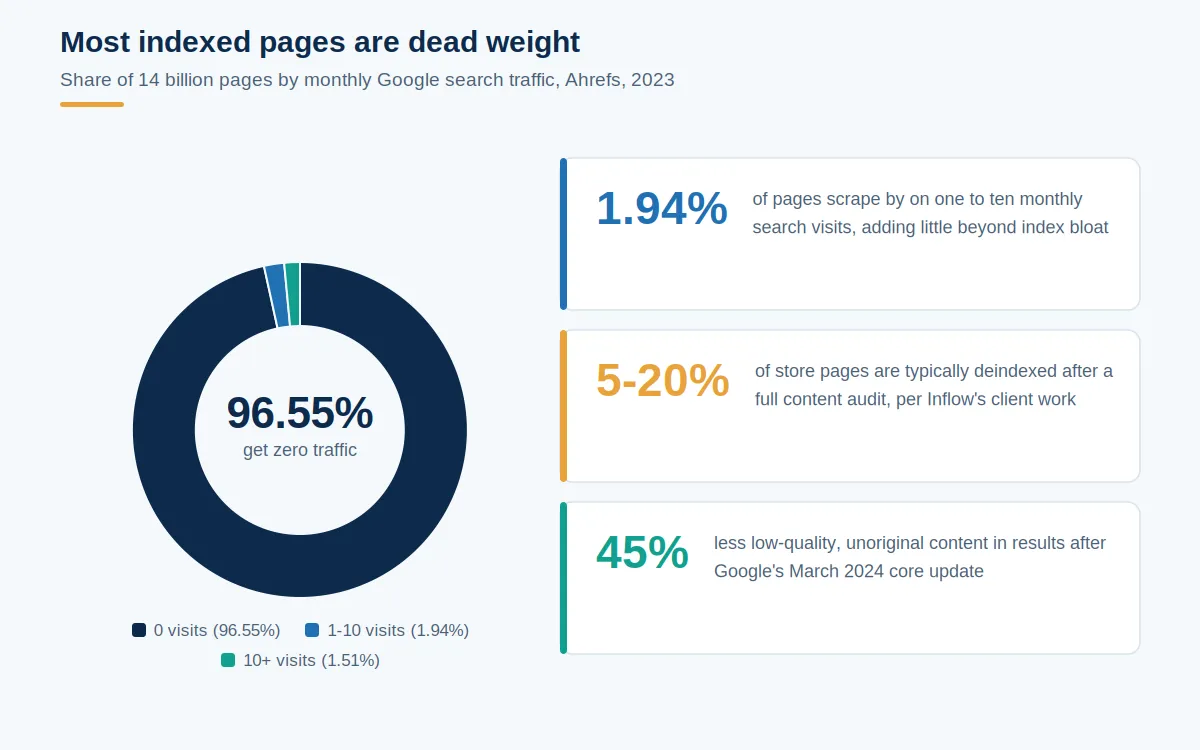
The case for pruning starts with an uncomfortable number. Ahrefs studied roughly 14 billion pages in its Content Explorer index and reported in 2023 that 96.55 percent of them receive no organic traffic from Google at all, with a further 1.94 percent scraping by on one to ten visits a month. Most sites carry their own miniature version of that distribution. Three distinct mechanisms explain why trimming it helps the survivors.
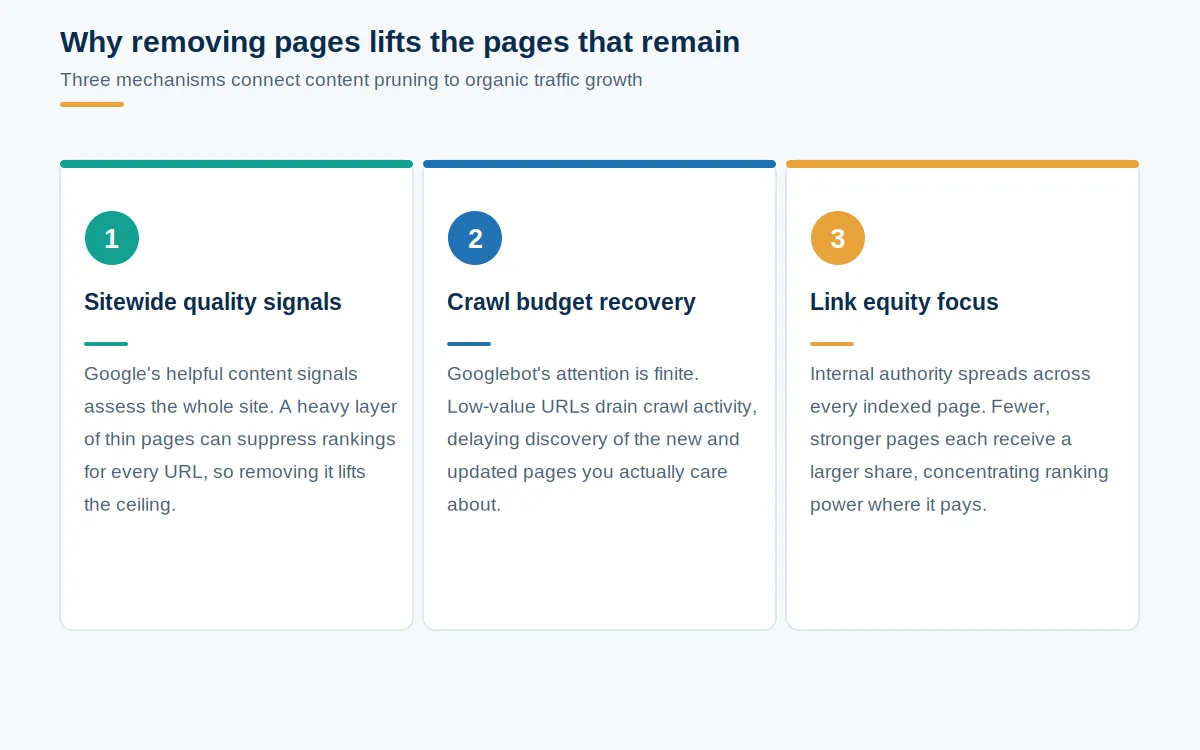
Sitewide quality signals #
Google's helpful content system, announced in August 2022, introduced a classifier that evaluates sites as a whole. Google's own documentation stated that "removing unhelpful content could help the rankings of your other content," because a site carrying a relatively high share of unhelpful pages is less likely to perform well anywhere. That system was folded directly into the core ranking systems with the March 2024 core update, which Google reported ultimately cut low-quality, unoriginal content in search results by 45 percent, ahead of the 40 percent reduction it projected when the rollout began in March 2024. The bar for sitewide quality is higher than it has ever been, and a bloated archive works against every URL you publish.
Crawl budget recovery #
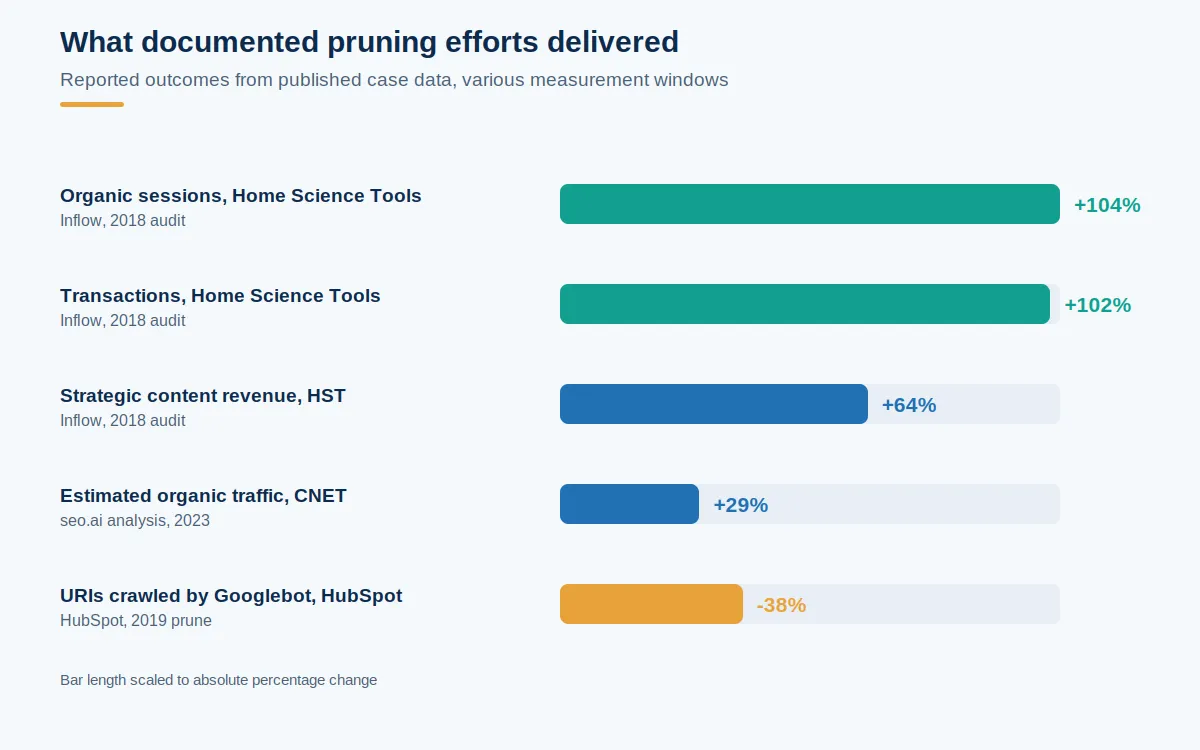
Googlebot's attention is finite. Google's crawl budget guidance from January 2017 is explicit that wasting server resources on low-value URLs drains crawl activity from pages that do have value and can significantly delay the discovery of new or updated content. The effect is measurable. After HubSpot deleted roughly 3,000 outdated posts in February 2019, its technical SEO team recorded a 20 percent decrease in total crawls and a 38 percent decrease in URIs crawled, and new posts started getting indexed within minutes or hours rather than days.
Concentrated link equity #
Internal authority behaves like a fixed budget spread across every indexed page. Each thin URL that sits in your architecture claims a slice of the equity flowing through navigation, category, and contextual links. Prune a few hundred pages that were never going to rank, and every remaining page inherits a larger share, which is why keyword footprints usually expand across the whole site after a prune rather than only on directly affected sections.
What the Documented Results Look Like #
HubSpot's project is the most transparent large-scale example. The team crawled the blog, merged analytics and backlink data per URL, and routed every low-traffic post through a three-way decision: delete it, redirect it, or historically optimize it. Alongside the crawl efficiency gains, HubSpot reported that organic traffic climbed after the removal of 3,000 posts, while pruned articles with salvageable content were syndicated externally to build hundreds of new backlinks.
The agency Inflow published an unusually well-measured mid-market case. For Home Science Tools, an education retailer, roughly 200 blog pages, about 10 percent of the blog, were pruned in August 2018 based on a simple test: little or no organic traffic, pageviews, conversions, or backlinks. The keyword footprint dipped slightly, then expanded through the following 90 days. Inflow's published results show a 104 percent increase in organic sessions, a 102 percent increase in transactions, and a 64 percent increase in strategic content revenue, a pattern the agency reports across ecommerce marketing clients where 5 to 20 percent of pages typically get deindexed after a full audit.
Even the controversial CNET prune produced suggestive numbers. An August 2023 analysis by seo.ai of Ahrefs visibility data estimated CNET's organic traffic rose about 29 percent in the two months after its mid-2023 cleanup, from roughly 19 million to 24.5 million estimated monthly visits, reversing a multi-year decline. Correlation deserves caution, and Google's public discomfort with the framing was real. But the pattern across all three cases is consistent: remove what demonstrably earns nothing, and the rest of the site breathes.
How to Run a Content Pruning Audit #
The audit is where pruning succeeds or fails, because every later step simply executes what the spreadsheet decided. Budget most of your effort here.
Build the inventory #
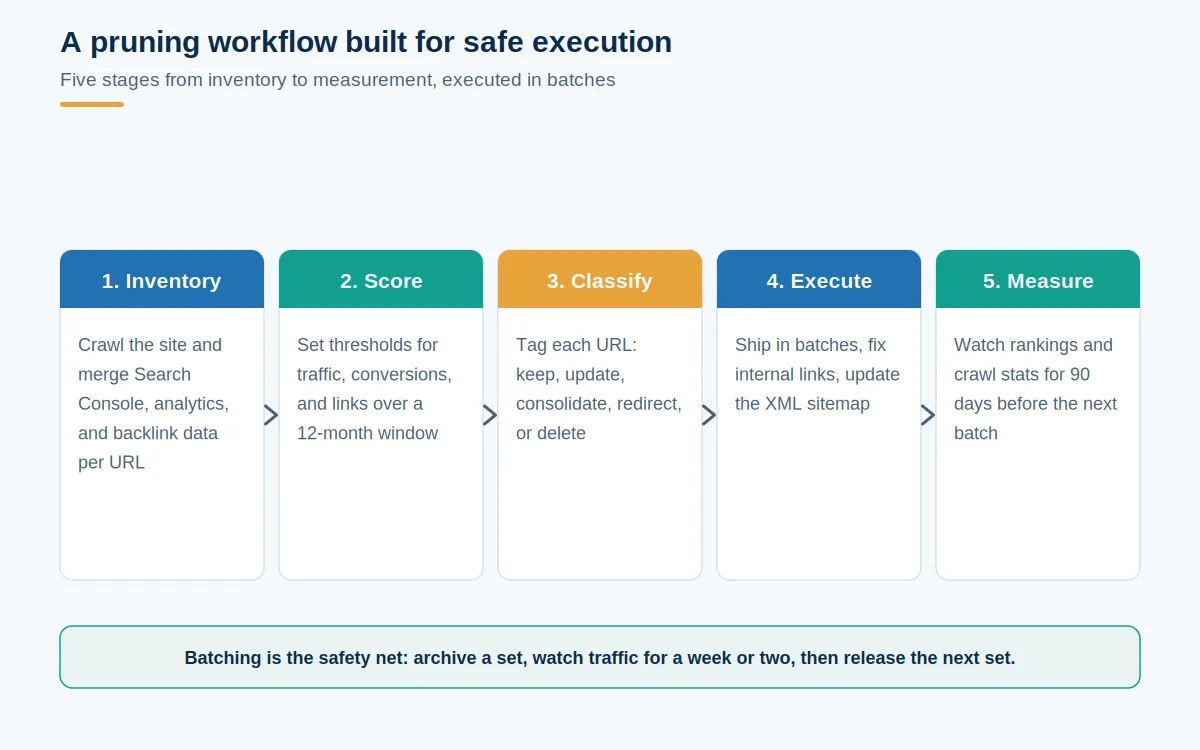
Crawl the target section with a tool such as Screaming Frog, then join three data sources onto every URL: Search Console clicks and impressions, analytics sessions and conversions, and backlink counts from a link index. Use a full 12-month window so seasonal pages get a fair reading. The output is one row per URL with everything you need to judge it, including indexability status, internal link counts, word count, and last modified date.
Set performance thresholds #
Thresholds should be relative to your own traffic distribution, not an absolute number borrowed from someone else's site. A practical approach is to isolate the bottom slice of URLs that collectively contribute under a few percent of organic sessions, then screen that slice against two protective filters: pages earning meaningful traffic from non-organic channels, and pages that assist conversions even at low volume. This is where pairing the audit with conversion rate optimization data pays off, because a page with 30 visits and a 12 percent demo request rate is not dead weight; it is a quiet asset.
Classify every URL #
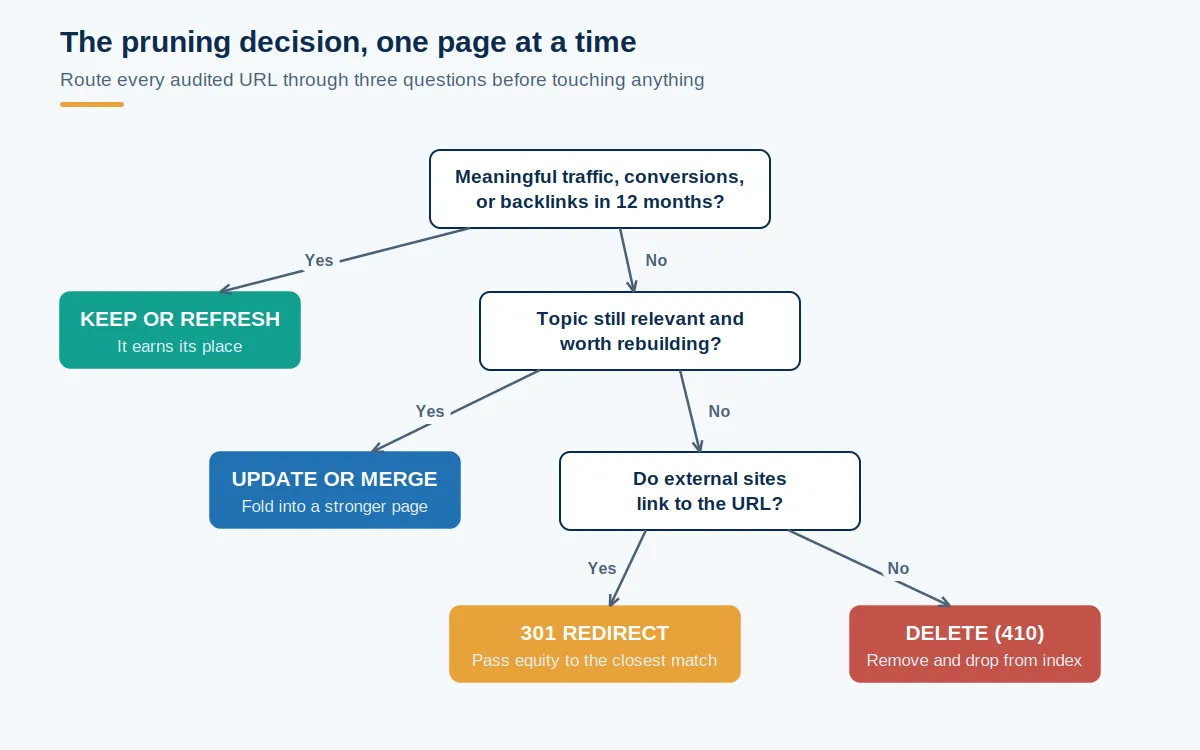
Route each surviving candidate through three questions. Does it earn meaningful traffic, conversions, or links? If yes, keep or refresh it. Is the topic still relevant and worth rebuilding? If yes, update it or merge it into the strongest overlapping page, a job worth briefing properly if you use external content writing services. If neither, the deciding factor is backlinks: redirect URLs that have them, delete URLs that do not. Pages with navigation or user value but no search value, such as tag archives, take a noindex tag instead of deletion.
Executing the Prune Without Losing Equity #
Execution is mechanical, but four details protect the equity you already hold. First, redirect to the closest topical match, never in bulk to the homepage or a category root. Google treats irrelevant redirects as soft 404s, and the authority you hoped to pass evaporates. Second, serve a 410 status for true deletions rather than a 404 where your platform allows it, since a 410 tells crawlers the removal is deliberate and permanent, which clears the index faster.
Third, clean up after yourself. Strip internal links that point at removed URLs, regenerate the XML sitemap so it lists only live, indexable pages, and check that no canonical tags reference destinations that no longer exist. HubSpot considered this important enough to script the internal link cleanup before archiving a single post. Fourth, ship in batches. Archive one tranche, watch rankings and crawl stats for a week or two, then release the next. Batching converts a bet-the-site decision into a series of small reversible experiments.
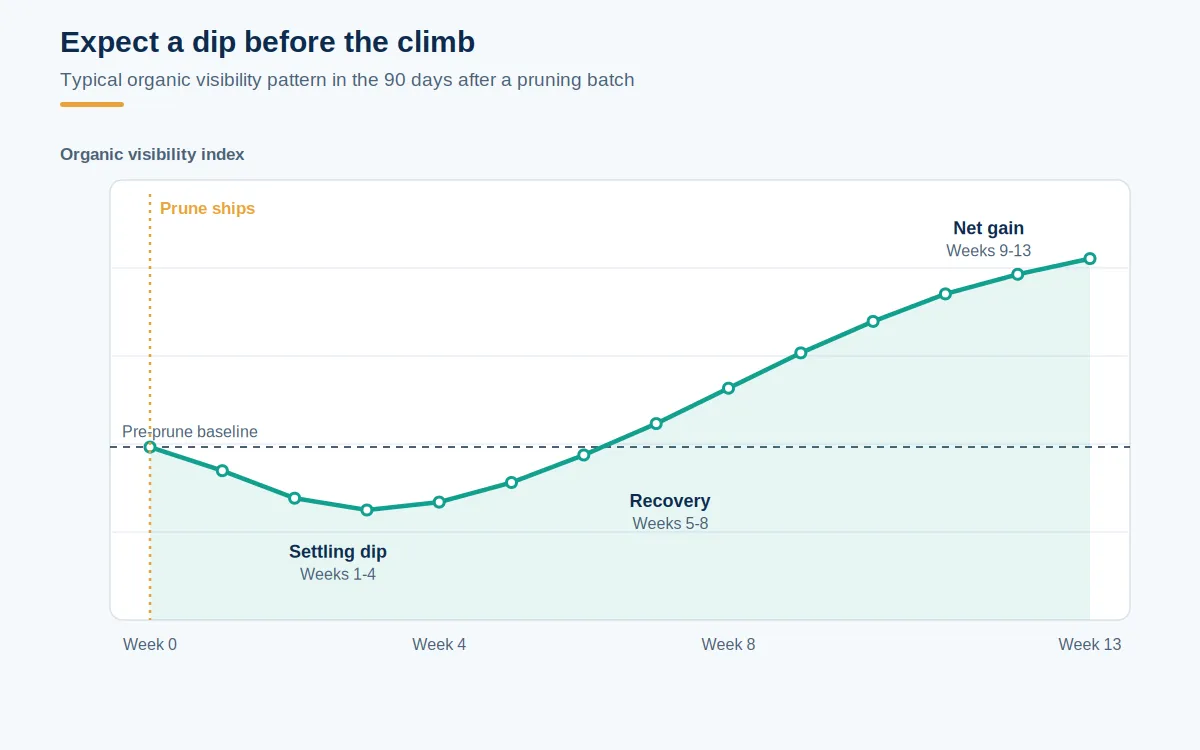
Then leave the scoreboard alone for a while. Expect a modest visibility dip in the first two to four weeks as Google recrawls and resettles the section, the same pattern Inflow observed before Home Science Tools' 90-day climb. Teams that panic and restore everything in week three usually convert a temporary dip into a permanent muddle. Judge the project at 90 days on organic sessions, keyword footprint, indexation counts, and crawl stats, not on day ten screenshots.
The Judgment Calls That Decide the Outcome #
Most pruning damage traces back to a handful of predictable judgment calls rather than the concept itself. Pages that convert without ranking, such as sales enablement content shared by reps, deserve protection no matter what their organic numbers say. Seasonal pages measured in their off-season will always look prunable and almost never are. Legal, support, and policy pages carry obligations that outrank traffic math entirely.
Backlinked URLs need individual review rather than batch treatment, because a single forgotten page with 80 referring domains can be worth more than everything else on the delete list combined. And when a page has usability value but no search value, noindex preserves the experience while removing the ranking liability. The common thread: the spreadsheet nominates candidates, but a human confirms every removal.
Content Pruning in the AI Search Era #
Pruning now pays a second dividend beyond the classic ranking mechanics. AI search surfaces, from Google's AI Overviews to assistants like ChatGPT and Perplexity, retrieve a small set of pages per answer and cite the sources that map most cleanly onto a topic. A site whose archive is 40 percent near-duplicate or abandoned content presents a blurry topical footprint to those retrieval systems, while a pruned site concentrates its signals into fewer, stronger, more quotable pages. The same consolidation that sharpens topical authority for classic rankings makes a site easier for generative engine optimization to build on, and it trims the low-value URLs that AI crawlers would otherwise spend their own finite attention fetching.
The practical move is to add one column to the next audit: whether a URL earns citations or mentions in AI answers, which modern AI SEO tracking can now surface alongside classic metrics. Pages that AI systems already trust get the same protection as converting pages, whatever their click counts say. If running the full inventory, scoring, and execution cycle in-house feels heavy, an experienced SEO services team can carry the audit end-to-end and hand back a defensible removal list.
Frequently Asked Questions #
What is SEO content pruning?
SEO content pruning is the process of auditing a site's pages and removing, consolidating, redirecting, or updating the ones that earn no traffic, conversions, or links, so quality signals and crawl budget concentrate on stronger pages.
Does deleting old content improve SEO?
Deleting content because it is old does not help. Deleting content because it demonstrably earns nothing can help, since Google's helpful content documentation notes that removing unhelpful content may improve how other content ranks.
How do I know which pages to prune?
Flag URLs with little or no organic traffic, conversions, and backlinks over a full 12-month window, then manually confirm each candidate has no business, seasonal, or navigational value before acting.
Should I delete, redirect, or noindex a low-performing page?
Delete pages with no backlinks and no salvageable value, 301 redirect pages that have backlinks to the closest topical match, and noindex pages that help users but should not rank, such as tag archives.
How many pages should I prune at once?
Work in batches. Remove one tranche, monitor rankings and crawl stats for a week or two, then release the next, so any unexpected drop stays small and reversible.
How long does content pruning take to show results?
Expect a small dip in the first two to four weeks, recovery by weeks five to eight, and a fair verdict at 90 days, the window in which documented cases like Home Science Tools showed their gains.
Can content pruning hurt my rankings?
Yes, if pages with backlinks, conversions, or seasonal demand are removed carelessly. Data-driven classification, individual review of backlinked URLs, and batched rollouts remove most of that risk.
What is the difference between a 404 and a 410 for removed pages?
Both signal a missing page, but a 410 states the removal is permanent and intentional, so search engines typically drop the URL from the index faster than with a 404.
How often should I run a content pruning audit?
Once or twice a year suits most sites. Large publishers and stores that add pages continuously benefit from auditing a different section every quarter.
Does content pruning help with AI search visibility?
Yes. A pruned site presents a cleaner topical footprint to AI retrieval systems, which favors the concentrated, authoritative pages that earn citations in AI-generated answers.