Topical Authority vs Expertise: What Wins on Google Search?

Tuba
August 4, 2026
Table of Contents
- Key takeaways
- What Topical Authority Actually Means, and Where the Idea Came From
- What Google Means When It Says Expertise
- Why the Versus Framing Falls Apart
- A Six-Month Test of Going All In on Topics
- The Query Decides the Winner
- AI Overviews Raised the Price of Being Uncited
- Building Both Without Doubling the Content Budget
- How to Audit Where Your Site Stands Right Now
- Frequently Asked Questions
Key takeaways #
Topical authority and expertise are not competing strategies, and framing them as rivals is how sites end up with neither. Comprehensive topic coverage gets you into the candidate set for rankings and AI citations; verifiable expertise and trust decide who wins high-stakes queries. The sites growing through 2026 build both deliberately, and this article shows the data behind that claim plus a playbook for doing it without doubling your content budget.
Ask this question in any marketing meeting, and you will hear two confident camps. One says Google rewards sites that cover a subject completely, so publish the full cluster and the rankings follow. The other says Google rewards credentials and reputation, so one article from a recognized expert beats forty from a content team. Both camps can point to wins. Both are describing half of the same system.
This guide walks through what each concept actually means inside Google's documentation, what six months of fresh case study data shows, how AI Overviews changed the economics, and how to build both signals at once on a mid-market budget.
What Topical Authority Actually Means, and Where the Idea Came From #
Topical authority is a site's demonstrated depth and breadth on a subject: the degree to which it covers the full set of subtopics, questions, and entities around a theme, so search systems treat it as a reliable source for that territory. It is measured at the site and topic level, not the page level, which is why a single long article rarely creates it.
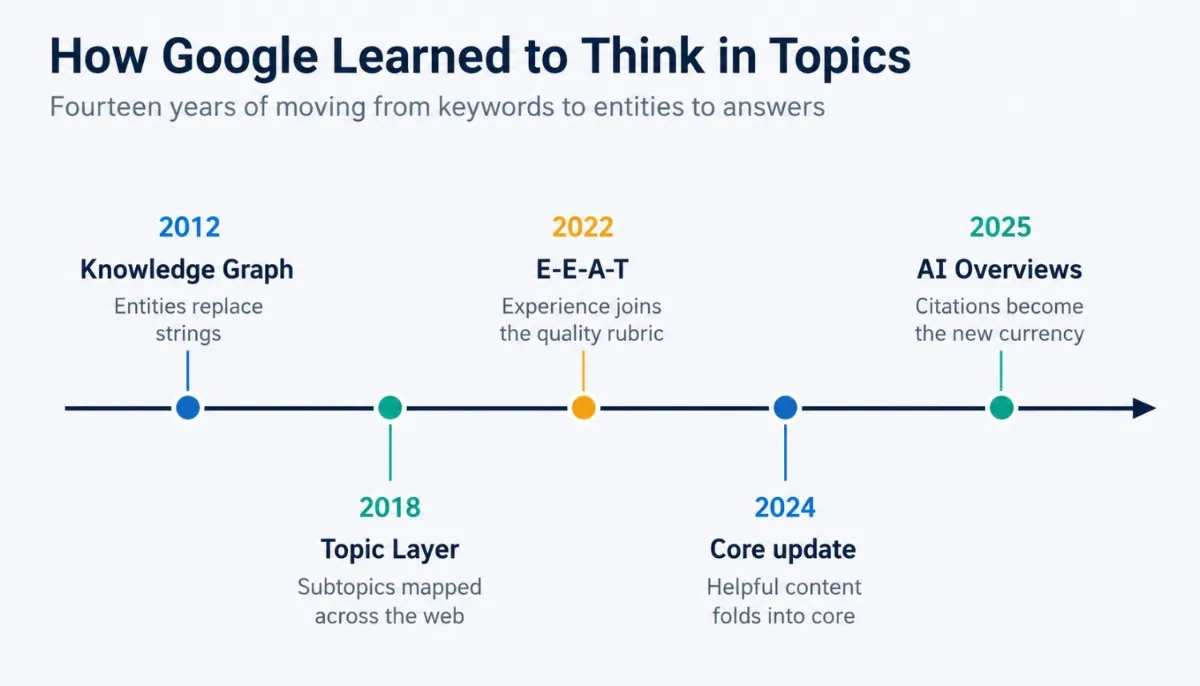
The concept is not an SEO invention. Google introduced the Knowledge Graph in 2012 to understand entities rather than keyword strings, then announced the Topic Layer in September 2018 as a dedicated system, described on Google's own blog as being built by analyzing web content for each topic and developing “hundreds and thousands of subtopics” that can relate to one another. In other words, Google maintains a map of every subject. Topical authority is how closely your site's coverage matches that map compared with everyone else competing for it.
That framing explains the practical pattern most SEO teams have observed: thirty interlinked pages that each resolve one subtopic tend to outperform one heroic five-thousand-word page, because the cluster mirrors the structure Google already uses to understand the subject.
What Google Means When It Says Expertise #
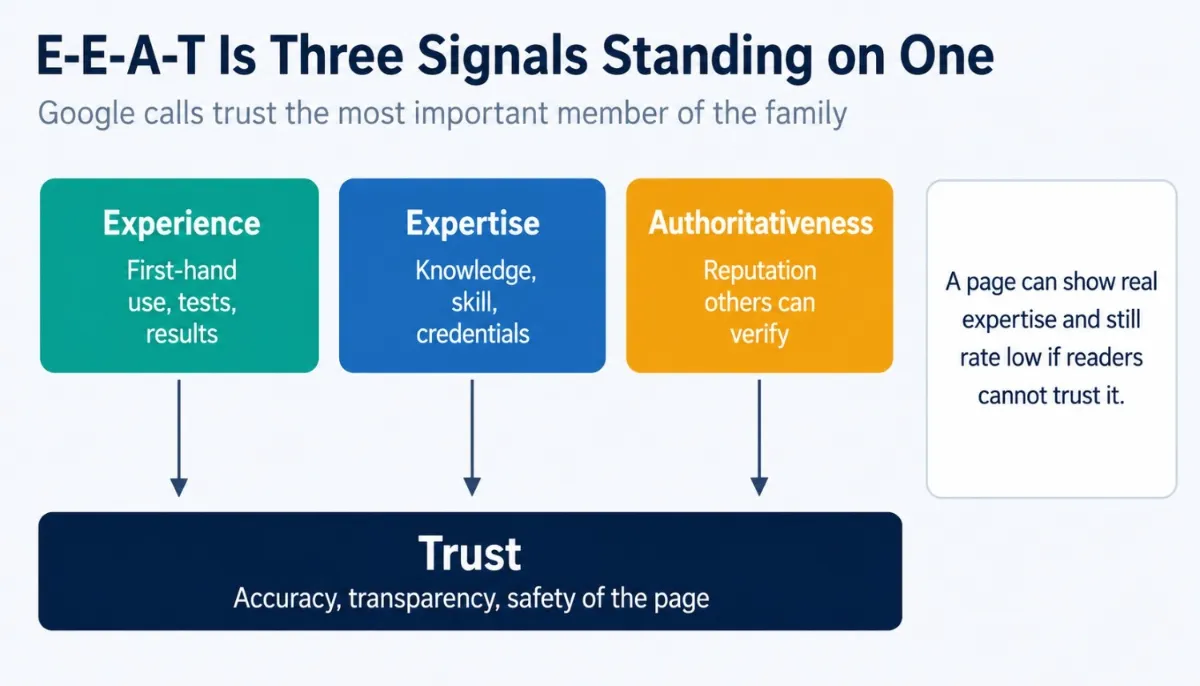
Expertise lives inside E-E-A-T: Experience, Expertise, Authoritativeness, and Trust, the rubric Google's human quality raters use to score search results. Google added the first E, Experience, on December 15, 2022, to distinguish first-hand knowledge, such as having actually used a product or lived through a situation, from formal expertise, such as a credential or professional skill. Authoritativeness covers reputation: whether other people and publications recognize you as a source. Trust sits underneath all three, and Google's guidance is explicit that trust is the most important member of the family.
Two details matter for strategy. First, raters do not set rankings; their scores calibrate automated systems, so E-E-A-T describes what the algorithms are tuned to find, not a checkbox on your page. Second, Google's helpful content documentation tells creators to self-assess against “Who, How, and Why”: who created the content, how it was produced, and why it exists. That is a machine-readable brief, since bylines, author pages, schema markup, and off-site corroboration are all things crawlers can verify.
Reputation is the piece most teams underinvest in. What the rest of the web says about your brand and your authors feeds authoritativeness directly, which is why reputation management has quietly become an SEO discipline rather than a PR afterthought.
Why the Versus Framing Falls Apart #
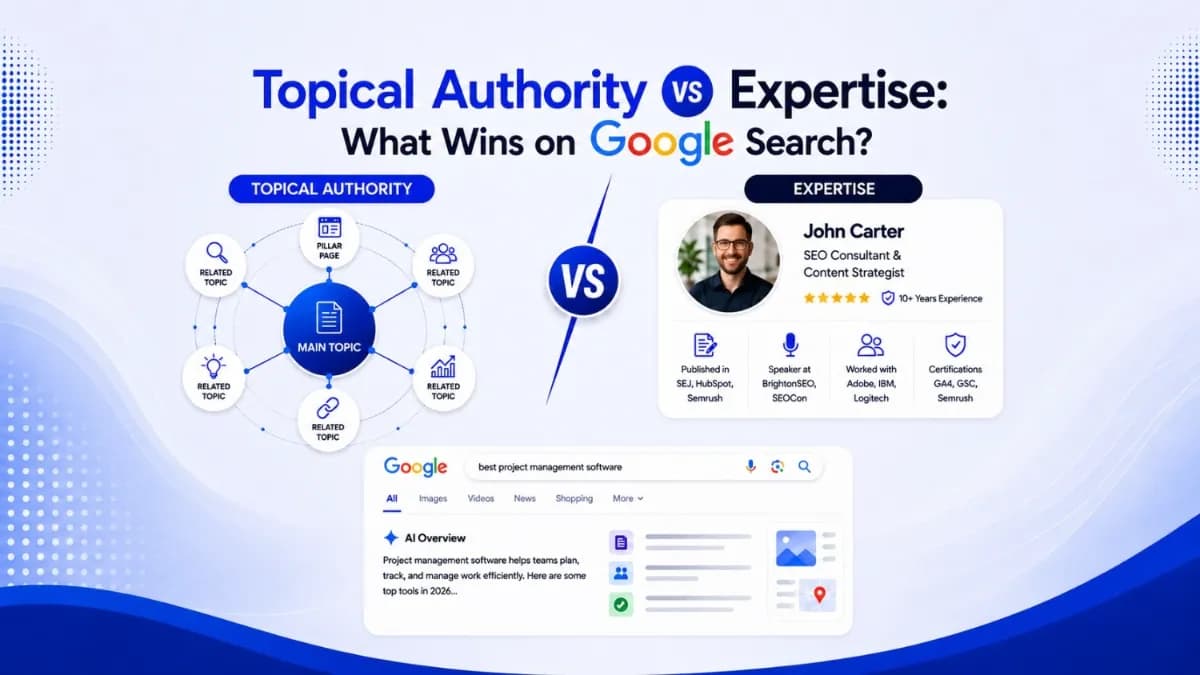
Coverage and credibility answer two different questions. Topical authority answers: does this site know the whole territory? Expertise answers: should anyone believe it? Because the questions are different, the signals are built through different work, and a site can hold any combination of the two.
The confusion persists because both deficits produce the same surface symptom, disappointing rankings, while failing in different ways. A coverage deficit shows up as absence: you never appear for most of the territory, and the loss is invisible in analytics because there is nothing to decline. A credibility deficit shows up as volatility: rankings arrive, then get re-scored away in the next core update, which reads as an algorithm problem when it is really a proof problem. Diagnosing which failure you actually have is the single most valuable thing this comparison can do for a marketing budget.
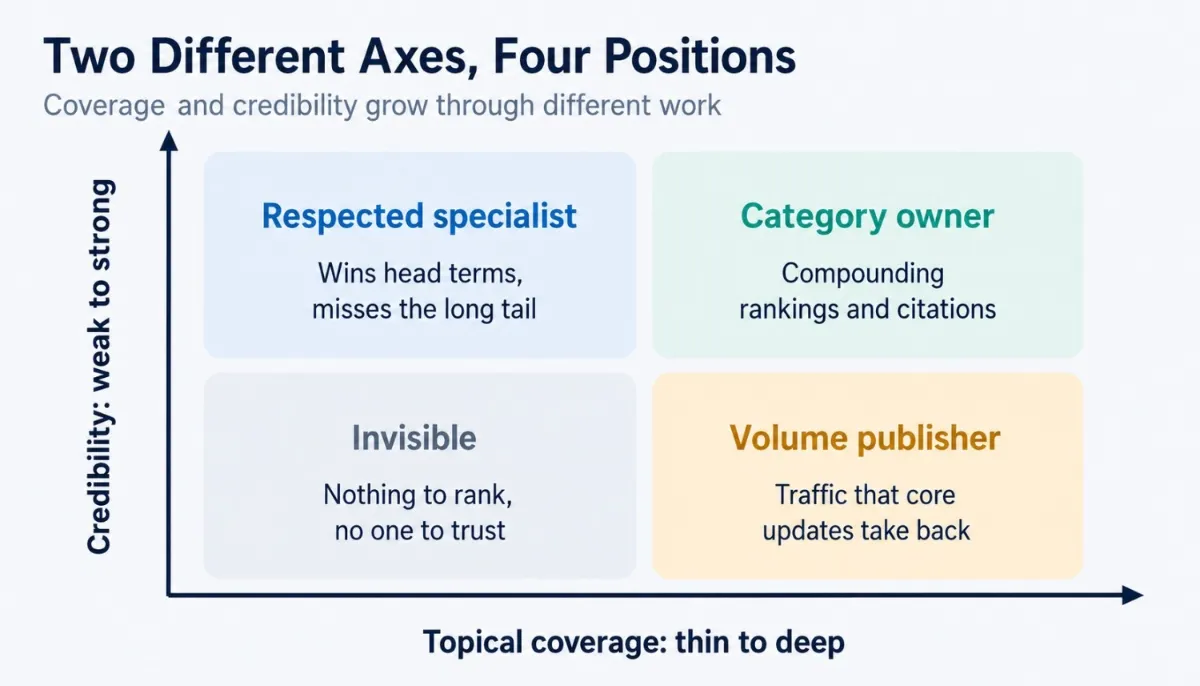
Plot them as axes and four positions appear. Sites with neither are invisible. Sites with strong credibility but thin coverage, think a respected consultancy with twelve blog posts, win their head terms and miss the long tail. Sites with deep coverage but weak credibility, the classic programmatic content play, rank until a core update re-scores them, which is exactly what happened at scale across 2024 and 2025. The compounding position is the fourth quadrant: full coverage published by people Google can verify.
A Six-Month Test of Going All In on Topics #
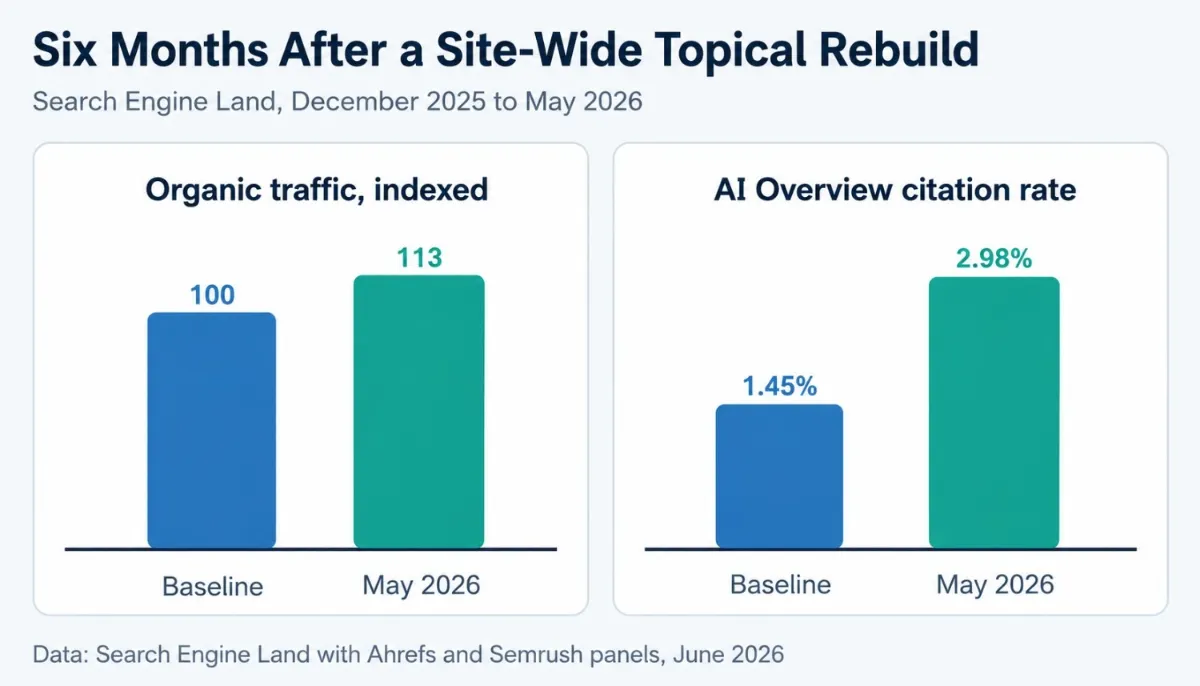
The most useful recent evidence comes from Search Engine Land, which ran a site-wide topical analysis and rebuild starting in early March 2026 and published the results in June 2026. By the end of May, its organic traffic stood at 113 percent of the pre-rollout baseline in Ahrefs panel data, during a period when comparable editorial sites were flat or declining. Its AI Overview citation rate, the share of ranking keywords where the domain is cited as a source, more than doubled from 1.45 percent to 2.98 percent by mid-May in SEMrush Domain Overview data.
Read the result carefully, because it is evidence for both camps. Search Engine Land already had the credibility layer: named industry journalists with long public track records. What changed was systematic coverage. The expertise was real but underexpressed until the topic map was filled in, at which point both rankings and citations moved within a single quarter. Coverage did not replace expertise; it unlocked the value of expertise that was already there.
The Query Decides the Winner #
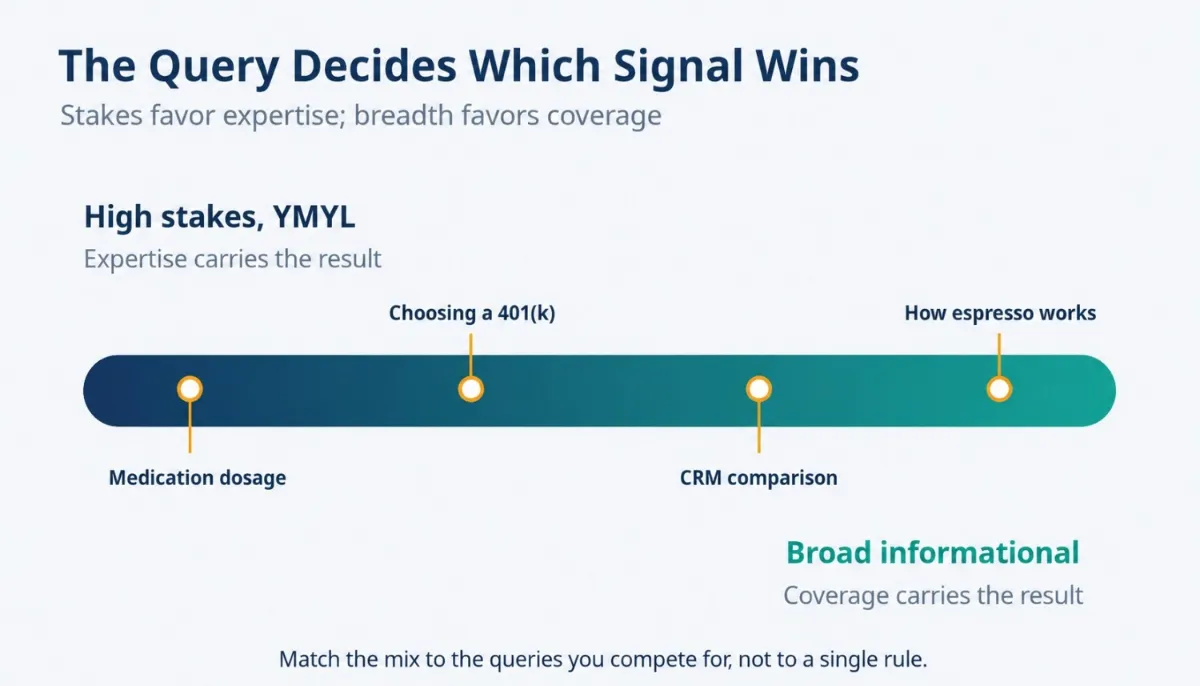
If you need a single rule, use this one: the query decides how the weight is distributed. On YMYL searches, the health, finance, safety, and legal topics where a bad answer causes real harm, Google's rater guidelines demand the highest E-E-A-T, and expertise signals dominate. A hundred well-clustered pages on medication dosages from an anonymous site will not outrank a thin page from a hospital system.
Move along the spectrum and the balance shifts. Commercial comparison queries reward both: buyers want a site that covers every alternative and shows hands-on evidence of testing, and those are also the pages where conversion rate optimization pays back fastest because the traffic has intent. At the far end, broad informational queries are won mostly on coverage quality, and Google's own December 2022 guidance notes that for some personal topics, first-hand experience beats formal credentials entirely.
The operational move is to segment your target keyword set by stakes before assigning authors. High-stakes clusters get credentialed review and named experts. Mid-stakes clusters get practitioner authors with evidence. Broad informational clusters get your content team working from a subtopic map.
AI Overviews Raised the Price of Being Uncited #
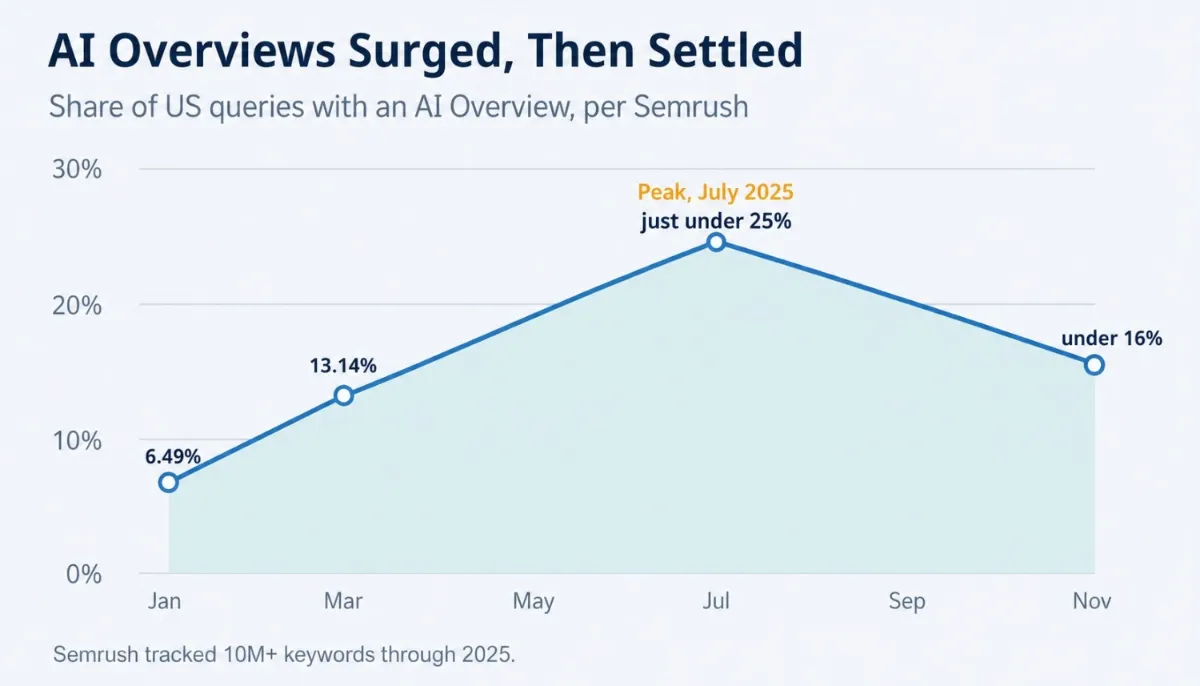
Whatever balance held in classic blue-link search, AI Overviews changed the payout table. A SEMrush study of more than 10 million keywords, updated in December 2025, tracked the feature across the year: AI Overviews appeared on 6.49 percent of US queries in January 2025, reached 13.14 percent by March, peaked just under 25 percent in July, then settled below 16 percent by November as Google tuned where they show. The same dataset found navigational queries triggering an Overview jumped from 0.74 percent in January to 10.33 percent by October, meaning even branded searches now route through synthesized answers.
The commercial follow-up is more pointed. A second SEMrush analysis published in July 2026, covering November 2025 through April 2026, found finance commercial queries triggering AI Overviews grew 231 percent in six months, and SERPs showing both Google Ads and an AI Overview had grown 394 percent by late 2025. In Jobs and Education, keywords with an Overview carried an average cost per click of $5.02 against $1.51 without one, which means organic citation and paid search budgets are now competing for the same high-value real estate.
Selection into those citations behaves like a compressed version of the ranking argument in this article: the models cite sources that look authoritative on the topic and are structured for extraction. That is why AI SEO and generative engine optimization programs both start from the same two inputs, a complete topic map and verifiable authors, rather than from any trick specific to the AI surface.
Building Both Without Doubling the Content Budget #
The efficient path is sequencing, not parallel spending. Six moves cover it.
Map before you write. Build the subtopic map for one commercial theme first: every question, comparison, and entity. The map is the brief for the next two quarters and prevents duplicate, overlapping posts.
Put a named human on every page. Real bylines, author pages with credentials, Person schema, and consistent author identities across LinkedIn and industry sites. Anonymous content forfeits the expertise axis entirely.
Add proof of experience. Screenshots, your own test data, dated results, and specifics only a practitioner would know. This is the cheapest E-E-A-T upgrade available because it reuses knowledge your team already has.
Pair experts with writers. Full expert authorship rarely scales; expert review of professionally produced drafts does. A disciplined content writing process with subject-matter sign-off satisfies both axes at roughly a third of the cost.
Interlink like the map says. Every cluster page links to the pillar and to its nearest siblings with descriptive anchors. Internal links are how you show Google the shape of your coverage.
Earn corroboration. Citations, mentions, podcasts, and data other sites reference. Authoritativeness is granted by third parties, and it is the signal that carries into AI citations most directly.
Cadence matters as much as the checklist. Coverage compounds on a publishing rhythm your team can hold for several quarters, and credibility compounds every time an author appears somewhere new, so review both monthly against the map instead of reacting to individual keyword movements week by week.
How to Audit Where Your Site Stands Right Now #
Before commissioning anything, spend an afternoon locating yourself on the matrix from Figure 3. The audit takes five steps.
Pick the one topic that drives revenue and list every subtopic a genuine expert would expect a definitive resource to cover. Score your coverage as a percentage of that list.
Check the author layer: do your top twenty organic pages carry named authors, and do those authors exist anywhere off your site? If the answer is no, credibility is your constraint.
Pull your fifty most valuable informational queries and record how many trigger an AI Overview and whether you are cited. That gap is your exposure.
Compare against the two competitors you lose to most. If they out-cover you, the fix is the map. If they out-credential you, the fix is authors and corroboration.
Place yourself in a quadrant and sequence accordingly: specialists build out coverage from proven strength, volume publishers retrofit authors and evidence before publishing anything new, and category owners defend by updating and pruning.
Run the audit once a quarter, and the versus question answers itself: whichever axis scores lower is where the next dollar goes.
Frequently Asked Questions #
What is topical authority in SEO? #
It is a site's demonstrated depth and breadth on a subject, built by covering the full set of subtopics and questions around it so search systems treat the site as a reliable source for that territory.
Is topical authority a confirmed Google ranking factor? #
Google has never named it as a discrete factor, but its topic-mapping systems and helpful content guidance reward comprehensive, interlinked coverage in ways that behave like one.
What is the difference between topical authority and E-E-A-T? #
Topical authority measures how completely a site covers a subject; E-E-A-T measures whether the people and brand behind the content can be trusted. One is coverage, the other is credibility.
Which matters more for a small site? #
Coverage of a tightly defined niche is the practical entry point: win one narrow subtopic completely, then layer in author credibility as the site grows.
How long does it take to build topical authority? #
Search Engine Land saw measurable movement within one quarter of a site-wide rollout, but most sites should plan on six to twelve months of consistent, mapped publishing.
Does domain authority equal topical authority? #
No. Domain-level scores are third-party estimates of link equity, and a strong link profile does not transfer to a subject the site has never covered.
Can AI-generated content build topical authority? #
It can fill a cluster quickly, but it fails the experience and originality tests on its own, so treat it as drafting support underneath expert review rather than the finished layer.
How does topical authority affect AI Overview citations? #
Strongly: comprehensive, well-structured coverage is associated with higher citation rates, and Search Engine Land's citation rate doubled within three months of its topical rebuild.
What expertise signals can Google actually read? #
Bylines, author bio pages, Person and Organization schema, credentials, consistent author identities across the web, original data, and first-hand evidence inside the content.
Should I hire subject-matter experts or SEO writers? #
Pair them. Expert review of professionally written drafts satisfies both the coverage and credibility tests at a fraction of the cost of full expert authorship.