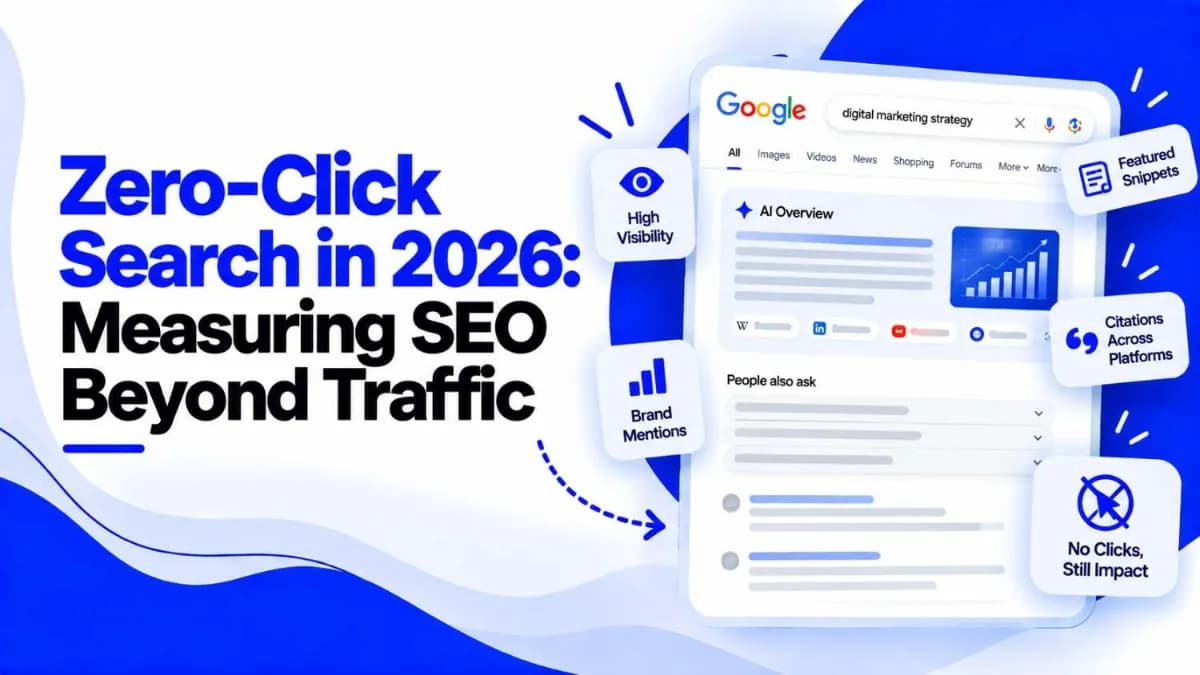
Zero-Click Search in 2026: Measuring SEO Beyond Traffic

Tuba
September 25, 2026
Table of Contents
- Key takeaways
- Zero-Click Search in 2026: Why SEO Success Can No Longer Be Measured by Traffic Alone
- What Zero-Click Search Means in 2026
- The 2026 numbers: what happens after a Google search
- AI Overviews and AI Mode: Where the Clicks are Going
- Reddit: The Clearest Case of Visibility and Traffic Pulling Apart
- Quora: Cited in One of Every Fourteen AI Mode Answers
- Why Traffic Alone Now Misreads SEO Performance
- How to Measure SEO Success in a Zero-Click World
- What Changes in Content and Channel Strategy
- Frequently Asked Questions
Key takeaways #
68.01% of US Google searches ended without a click between January and April 2026, up from 60.45% in 2024. That is the fastest two-year rise since the metric was first tracked (SparkToro, using Similarweb data, June 2026).
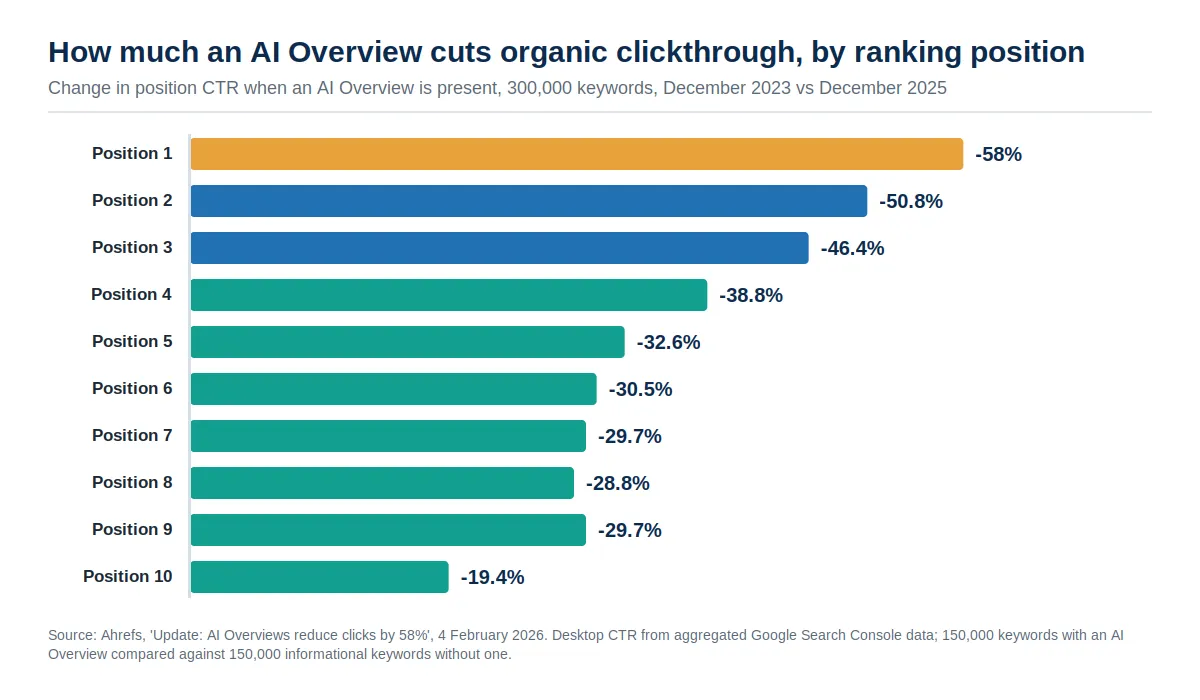
When an AI Overview is present, the top organic result loses about 58% of its expected click-through (Ahrefs, February 2026). Pew's browsing panel found users click a result on 8% of AI-summary searches versus 15% without one (July 2025).
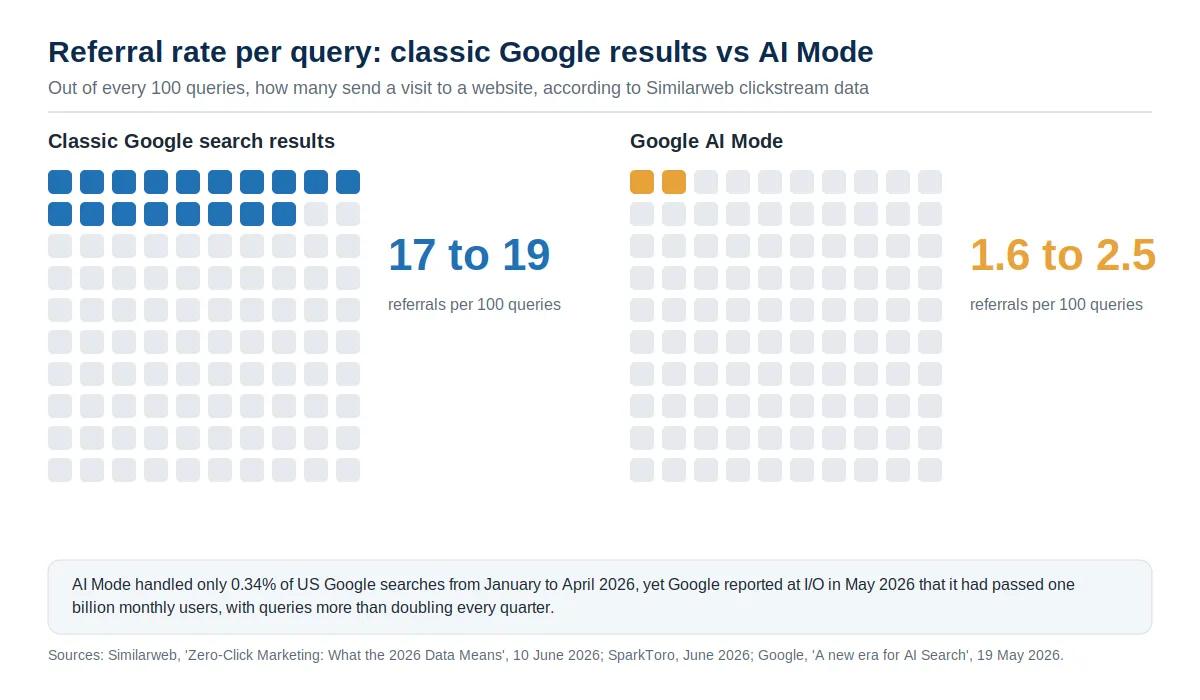
Google AI Mode sends a visit to a website on roughly 1.6 to 2.5 out of every 100 queries, against 17 to 19 for classic results (Similarweb, June 2026), and it has already passed one billion monthly users (Google, May 2026).
Reddit is the clearest case study in the split between visibility and traffic. Google now quotes forum and social posts directly inside AI answers (May 2026), while Reddit told investors its Google search referrals were 'choppy' in Q2 2026 even as revenue grew 61%.
Quora appears in about 1 in 14 Google AI Mode answers, and the answers that get cited are long, direct, and already flagged as most relevant by Quora's own ranking (Semrush, September 2025).
Traffic should move from the scorecard to the diagnostics. The scorecard now needs AI impressions, citation and mention share, branded search lift, and conversions from the visits that still arrive.
Zero-Click Search in 2026: Why SEO Success Can No Longer Be Measured by Traffic Alone #
For twenty years, the deal between Google and website owners was simple. You published something useful, Google ranked it, and some searchers came to your site. Traffic was the receipt. In 2026, that receipt no longer reflects what happened, because most searches now end on Google itself.
This post pulls together the most recent primary data on zero-click search across Google, Reddit, and Quora, explains why the numbers look the way they do, and lays out how to measure an SEO program when most people it reaches never click. Every statistic below is dated and linked to its source.
What Zero-Click Search Means in 2026 #
A zero-click search is a query where the searcher gets what they need on the results page and leaves without visiting any website. Featured snippets, knowledge panels, People Also Ask boxes, local packs, and unit conversions have been producing zero-click outcomes for a decade. What changed in 2024 and 2025 is that AI Overviews began answering longer, more specific questions in full, and in 2026 AI Mode turned Google into a conversational interface that rarely needs to send anyone away.
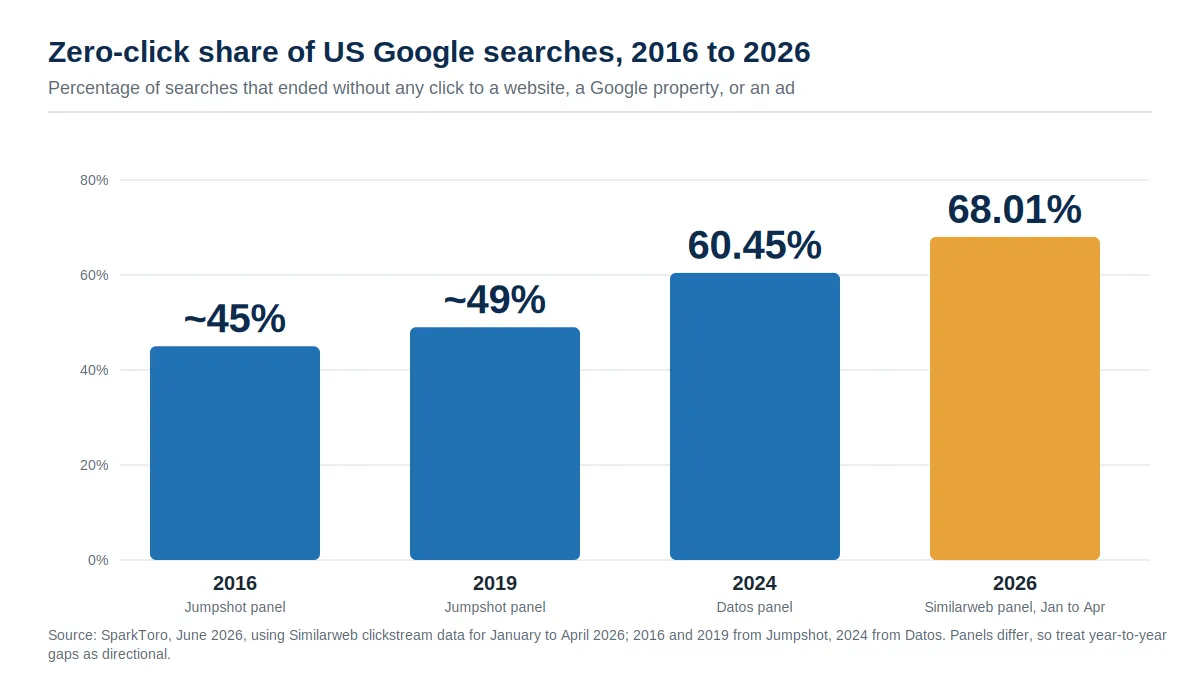
The most useful long-run series comes from SparkToro. Rand Fishkin first published a figure of roughly 49% zero-click searches in 2019 using Jumpshot clickstream data. Using Datos data for 2024, the US rate stood at 60.45%. In June 2026, he published a new study built on Similarweb's desktop and mobile browser panel, covering January to April 2026, and found that 68.01% of US Google searches ended without a click. Fishkin notes that the three panels differ, so the year-to-year gaps are directional rather than exact. The direction, however, has not changed once in ten years.
One methodological detail matters for anyone reading the number. The 2026 panel covers searches made in a mobile browser, not in the Google app, where zero-click features are used even more aggressively. The true figure is therefore likely higher than 68%.
The 2026 numbers: what happens after a Google search #
The headline figure hides the more interesting movement underneath it. Comparing 2024 with 2026, the share of searches that produced any click at all (to a website, to a Google property, or to an ad) fell by 9.51 percentage points, a 22.9% decline. The second largest change was the share of searchers who simply ran another search, which rose by 7.2 points. Google has become better at answering and better at prompting the next question, and both behaviors keep people on the results page.
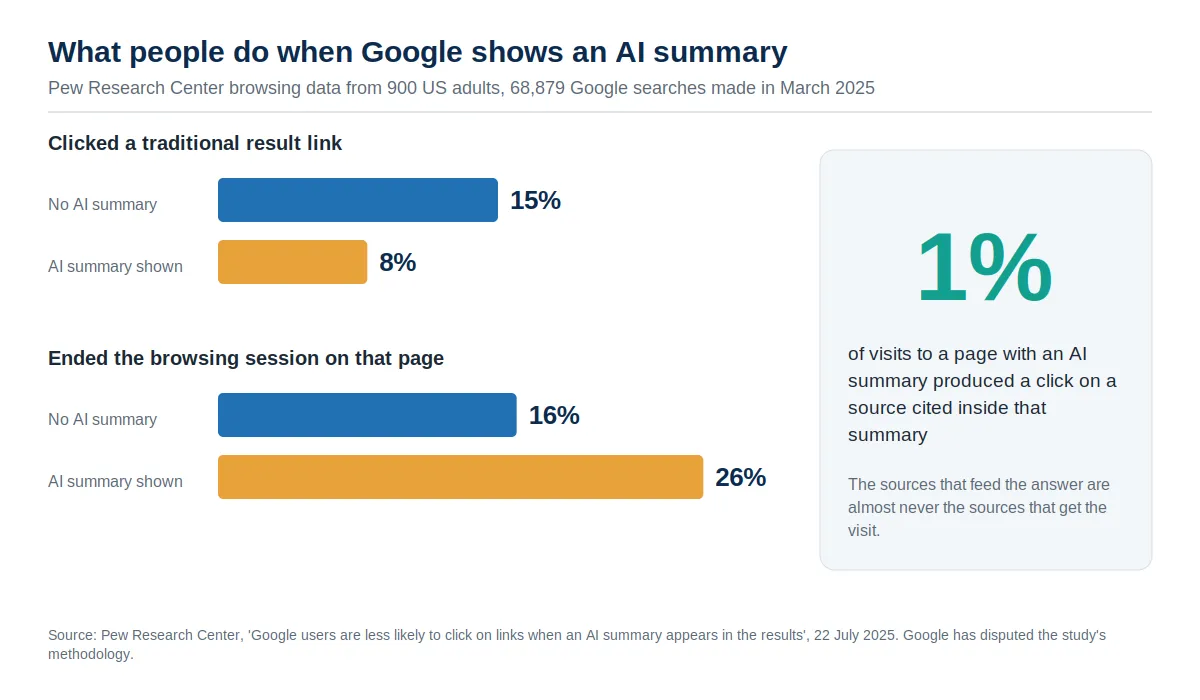
Independent behavioral data points to the same thing. In July 2025, Pew Research Center analyzed 68,879 Google searches made in March 2025 by 900 US adults who had agreed to share their browsing data. When an AI summary appeared, users clicked a traditional result on 8% of visits, against 15% when there was no summary. They clicked a source cited inside the summary on just 1% of visits, and they were more likely to end their browsing session on that page entirely (26% versus 16%). Google described the study's query set as unrepresentative, which is worth recording, but no comparable behavioral dataset from Google has been published to rebut it.
Similarweb's own analysis of the same 2026 panel adds a device split that B2B marketers should read twice. On desktop, 48% of searches ended with no activity, and only 20.4% clicked to a non-Google site. Mobile searchers were more likely to click out. If your buyers research on desktop, your real zero-click exposure is closer to 80% than 68%.
AI Overviews and AI Mode: Where the Clicks are Going #
AI Overviews now appear on more than 20% of Google searches, according to Ahrefs' trigger analysis cited in the SparkToro study, and their effect on click-through has worsened as the feature has matured. In April 2025, Ahrefs found that an AI Overview reduced clicks to the top-ranking page by 34.5%. In February 2026, the team re-ran the study on 300,000 keywords, comparing December 2023 with December 2025 Search Console data, and found that the presence of an AI Overview now correlates with a 58% lower click-through rate for position one. The damage runs down the page: position two loses 50.8%, position five loses 32.6%, and even position ten loses 19.4%.
AI Mode is the next phase, and it has barely started. Only 0.34% of US Google searches reached AI Mode between January and April 2026. Yet Google announced at I/O on 19 May 2026 that AI Mode had passed one billion monthly users, with queries more than doubling every quarter since launch, and that total Google queries had reached an all-time high. The same announcement made Gemini 3.5 Flash the default model in AI Mode, added an AI-powered search box, and let searchers flow from an AI Overview straight into a conversational follow-up.
What AI Mode does to referrals is the number to plan around. Similarweb measured AI Mode sending a visit to a website on 1.6% to 2.5% of queries, compared with 17% to 19% for classic Google results. A surface that refers to roughly a tenth of the old rate, growing at that pace, is why AI SEO has stopped being a niche specialism and become the center of the discipline.
The pattern is not confined to Google. Similarweb's traffic data showed AI platform visits growing 76% year over year in the second half of 2025 while referrals from those platforms had plateaued. The gap between how much people use AI and how much traffic AI sends is the structural signature of this era.
Reddit: The Clearest Case of Visibility and Traffic Pulling Apart #
Reddit is where the zero-click story becomes concrete, because it is one of the few large sites that reports its search dependence to investors every quarter.
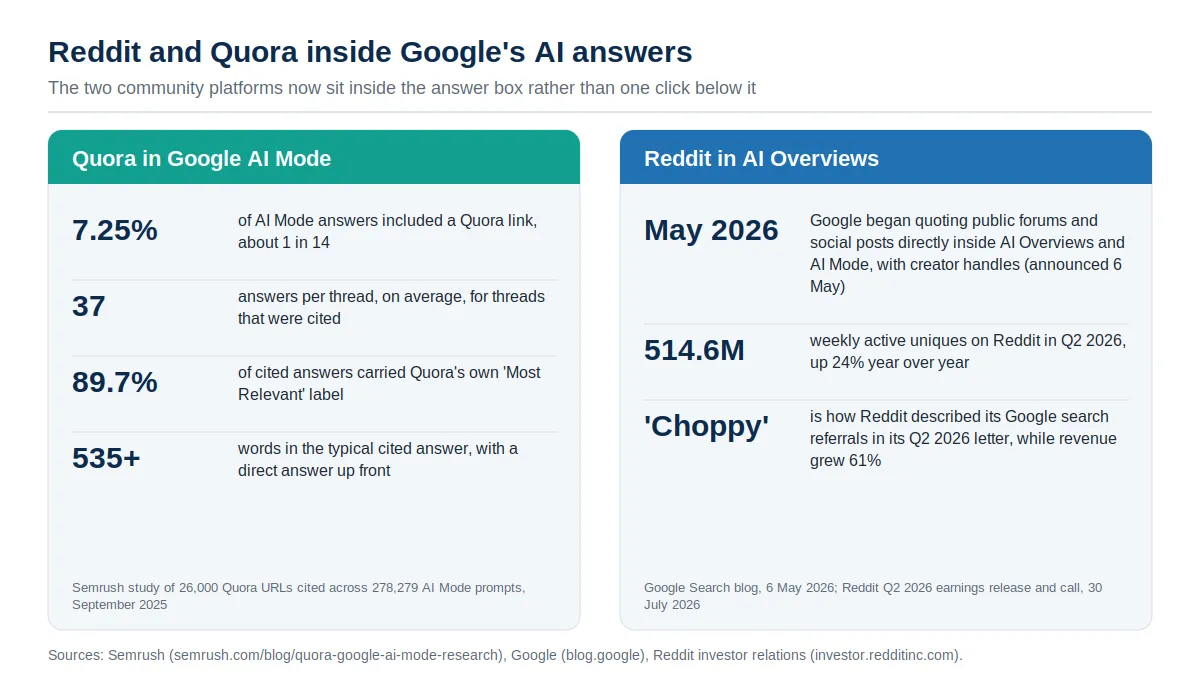
On the visibility side, Reddit's position has never been stronger. On 6 May 2026, Google announced five changes to AI Overviews and AI Mode, including a section that quotes perspectives from public online discussions, social media, and other firsthand sources directly inside the AI response, attributed to the creator's name, handle, or community. Google's stated reason was that, for many searches, people are increasingly seeking advice from others, a polite description of the habit of adding the word 'reddit' to a query. Reddit already ranked among the most-cited domains across AI engines: Semrush's 248,000-post study (refreshed October 2025) found Reddit links in 9% of Google AI Mode responses and 12.6% of SearchGPT answers, and a Peec AI analysis of 30 million cited sources, reported by Search Engine Land in March 2026, placed Reddit first across ChatGPT, AI Mode, Gemini, Perplexity, and AI Overviews.
On the traffic side, the picture is different. Reddit's second-quarter 2026 results, published on 30 July 2026, showed revenue up 61% year over year to $805 million and weekly active uniques up 24% to 514.6 million. The shareholder letter still said search referrals were 'choppy', and on the call, chief executive Steve Huffman said the ten blue links had driven real value while AI Overviews had 'yet to make a similar level of positive impact', adding that visibility into referral traffic remained low. He also said direct and app users were worth multiples more than search referrals and that Reddit was not building for drive-by traffic. The stock fell sharply the next day despite the beat.
That is the whole lesson in one company. Reddit is more visible in search than ever, is quoted inside the answer box itself, and is getting less predictable traffic for it. A brand that measured Reddit's SEO by sessions would conclude the program was failing. A brand that measured it by influence on the buying decision would reach the opposite conclusion.
For everyone else, the practical point is that Reddit threads are now raw material for Google's answers. If your category is discussed there and your brand is absent or misdescribed, that gap shows up in AI answers you will never see in analytics. This is reputation management work as much as SEO work.
Quora: Cited in One of Every Fourteen AI Mode Answers #
Quora has had a quieter decade than Reddit, but it has found a specific role inside Google's AI surfaces. In September 2025, Semrush analyzed 278,279 unique AI Mode prompts and identified 26,000 Quora URLs that were cited at least once. Quora appeared in 7.25% of AI Mode answers, about one in fourteen, which made it one of the four most-cited domains behind LinkedIn, Reddit, and Google's own properties. Semrush's earlier research had found Quora to be the most-cited source in AI Overviews.
The study also describes what a cited Quora answer looks like, and the description doubles as a brief for any content meant to survive inside an AI answer. Cited threads averaged 37 answers, and the cited replies averaged 15 upvotes and at least 535 words. Almost 90% (89.7%) of cited answers already carried Quora's own 'Most Relevant' label, which suggests Google leans on the platform's quality ranking rather than re-judging each answer. AI Mode does not quote Quora verbatim: the average overlap between an AI Mode response and the closest Quora answer was 0.435, so ideas are blended and rewritten rather than lifted.
Quora's own team, quoted in the study, recommends answering in the first one to three sentences, stating who you are and why you are qualified, keeping promotion to a fifth of the answer at most, and formatting for scanning. None of that is new advice. What is new is that a well-written answer on a third-party site can now be more visible in Google's AI surfaces than a page on your own domain, without producing a single measurable visit to either.
Don't treat Quora and Reddit as interchangeable. Different AI systems weight them differently, and the citation mix shifts month to month: Semrush's 13-week study of 230,000 prompts, published November 2025, found user-generated domains moved the most on AI Mode after Google's September 2025 changes, with YouTube, Reddit, and Facebook rising while Medium, Quora, and LinkedIn declined. Track your own category rather than assuming.
Why Traffic Alone Now Misreads SEO Performance #
Put the data together, and a familiar monthly report starts to look like a measurement error. Organic sessions fall while impressions hold or rise. Rankings are stable; click-through is not. Branded searches climb for reasons the attribution model cannot see. None of that means the SEO work stopped working. It means the work is paying out in a currency the dashboard doesn't count.
Four reasons traffic has become an unreliable proxy for SEO success. First, Google is consuming the click: the 22.9% fall in click-of-any-kind between 2024 and 2026 reflects a change in what Google does, not what your pages do. Second, the traffic that still arrives is different. Similarweb's September 2025 US desktop comparison found ChatGPT-referred visitors spent 15 minutes on site versus 8 for Google visitors, viewed 12 pages versus 9, and converted at 7% on transactional sites versus 5%. Fewer visits at higher intent is not the same as a decline.
Third, the influence happens off-site. Someone who reads your explanation in an AI Overview, sees your brand quoted in a Reddit thread, and searches your name a week later shows up as a branded or direct visit, not organic search. Fourth, Google itself has stopped reporting search visibility purely as clicks. In June 2026, Google Search Central introduced generative AI performance reports in Search Console, rolled out to every property worldwide on 31 August 2026. The reports show impressions from AI Overviews and AI Mode by page, country, device, and date. They don't show clicks, which tells you how Google now values appearing in an answer.
The SparkToro study makes the point bluntly: traffic can fall precipitously even as revenue rises, and the advice is to replace traffic as a KPI rather than to try to win it back through better rankings. That is uncomfortable for anyone whose contract or bonus is written in sessions, but it is the honest reading of the data.
How to Measure SEO Success in a Zero-Click World #
Traffic does not disappear from the report. It moves from the scorecard to the diagnostics, and we rebuild the scorecard around visibility, influence, and outcomes. Here is the structure we use.
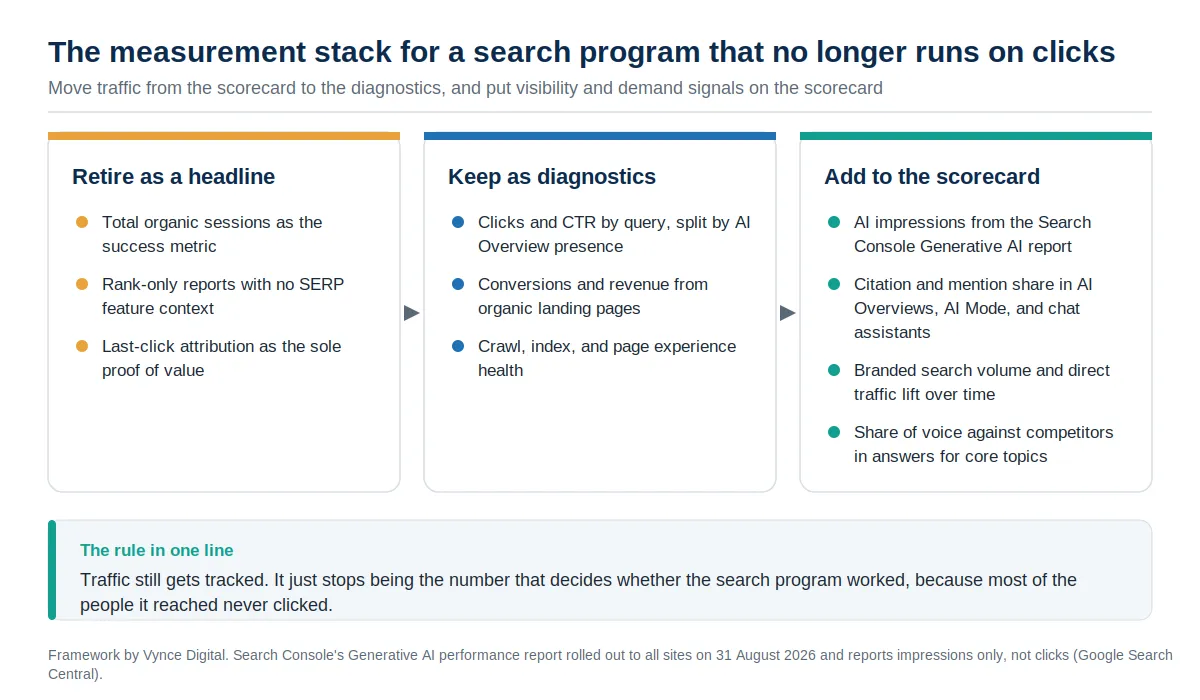
Keep clicks, but split them. Pull Search Console data by query and tag each query by whether an AI Overview appears for it. A page losing 50% of clicks on AI Overview queries and holding steady elsewhere is not a page with a content problem. Report the two groups separately so nobody optimizes the wrong thing. Keep conversions and revenue from organic landing pages exactly as before; those are the outcomes the whole program exists for.
Add AI impressions from the Search Console Generative AI report as a first-party visibility measure. It is impressions only and still labeled beta, so use it to compare pages and trends within your own site rather than as a traffic number. Pair it with citation tracking: run your core category prompts through AI Overviews, AI Mode, ChatGPT, and Perplexity on a fixed schedule and record whether your domain, your brand, or a third-party page about you is cited or mentioned. Share of voice against named competitors on those prompts is the closest thing to a ranking report the AI era offers, and it is the core of any generative engine optimization program.
Add demand signals. Branded search volume, direct traffic, and branded query impressions in Search Console are the downstream evidence that off-site visibility is working. Track them monthly against content publication dates and citation wins. The link is indirect, but an unexplained lift in branded search following a run of AI citations is the attribution signal you actually have.
Classify keywords by their zero-click rate before setting targets. Similarweb's keyword data now reports a zero-click rate per query. A definitional or factual term where 80% of searches never click should be judged on citation and presence, not sessions. A commercial comparison term where most searches still click should be judged on clicks and conversion rate. Setting a traffic target on a query Google answers in full sets you up for failure.
Finally, give the number a context that clients and leadership can read at a glance. A line such as 'organic sessions down 18%, AI impressions up 40%, branded search up 12%, organic revenue flat' tells a truthful story. 'Traffic down 18%' on its own tells a false one.
What Changes in Content and Channel Strategy #
Measurement follows strategy, and the strategy has three parts. First, write for extraction. AI systems retrieve passages, not pages. Every section should open with its conclusion, define its terms explicitly, and carry dated, sourced numbers, because those are the passages that get cited. This brief differs from writing to hold attention for eight minutes, and most content programs still write to the old brief.
The second is to show up where the answers are sourced. Reddit and Quora now feed into Google's answer, and so do YouTube, LinkedIn, and the specialist publications in your field. Participation has to be real: Quora's own guidance is four parts useful to one part promotional, and Reddit communities remove anything less. Treat community presence as a social channel with an SEO outcome, staffed by people who know the subject.
The third is to accept that some categories still earn clicks and to defend them. Branded queries, local intent, and high-intent transactional searches remain click-rich, and SparkToro's summary of the sites still growing in Google in 2026 points to the same profile: a product or service to buy, a task the visitor can complete, proprietary data, tight topical focus, and a recognizable brand. Those are the pages where traffic is still the right measure, and they deserve the classic on-page and technical work.
None of this makes SEO less valuable. It makes SEO harder to measure lazily. If you would like a second opinion on how your search performance looks once you compare traffic with visibility and demand signals, we are happy to walk through the data with you.
Frequently Asked Questions #
What is a zero-click search? #
A zero-click search is a Google query that ends without the searcher clicking through to any website. The answer appears on the results page through features such as AI Overviews, featured snippets, knowledge panels, local packs, or direct answers, and the searcher either stops there or runs another search.
What percentage of Google searches are zero-click in 2026? #
According to SparkToro's June 2026 study using Similarweb clickstream data, 68.01% of US Google searches made in a browser between January and April 2026 ended without a click. That is up from 60.45% in 2024 and roughly 49% in 2019, though the three figures come from different panels.
How much do AI Overviews reduce clicks? #
Ahrefs' February 2026 study of 300,000 keywords found that the presence of an AI Overview correlates with a 58% lower clickthrough rate for the top-ranking page, up from a 34.5% reduction measured in April 2025. Pew Research Center's browsing data found users clicked a result on 8% of searches with an AI summary versus 15% without one.
Does Google AI Mode send traffic to websites? #
Very little. Similarweb data published in June 2026 shows AI Mode sending a visit to a website on about 1.6% to 2.5% of queries, compared with 17% to 19% for classic Google results. AI Mode handled 0.34% of US Google searches in early 2026 but had passed one billion monthly users by May 2026, so its share is expected to grow quickly.
Why is Reddit so visible in Google and AI search? #
Reddit content is public, indexed, and organized into topic communities, which makes it easy for search and AI systems to retrieve when a query asks for firsthand experience. Google's May 2026 update to AI Overviews and AI Mode explicitly added quoted perspectives from forums and social posts, and multiple 2025 and 2026 citation studies rank Reddit among the most-cited domains across AI engines.
Is Reddit losing traffic from Google? #
Reddit does not publish referral figures, but in its Q2 2026 shareholder letter, published 30 July 2026, it described search referrals as 'choppy', and its chief executive said AI Overviews had yet to deliver the positive impact the ten blue links had. Revenue still grew 61% year over year in the same quarter.
How often is Quora cited in Google AI Mode? #
Semrush's September 2025 analysis of 278,279 AI Mode prompts found a Quora link in 7.25% of answers, about one in fourteen, making Quora one of the four most-cited domains. Cited answers averaged at least 535 words, and 89.7% of them carried Quora's own 'Most Relevant' label.
What metrics should replace organic traffic as the main SEO KPI? #
Keep traffic and conversions as diagnostics, and build the scorecard from AI impressions (now available in Google Search Console's generative AI report), citation and mention share across AI Overviews, AI Mode, and chat assistants, share of voice against competitors on core prompts, and branded search and direct traffic lift over time.
Can I see AI Overview and AI Mode visibility in Google Search Console? #
Yes. Google introduced generative AI performance reports in Search Console in June 2026 and rolled them out to all websites worldwide on 31 August 2026. The reports show impressions from AI Overviews, AI Mode, and generative AI features in Discover, broken down by page, country, device, and date. They do not yet show clicks or queries.
Is SEO still worth investing in if most searches are zero-click? #
Yes, but the investment case has changed. Branded, local, and high-intent transactional searches still drive clicks, and content that ranks well in Google is also what AI systems draw on for their answers. The return now comes partly as visibility, citations, and branded demand rather than only sessions, so the program must be measured accordingly.