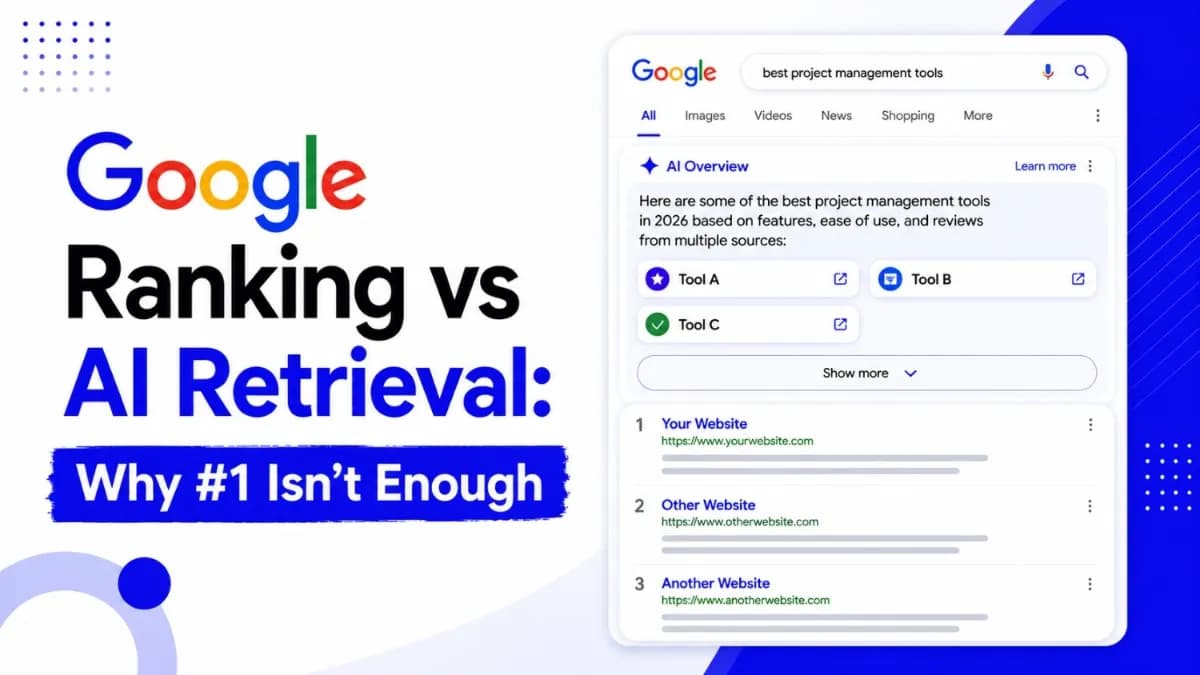
Google Ranking vs AI Retrieval: Why #1 Isn't Enough

Tuba
August 10, 2026
Table of Contents
- Key takeaways
- Why Ranking #1 on Google No Longer Guarantees You Show Up in AI Answers
- Ranking and Retrieval Are Two Different Machines
- How Much Do AI Citations Overlap With Google's Top 10?
- Even a #1 Ranking is a Coin Flip Inside AI Overviews
- Query Fan-Out is Where the Gap Comes From
- Google's Own AI Surfaces Do Not Even Agree With Each Other
- The Signals That Predict AI Visibility Are Not The Ones You Have Been Building
- What the Gap Means For Your Traffic
- How to Close the Ranking-to-Retrieval Gap
- Auditing Your Own Ranking-to-Retrieval Gap
- Frequently Asked Questions
Key takeaways #
Google rankings and AI citations come from two different systems. Across 2025 and 2026 studies, a #1 ranking gave a page roughly a 50% chance of being cited in the AI Overview for its query; only 12% of Google AI Mode citations matched a top-10 URL, and plain-text brand mentions predicted AI visibility three times more strongly than backlinks. Winning both channels means optimizing for retrieval, not just rank.
Why Ranking #1 on Google No Longer Guarantees You Show Up in AI Answers #
Here is a situation playing out in reporting meetings everywhere: the rank tracker shows position one, the traffic chart slopes down, and when someone asks ChatGPT or Google's AI Mode the exact question your page answers best, your brand is nowhere in the response. Nothing is broken. The two outcomes are produced by two different machines, and they reward different things.
This guide walks through what the 2025 and 2026 data actually shows about the relationship between Google ranking and AI retrieval, why the gap exists at a mechanical level, and what to change so your best pages get cited as well as ranked. The short version: rankings and citations correlate, but the correlation is loose, it varies wildly by surface, and the levers that move each one are different. Every statistic below is dated and linked to its original study, because this is a topic where secondhand numbers drift fast.
Ranking and Retrieval Are Two Different Machines #
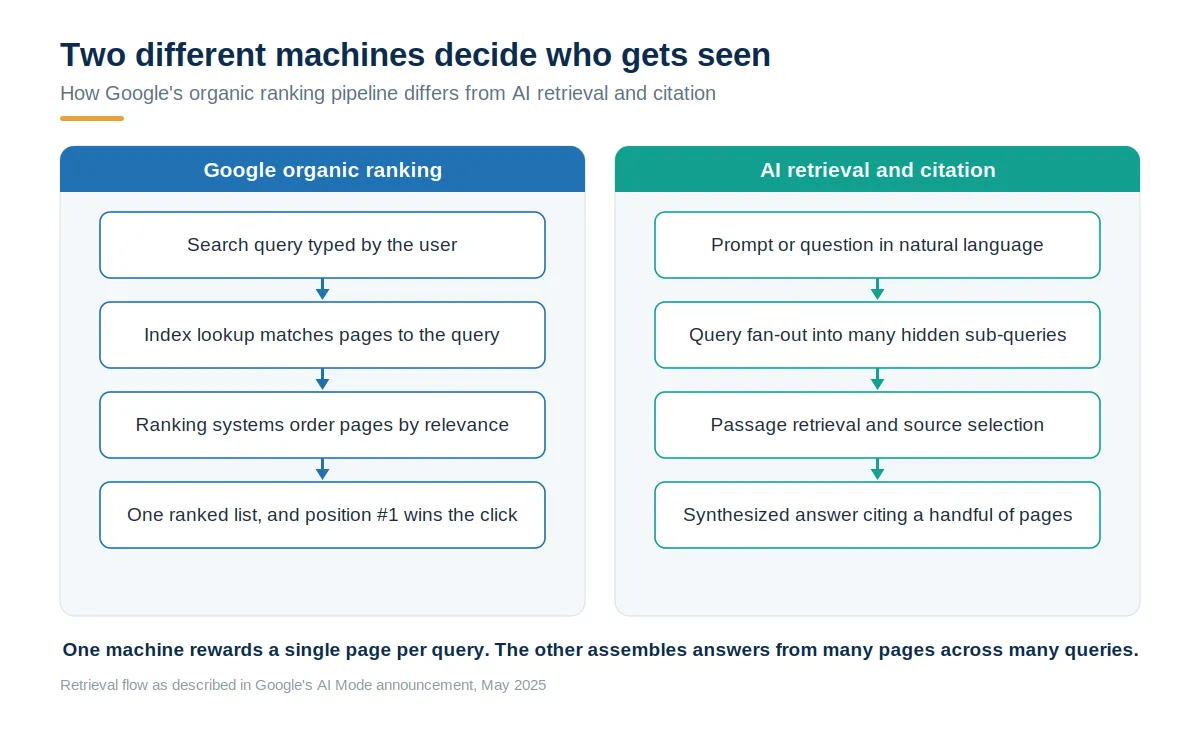
Classic organic search is a ranking problem. Google matches a query against its index, orders candidate pages with its ranking systems, and presents one list. Position #1 is a durable asset: it collects the largest share of clicks for that query until something outranks it.
AI answers are a retrieval problem. When you ask Google's AI Mode, an AI Overview, ChatGPT, or Perplexity a question, the system does not fetch one ranked list and read it aloud. As Google described at I/O in May 2025, AI Mode breaks the question into subtopics and issues many searches simultaneously, then reads across the results and synthesizes a single answer that cites a handful of supporting pages. The unit of competition shifts from the page to the passage, and from one query to a cluster of queries.
There is a second layer to the difference. Chat assistants blend what they retrieve live with what they already know from training data, so a page can be fetched during retrieval and still go unmentioned if the model has never seen your brand discussed in connection with the topic. Ranking is earned at query time; a share of retrieval is earned months earlier, in the text the model trained on.
That architectural difference explains almost every surprising number in the studies that follow. A system that assembles answers from many searches has no obligation to cite the page that ranks first for the original phrase.
How Much Do AI Citations Overlap With Google's Top 10? #
The honest answer is: it depends on the platform, and the overlap is shrinking on the surfaces that matter most. SEMrush's July 2025 study ran 5,000 keywords through four AI platforms and compared more than 150,000 citations against Google's top 10 organic results. Perplexity showed 82% URL overlap, Google AI Overviews 67%, and the sidebar links in Google AI Mode just 32%.
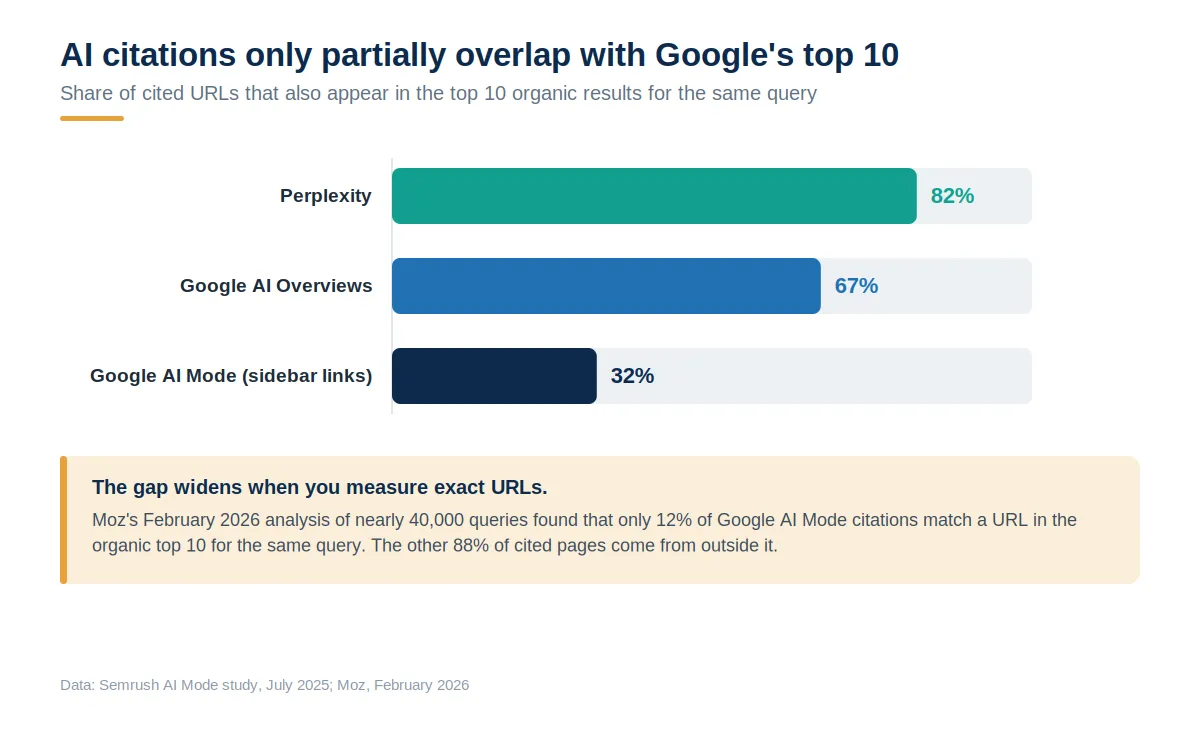
Measured more strictly, the picture gets starker. Moz's February 2026 analysis of nearly 40,000 queries found that only 12% of Google AI Mode citations matched a URL in the organic top 10 for the same query. Put the other way around, 88% of the pages AI Mode cites are not in the results a rank tracker monitors. Even at the domain level, only about one in five cited sites appeared in the traditional top 10.
Both findings can be true at once. AI Overviews still lean heavily on Google's classic index, so overlap is high there. AI Mode and chat assistants retrieve across many sub-queries and reward passage-level relevance, so overlap collapses. If your visibility reporting only tracks rankings, it is measuring the surface with the most overlap and ignoring the ones with the least.
Even a #1 Ranking is a Coin Flip Inside AI Overviews #
What about the friendliest surface, AI Overviews? Ahrefs studied 1.9 million citations from one million AI Overviews in July 2025 and calculated a Spearman correlation of 0.347 between ranking in the top 10 and being cited among the top three AI Overview links. Positive, but moderate. Pages ranking #1 appeared in those citations about 50% of the time. The researchers called it a coin flip at best.
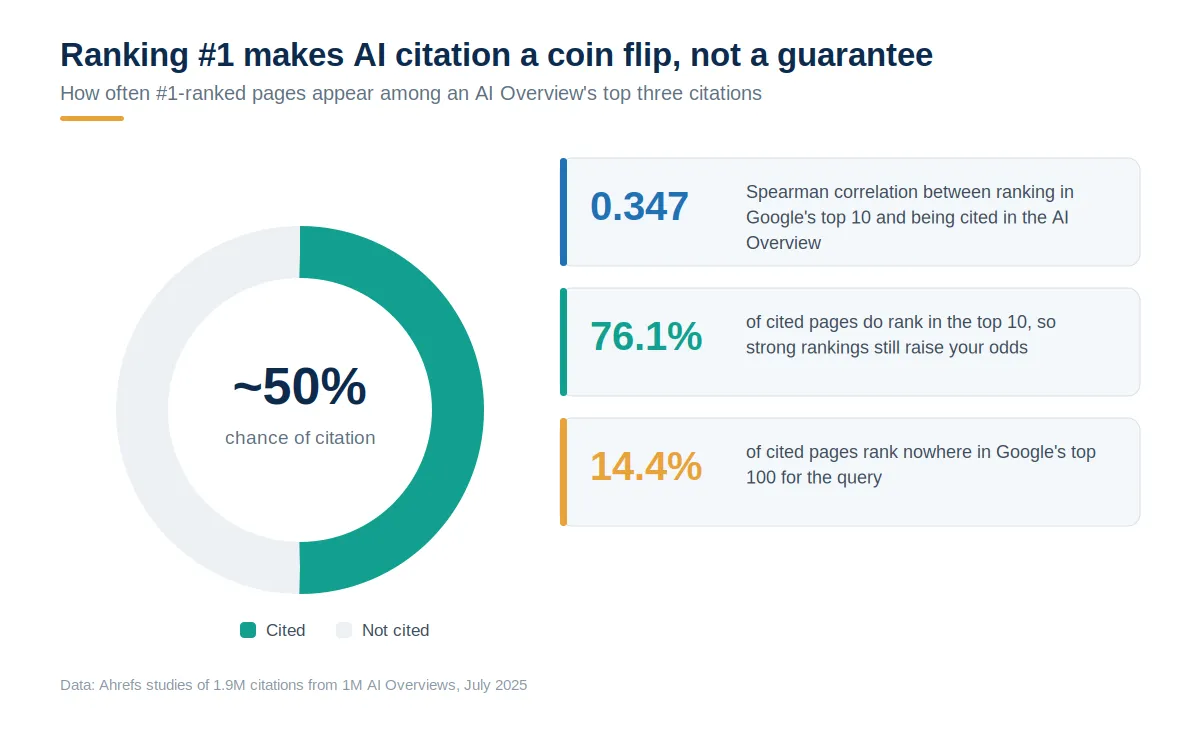
The companion Ahrefs study adds useful nuance: 76.1% of AI Overview-cited pages do rank somewhere in the top 10, the top-cited URL has a median organic position of 2, and 14.4% of cited pages rank nowhere in Google's top 100. Rankings clearly feed the citation pool. They just stop short of deciding who gets picked from it, and when a page is picked, higher-ranking pages tend to be cited more prominently (a 0.445 correlation between citation position and organic position). For reporting, that means position #1 should be read as a strong lottery ticket for AI Overview visibility, not as the visibility itself.
Query Fan-Out is Where the Gap Comes From #
Fan-out is the mechanism behind the mismatch. A prompt like "best CRM for a small agency" quietly becomes searches about pricing, integrations, reviews, setup difficulty, trials, and support. Each sub-query retrieves its own candidates, and the final answer stitches citations together from across the set. A page that ranks #1 for the head term competes in exactly one of those searches.
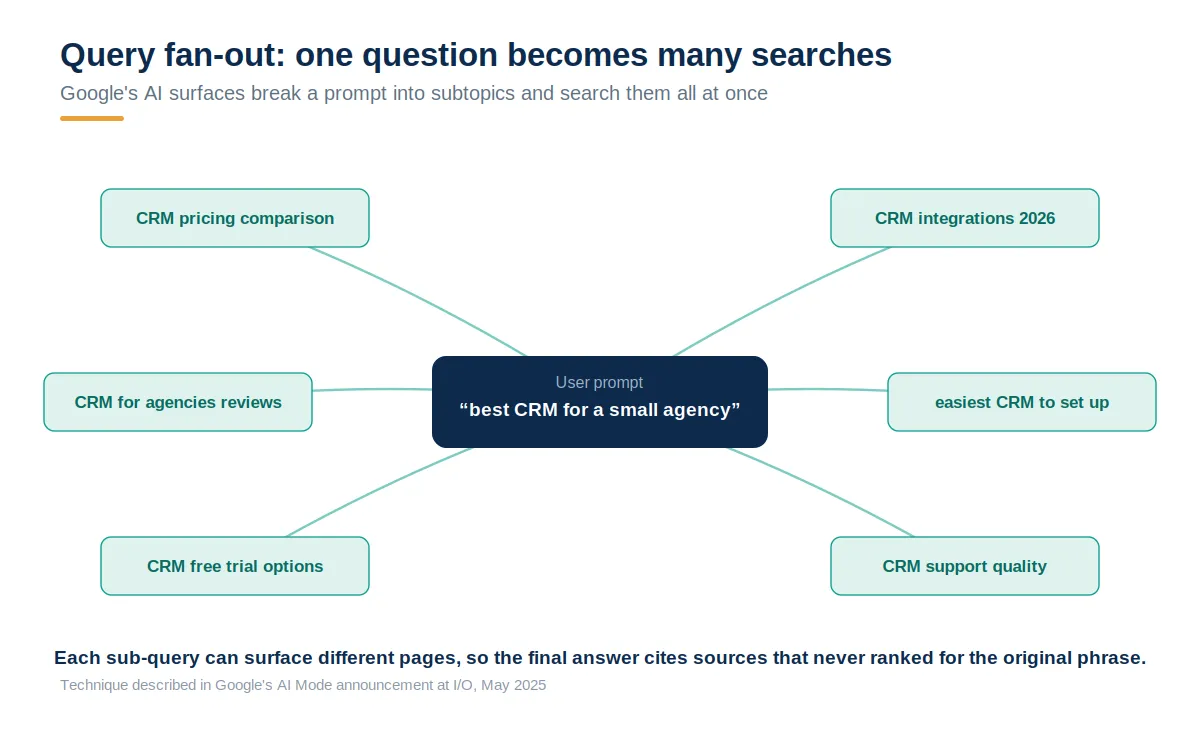
Surfer quantified the effect in November 2025 by studying 173,902 URLs across 10,000 keywords and their 33,000 generated fan-out queries. The number of fan-out queries a page ranked for showed a 0.77 Spearman correlation with being cited in AI Overviews, and pages ranking for the main query plus fan-outs were 161% more likely to be cited than pages ranking for the main query alone. The detail worth pinning to the wall: when AI Overviews cited organically ranking pages, 29.2% of those pages ranked only for fan-out queries while 19.6% ranked only for the main query, a 49% edge for the fan-outs. Coverage of the question space, not position on a single phrase, is what retrieval rewards.
Google's Own AI Surfaces Do Not Even Agree With Each Other #
If the ranking-to-citation gap were a single fixed offset, you could optimize for it once. It is not. Ahrefs compared 730,000 paired AI Mode and AI Overview responses in December 2025 and found the two surfaces reached semantically similar conclusions 86% of the time while citing the same URLs only 13.7% of the time. AI Mode responses ran roughly four times longer, leaned on Wikipedia and reference content where AI Overviews favored YouTube and community sites, and cited no sources in just 3% of responses versus 11% for AI Overviews.
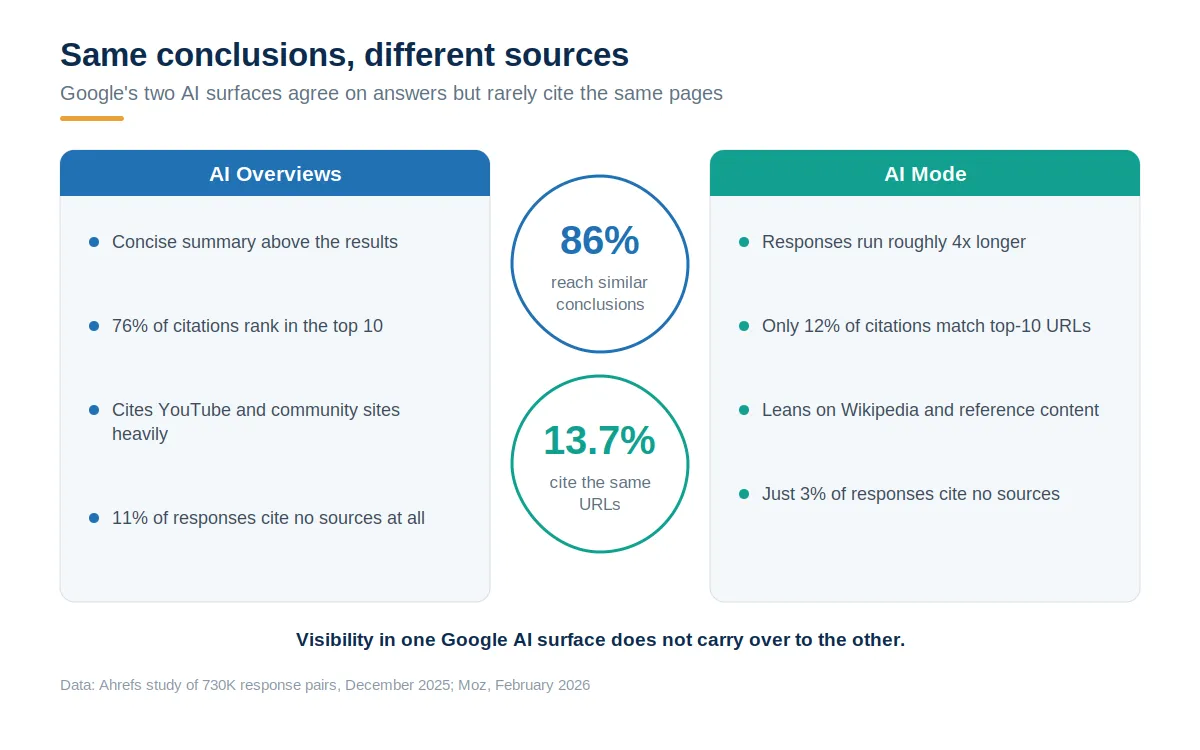
The source mixes diverge in specific, plannable ways. Wikipedia appeared in 28.9% of AI Mode citations against 18.1% for AI Overviews, Quora showed up 3.5 times more often in AI Mode, and AI Overviews cited videos and homepages nearly twice as often. The same asset rarely performs equally on both surfaces, which is an argument for publishing in more than one format.
There is one consolation for established brands: when AI Overviews mentioned an entity, AI Mode included that same entity 61% of the time and then added more competitors around it. Visibility carries over partially for brands, and barely at all for URLs. Practically, that means AI Overviews, AI Mode, and third-party assistants each need their own tracking, because a citation in one says little about the others.
The Signals That Predict AI Visibility Are Not The Ones You Have Been Building #
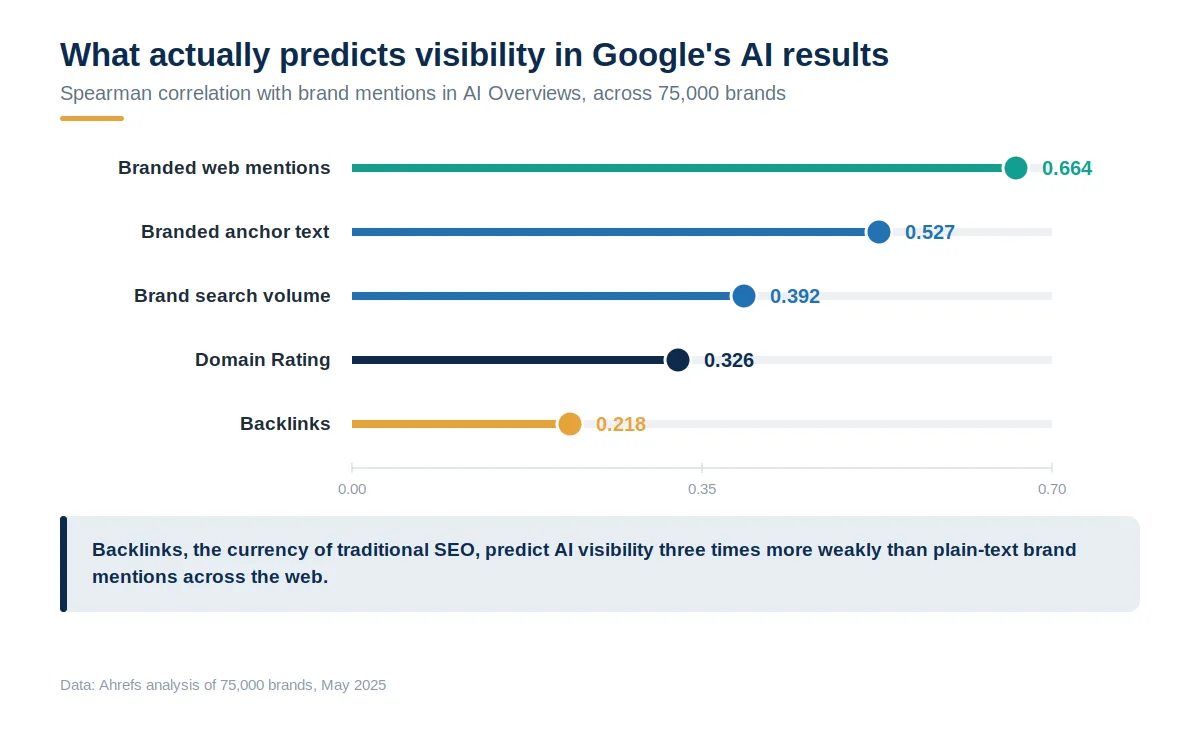
So what does move citations? Ahrefs analyzed 75,000 brands in May 2025 and correlated search factors with brand mentions in AI Overviews. Branded web mentions, linked or unlinked, came out strongest at 0.664. Branded anchor text followed at 0.527 and brand search volume at 0.392. Backlinks, the core currency of traditional SEO, sat at 0.218, and Domain Rating at 0.326. Brands in the top quartile for web mentions earned a median of 169 AI Overview mentions, more than ten times the next quartile, while brands in the bottom half barely registered at all.
Seer Interactive's January 2025 research points in the same direction from the ChatGPT side: presence on page one of Google correlated with LLM brand mentions at roughly 0.65, while backlinks showed almost no relationship at 0.10. The interpretation that fits both datasets is that rankings and citations share upstream causes- broad relevance and a widely discussed brand- but the levers differ. Language models learn who to trust from text about you across the web, which is why online reputation and mention building now sits inside the visibility stack rather than beside it.
What the Gap Means For Your Traffic #
The stakes are not abstract. Pew Research Center tracked 900 U.S. adults through March 2025 and found that when a Google search returned an AI summary, users clicked a traditional result on just 8% of visits, versus 15% when no summary appeared. Links inside the summaries themselves were clicked on only 1% of visits. Sessions also ended outright on 26% of pages with a summary, versus 16% without one. Being ranked but not cited increasingly means being invisible at the moment the answer is formed, while the searcher gets their answer and leaves.
The clicks that survive are more qualified, because much of the evaluation happens inside the AI interface before anyone lands on your site. That raises the value of every remaining session and makes conversion rate optimization the natural partner to any AI visibility push: fewer visits, each worth more, landing on pages that must close.
How to Close the Ranking-to-Retrieval Gap #
None of this data argues for abandoning rankings. It argues for treating them as one input to a retrieval strategy. Six moves follow directly from the studies above.
Sequencing matters as much as the list itself. Structure and technical hygiene are changes you control on your own pages this quarter. Fan-out coverage is a content roadmap measured in months. Mentions and freshness compound over years. Protect the queries that already convert first, then point the content and outreach budget wherever the audit below shows the widest gaps.
Keep the classic engine healthy. With 76.1% of AI Overview citations ranking in the top 10, strong technical and on-page SEO still buys you entry into the citation pool. It is necessary, just no longer sufficient.
Cover the fan-out, not just the head term. Map the sub-questions behind each money query and answer them across a connected cluster. Surfer's 0.77 correlation makes fan-out coverage the highest-leverage content target of 2026, and it is the organizing principle behind modern content writing built for retrieval.
Structure pages for passage-level extraction. Retrieval selects chunks, not pages. Direct answers under descriptive headings, one idea per section, dated statistics, and liftable definitions all raise the odds that some passage of yours wins some sub-query.
Build mentions where models read. The 0.664 correlation belongs to plain-text brand mentions across editorial coverage, reviews, YouTube, and communities. A deliberate social and community presence feeds the same signal.
Keep the cited material fresh. In Seer Interactive's June 2025 log-file and citation study of more than 5,000 cited URLs, nearly 65% of AI bot hits landed on content published within the past year and about 85% of AI Overview citations came from pages dated 2023 to 2025. Stale pages age out of the citation pool even while their rankings hold.
Track rankings and citations as separate scoreboards. A rank tracker cannot see the 88% of AI Mode citations that live outside the top 10. Pair it with citation monitoring across AI Overviews, AI Mode, ChatGPT, and Perplexity, the core reporting layer of a generative engine optimization program.
Auditing Your Own Ranking-to-Retrieval Gap #
The fastest way to make this concrete is a gap audit you can run in an afternoon. Pull your twenty highest-value queries. Run each through Google with AI Overviews enabled, through AI Mode, and through ChatGPT and Perplexity, and log every cited URL alongside your current organic position. Each query then lands in one of three buckets: cited and ranking (defend), ranking but not cited (diagnose), or neither (build).
For the ranking-but-not-cited bucket, classify the cause. A coverage gap means the fan-out sub-questions are answered by someone else; a structure gap means your page answers them but not in extractable passages; a mention gap means competitors are simply discussed more across the web than you are. Each cause maps to one of the five moves above, which turns an unsettling data story into an ordinary prioritized backlog.
Score the output as citation share: of all URLs cited across your query set on each surface, what percentage are yours, and what percentage belong to each competitor? That one number, tracked monthly per surface, gives leadership a metric that moves on the same timescale as the AI systems themselves and keeps the program honest between audits.
Repeat the audit quarterly, because citation pools churn far faster than rankings do. If you would rather have a specialist team run the first pass and hand you the backlog, that is exactly what an AI SEO engagement is built to do.
Frequently Asked Questions #
What is the difference between Google ranking and AI retrieval? #
Google ranking orders whole pages into one list for one query. AI retrieval breaks a prompt into many sub-queries, pulls relevant passages from across the web, and synthesizes an answer that cites a few sources.
Does ranking #1 on Google guarantee an AI Overview citation? #
No. Ahrefs' July 2025 study found pages ranking #1 appeared among the top three AI Overview citations only about 50% of the time, a coin flip rather than a guarantee.
What is query fan-out? #
Query fan-out is the technique Google's AI surfaces use to break one question into many related sub-queries, search them simultaneously, and assemble the answer from the combined results.
Why does AI cite pages that do not rank? #
Because citations are selected per sub-query and per passage. A page can lose the head term yet win a fan-out query, and 14.4% of AI Overview citations rank nowhere in Google's top 100.
Do AI Overviews and AI Mode cite the same sources? #
Rarely. Ahrefs' December 2025 study of 730,000 response pairs found only 13.7% citation overlap, even though the two surfaces reached similar conclusions 86% of the time.
Do backlinks help AI visibility? #
Only weakly. Backlinks correlated with AI Overview brand visibility at 0.218 in Ahrefs' 75,000-brand study, about a third of the 0.664 correlation for plain-text brand mentions.
What predicts AI visibility most strongly? #
Branded web mentions (0.664), branded anchor text (0.527), and brand search volume (0.392) were the strongest predictors in Ahrefs' May 2025 data, all off-site brand signals.
Does traditional SEO still matter for AI search? #
Yes. 76.1% of AI Overview citations rank in Google's top 10, so rankings feed the citation pool. They are the entry ticket, not the whole game.
How do AI Overviews affect click-through rates? #
Pew Research found users clicked a traditional result on 8% of visits when an AI summary appeared, versus 15% without one, and clicked links inside summaries on just 1% of visits.
How do I measure my AI visibility? #
Run your key queries through AI Overviews, AI Mode, ChatGPT, and Perplexity, log cited URLs against your rankings, and track citation share over time alongside your rank tracker.