LinkedIn AI Content: What Marketers Need to Know in 2026

Tuba
August 17, 2026
Table of Contents
- Key takeaways
- LinkedIn Is Changing: What Marketers Need to Know About AI-Generated Content in 2026
- How Much LinkedIn AI Content Is Out There
- Why LinkedIn Cracked Down in 2026
- What the Feed Does to Generic AI Posts Now
- The Engagement Numbers Marketers Should Actually Use
- What B2B Marketers Are Doing About It
- A LinkedIn AI Content Policy That Survives 2026
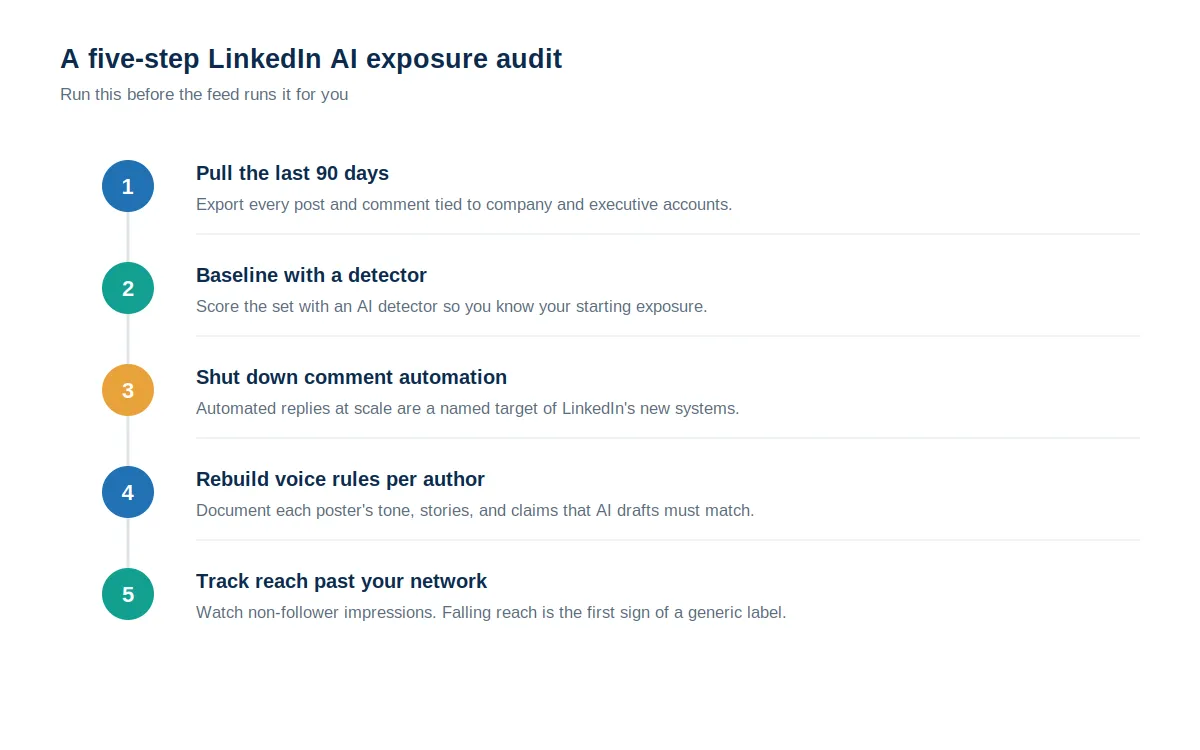
- How to Audit Your LinkedIn Presence for AI Risk
- Frequently Asked Questions
Key takeaways #
More than 80% of long-form LinkedIn posts sampled in July 2026 were likely AI-written, and LinkedIn is now suppressing generic AI content, allowing members to flag it with a new feedback button, and rewarding posts that convey a clear human point of view. Marketers who keep publishing templated AI posts will lose reach. Marketers who pair AI efficiency with named authors, real numbers, and first-hand stories will gain it.
LinkedIn Is Changing: What Marketers Need to Know About AI-Generated Content in 2026 #
LinkedIn spent 2023 and 2024 encouraging AI writing. It shipped drafting assistants, profile rewriters, and an Enhance Post button. In 2026, it is doing something very different: training systems to spot low-effort AI content, cutting its distribution, and giving members a button that literally says, "The post seems like AI slop."
That reversal changes the math for every marketing team that publishes on the platform. This guide covers what the newest detection studies actually found, what LinkedIn changed and when, how engagement differs between AI and human posts by category, and how to run a program that benefits from AI without getting caught in the crackdown.
How Much LinkedIn AI Content Is Out There #
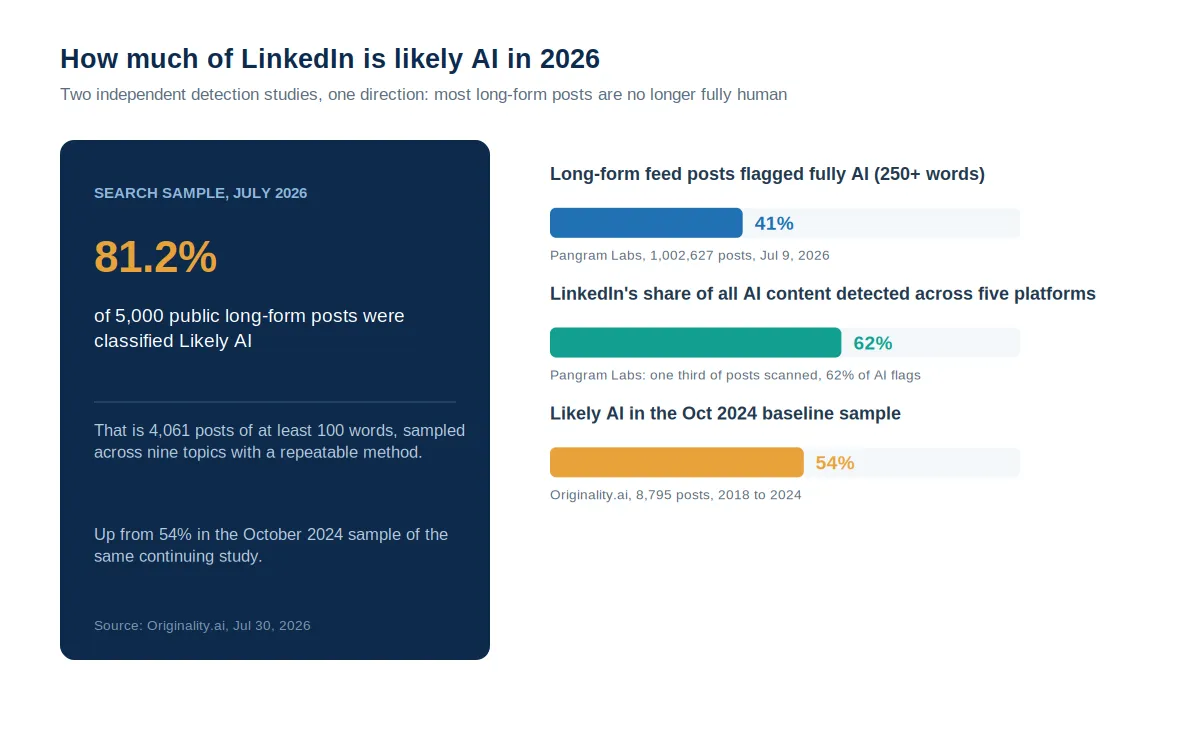
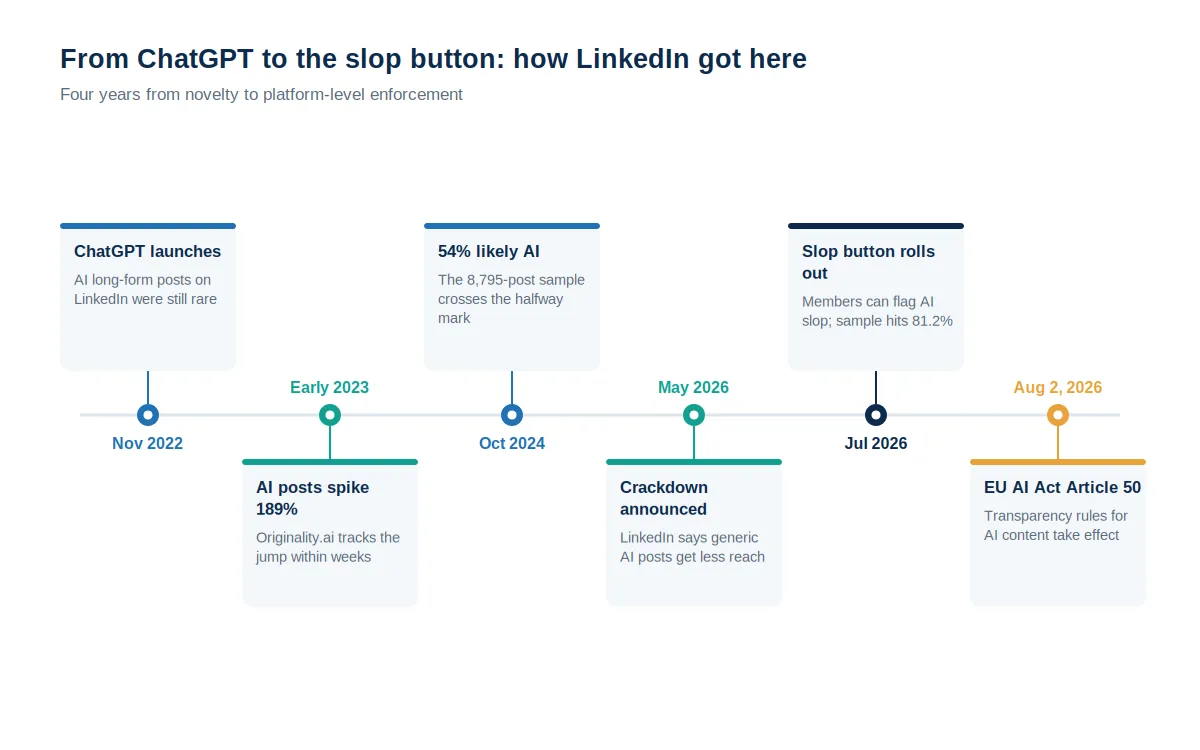
Two independent detection firms measured the platform this year using different methods, and both reached the same conclusion. In its July 2026 study update, Originality.ai analyzed 5,000 public long-form posts of at least 100 words across nine topics. It classified 81.2% of them, 4,061 posts, as likely AI. The same ongoing study reported 54% in October 2024 and traces the original surge to early 2023, when AI posts likely jumped 189% in the weeks after ChatGPT launched.
Pangram Labs took a different route. Its AI in Your Feed study, published July 9, 2026, drew on 1,002,627 posts that opted-in users encountered across LinkedIn, X, Reddit, Medium, and Substack after April 24, 2026. Using a stricter 250-word threshold, it flagged 41% of long-form LinkedIn posts as fully AI-generated. LinkedIn accounted for about a third of the posts scanned but 62% of all AI-detected content, nearly twice the concentration of any other platform.
The exact percentage depends on the method. Search-based samples and feed-based samples measure different slices of the platform, and no detector is perfect. The direction is not in dispute. On LinkedIn in 2026, a long post written entirely by a person is the exception, not the rule.
Why LinkedIn Cracked Down in 2026 #
The business context explains the timing. LinkedIn passed 1.2 billion members in Microsoft's fiscal 2025 reporting, and Microsoft's fiscal Q3 2026 earnings, published in April 2026, showed LinkedIn revenue up 12% with growth across every line of business. The product sold to advertisers and recruiters alike is attention from real professionals. A feed full of synthetic essays threatens exactly that.
So on May 20, 2026, LinkedIn published a policy statement titled Keeping conversations real on LinkedIn. The mechanics matter more than the framing. LinkedIn built classification systems with its editorial team to recognize what it calls AI slop: content that sounds polished but adds no perspective, context, or expertise. In early testing, LinkedIn says those systems correctly identified generic content 94% of the time. Flagged content is much less likely to be distributed beyond a member's immediate network. The policy also names two specific behaviors for demotion: comments created and posted at scale with automation tools, and replies that restate the original post without adding anything.
Two months later, the visible piece came. In July 2026, LinkedIn began rolling out a "Seems like AI slop" option in the three-dot menu for posts and ads. LinkedIn's chief product officer, Hari Srinivasan, confirmed the rollout and called AI slop a top priority. Member flags now feed the same classifiers, which means the audience marketers are training the definition of slop are trying to reach. LinkedIn has also opened its verified-member filter, covering more than 100 million verified members, to comments and feed conversations, a direct move against bot accounts.
What the Feed Does to Generic AI Posts Now #
The enforcement model is distribution capping, not deletion. A post judged generic still publishes, still shows to some first-degree connections, and still looks alive to its author. What it loses is everything that made LinkedIn organic reach valuable: distribution to second- and third-degree networks, interest-based routing to non-followers, and the compounding effect of early engagement. Teams often misread this as an algorithmic change that hurts everyone. It is a quality gate hurting a specific kind of post.
Note what LinkedIn is not doing. It is not punishing AI assistance. The policy states plainly that using AI to help write is fine, as long as posts and comments represent your voice and perspective. The target is volume automation: accounts publishing interchangeable insight posts on a schedule, and comment bots congratulating strangers at scale. If your program depends on either, the reach loss has already started.
Plan for a second-order effect. As flags accumulate, LinkedIn's classifiers get better at recognizing the house style of popular AI writing tools: the rhetorical question hook, the one-line paragraphs, the tidy three-part list. Content that shares that fingerprint will increasingly meet the same fate, even when a human wrote it. The safest structural choice in 2026 is sounding like a specific person rather than a template.
The Engagement Numbers Marketers Should Actually Use #
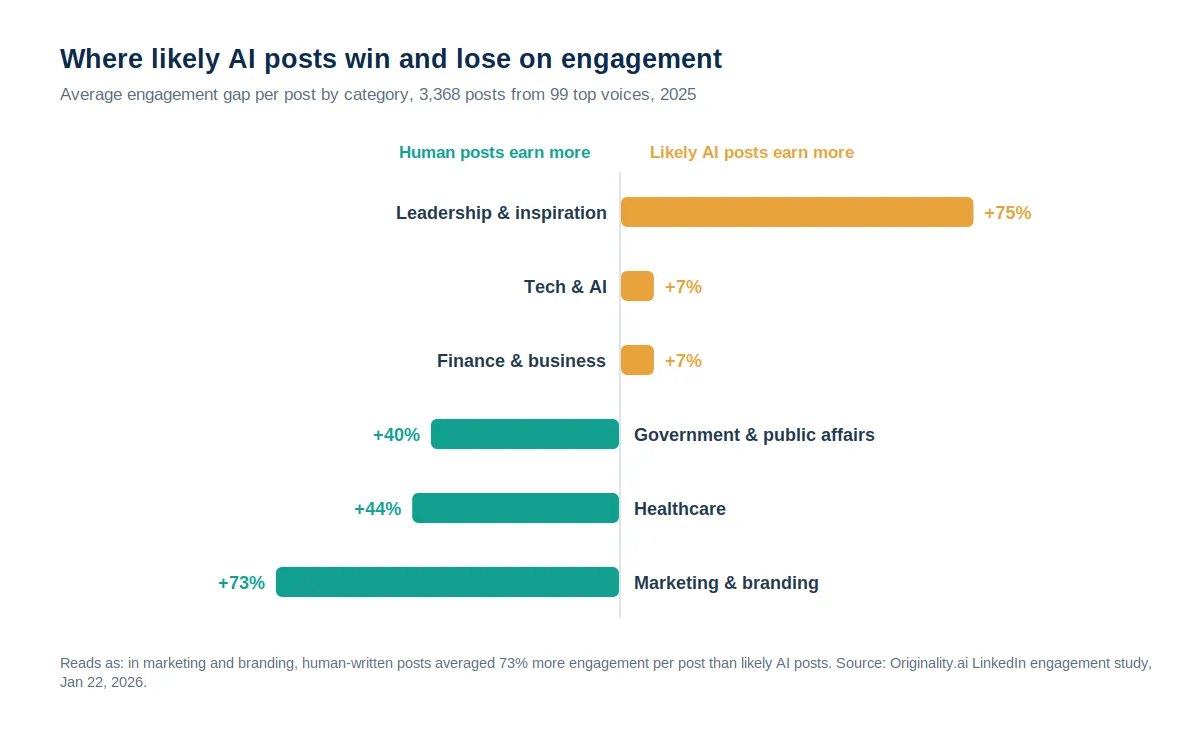
Reach is only half the story. The Originality.ai engagement analysis published January 22, 2026 scored 3,368 long-form posts from 99 influential LinkedIn voices, posted between January and November 2025, and matched AI classification against average engagement per post. Just over half the posts were likely AI. The performance gap strongly favored human writing, but not uniformly.
Human-written posts outperformed likely AI posts in most categories, and the gaps were large where credibility gets checked. In marketing and branding, human posts averaged 73% more engagement per post, even though 61% of the category's content was likely AI. Healthcare showed a 44% human advantage, and government and public affairs showed a 40% human advantage. The reversal came in leadership and inspiration content, where likely AI posts averaged 75% more engagement, driven by consistent motivational formats. Tech and finance were close, with likely AI posts about 7% ahead.
The pattern is useful. Categories where readers evaluate the author before trusting the claim punish AI writing hard. Categories that reward formula tolerate it. Most B2B marketing sits firmly in the first group, which means the average mid-market company is publishing AI content in exactly the categories where it underperforms most.
What B2B Marketers Are Doing About It #
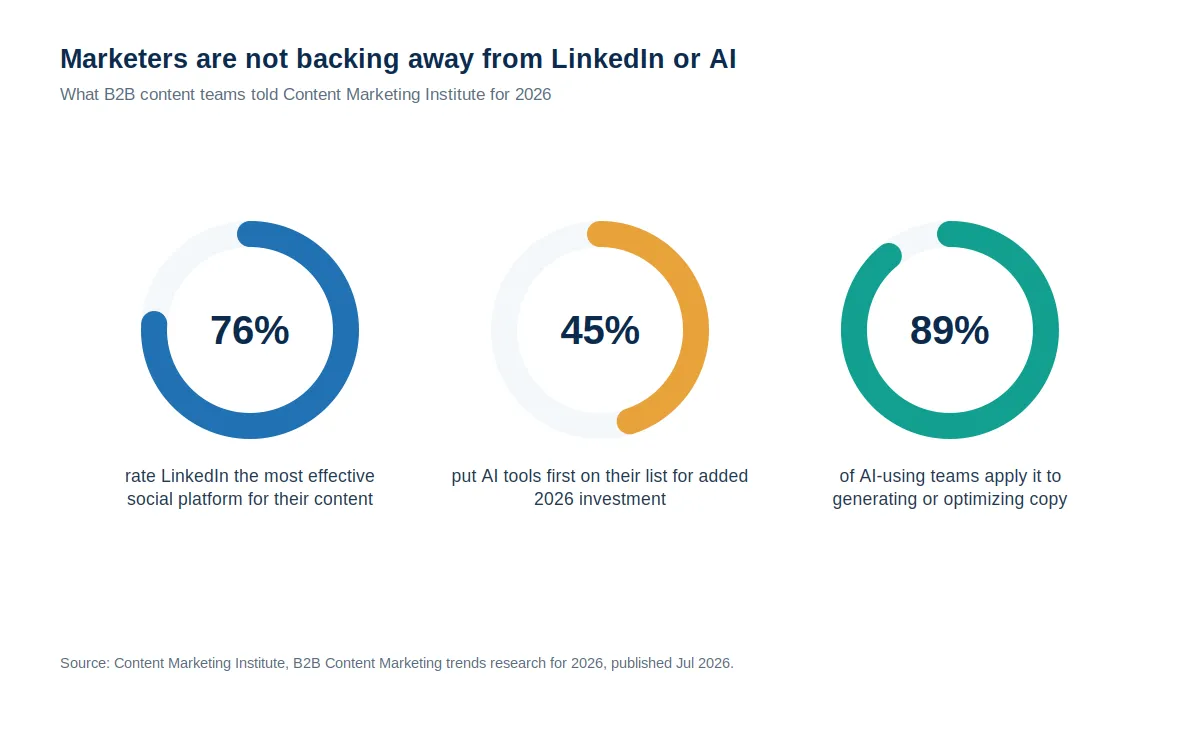
None of this is pushing marketers off the platform. In Content Marketing Institute's B2B research for 2026, 76% of B2B marketers rated LinkedIn the most effective social platform for their content, and AI topped the investment list, with 45% planning to increase spending on AI-powered marketing tools, more than any other area. Among teams already using generative AI, 89% use it to generate or optimize written content. The tools are not going anywhere. The question is where they sit in the workflow.
Buyer research explains why the human layer is worth protecting. The 2025 Edelman-LinkedIn B2B Thought Leadership Impact Report, built on a survey of nearly 2,000 management-level professionals, found that decision-makers trust strong thought leadership more than marketing materials and product sheets, and that it reaches hidden members of buying groups that ads rarely touch. Thought leadership only works because it signals a real expert thought something. Content that reads as machine-written sends that signal instead of building it.
Meanwhile, the platform's human engagement continues to grow. Reporting on LinkedIn's calendar Q2 2026 results in August 2026 noted revenue up 12% on the strength of Marketing Solutions, with LinkedIn leadership citing double-digit member growth, content consumption up 10% year over year, and time spent engaging with comments up 18%. The audience is there and paying closer attention to conversations. Teams that treat comments as a growth surface, with actual humans doing the commenting, are buying reach that automated accounts just lost. That is also where a managed social media program earns its keep: consistent human presence is now a ranking input, not a nice extra.
A LinkedIn AI Content Policy That Survives 2026 #
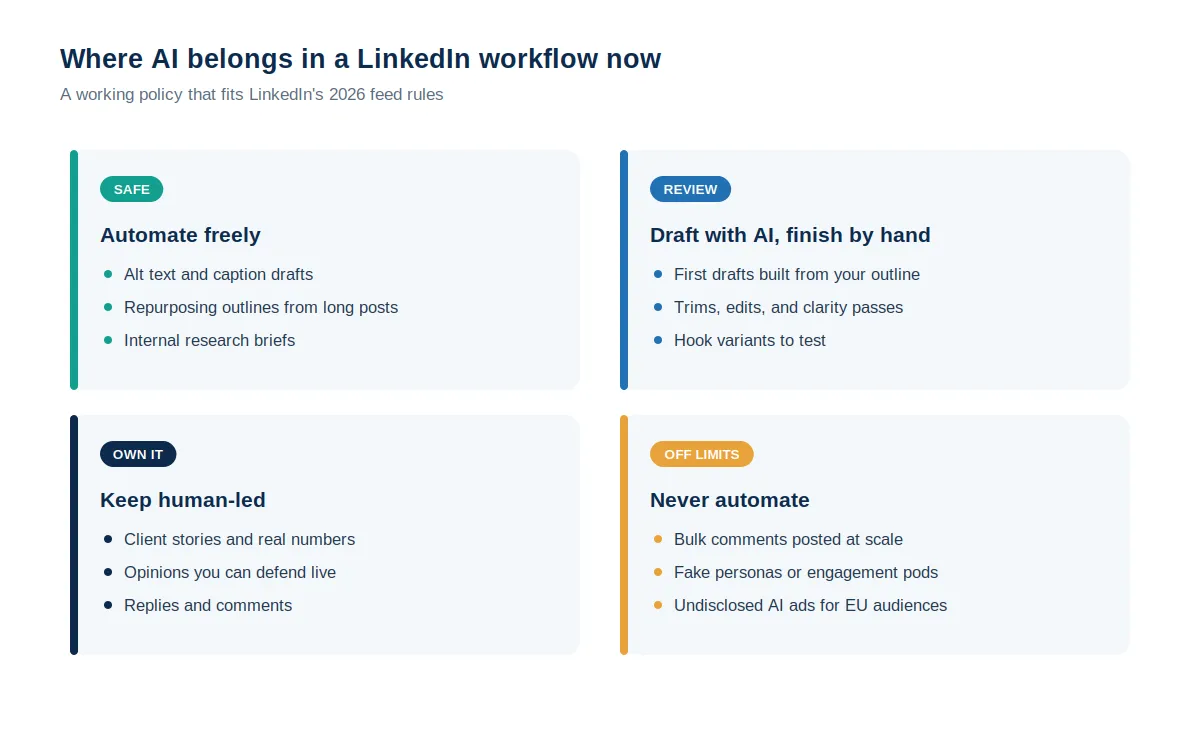
Teams handling this well aren't choosing between AI and human writing. They draw a line through the workflow and enforce it. A working version has four zones.
Automate freely. Alt text, caption drafts, repurposing outlines, internal research briefs, and first-pass summaries of long source material. No reader-facing judgment lives here, so speed wins.
Draft with AI, finish by hand. First drafts built from your own outline, editing passes, and hook variants to test. The author rewrites the opening lines, and at least one observation per post must come from first-hand knowledge: a client result, a number from your own operation, a position you would defend on a call. Teams without in-house writing capacity often pair professional content writing with their subject-matter experts to keep this layer genuinely human.
Keep human-led. Client stories, opinions, replies, and comments. Comments especially: they are cheap to write, they are weighted in the new feed, and automating them is now a named violation.
Never automate. Bulk comments, engagement pods, fake personas, and undisclosed AI-generated ads aimed at EU audiences. On that last point, Article 50 of the EU AI Act brings transparency obligations for AI-generated content into application on August 2, 2026. Disclosure planning belongs in your policy now, and it doubles as online reputation management: brands caught passing off synthetic content rarely get the benefit of the doubt twice.
How to Audit Your LinkedIn Presence for AI Risk #
If your team has been publishing AI-assisted content for a year or more, assume you're exposed and measure it. The audit takes an afternoon.
First, pull the last 90 days. Export every post and comment tied to company pages and executive profiles. Include ghostwritten content. The feed does not care who pressed publish.
Second, baseline with a detector. Score the set with an AI detection tool. You are not chasing a perfect verdict; you are finding the posts that cluster at high AI confidence with low engagement. Those are your slop candidates.
Third, shut down comment automation. Any tool posting replies on your behalf at scale is now a direct target. Cancel it before the accounts it touches inherit the penalty.
Fourth, rebuild voice rules per author. Document how each named poster actually writes: sentence habits, recurring stories, claims they can back. Feed those constraints into every AI draft so output starts from the person, not the template.
Fifth, track reach beyond your network. Non-follower impressions are an early-warning metric. If they fall while follower impressions hold, the feed is quietly capping you. This measurement layer connects directly to AI SEO services work because the same LinkedIn posts increasingly appear as citations in AI search answers, and a generative engine optimization program can track whether your named experts are being quoted by ChatGPT and Perplexity or drowned out by synthetic competitors.
Frequently Asked Questions #
How much LinkedIn content is AI-generated in 2026? #
A lot of it. Originality.ai classified 81.2% of 5,000 publicly available long-form posts sampled in July 2026 as likely AI-generated. Pangram Labs, using a stricter 250-word threshold on feed data, flagged 41% of long-form posts as fully AI-generated. Both studies place LinkedIn ahead of every other major platform.
Does LinkedIn penalize AI-generated content? #
LinkedIn does not penalize AI assistance itself. It restricts distribution of content its systems judge to be generic, repetitive, or produced by automation with little human involvement. That content is far less likely to reach anyone beyond your immediate network. Posts with a clear personal perspective still travel.
What is the LinkedIn Seems like AI slop button? #
It is a feedback option LinkedIn began rolling out in July 2026. It sits in the three-dot menu on posts and ads, next to Not interested and Report. Selecting it hides the post and feeds the signal back into LinkedIn's ranking systems, which use member flags to refine what counts as low-value AI content.
Can LinkedIn detect AI-written posts? #
LinkedIn says its systems, built with its editorial team, correctly identified generic content 94% of the time in early testing. Detection is not aimed at proving a machine wrote something. It targets the signals of low-effort content: a recycled structure, restated ideas, and a lack of first-hand perspective.
Will AI content hurt my LinkedIn reach? #
Templated AI content will. LinkedIn now limits how far generic posts spread beyond your first-degree connections, and members can flag them directly. AI-assisted posts that carry your own stories, numbers, and opinions are treated like any other content and can still earn full distribution.
Should B2B marketers stop using AI for LinkedIn posts? #
No, but the workflow has to change. Use AI for outlines, edits, repurposing, and research support. Keep the point of view, the examples, and the first and last pass human. Content Marketing Institute's 2026 research shows 45% of B2B marketers are increasing AI investment, so the tools are staying. The differentiator is judgment.
Do AI-generated LinkedIn posts get less engagement? #
Usually, in Originality.ai's January 2026 analysis of 3,368 posts from 99 top voices, human-written posts outperformed likely AI posts in most categories, including a 73% engagement advantage in marketing and branding. The exception was motivational leadership content, in which formulaic AI posts averaged 75% higher engagement.
Does the EU AI Act apply to LinkedIn content? #
Yes, in part. Article 50 of the EU AI Act sets transparency duties for AI-generated content, and those obligations apply from August 2, 2026. Marketers publishing AI-generated material to EU audiences should plan for disclosure now rather than retrofitting it after enforcement questions arise.
How can I tell if my LinkedIn content reads as AI slop? #
Run the test LinkedIn's systems run. Does the post restate common knowledge without adding perspective, context, or expertise? Could any company in your category have published it? Does it lean on the same hook and listicle structure as everything else in the feed? If yes, expect capped reach.
What types of LinkedIn content should never be automated? #
Comments posted at scale, engagement pods, fake personas, and undisclosed AI-generated ads aimed at EU users. LinkedIn's 2026 policy names automated comments as a direct target, and the EU AI Act adds legal exposure for undisclosed synthetic content. These are no longer gray areas.