Social Media Strategy for Brand Trust and Sales Growth Guide

sadiya
July 1, 2026
Table of Contents
- What is Social Media Strategy?
- Social Media Strategy vs Random Posting
- Top Signs You Need Social Media Strategy
- Root Causes: Why Social Media Builds Trust and Sales
- How to Get Started
- Solutions and Strategies
- Actionable Framework: Social Media Strategy Checklist
- The Hidden Impact
- Common Mistakes to Avoid
- Frequently Asked Questions
- Conclusion and Next Steps
Social media is not just a place to post updates anymore. For many customers, it is where they first discover your brand, compare your personality, read comments, check proof, and decide whether you feel trustworthy enough to buy from. If your social presence looks random, quiet, or inconsistent, people notice.
That is why a clear social media strategy matters. It turns scattered posting into a system for building brand trust, audience relationships, website traffic, leads, and sales.
The target audience for this guide includes small business owners, startup founders, marketing managers, service businesses, e-commerce brands, B2B companies, local businesses, agencies, consultants, and creators that want social media to support growth instead of simply filling a content calendar.
The opportunity is large. DataReportal reported 5.79 billion social media user identities worldwide at the start of April 2026, while noting that user identities do not always equal unique individuals.
What is Social Media Strategy? #
Social media strategy is a structured plan for using platforms like Instagram, Facebook, LinkedIn, TikTok, YouTube, and X to reach the right audience, build trust, share useful content, drive engagement, and convert attention into measurable business results.
A proper strategy defines your audience, brand voice, content pillars, posting schedule, platform focus, engagement process, paid campaign approach, and reporting system.
It is not just “post three times a week.” That may create activity, but activity without direction does not always create sales.
A strong strategy answers simple but serious questions: Who are we trying to reach? What do they care about? Why should they trust us? What should they do after engaging with our content?
Social Media Strategy vs Random Posting #
Most brands do not fail on social media because they post too little. They fail because the content has no clear job.

Random posting keeps your profile alive. Strategy gives people a reason to remember you.
Top Signs You Need Social Media Strategy #
You need a stronger social media if your content exists but does not move the business forward. Common signs include:
You post regularly but get weak engagement
Your audience does not comment, share, or message
Your content looks inconsistent
Your brand voice changes from post to post
You have followers but few leads
Your team does not know what to post
Your paid campaigns are not converting
Your competitors look more trusted online
You are active on too many platforms
Your content does not support your website, offers, or sales funnel
Social media also affects trust. Edelman’s 2025 Brand Trust report says 80% of people trust the brands they use, and that consumers increasingly look to brands for confidence, calm, inspiration, and personal stability.
That trust does not appear from one post. It builds through repeated, consistent, useful, and human communication.
Root Causes: Why Social Media Builds Trust and Sales #
Social media works because it lets people experience your brand before they buy. They see how you explain ideas. They read how you reply to comments. They notice whether your content helps or only sells. They compare your consistency, tone, and proof against other brands.
This is where social media strategy examples become helpful. A skincare brand may use Instagram Reels to show real product use, before-and-after content, and customer education. A B2B agency may use LinkedIn to share insights, client problems, founder opinions, and proof of process.
The mechanics are simple:
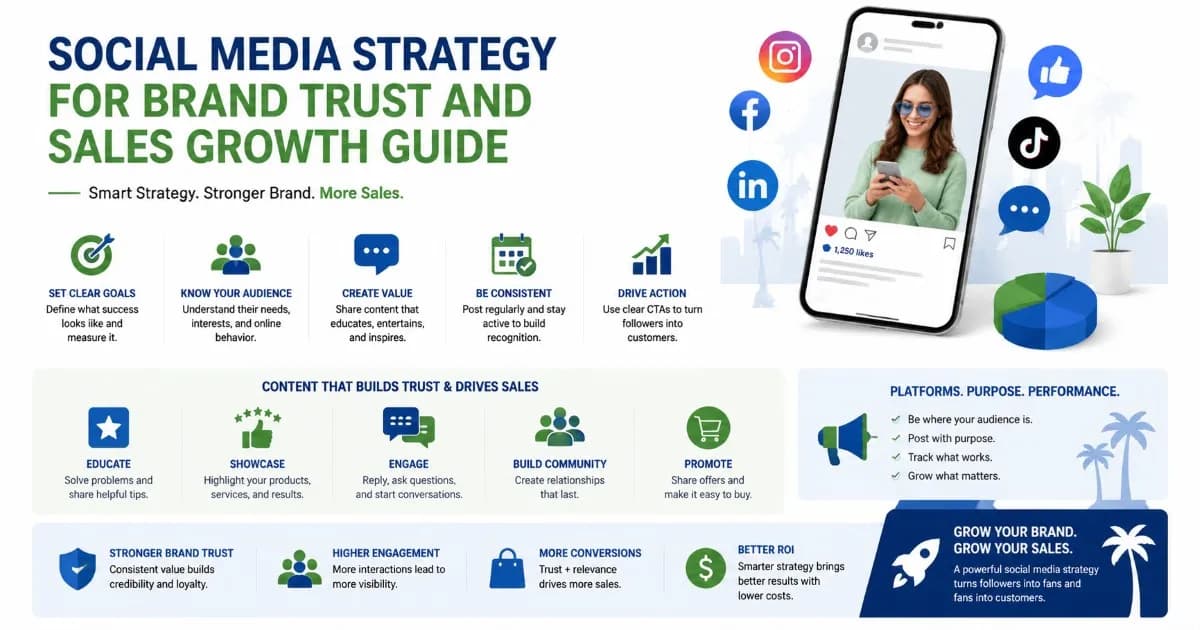
Consistency builds familiarity
Familiarity builds trust
Trust reduces hesitation
Clear CTAs create action
Retargeting brings warm users back
Content plus paid ads improves reach
HubSpot’s 2026 marketing statistics report that social media has billions of users globally and remains a major part of how marketers reach audiences.
Warning: Social media can waste time if you only chase likes. A post that earns attention but does not support trust, traffic, leads, or sales is not doing enough for the business.
How to Get Started #
Before building a social media plan, diagnose what is currently missing.
Define your business goal
Decide whether your main goal is awareness, engagement, leads, sales, website traffic, community, hiring, or brand trust.Identify your audience
Write down who you want to reach, what they care about, what they fear, and what makes them buy.Audit your current profiles
Check your bio, profile image, highlights, links, content quality, posting frequency, and visual consistency.Review your best-performing content
Look for posts that earned saves, shares, comments, clicks, DMs, or inquiries, not just likes.Study competitors
Review their content themes, hooks, comments, offers, platform focus, and engagement style.Choose your core platforms
For B2C, an Instagram approach may be central. For B2B, LinkedIn may play a bigger role.Set measurable KPIs
Track reach, engagement rate, website clicks, leads, sales, cost per lead, conversion rate, and follower quality.Create content pillars
Choose repeatable themes such as education, storytelling, proof, offers, behind-the-scenes, FAQs, customer stories, and founder insights.
Solutions and Strategies #
Foundational Strategy #
Start with the basics that make your brand easier to trust. Your foundation should include:
Clear brand positioning
Consistent tone of voice
Defined audience segments
Platform-specific content plan
Strong visual identity
Content calendar
Simple CTA structure
Community engagement process
Basic analytics tracking
For example, a local restaurant may focus on Instagram Reels, customer reviews, behind-the-scenes kitchen videos, menu highlights, and location-based paid ads. A B2B company may focus on LinkedIn thought leadership, case studies, short expert videos, and lead magnets.
Tools Strategy #
Use tools to keep your social media strategy organized and measurable. Helpful tools include:
Content planning: Notion, Trello, Airtable, Google Sheets
Scheduling: Buffer, Later, Hootsuite, Sprout Social
Design: Canva, Figma, Adobe Express
Video editing: CapCut, Descript, Premiere Pro
Analytics: GA4, platform insights, Looker Studio
Paid campaigns: Meta Ads, LinkedIn Ads, TikTok Ads, Google Ads
Social listening: Brand24, Sprout Social, Mention
CRM: HubSpot, Zoho, Pipedrive
The tool is not the strategy. It only helps your team execute faster and stay consistent.
Professional Strategy #
A professional social media strategy connects content with the customer journey.
At Vynce Digital, that means going beyond random posting and building a system around brand positioning, content that connects, data-driven growth, and paid campaign amplification. A professional strategy should cover:
Audience research
Competitor analysis
Brand voice
Creative direction
Content pillars
Monthly calendar
Reels and short-form video plan
Platform-specific captions
Community management
Paid ad funnels
Retargeting
Analytics and reporting
This is how followers become more than numbers. They become a warm audience that recognizes, trusts, and eventually buys from your brand.
Actionable Framework: Social Media Strategy Checklist #
Use this checklist before creating your next social media plan.

The Hidden Impact #
The hidden impact of a weak social media presence is lost trust. People may search your brand, visit your profile, and quietly decide not to buy because the content feels inactive, inconsistent, or unclear. You may never know how many customers left before contacting you.
A strong social presence also supports sales conversations. When prospects already know your values, style, process, and proof, your team does not have to start from zero.
There is also an SEO and traffic impact. Social media may not replace search, but it can send qualified visitors to your website, promote content, increase brand searches, and strengthen overall visibility.
Common Mistakes to Avoid #
Avoid these mistakes when building your social media strategy:
Posting without clear goals
Measuring only likes
Using the same content on every platform
Ignoring audience comments and DMs
Changing brand voice too often
Posting only promotional content
Not using social proof
Skipping short-form video
Running paid ads without landing pages
Not tracking website clicks or leads
Posting inconsistently
Copying competitors without understanding your audience
The biggest mistake is treating social media like a notice board. It should feel like a relationship channel.
Frequently Asked Questions #
What is a social media strategy? #
A social media strategy is a plan for using social platforms to reach your audience, build trust, create engagement, and drive business results. It includes platform selection, content pillars, posting rhythm, engagement, paid campaigns, and measurement.
Why is social media strategy important for brand trust? #
Social media strategy builds trust by showing your brand consistently over time. When people see helpful content, real stories, replies, proof, and clear messaging, they feel more confident engaging with your business.
Can social media strategy increase sales? #
Yes, social media can increase sales when content is connected to clear offers, landing pages, retargeting, and conversion tracking. The strongest results usually come from combining organic content with paid campaigns.
What are good social media strategy examples? #
Good social media strategy examples include Instagram Reels for product education, LinkedIn posts for B2B thought leadership, TikTok videos for discovery, and Facebook campaigns for local engagement. The right example depends on your audience and business model.
What should a social media strategy Instagram plan include? #
A social media strategy Instagram plan should include Reels, carousels, Stories, highlights, profile optimization, branded visuals, community engagement, and clear CTAs. It should also connect profile traffic to your website, DMs, booking page, or product pages.
How often should a business post on social media? #
Most businesses should focus on consistency before volume. A practical starting point is three to five quality posts per week, supported by Stories, short videos, and regular engagement.
How long does social media marketing take to show results? #
Many businesses see early engagement improvements within four to six weeks. Sales impact usually takes longer because trust, retargeting, content testing, and audience growth need time to work together.
Conclusion and Next Steps #
Social media is not just about being visible. It is about becoming familiar, trusted, and easy to buy from.
Key takeaways:
Social media strategy turns random posting into a growth system.
Trust grows through consistency, useful content, proof, and engagement.
Social media strategy examples should be adapted to your audience, not copied blindly.
A strong social media strategy Instagram plan can support brand awareness, product education, and lead generation.
Organic content builds relationships, while paid campaigns amplify what works.
Analytics help you stop guessing and improve each month.
Start by auditing your current profiles, defining your audience, choosing your main platforms, and building content pillars around real customer needs.
At Vynce Digital, we help businesses turn social media into a platform for trust, storytelling, and sales through strategy, content, paid campaigns, and measurable growth systems.
The brands that win on social media are not the ones that post the most. They are the ones that show up with clarity, consistency, and a reason for people to trust them.