YouTube SEO in 2026: Why Every Search Strategy Needs It

Tuba
July 28, 2026
Table of Contents
- Key takeaways
- YouTube Has Become the Web's Most Cited Source in AI Answers
- The Attention Shifted While Search Teams Were Looking Elsewhere
- AI Cites Long-Form Video, and it Rarely Cites Shorts
- Chapters Do the Job That Subheadings Do on a Page
- Channel Size Has Almost Nothing To Do With It
- YouTube is Becoming a Conversational Search Engine in its Own Right
- Building a Workflow That Serves Both Surfaces
- How to Tell Whether It Is Working
- What This Changes
- Frequently Asked Questions
Key takeaways #
YouTube is now the most-cited domain in Google's AI Overviews, ahead of Wikipedia and Google's own properties. The videos earning those citations are long, clearly chaptered, and frequently published by channels with fewer than 10,000 subscribers. That makes YouTube a search visibility channel first and a social channel second, and it puts video work inside the SEO plan rather than beside it.
For most of the past decade, YouTube lived in the social column of the marketing plan. It got a content calendar, a posting cadence, and almost no attention from the people responsible for search performance. That division has stopped making sense.
Two things changed at once. Google's AI Overviews and AI Mode now resolve a large share of informational queries inside the results page, and when they show their sources, the one they reach for most often is a video. Separately, YouTube has begun answering questions conversationally rather than returning a wall of thumbnails, which turns the platform into an answer engine rather than a catalog.
Neither shift is about production values or subscriber counts. Both are about retrieval: whether a machine can locate a specific passage of your content, understand what it covers, and quote it back to someone asking a question. That is a search problem, and the 2026 data says video is now central to solving it.
YouTube Has Become the Web's Most Cited Source in AI Answers #
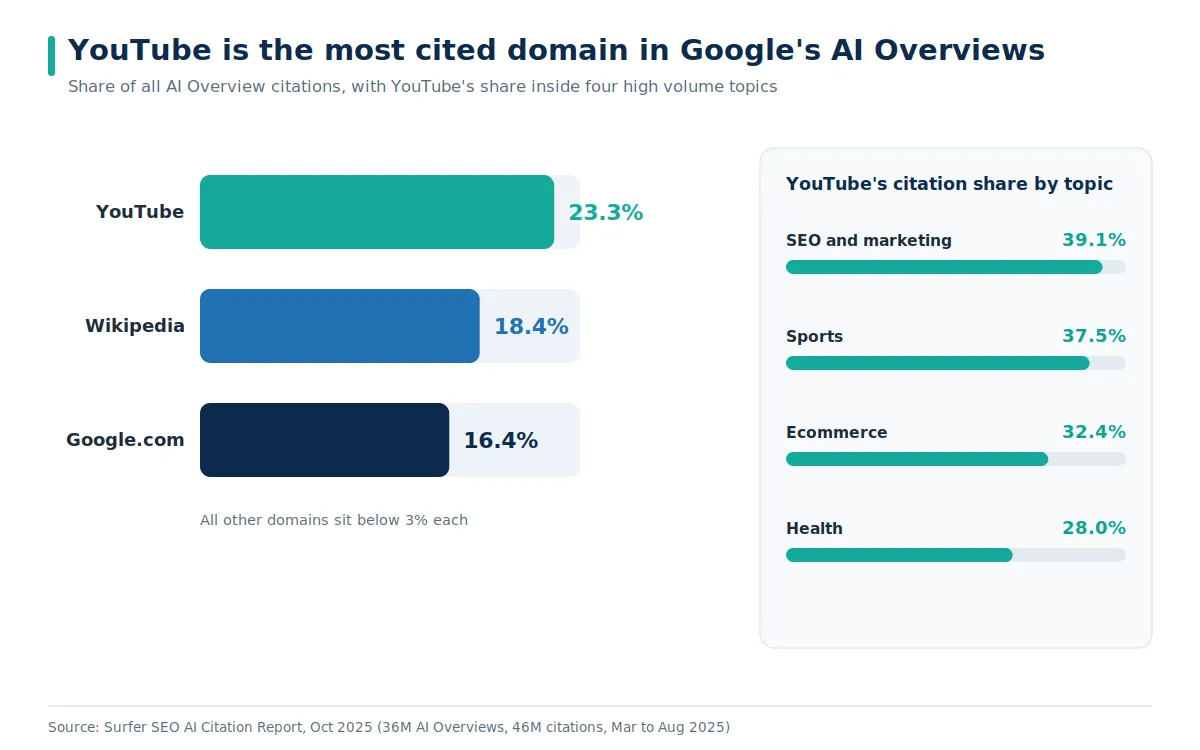
Surfer SEO's AI Citation Report examined 36 million AI Overviews and 46 million citations between March and August 2025. YouTube accounted for roughly 23.3 percent of every citation Google's AI Overviews produced. Wikipedia followed at 18.4 percent and Google's own properties at 16.4 percent. No newspaper, trade publication, or research institution came close to any of the top three.
The pattern intensifies by topic. On SEO and marketing queries, YouTube took 39.1 percent of citations, almost exactly level with Google.com. Sports queries sent 37.5 percent to video, ecommerce 32.4 percent, and health 28 percent, the last of those in a vertical where clinical institutions such as the NIH and Mayo Clinic otherwise dominate.
The explanation is structural rather than promotional. Answer engines assemble responses from sources that are clear, complete, and easy to break into parts. A competent explainer video is all three. SEMrush's study of AI Overview result pages found video carousels appearing alongside AI Overviews with growing frequency, which suggests Google treats video as a companion format to its generated answers rather than a rival for the same space.
For a brand with no video presence, the consequence is direct. Roughly a quarter of the citations shaping how AI systems describe your category are being awarded to content you did not create. That is a visibility gap rather than a ranking gap, and it belongs in the same conversation as generative engine optimization and the signals that make AI systems trust one site over another.
The Attention Shifted While Search Teams Were Looking Elsewhere #
The citation data reflects something simpler underneath: sheer viewing time.
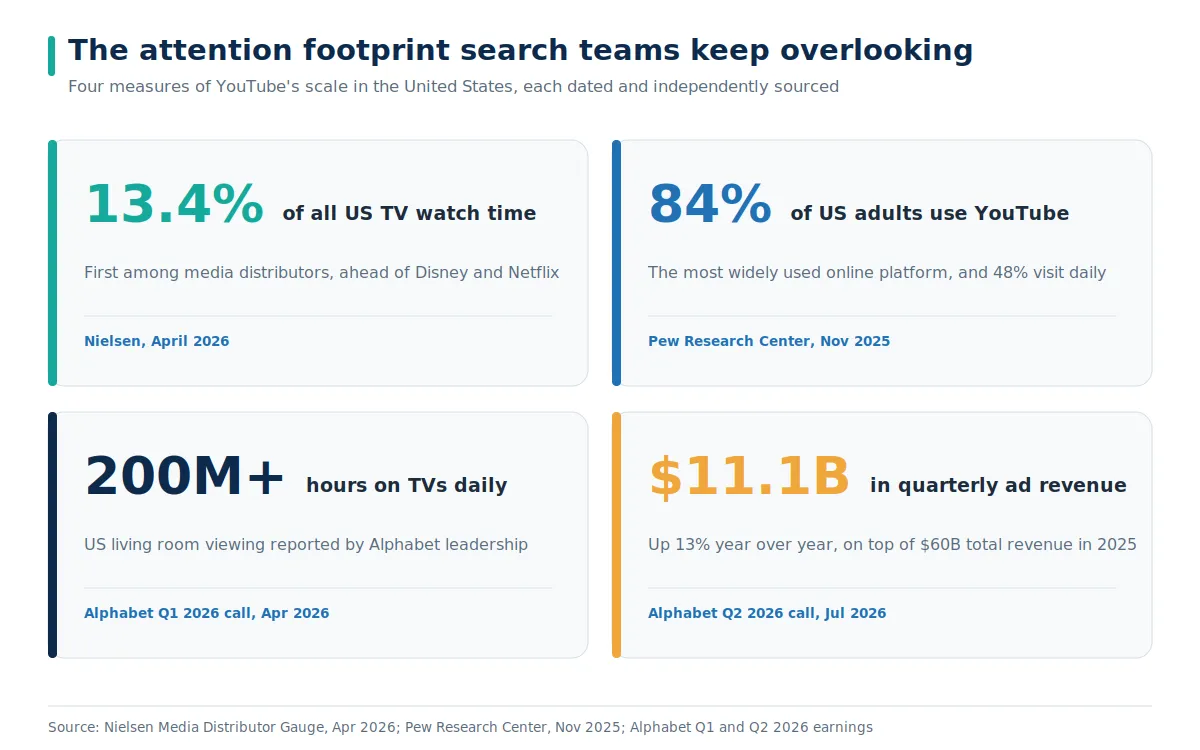
Nielsen's The Gauge put YouTube at 13.4 percent of all television watch time in the United States in April 2026, a full share point higher than a year earlier and comfortably first among media distributors. Disney followed at 10.3 percent and Netflix at 7.8 percent. The measurement covers content viewed on a television screen, which means YouTube is no longer competing only with other websites for attention. It is competing with broadcast networks, and winning.
The Pew Research Center reported in November 2025 that 84 percent of US adults use YouTube, making it the most widely used online platform in the country, with 48 percent visiting daily. Alphabet said in April that US viewers were watching more than 200 million hours of YouTube content on living room screens every day, and that YouTube revenue across advertising and subscriptions had passed 60 billion dollars for 2025. The momentum held into the summer. On its second-quarter 2026 earnings call on 22 July, the company reported $ 11.1 billion in quarterly YouTube ad revenue, up 13 percent year over year, and said more than 1.7 billion unique viewers watched World Cup-related videos on the platform during the FIFA World Cup.
None of that automatically converts into business results. What it establishes is where the questions are being asked. When Wyzowl surveyed marketers for its 2026 State of Video Marketing report, 91 percent of businesses said they use video as a marketing tool, and 82 percent reported a good return, down from 93 percent the year before. Adoption has stopped being the differentiator. Structure has become it.
AI Cites Long-Form Video, and it Rarely Cites Shorts #
This is where most video strategies diverge from what the data rewards, because they optimize for the format that generates views rather than the format that generates citations.
OtterlyAI analyzed more than 100 million AI citations across ChatGPT, Google AI Overviews, Google AI Mode, Perplexity, Microsoft Copilot, and Gemini over a 30-day window, publishing the results in March 2026. Of the citations pointing at YouTube, 94 percent went to long-form videos. Shorts accounted for 5.7 percent, and playlists, channels, and livestreams together took 0.3 percent.
Where those citations appear varies just as sharply. Perplexity produced 38.7 percent of all YouTube citations in the dataset, Google AI Overviews 36.6 percent, and Google AI Mode 19.6 percent. ChatGPT contributed 4.4 percent, while Copilot and Gemini were close to zero at 0.5 percent and 0.2 percent.
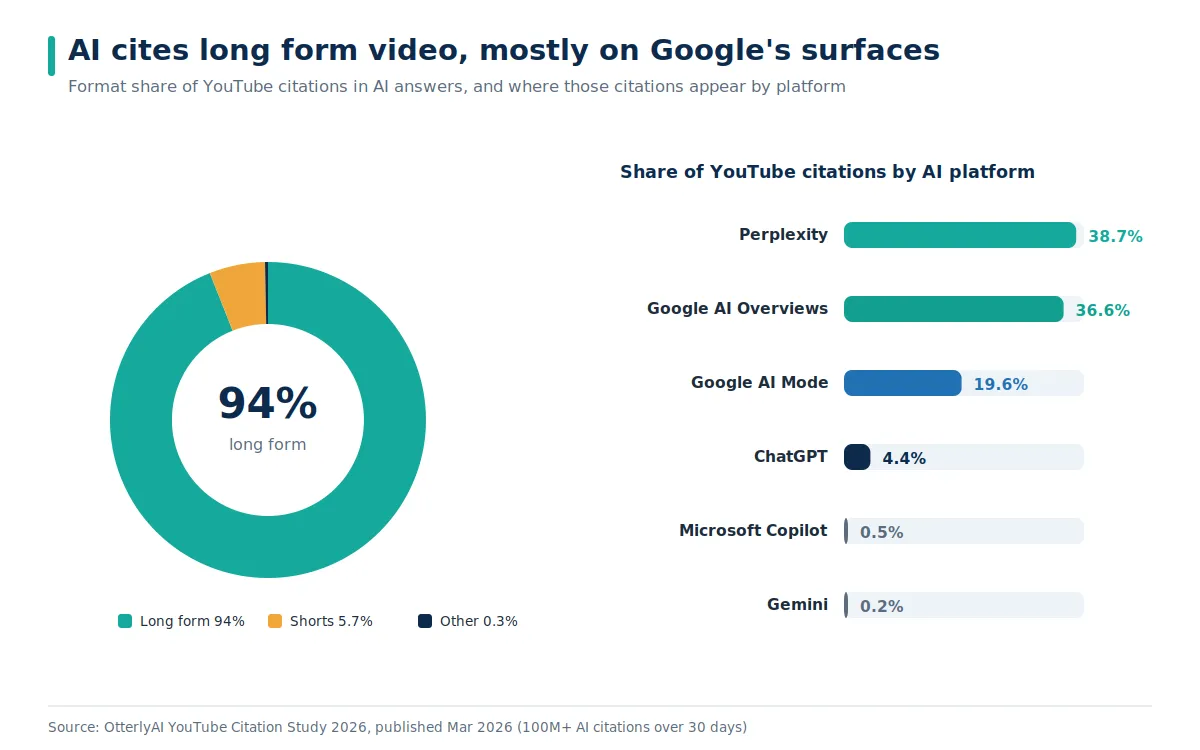
Two conclusions follow. Short-form video still does useful work for reach and recall, but it is not the asset that earns a place inside an AI answer, so it deserves separate goals and separate measurement of the kind set out in this guide to short-form video strategy. And if AI visibility is the objective, Google's surfaces and Perplexity are where video effort pays back. Optimizing for Gemini or Copilot via YouTube is close to wasted effort today.
It is worth keeping the scale honest. Social and video domains together supplied 5.54 percent of all citations in the OtterlyAI dataset, while brand-owned domains accounted for 52.2 percent and news or media sources 20.3 percent. YouTube is the dominant video source inside a category that is meaningful rather than enormous. The case for video is not that it replaces your website in AI answers. It is that it is the highest-yield surface you do not currently own, and one where a single asset can be cited many times.
Chapters Do the Job That Subheadings Do on a Page #
The most actionable finding in the 2026 research concerns timestamps.
When an AI citation pointed to a specific moment inside a video rather than the video as a whole, it appeared in Google AI Overviews 73 percent of the time and in Google AI Mode the remaining 27 percent. No time stamped citations were recorded in ChatGPT, Perplexity, Copilot, or Gemini during the study window. Google, in other words, is parsing video structure rather than simply linking to a video.
The compounding effect matters more than the split. Among videos carrying timestamps, 78 percent were cited more than once, most often across two to five different chapters. A single well-structured video can therefore earn several separate citations, each answering a different sub-question. Only 31 percent of cited videos contained timestamp signals at all, so the field is far from crowded.
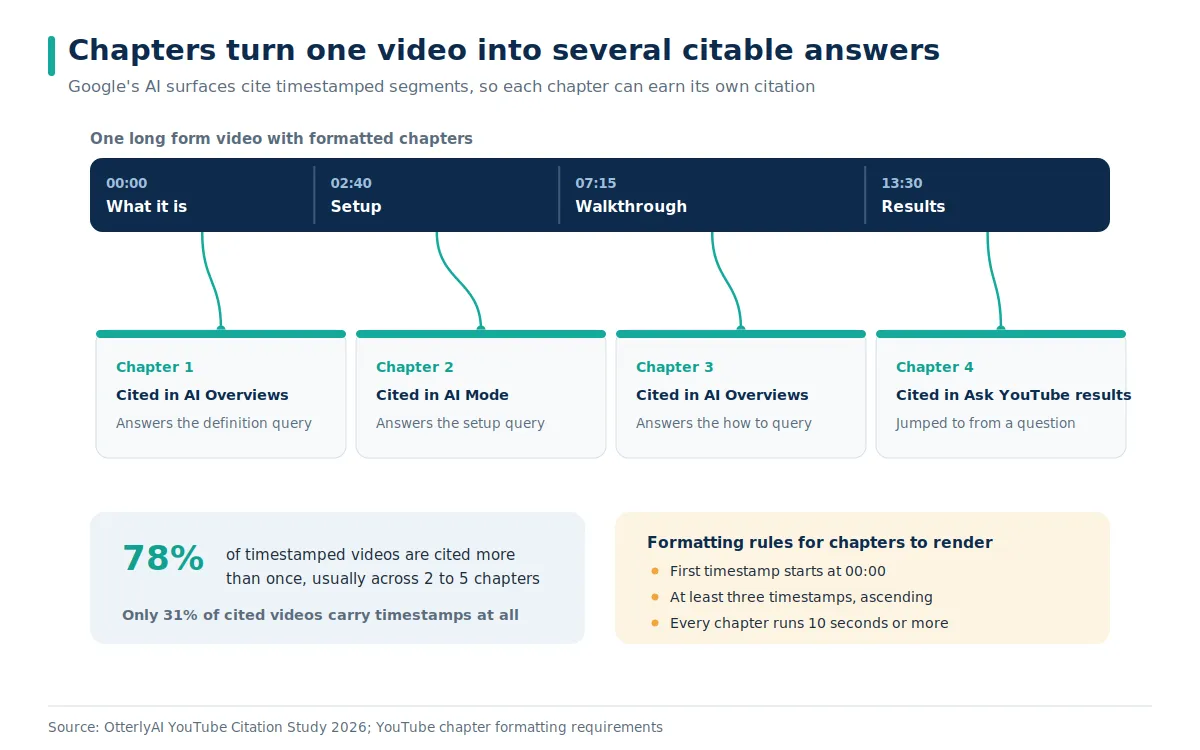
YouTube converts correctly formatted timestamps in a description into navigable chapters. The requirements are specific: the first timestamp must start at 00:00, there must be at least three in ascending order, and each chapter must run for at least ten seconds. Miss any of those and the timestamps stay as plain text.
Treat chapter titles the way you would treat an H2. Each should name the question that section answers, in the words someone would actually use, which is the same logic behind writing content that AI systems cite rather than merely crawl.
Channel Size Has Almost Nothing To Do With It #
The most encouraging finding for smaller brands is also the least intuitive.
Across the cited videos in the OtterlyAI dataset, view count showed a correlation of minus 0.03 with how often a video was cited again. Likes came in at minus 0.02, channel subscribers at minus 0.03, and total channel video count at minus 0.02. All are statistically indistinguishable from no relationship at all.
The variables that did show a signal were unglamorous. Description length correlated at 0.31, recency at roughly 0.30, and the presence of hashtags in the description at 0.20. These are weak to moderate effects rather than strong ones, but the direction is consistent: AI systems reward clarity and topical signposting, not popularity.
The distribution makes the point plainly. Of the videos AI systems cited, 40.8 percent had fewer than 1,000 views. Around 35 percent of the channels behind them had fewer than 10,000 subscribers, and half had published fewer than 41 videos in total.
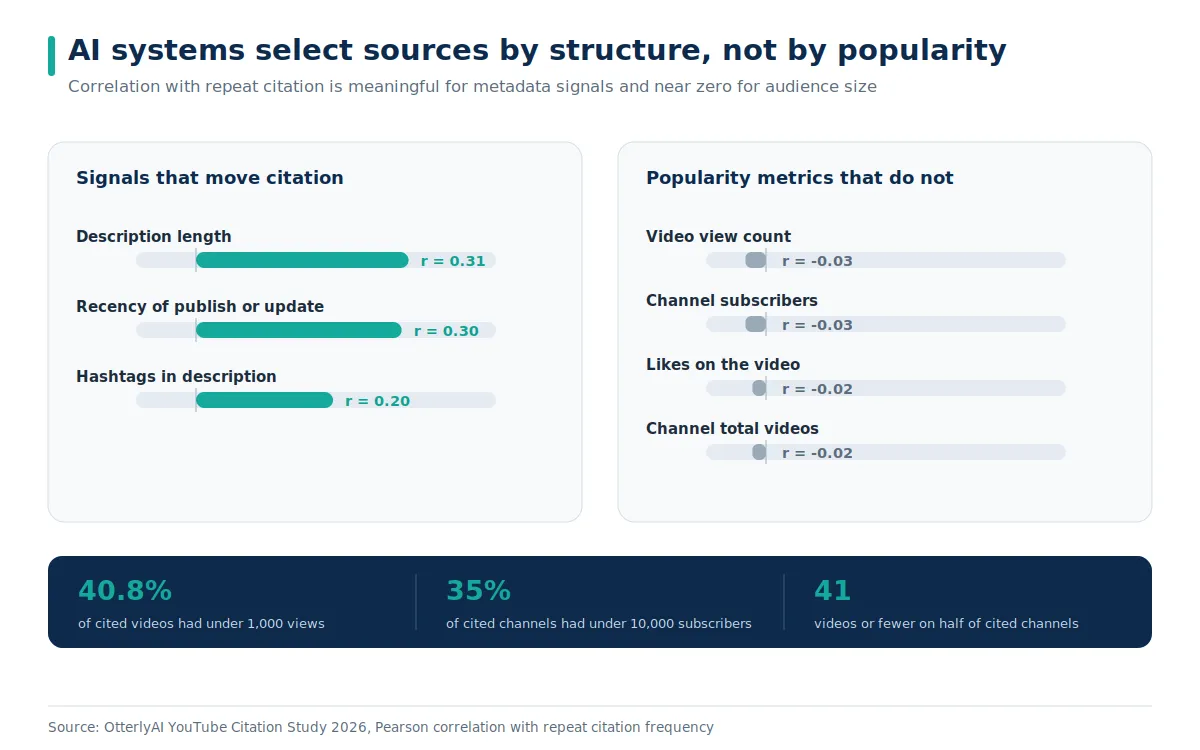
Selection behaves less like recommendation and more like reference. A 200-view video that answers a narrow question precisely can be chosen over a polished production from a channel with a million subscribers, because the system is looking for a source rather than a hit. The same pattern is visible in how community platforms became a primary AI knowledge base, and it sits alongside the work of building a recognizable brand entity. For any team that has avoided video because it lacks an audience, this should reset the calculation.
YouTube is Becoming a Conversational Search Engine in its Own Right #
Alongside the citation shift, the platform's own search is changing. YouTube announced Ask YouTube at Google I/O in May 2026, a conversational search experience that accepts full questions instead of keywords, returns a structured response combining text with long-form videos and Shorts, and supports follow-up questions. It began as an opt-in test for US Premium members aged 18 and over. On 6 July 2026, it expanded to all signed-in US desktop viewers aged 13 and up, with more devices and languages planned for later in the year.
Adoption has been fast. On Alphabet's second quarter call, Sundar Pichai said more than 140 million users engaged with Ask YouTube on the watch page in June 2026, and YouTube has confirmed that views generated through the feature count toward standard analytics. A tool this new rarely arrives with an audience of that size already using it.
The practical implication is that a video no longer has to win a thumbnail grid to be found. It has to contain a passage that answers a specific question well enough to be surfaced and, where relevant, jumped to directly. That rewards exactly the qualities Google's AI surfaces reward: complete answers, clear chapter boundaries, and descriptions that state plainly what the video covers. A team that structures video for AI Overviews is already most of the way to being ready for this.
Building a Workflow That Serves Both Surfaces #
None of this requires a studio. It requires treating each video as a documented answer rather than a piece of content.
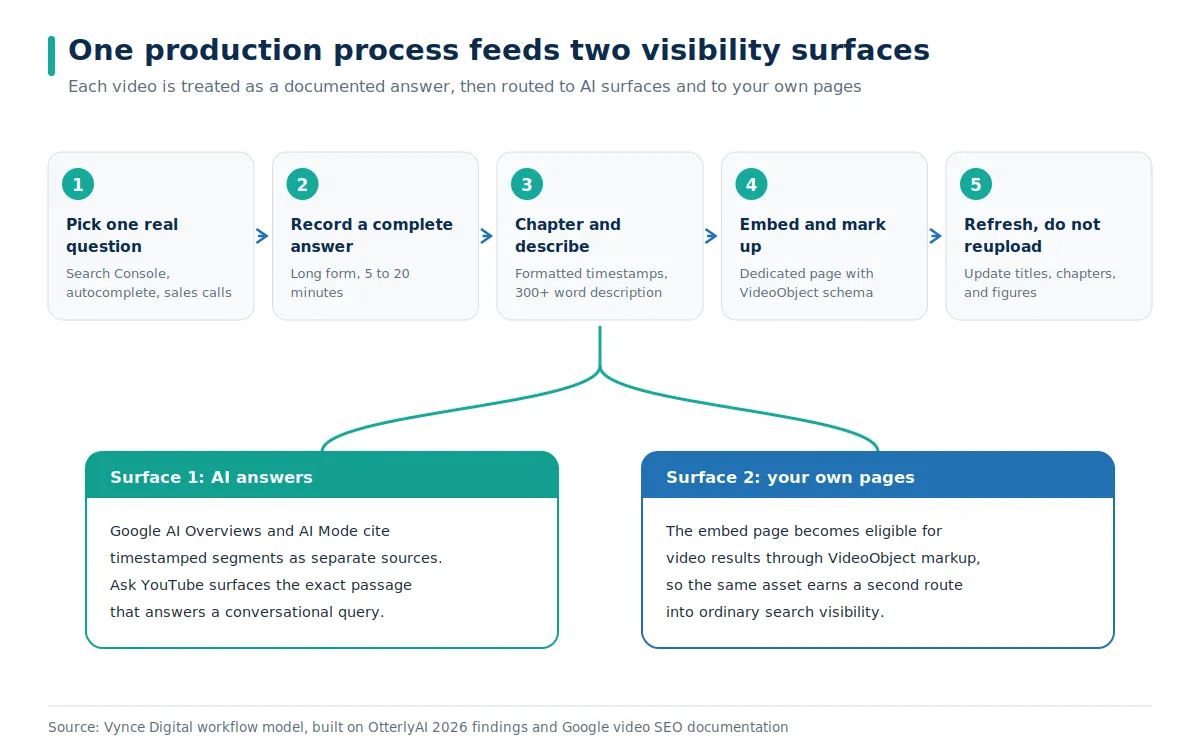
Start from questions you already have evidence for. Search Console queries that trigger AI Overviews, YouTube autocomplete suggestions, and the questions your sales team answers repeatedly are all better inputs than a brainstorm. Give each question one video rather than bundling several into a round-up, because bundled videos are harder to cite cleanly.
Aim for the five to twenty minute range. Half of the cited videos in the dataset ran under eight minutes, and the largest single cluster fell between ten and twenty, so runtime matters less than completeness within a defined scope.
Write titles as questions or plain statements of what the video delivers. Cited videos in the dataset averaged 19 words in the title, which is longer than the punchy phrasing most channels favor and closer to how a person actually phrases a query. Title length itself showed no correlation with repeat citation, so this is about matching the question rather than hitting a word count.
Write the description as machine-readable metadata: a plain summary in the opening lines, the entities and tools covered, supporting links, and a correctly formatted chapter list. The average cited description ran to 334 words, considerably more than most brands publish.
Then close the loop on your own site. Embedding the video on a dedicated page and marking it up with VideoObject structured data, as set out in Google's video SEO documentation, gives the same content a second route into search results. The wider schema markup guidance applies here in full, and the page itself still has to earn its place through ordinary technical and on-page SEO.
Finally, refresh rather than reupload. Recency showed a modest positive correlation with repeat citation, so updating a title, adding chapters, or correcting figures on a video that already earns citations is usually a better use of time than starting again. Letting a well-cited asset go stale produces the same outcome described in why strong pages stop appearing in AI answers.
How to Tell Whether It Is Working #
Standard YouTube analytics will not answer this question, because views and watch time measure something different from citation.
Track three things instead. First, citation monitoring: check whether your videos appear as sources in AI Overviews, AI Mode, and Perplexity for your priority questions, which is the kind of reporting that belongs inside AI search optimization rather than a standard traffic dashboard. Second, referral behavior, since video-driven visits often arrive with higher intent because the viewer has been pre-qualified by the answer they watched, which makes the pages those visits land on a natural place to invest in conversion rate optimization. Third, chapter-level retention inside YouTube Studio shows which segments hold attention and therefore are most likely to be extracted.
Set expectations accordingly. Citation visibility moves on a slower cycle than rankings, and a video may sit dormant for weeks before an AI system begins using it as a reference. Consistency of structure matters more than publishing frequency.
What This Changes #
Video has moved out of the awareness end of the funnel and into the retrieval layer of search itself. YouTube is the most cited domain in Google's AI answers, the largest single distributor of television watch time in the United States, and now a conversational search engine that more than 140 million people used in a single month.
What that asks of a search team is modest in practice. Publish long-form answers to real questions, chapter them properly, describe them like documentation, embed them on your own pages with the right markup, and keep them current. Channel size, production budget, and view count are not what decides whether a machine picks your video as a source. Structure and clarity are.
The teams treating YouTube as a search surface rather than a social feed will hold visibility in places their competitors are not yet measuring.
Frequently Asked Questions #
What is YouTube SEO? #
YouTube SEO is the practice of optimizing video titles, descriptions, chapters, and metadata so videos are found in YouTube search, Google results, and AI-generated answers.
Is YouTube really the most cited source in Google's AI Overviews? #
Yes. Surfer SEO's analysis of 46 million citations between March and August 2025 found YouTube accounted for about 23.3 percent of all AI Overview citations, ahead of Wikipedia at 18.4 percent.
Do YouTube Shorts help with AI visibility? #
Rarely. Long-form videos received 94 percent of YouTube citations in AI answers during OtterlyAI's 2026 study, while Shorts received 5.7 percent.
How long should a video be to earn AI citations? #
Most cited videos run between five and twenty minutes, with the largest cluster between ten and twenty. Completeness within a defined topic matters more than a target runtime.
Do I need a large subscriber base to be cited by AI? #
No. About 35 percent of channels cited in the 2026 dataset had fewer than 10,000 subscribers, and 40.8 percent of cited videos had fewer than 1,000 views.
Why do video chapters matter for SEO? #
Google's AI surfaces cited individual timestamped segments, so chapters let one video earn several separate citations. Around 78 percent of timestamped videos were cited more than once.
How do I set up YouTube chapters correctly? #
List timestamps in the description starting at 00:00, include at least three in ascending order, and make every chapter at least ten seconds long.
Does YouTube SEO help my website rank? #
Indirectly. Embedding a video on a dedicated page with VideoObject structured data can make that page eligible for video results, giving the same content a second route into search.
What is Ask YouTube? #
Ask YouTube is YouTube's conversational search experience, expanded to signed-in US desktop viewers aged 13 and over on 6 July 2026. More than 140 million users engaged with it in June 2026.
How long does YouTube SEO take to show results? #
Citation visibility usually moves more slowly than rankings, and a video may be live for several weeks before AI systems begin using it as a reference source.